
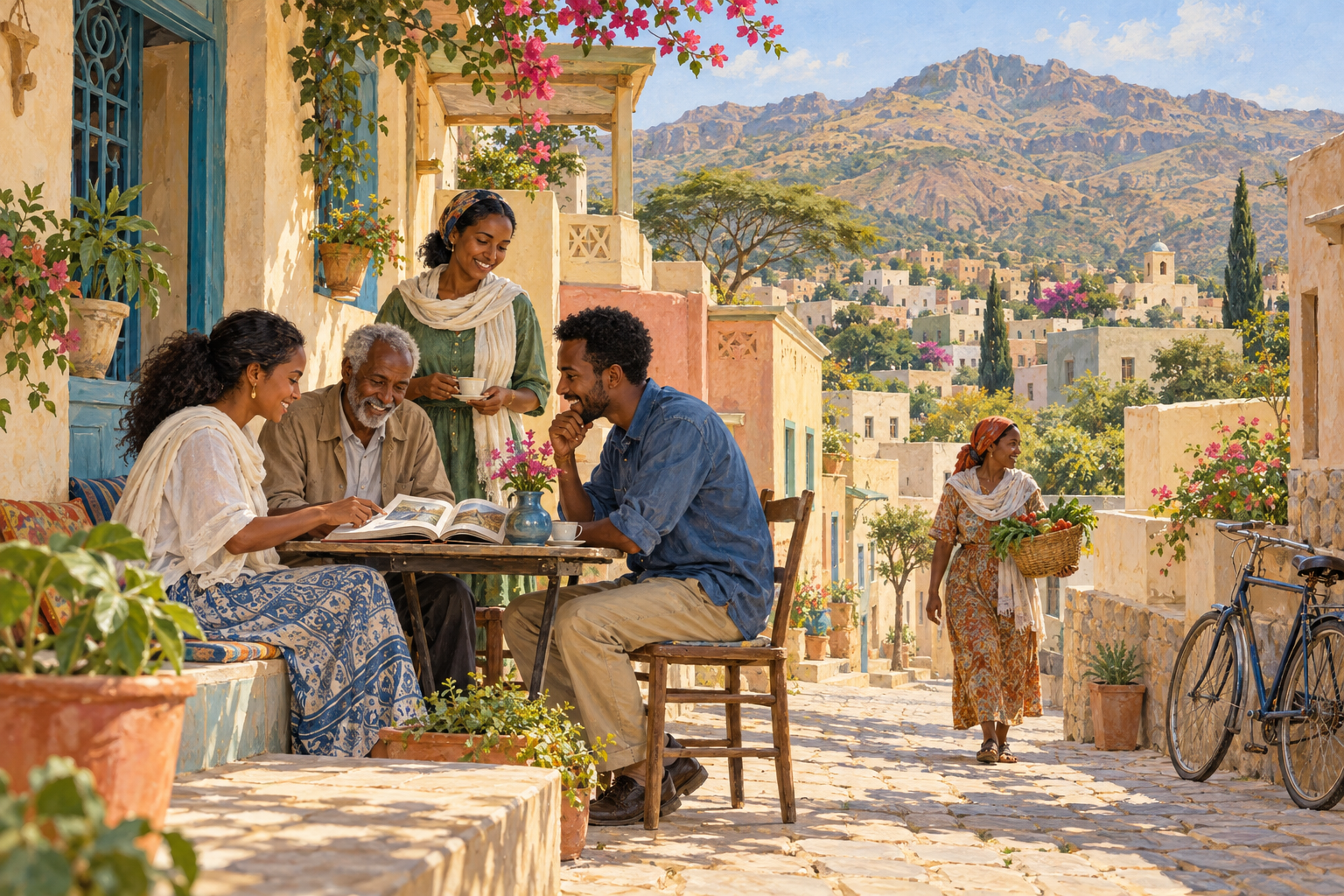
Eritrea has a remarkable travel story, but it is not a country to approach with an ordinary last-minute sightseeing checklist. The best things to do when visiting and touring Eritrea begin with understanding Asmara’s UNESCO-listed modernist streets, its striking Fiat Tagliero building and cinema architecture, then exploring the history of Keren, the Red Sea city of Massawa and the archaeological and maritime worlds beyond. Each place is fascinating, and each requires attention to official travel permits, sensitive borders and present political conditions before anyone attempts a journey.
This Eritrea travel guide introduces ten experiences and cultural subjects, Asmara architecture, highland and coastal geography, the famous Asmara–Massawa escarpment, heritage, coffee culture and critical 2026 entry and security rules. If you are searching for Eritrea tourist attractions, things to do in Asmara, Massawa old town, Keren market or the Dahlak Islands, this article separates what can be learned from reliable sources from travel that requires specific authorisation. The country’s UNESCO heritage is worth appreciating; a beautiful photograph is not a substitute for a visa, regional travel permit or current safety assessment.
Travel guidance checked 9 October 2026: UK FCDO guidance updated in July 2026 advises against all travel within 25 km of all Eritrea’s land borders. It notes heightened tension with Ethiopia, difficulties in an emergency and a permit requirement for foreign nationals travelling outside Asmara’s Zoba Maekel province, as well as for certain sensitive city sites. International SIM cards do not work, local phone access is restricted, and photography of government or military installations is illegal. Eritrea requires a visa and has strict customs and foreign currency rules. Current official permissions, travel restrictions and emergency conditions must be checked for the precise itinerary.
eduKateSG · A WORLD WORTH UNDERSTANDING
Explore Eritrea with the right context
One exceptional UNESCO modernist city, working highland traditions, Red Sea histories and responsible boundaries.
Eritrea at a glance
Eritrea lies beside the Red Sea in the Horn of Africa. Its highland capital Asmara is more than two kilometres above sea level, while the historic port of Massawa is on the coast. That difference in altitude creates dramatic changes in climate, landscape and travel experience. Keren introduces another highland city, and archaeological sites record much older networks of trade.
As of 2026, Asmara: A Modernist African City is Eritrea’s one inscribed UNESCO World Heritage property. UNESCO recognises the urban plan and preserved modernist buildings, but also explains the colonial racial segregation and politics embedded in the original design. Appreciating the architecture responsibly means acknowledging the difficult history, not romanticising the colonial era.
Eritrea’s travel rules make geography a legal and practical matter. A visitor who is authorised to remain in Asmara cannot simply set off to a coastal town or rural archaeological site. The FCDO specifies that travel permits are required outside Zoba Maekel, may take several days and are not always granted. Check the permit before treating any further destination as bookable.
- Best cultural starting point: Asmara and the UNESCO modernist ensemble, with sensitive-site photography restrictions.
- Distinct coast: Massawa, a Red Sea port with layered architectural and commercial histories, requires travel permission.
- Border constraints: No travel within 25 km of land borders under UK FCDO advice, with mine and military risks.
- Communications: International mobile SIM cards do not work; the ability to buy a local SIM is restricted.
Safety, travel permissions and important boundaries
The FCDO currently advises against all travel to areas within 25 kilometres of Eritrea’s land borders with Ethiopia, Djibouti and Sudan. Tensions with Ethiopia are high, and a crisis could restrict movement or exit rapidly. Landmines are a risk near some borders. The Hanish Islands in the Red Sea are sensitive because of proximity to the Yemen conflict; their access should not be advertised as an ordinary private-boat outing.
Independent internal travel is unusually constrained. Foreign visitors need advance permits to leave Zoba Maekel, and some sites within Asmara, including the so-called tank graveyard, also require permission. Authorities ask for vehicle details, and tourists have sometimes been prevented from using public transport outside the capital. Carry documents, follow checkpoints and avoid any route that cannot be explicitly authorised.
Communications, money and photography need special preparation. The FCDO says international SIM cards do not work and local SIM purchases require residency. Visitors must declare electronic devices and follow official foreign-currency rules. Photographing government or military buildings is illegal. The appropriate travel plan includes credible local assistance, a medical evacuation arrangement where possible and the humility to postpone if regional conditions are not suitable.
1. Walk Asmara’s UNESCO modernist streets with their full history
Asmara’s preserved streets form one of the world’s most distinctive early-modernist urban ensembles. UNESCO describes an orthogonal grid, later radial elements, civic spaces and architectural work produced during Italian colonial occupation. The city includes cinemas, residential buildings, shops, religious structures and public buildings that still function within everyday urban life.
A careful walk should not treat the buildings as an uncomplicated souvenir from Europe. UNESCO explicitly records that colonial planning involved racial segregation, while Eritreans later incorporated the built environment into their own struggle for self-determination and sense of place. The city is both architecture and lived history.
Choose a reputable, permitted route and pay attention to details: balconies, street corners, materials and how buildings meet open space. The best interpretation helps you see the human scale of the city. Its value is not measured by how many facades can be photographed before lunch.
Learn or experience responsibly: Study UNESCO’s outstanding-universal-value statement and enjoy an authorised public-street architectural route.
Important boundary: Do not photograph security-sensitive structures; verify which public areas and interiors are accessible.
2. See Fiat Tagliero as an imaginative engineering question
One of Asmara’s most celebrated modernist landmarks is the Fiat Tagliero building, often described as resembling an aircraft with concrete wings. It is a striking example of the bold forms associated with the city’s twentieth-century architecture. A building that catches the eye immediately becomes even more interesting when you consider its structure and original purpose.
Ask how an architect can make a heavy material feel light. What role does reinforced concrete play, and why did this form suit the ambitions of the time? The famous stories surrounding the structure are not all equally documented; responsible visitors distinguish verified design facts from repeated legends.
The building has been used in everyday urban life rather than functioning only as a museum display. Treat it and its surroundings respectfully. Never assume a tour website’s description grants permission to enter, walk into a working site or photograph nearby official installations.
Learn or experience responsibly: Observe the landmark from a lawful public location with architectural interpretation.
Important boundary: Confirm permitted access, current use, safe standing areas and specific photography restrictions.
3. Discover Cinema Impero and Asmara’s public cultural buildings
Asmara’s modernist ensemble includes notable cinema and entertainment buildings, including Cinema Impero. Their facades and interiors, when legitimately accessible, can reveal how public leisure spaces were designed in the twentieth century. The buildings also prompt questions about who was originally welcomed into those spaces and how their meaning changed after Eritrea’s independence.
A cinema makes an appealing comparison with a cathedral or café: different activities, yet each relies on design choices about how people gather. Look at signage, scale, circulation and the relationship between street and interior. A knowledgeable guide can explain stylistic differences without flattening every building into the label Art Deco.
Current operations are the important practical detail. A historic cinema may not be running a regular public schedule, and a photograph of an interior does not establish free visitor access. Respect tickets, events and maintenance work where relevant.
Learn or experience responsibly: Use an authorised architecture-focused tour and compare leisure buildings with other functions in the UNESCO ensemble.
Important boundary: Verify actual venue operations, interior permissions, any admission and photography rules.
4. Learn from Asmara’s religious buildings and neighbourhoods
Asmara’s UNESCO description includes churches, mosques, a synagogue and distinctive neighbourhoods within the protected city landscape. The mixture makes it possible to study how religion, colonial-era urban planning and later Eritrean life interact. Buildings that look similar from a distance may have very different histories and community uses.
Explore appropriate public spaces with a guide who can explain each site’s context and its relationship to the people who use it now. A place of worship is not a stage set. Ask about dress, opening conditions and whether photography is welcomed; a quiet exterior view may sometimes be the only respectful choice.
The older neighbourhoods also teach something about the difference between formally planned city districts and organic settlement. Listen for accounts that include the experiences of Eritrean residents, rather than repeating a purely architectural history told through foreign designers.
Learn or experience responsibly: Choose a modest, consent-based urban heritage walk that treats active religious spaces as living institutions.
Important boundary: Confirm public opening, worship times, local etiquette and restrictions around official buildings.
5. Enjoy coffee and food as living Eritrean hospitality
Eritrean food offers a beautiful introduction to everyday culture. Flatbreads, stews, pulses, shared meals and coffee traditions all reveal relationships among agriculture, family life and migration. Dishes differ by household and community; the visitor should not insist on a single recipe being the definitive national version.
A good hosted meal or café stop becomes a conversation about ingredients, hospitality and who prepares food. If someone explains a coffee ceremony, listen to the meaning they choose to share instead of demanding a staged performance. The equipment, aroma and rhythm of preparation are only part of the story.
Market visits require even more care in a place where photography and identification rules are strict. Ask before taking pictures of people or goods, and avoid turning someone’s livelihood into anonymous ‘local colour’. A thoughtful food afternoon can be enjoyable without requiring a long road trip.
Learn or experience responsibly: Share an appropriate meal or coffee experience with local hosts and credit their knowledge.
Important boundary: Check food hygiene, dietary needs, photography permission and transportation back to accommodation.
6. Read Keren’s market as a highland economy
Keren is often associated with its market culture, including livestock trading, and with a highland setting distinct from Asmara. A market tells a story about more than commercial exchange: animal husbandry, rural roads, household needs and regional identities can all become visible when a knowledgeable local interpreter explains them.
Rather than treating traders and animals as a picturesque performance, learn why certain goods are bought or sold and how the market connects surrounding communities. Some market activities occur on particular days, so a travel advertisement’s schedule is not a promise that every visitor will observe the same scene.
Keren lies outside the capital’s permit region. A visit requires official permission and a credible transport plan; if authorisation is denied, do not attempt to continue beyond a checkpoint. Researching the market’s social role remotely remains a meaningful way to understand the country.
Learn or experience responsibly: If formally permitted, use a local guide for a respectful market and highland-town interpretation.
Important boundary: Obtain advance regional travel permits, confirm the actual market day, and ask before photographing anyone.
7. Understand the Asmara–Massawa escarpment without romanticising the road
The descent from Eritrea’s highland capital towards the Red Sea coast is a dramatic geography lesson. As altitude falls, temperature, vegetation and views change, helping visitors understand why inland towns and port cities developed different relationships with climate and trade. The scenery is often celebrated by travellers, but an attractive road is not an unrestricted tourist attraction.
Ask a guide about the geology, settlement and older transport history rather than watching only for the next scenic bend. The route can inspire interesting questions about engineering and how people connect a high plateau to a port. Weather, traffic, road maintenance and official checkpoints remain fundamental.
Independent travel should not be assumed. The FCDO describes advance permits for movement outside Zoba Maekel and sometimes additional vehicle restrictions. Take no spontaneous diversions into unapproved rural areas or towards sensitive borders.
Learn or experience responsibly: Study highland-to-coast geography and travel only on a presently authorised, professionally supported route.
Important boundary: Verify travel permit, designated vehicle, road condition, communications and medical contingencies.
8. Explore Massawa’s old port as a Red Sea history, if permitted
Massawa has a distinctive Red Sea identity shaped by maritime trade and successive periods of influence. Older districts contain architecture and urban forms that differ sharply from Asmara’s highland modernism. The attraction is not simply an old building beside the sea, but the accumulated story of communities moving through a strategic maritime place.
An appropriate historic walk can reveal how ports connect languages, food and commerce across water. The city’s coastal climate and building materials invite another set of architectural questions. Where buildings are fragile or occupied, treat them as living or protected spaces rather than ruins awaiting exploration.
Massawa cannot be promised as an effortless add-on to Asmara. It requires permission to travel outside the capital region, local safety assessment and careful photographic judgment around working port infrastructure. Weather and services should be confirmed for the actual date.
Learn or experience responsibly: Use credible local historical interpretation after obtaining the required travel permission.
Important boundary: Respect port and security restrictions; confirm official access, transport, accommodation and heat.
9. Learn about ancient Adulis and Eritrea’s long trade networks
Adulis, associated with the coast south of Massawa, is an archaeological subject connected to Red Sea trade and the ancient world around the Aksumite period. Its significance lies in the way ports carried goods, people, language and ideas between inland Africa and lands across the water. The evidence deserves attention beyond sensational claims about lost cities.
Start with archaeologists’ published work and maps of ancient trading networks. Ask what excavated objects reveal about everyday commerce and how scholars establish dates and connections. These methods make the history accessible without inventing an operating museum or a present-day guided site programme.
Coastal archaeology can lie near sensitive infrastructure or difficult roads. Access, permits and current security must be established independently. If permission or professional interpretation is unavailable, continue the historical research remotely; the learning does not require crossing a restricted boundary.
Learn or experience responsibly: Explore verified archaeology and the connections between Red Sea maritime trade and Eritrean inland history.
Important boundary: Do not assume excavation areas are publicly accessible or that a regional travel permit covers every site.
10. Approach the Dahlak Archipelago as marine heritage, not a spontaneous boat hire
Off Eritrea’s Red Sea coast lies the Dahlak island group, associated with marine ecosystems, island histories and historic maritime networks. Its geography can be fascinating even from a map. Coastal habitats, reefs and seagrass need careful conservation, while island communities and researchers have their own relationships with the sea.
Some tourism operators advertise boat outings, but a commercial listing does not establish current clearance for every location. The wider Red Sea region is sensitive, and the FCDO warns about military activity and specifically says permits for vessels to the Hanish Islands are highly unlikely. The Dahlak group and Hanish Islands must not be conflated, yet both require real navigational and official permission checks.
No independent island-hopping plan should be inferred from a travel photograph. If competent authorities and credible operators cannot confirm the exact route, sea safety, permits and return arrangements, treat the archipelago as a subject for marine research and future learning.
Learn or experience responsibly: Use conservation and historical research to understand the islands and seek only explicitly authorised, professionally supported access if appropriate.
Important boundary: Never improvise offshore travel, enter prohibited maritime zones or assume a previous year’s boat programme still runs.
Choose a responsible chapter, not a risky national sprint
An Asmara-focused cultural journey
If current entry and security conditions support a visit, concentrate on the UNESCO city within the authorised region: urban planning, architecture, public history, food and living neighbourhoods. Confirm permissions for any sensitive city site rather than adding ambitious remote excursions.
A separately permitted Keren or coastal extension
Research Keren or Massawa as distinct journeys that require official movement permits, vehicle details and reliable support. A permit denial means a change of plan, not a search for an alternative unmarked road. Do not schedule both automatically on a short stay.
A Red Sea and archaeology reading route
Use maps and credible publications to connect Massawa, Adulis and island maritime heritage. This can be undertaken entirely as research when boat, coastal or archaeological access cannot be verified. Avoid Hanish and any militarily sensitive route.
No border sightseeing under current all-travel warnings
Do not propose cross-border trips or the sensitive 25-kilometre border strips. Archaeological landscapes such as Qohaito may be important subjects for future historical reading, but routes should not be inferred from their position on a map in the present regional security context.
Practical decisions before considering departure
Entry requires a visa according to the FCDO, which describes six-month passport validity and two consecutive blank pages for British travellers. Authorities also require declaration of electronic devices and apply strict foreign-currency accounting rules. These are unusually consequential details; obtain nationality-specific guidance from the relevant embassy before buying non-refundable travel.
Internal permissions are not an administrative footnote. Foreign nationals travelling beyond Zoba Maekel need Ministry of Tourism permission for leisure visits, and applications may take several days or be refused. Exact vehicles and permitted places must match what officials approve. Prepare with a reliable local operator without assuming it has authority to waive government restrictions.
Plan communications independently of a normal international roaming package. The FCDO states that foreign SIM cards do not work and that local SIM acquisition is restricted. Emergency medical support, road reliability and consular assistance may also be constrained. A responsible traveller assesses these issues before treating any proposed itinerary as confirmed.
- Review UK and nationality-specific advisories and avoid all land-border strips under the FCDO warning.
- Secure the correct visa and verify passport validity and stamping requirements.
- Declare electronics and foreign currency as required by current Eritrean customs rules.
- Obtain advance Ministry permission for travel outside Zoba Maekel and sensitive city sites.
- Do not photograph government or military buildings or restricted facilities.
- Prepare communications without assuming international SIM or mobile roaming will work.
- Use authorised, reliable transport and do not improvise road or boat routes.
- Respect residents, places of worship, wildlife and fragile historic architecture.
Twelve useful English–中文 travel terms
For English–Chinese readers, these terms clarify practical travel and heritage contexts. They do not replace Tigrinya, Arabic or other local languages, current law, permission or community consent.
| English | 中文 | Practical meaning |
|---|---|---|
| modernist architecture | 现代主义建筑 | Asmara has a UNESCO-listed urban ensemble. |
| colonial history | 殖民历史 | Read design together with unequal power. |
| travel permit | 旅行许可 | Needed for most journeys beyond Asmara. |
| checkpoint | 检查站 | Carry the required documents. |
| highland | 高地 | Altitude and climate differ from the coast. |
| port city | 港口城市 | Massawa has a maritime history. |
| cinema | 电影院 | Historic cultural buildings have current uses. |
| market | 市场 | Respect livelihoods and consent. |
| coffee ceremony | 咖啡仪式 | An invitation, not an entitlement. |
| archaeological site | 考古遗址 | Verify authorised access. |
| border warning | 边境警告 | Avoid the warned land-border zone. |
| photography restriction | 摄影限制 | Security facilities may not be photographed. |
A notebook that notices more than old buildings
Begin with one piece of architecture and write two paragraphs about it: what the designer hoped the building would express, and how Eritrean communities have lived with and interpreted it over time. The difference is important. UNESCO’s inscription is about both built form and a changing sense of place, not just a list of impressive facades.
Create a map from Asmara to the Red Sea and mark where official permission, road conditions and maritime restrictions enter the discussion. Travel becomes more honest when those details are visible. You can admire a country without pretending that admiring it automatically grants access.
Frequently asked questions
Can visitors move freely from Asmara to Massawa or Keren?
No. The FCDO says foreign visitors need advance permits for travel outside Zoba Maekel, and permits may be refused. Vehicle details are part of the process.
Why is Asmara UNESCO World Heritage?
UNESCO recognises its well-preserved twentieth-century modernist urban plan and buildings, including the way colonial planning was later understood through Eritrean experiences and independence.
Are Eritrea’s borders safe for tourist excursions in 2026?
The UK FCDO advises against all travel within 25 kilometres of Eritrea’s land borders. Tensions and landmine risks mean these are not ordinary visitor areas.
Will my overseas SIM card work in Eritrea?
The UK guidance says international SIM cards do not work; obtaining a local SIM is restricted. Arrange a communications plan before travel.
Can I take photographs freely in Asmara and Massawa?
No. Government and military sites must not be photographed, and some attractions require separate permits. Ask before photographing people or sensitive places.
Original sources and onward country
UNESCO and the cited government safety sources support the heritage and travel context. Their statements do not promise that a particular road, site or operator is available; reassess at the moment of travel.
- UNESCO — Asmara: A Modernist African City
- UNESCO — Asmara management and conservation documentation
- UK FCDO — Eritrea travel advice
- UK FCDO — border risks and Hanish Islands
- UK FCDO — permits, photography, telecommunications and transport
- UK FCDO — visas, electronic declarations and currency rules
Continue alphabetically: Equatorial Guinea ← Eritrea → Estonia. Return to the World Country Directory, the City Experiences Directory, or the World Travel Hub.