
Archaeology vocabulary helps you read an Egyptian museum label with more than recognition: you can ask where an object came from, how it was dated and what its context supports. These 100 archaeology vocabulary words provide clear English meanings, natural collocations and original examples for finds, layers, written records, scientific methods and interpretation.
Egypt is a rich setting because material evidence reaches across domestic life, craft, religious practice, exchange and many historical periods. A pottery fragment and a monumental inscription may answer different questions. This guide keeps those questions visible instead of treating every object as a treasure with the same story.
Begin with a published object record. Write what is documented, what you can observe and what remains an interpretation. Learn a small related word family, then apply it to another record. “Top 100” denotes a curated learning list, not a statistical frequency ranking or permission to excavate, collect or handle heritage material.
Find your next learning step
Begin with the task closest to yours. Keep the word families connected with a real question, then check your explanation on a new example.
Full reading index
Word groups 1–5
Word groups 6–10
Explanation, practice and next routes
- Can you keep the object and its context together?
- Egypt’s evidence is more varied than one display case
- One fragment, three different sentences
- Four distinctions that make history easier to trust
- Ask a catalogue a better question
- Build a short evidence trail
- Questions about archaeology words and Egypt
- Continue with the learner’s actual task
Can you keep the object and its context together?
Imagine a photograph of a decorated pottery fragment with no scale, location or date. A learner may call it old and beautiful, but that does not establish a period or use. Ask which missing information would help answer a specific question.
Someone who confuses provenance and find position needs a record-reading task. Someone who recognises the distinction but cannot express it needs a sentence frame: “The catalogue records…, while the find context remains…”. A learner who supplies a confident story without evidence needs to separate observation from inference.
Start small. A younger reader can identify three visible features in a documented image. A secondary student can compare a label and a fuller catalogue record. An adult can practise tracing a claim back to its source and marking the boundary of what it establishes.
Back to contents · Begin the word bank
Archaeology studies material in relationships. These English terms help readers see why an object’s context matters alongside its appearance. Egypt provides several periods and settings, not one undifferentiated ancient story.
| No. and word | Meaning in context | Natural collocation | Original example |
|---|---|---|---|
| 1. Archaeology | Study of past human life through material evidence and its context. | archaeological research | Archaeological research asks how objects relate to people and places. |
| 2. Artefact | An object made or modified by people. | recorded artefact | The recorded artefact retained information about where it was found. |
| 3. Site | A place containing evidence of past activity. | archaeological site | The archaeological site was studied through several kinds of evidence. |
| 4. Context | An object’s or feature’s documented position and relationships. | excavation context | Excavation context gave the fragment more meaning than appearance alone. |
| 5. Excavation | Controlled investigation by removing and recording material. | documented excavation | The documented excavation recorded changes before material was removed. |
| 6. Survey | Systematic investigation of an area without necessarily excavating it. | site survey | The site survey identified questions for later investigation. |
| 7. Stratigraphy | The study of layers and their relationships. | site stratigraphy | Site stratigraphy helped the team reconstruct a sequence. |
| 8. Chronology | The ordered sequence or dating framework of events. | relative chronology | Relative chronology established order without giving every exact year. |
| 9. Evidence | Information supporting or challenging an account. | material evidence | Material evidence supported a more qualified conclusion. |
| 10. Interpretation | An explanation developed from evidence and context. | archaeological interpretation | Archaeological interpretation changed when new records were considered. |
A recorded find position and a later ownership history are different. Provenience is especially used for the first; provenance commonly describes the broader history. Terminological practice can vary, so read the record’s definitions.
| No. and word | Meaning in context | Natural collocation | Original example |
|---|---|---|---|
| 11. Layer | A distinct deposit or level within a sequence. | sediment layer | The sediment layer was recorded separately from the material beneath. |
| 12. Deposit | Material accumulated or placed in a location. | burial deposit | The burial deposit required careful documentation. |
| 13. Feature | A non-portable trace or structure of past activity. | architectural feature | The architectural feature remained part of the site’s plan. |
| 14. Cut | An interface created by removing earlier material. | recorded cut | The recorded cut interrupted an earlier layer. |
| 15. Fill | Material occupying a cut or other space. | pit fill | The pit fill was distinguished from the surrounding deposit. |
| 16. Section | A vertical view or record of a sequence. | section drawing | The section drawing showed the layers’ relationships. |
| 17. Trench | A defined excavation area, often elongated. | excavation trench | The excavation trench had a documented boundary. |
| 18. Grid | A spatial reference arrangement of intersecting lines or units. | site grid | The site grid helped connect separate records. |
| 19. Datum | A fixed reference used for position or measurement. | survey datum | The survey datum made measurements comparable. |
| 20. Provenience | The recorded find location of an object, especially in archaeological usage. | find provenience | Find provenience differed from the object’s later ownership history. |
Fragments, tools and residues can carry important information. A beautiful object is not automatically the most informative one for the question. Identification and function require evidence.
| No. and word | Meaning in context | Natural collocation | Original example |
|---|---|---|---|
| 21. Sherd | A broken fragment of pottery or another brittle vessel material. | pottery sherd | The pottery sherd preserved part of a rim. |
| 22. Vessel | A container made for holding material. | storage vessel | The storage vessel’s form suggested questions about use. |
| 23. Pottery | Clay objects hardened through firing. | pottery assemblage | The pottery assemblage was compared with documented examples. |
| 24. Faience | In Egyptian material study, a glazed siliceous material, distinct from clay pottery. | Egyptian faience | The catalogue identified Egyptian faience rather than simply calling the object ceramic. |
| 25. Flint | A hard siliceous stone used for tools and other purposes. | flint tool | The flint tool showed evidence of deliberate shaping. |
| 26. Tool | An object used to carry out a task. | stone tool | The stone tool’s likely use required more than its outline. |
| 27. Implement | An instrument or object used for practical work. | agricultural implement | The label discussed the agricultural implement cautiously. |
| 28. Amulet | An object associated with protective or other symbolic functions. | faience amulet | The faience amulet was interpreted within its documented cultural setting. |
| 29. Bead | A small object typically pierced or arranged for stringing. | glass bead | The glass bead formed one part of the recorded group. |
| 30. Residue | Material remaining on or within an object after use or deposition. | organic residue | Organic residue offered a different kind of evidence from decoration. |
These are English scholarly terms, not translations of Egyptian inscriptions. Reading an inscription requires appropriate specialist knowledge. A familiar-looking sign should not become an invented translation.
| No. and word | Meaning in context | Natural collocation | Original example |
|---|---|---|---|
| 31. Inscription | Writing cut, painted or otherwise recorded on a surface. | stone inscription | The stone inscription needed specialist reading. |
| 32. Hieroglyph | A sign within a hieroglyphic writing system. | hieroglyphic sign | The learner distinguished a hieroglyphic sign from a decorative motif. |
| 33. Script | A system or style of written signs. | writing script | The writing script could not be identified from one blurred image. |
| 34. Papyrus | A plant and the writing material made from it. | papyrus document | The papyrus document connected material and written evidence. |
| 35. Ostracon | A pottery or stone fragment bearing writing or drawing; plural ostraca. | inscribed ostracon | The inscribed ostracon preserved an everyday written trace. |
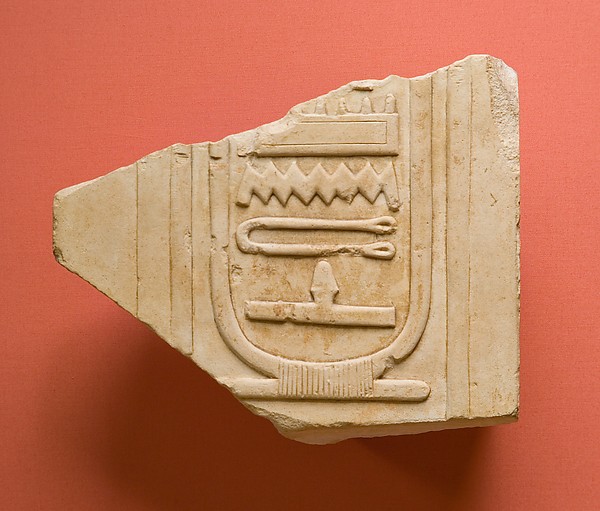
| 36. Cartouche | An oval enclosure used around some royal names in Egyptian writing. | royal cartouche | The caption identified a royal cartouche without supplying an invented translation. |
| 37. Stele | An upright stone slab or monument, often bearing text or imagery. | inscribed stele | The inscribed stele combined written and visual evidence. |
| 38. Relief | An image formed by carving or modelling relative to a background. | carved relief | The carved relief required both visual description and context. |
| 39. Iconography | The study or description of images and their conventional meanings. | religious iconography | Religious iconography needed evidence beyond a familiar-looking figure. |
| 40. Epigraphy | The study of inscriptions. | epigraphic study | Epigraphic study examined the signs and their material setting. |
Homes, workshops and landscapes broaden the inquiry. A place’s present appearance does not establish its earlier function. The examples illustrate language rather than identify an undocumented site.
| No. and word | Meaning in context | Natural collocation | Original example |
|---|---|---|---|
| 41. Settlement | A place where people lived or organised habitation. | ancient settlement | The ancient settlement contained evidence beyond monumental buildings. |
| 42. Household | A domestic social unit, interpreted through appropriate evidence. | household activity | Household activity was investigated through associated remains. |
| 43. Workshop | A place where skilled production or repair occurred. | craft workshop | The craft workshop interpretation depended on the recorded material. |
| 44. Quarry | A location where stone or other material is extracted. | stone quarry | The stone quarry connected landscape with production. |
| 45. Harbour | A sheltered water area supporting vessels or related activity. | ancient harbour | The ancient harbour required evidence about its changing environment. |
| 46. Temple | A structure or complex associated with religious practices. | temple complex | The temple complex was interpreted within a particular period. |
| 47. Tomb | A place prepared or used for burial. | documented tomb | The documented tomb was studied through its full record. |
| 48. Necropolis | A substantial burial area or cemetery. | ancient necropolis | The necropolis contained different forms of burial. |
| 49. Monument | A structure or object carrying commemorative or other public significance. | stone monument | The stone monument’s function was explained through sources. |
| 50. Landscape | The physical and human setting surrounding activity. | archaeological landscape | The archaeological landscape connected several sites. |
Different dating methods answer different questions. Order, calendar ranges and historical groupings should not be collapsed into a single confident year.
| No. and word | Meaning in context | Natural collocation | Original example |
|---|---|---|---|
| 51. Dynasty | A sequence or grouping of rulers used in historical organisation. | dynastic chronology | Dynastic chronology offered one framework for the objects. |
| 52. Period | A defined span of time in a historical framework. | historical period | The historical period needed more precision than the word old. |
| 53. Sequence | An ordered relationship among events or deposits. | occupation sequence | The occupation sequence included several phases. |
| 54. Phase | A distinct stage within a larger sequence. | building phase | The building phase was distinguished from later repairs. |
| 55. Relative dating | Establishing order or comparative age without necessarily assigning a calendar date. | relative dating method | The relative dating method placed one deposit before another. |
| 56. Absolute dating | Dating expressed in calendar or numerical terms, with uncertainty and method stated. | absolute date range | The absolute date range remained an estimate with limits. |
| 57. Radiocarbon dating | Estimating the age of suitable carbon-bearing material through carbon-14 behaviour. | radiocarbon sample | The radiocarbon sample did not date every object nearby automatically. |
| 58. Typology | Classification by shared forms or characteristics. | pottery typology | Pottery typology helped organise comparison. |
| 59. Seriation | Ordering assemblages or objects through changing characteristics or frequencies. | ceramic seriation | Ceramic seriation required an explicit method. |
| 60. Association | A documented relationship between objects or contexts. | contextual association | Contextual association supported the comparison without proving every proposed connection. |
Scientific recording can reveal new information while adding its own limits. These definitions support reading; they do not teach unauthorised investigation or object treatment.
| No. and word | Meaning in context | Natural collocation | Original example |
|---|---|---|---|
| 61. Sample | A selected portion used to investigate a larger material or group. | sediment sample | The sediment sample had a recorded origin. |
| 62. Analysis | Systematic examination to investigate a question. | material analysis | Material analysis tested a claim about composition. |
| 63. Microscopy | Examination using magnification through a microscope. | microscopic analysis | Microscopic analysis revealed details missed in the photograph. |
| 64. Imaging | Producing representations through a specified recording technique. | non-invasive imaging | Non-invasive imaging answered questions without opening the object. |
| 65. Tomography | Imaging that reconstructs internal sections from measured information. | computed tomography | Computed tomography produced views requiring specialist interpretation. |
| 66. Photogrammetry | Deriving measurements or spatial models from photographs. | photogrammetric model | The photogrammetric model depended on its recording method. |
| 67. Remote sensing | Obtaining information without direct physical contact with the subject. | remote-sensing survey | The remote-sensing survey identified possible features for investigation. |
| 68. Geophysics | Study of physical properties and processes, including methods used in site investigation. | geophysical survey | The geophysical survey did not itself identify every buried feature. |
| 69. Conservation | Care intended to retain significant material and its information. | object conservation | Object conservation included documentation of decisions. |
| 70. Restoration | Work aimed at recovering or revealing an earlier or intended state. | documented restoration | Documented restoration made later additions identifiable. |
A displayed object has a collection history and a condition. The label is a useful beginning, while a catalogue or archive may support deeper questions.
| No. and word | Meaning in context | Natural collocation | Original example |
|---|---|---|---|
| 71. Provenance | An object’s origin and subsequent history, including ownership or movement. | documented provenance | Documented provenance connected the museum object with its history. |
| 72. Catalogue | An organised record of objects or material. | collection catalogue | The collection catalogue identified the source of the attribution. |
| 73. Accession | The formal addition of an object to a collection. | accession number | The accession number let us locate the object’s record. |
| 74. Inventory | A systematic list of items or holdings. | museum inventory | The museum inventory helped distinguish individual objects. |
| 75. Archive | A maintained body of records. | excavation archive | The excavation archive contained drawings as well as notes. |
| 76. Label | A concise written identification or explanation attached to a display. | museum label | The museum label separated known facts from qualified interpretation. |
| 77. Attribution | An identification of origin, maker or association based on evidence. | qualified attribution | The qualified attribution did not pretend certainty. |
| 78. Replica | A reproduction of another object. | teaching replica | The teaching replica was clearly distinguished from the original. |
| 79. Authenticity | The quality of being what an object or account is claimed to be. | authenticity assessment | An authenticity assessment needed more than an attractive surface. |
| 80. Condition | An object’s current physical state. | condition report | The condition report recorded missing and altered areas. |
Evidence can be moved, reused, damaged or lost. These terms help explain why a surviving object is not a complete photograph of a past society.
| No. and word | Meaning in context | Natural collocation | Original example |
|---|---|---|---|
| 81. Hypothesis | A proposed explanation open to investigation. | testable hypothesis | The testable hypothesis connected a feature with possible activity. |
| 82. Inference | A conclusion drawn through evidence and reasoning. | cautious inference | A cautious inference marked the limits of the record. |
| 83. Uncertainty | Limits in knowledge or measurement. | dating uncertainty | Dating uncertainty was included with the result. |
| 84. Bias | A systematic influence affecting evidence or conclusions. | collection bias | Collection bias could change which activities seemed most visible. |
| 85. Taphonomy | Processes affecting remains between their original formation and later study. | taphonomic process | A taphonomic process could explain why some evidence survived. |
| 86. Preservation | The survival or maintenance of material and information. | differential preservation | Differential preservation made some materials easier to study. |
| 87. Disturbance | A change disrupting an earlier context or arrangement. | later disturbance | Later disturbance complicated the layer sequence. |
| 88. Reuse | Using an object or material again, sometimes for a different purpose. | stone reuse | Stone reuse separated the material’s first creation from its later setting. |
| 89. Deposition | The placing or accumulation of material. | deposition history | Deposition history helped explain the fragment’s context. |
| 90. Reconstruction | An evidence-based model or account of an earlier form or event. | qualified reconstruction | The qualified reconstruction showed which parts remained uncertain. |
Research, care and communication involve decisions as well as discoveries. Current permissions, community relationships and object histories deserve specific evidence.
| No. and word | Meaning in context | Natural collocation | Original example |
|---|---|---|---|
| 91. Heritage | Material and practices inherited and valued across generations. | cultural heritage | Cultural heritage includes relationships with living communities. |
| 92. Stewardship | Responsible care for material, places or knowledge. | heritage stewardship | Heritage stewardship continued after the display opened. |
| 93. Permission | Authorisation for a specified activity. | research permission | Research permission applied to the actual place and method. |
| 94. Ethics | Principles guiding responsible decisions and conduct. | research ethics | Research ethics shaped how the material was discussed. |
| 95. Repatriation | Return of material to an appropriate country, community or other claimant. | repatriation discussion | The repatriation discussion required accurate records and careful attribution. |
| 96. Collaboration | Working together across people or institutions. | research collaboration | Research collaboration brought different expertise into the account. |
| 97. Community | People connected through a particular place, practice or relationship. | local community | The local community was not treated as one undifferentiated voice. |
| 98. Publication | The public presentation of research or other material. | research publication | The research publication allowed others to examine the methods. |
| 99. Citation | A reference identifying the source of a claim or information. | precise citation | A precise citation helped us check the interpretation. |
| 100. Narrative | An organised account connecting events or ideas. | historical narrative | The historical narrative distinguished evidence from speculation. |
Egypt’s evidence is more varied than one display case
Egypt’s Ministry of Tourism and Antiquities provides museum and site accounts that introduce documented collections and historical settings. Its Egyptian Museum page describes material extending from predynastic contexts to Greek and Roman periods. That breadth matters: the country is not represented by a single moment.
The British Museum’s Naukratis research project investigates a port with varied histories and material, including Egyptian faience and pottery from other cultural settings. The project offers a useful question about contact and context rather than a licence to assign an origin from one decorative feature.
Another museum research project examines craft interactions in New Kingdom Egypt, connecting metalworking, glass and other production. Such work shows how technical analysis and material relationships can extend the story beyond royal names.
These are routes into specific evidence. Living Egypt, its communities and its later histories should remain visible alongside ancient material. An archaeological explanation is stronger when it states the period and place instead of treating a whole country as a timeless backdrop.
Contents · Previous section · Next section
One fragment, three different sentences
Consider an invented catalogue exercise: a ceramic rim fragment has a recorded find location, a drawn profile and a proposed date range. The record does not identify its owner or contents. No actual Egyptian object is being described.
Observation: “The fragment preserves part of a curved rim.” Documentation: “The record gives a find location and proposed date range.” Interpretation: “Its form can be compared with documented vessel types.” Each sentence has a different evidential job.
An unsupported leap would be, “A wealthy person used this cup for wine.” Wealth, ownership, vessel type and contents all require further evidence. A better next question asks which analyses or contextual records might test the proposed use.
Now imagine that the fragment came from a later disturbed deposit. Its own manufacture and its final deposition may belong to different times. The vocabulary of reuse, disturbance and association helps you hold that possibility without inventing the answer.
Contents · Previous section · Next section
Four distinctions that make history easier to trust
Relative dating establishes an order or comparison. Absolute dating expresses a numerical or calendar estimate, still with method and uncertainty. Absolute does not mean perfectly exact.
Provenience commonly identifies the find location; provenance concerns the object’s broader origin and history. Records may use terminology differently. State what the source actually documents rather than insisting that a label guarantees a complete history.
Egyptian faience is a glazed siliceous material and should not simply be equated with ordinary clay pottery. In other art-historical contexts, faience can have a different material meaning. Use the Egyptian material context explicitly.
A hieroglyph is a sign in a writing system. Iconography concerns images and their conventional meanings; epigraphy concerns inscriptions. A written sign can be visually elaborate without becoming merely decoration.
Contents · Previous section · Next section
Ask a catalogue a better question
Use this original exchange. A: “Does the label prove who owned the object?” B: “It identifies a proposed period and a recorded site, not an owner.” A: “What could we write confidently?” B: “The object record gives those details, while ownership remains unestablished.”
Practice 1: Does absolute dating mean an exact year with no uncertainty? Practice 2: Which term focuses on layer relationships? Practice 3: Can a decorative motif alone establish an object’s find location? Practice 4: What is the plural of ostracon?
Practice 5: Rewrite “The beautiful object must be royal” as a responsible observation. Practice 6: Explain why an object found in a later layer might have been made earlier.
Answers: 1. No. 2. Stratigraphy. 3. No. 4. Ostraca. 5. “The object has elaborate decoration; a royal association requires further evidence.” 6. Reuse, movement or disturbance may separate manufacture from final deposition, and the actual explanation must be investigated.
Contents · Previous section · Next section
Build a short evidence trail
Make a notebook entry with a word, its meaning, the source record and one sentence using it. Retrieve the meaning later without the notebook, then apply it to another object. Changing the example tests transfer rather than recognition of a familiar caption.
Connect artefact, context, association, interpretation and uncertainty in one paragraph. If the terms remain a list of separate labels, draw the relationships first. The aim is a reader who can explain how a claim was built.
A parent can ask a child to distinguish what a photograph shows from what a museum label supplies. A teacher can compare two original fictional records. A tutor can identify whether the problem concerns meaning, source attribution, chronology or sentence construction.
These skills transfer to history essays, museum presentations and everyday information checking. They support curiosity while preserving authorship and evidence. Specialist research and conservation require their own training and permissions.
Contents · Previous section · Next section
Questions about archaeology words and Egypt
Are these Egyptian-language vocabulary entries? No. Most are general English archaeological terms. Names such as hieroglyph and cartouche are explained for reading records, not for translating inscriptions.
Is archaeology only about excavation? No. Survey, archives, scientific analyses and existing collections can all contribute to investigation.
Can appearance establish authenticity? Not reliably on its own. Authentication and attribution need appropriate records and specialist methods.
Must every uncertainty be resolved before writing? No. State what is supported, qualify the interpretation and identify the next question. That is a complete and useful learning response.
Contents · Previous section · Next section
Continue with the learner’s actual task
English Tuition | Egypt encourages families to identify the real school system and communication task before choosing support. A short source-based museum explanation makes a useful independent sample of reading and writing.
Use the eduKate Vocabulary Learning Hub for the wider route from meaning to retrieval and use. Your next exercise is one new object record, five retrieved terms and a paragraph separating observation, documentation and interpretation.
If a difficulty repeats, ask a teacher or tutor to inspect the precise missing connection. Clearer evidence work can make a history account both more engaging and more trustworthy.
Contents · Previous section · Sources and further reading
Sources and further reading
Source review: 15 October 2026. Definitions are original teaching explanations, with original examples and exercises. The references support specific cultural, technical and language distinctions. This is a curated learning selection rather than a measured frequency ranking.
- Egyptian Ministry of Tourism and Antiquities: Egyptian Museum
- British Museum: Naukratis research
- British Museum: craft interactions in New Kingdom Egypt
- British Museum: ancient Egypt learning
- British Museum: Egyptian faience / glazed composition
- Cambridge Dictionary: provenance