
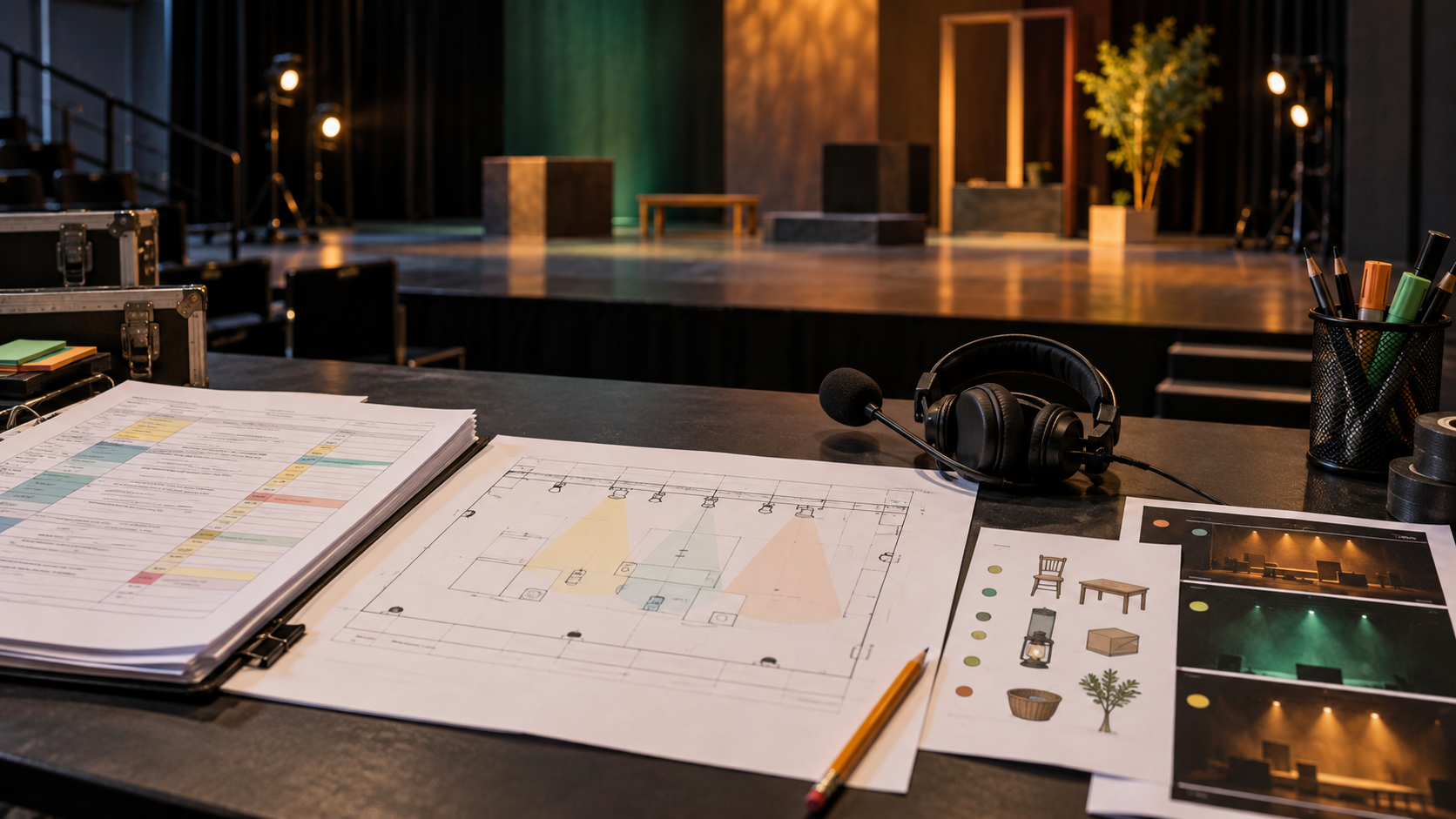
JC2 H2 Theatre Studies and Drama vocabulary for A-Level 9519: here are 200 terms covering dramatic texts, world theatre, acting, directing, stage design, technical production, devising, group performance and critical commentary. Each definition explains why the word matters when reading a scene, creating a production or reflecting on work.
For the 2027 Singapore-Cambridge H2 Theatre Studies and Drama examination, Paper 1 World Theatre and Drama carries 40%, Paper 2 Critical Commentary 15%, and Paper 3 Practical Assessment 45%. Candidates analyse plays from classical and modern traditions while developing an individual specialisation and collaborating with others. The writing and performance cannot be revised as disconnected subjects.
Quick information:
- Exactly 200 distinct glossary terms arranged into ten linked sections.
- SEAB subject code 9519 for H2 Theatre Studies and Drama, 2027 school candidates.
- Paper 1: three-hour open-book examination, three 25-mark answers, total 75 marks and 40% weighting.
- Paper 2: 2,000–2,500-word Critical Commentary, marked out of 30, worth 15%.
- Paper 3: 15% Individual Skills Presentation, 20% Group Presentation and 10% individually assessed contribution, total 45%.
- Includes original scene examples, rehearsal and design checklists, a four-week revision cycle, FAQs and official sources.
This independently selected glossary is not a list prescribed by SEAB. Assessment guidance is grounded in the published syllabus; the school specifies its actual rehearsal and submission timetable.
Find the topic you need
The top 200 H2 Theatre vocabulary words explained
1. Drama, stage language and interpretation
- theatre — Live event involving performers and spectators, where space, time and shared attention shape the meaning of action.
- drama — Representation of human conflict through action or dialogue, which may exist as a script, performance or devised event.
- dramatic text — Written material intended for performance, whose meaning also depends on staging choices and historical conditions.
- dramatic form — Organisation and conventions of a play, such as tragedy, comedy or episodic theatre, affecting expectation.
- genre — Recognisable category of theatre distinguished by conventions, subject and audience expectation rather than an immutable rule.
- plot — Arrangement of events and revelations determining what the audience knows and when.
- story chronology — Underlying order in which fictional events occur, potentially different from the staged order.
- exposition — Material establishing context, relationships and initial tensions without necessarily explaining everything directly.
- conflict — Opposition between goals, people or values that gives dramatic action its urgency.
- climax — Point of heightened stakes or decisive turning that changes the trajectory of a dramatic work.
- denouement — Aftermath or resolution following decisive conflict, potentially leaving meaningful uncertainty.
- theme — Concern developed through events, character choices and theatrical methods rather than simply a one-word topic.
- motif — Recurring image, phrase or action whose repetition builds significance across a production.
- subtext — Implied motive or meaning beneath the literal dialogue, inferred from situation and performance evidence.
- atmosphere — Emotional quality of the scene, created through setting, action, sound and audience expectations.
- dramatic tension — Anticipation arising from unresolved threats or competing intentions, which can be managed through pacing.
- focus — Aspect of action to which a director or performer guides audience attention at a given moment.
- contrast — Deliberate difference in pace, language or staging that clarifies an important relationship.
- symbol — Physical detail or action representing an idea beyond its immediate role, with meaning grounded in context.
- dramatic convention — Recognisable performance practice accepted within a theatrical tradition, which makers may reproduce or challenge.
2. Script, speech and unseen passages
- stage direction — Script instruction or description suggesting movement, setting or delivery, potentially open to interpretation.
- dialogue — Exchange of spoken lines between characters, revealing relationships as well as overt information.
- monologue — Extended speech by one character, potentially directed to others or the audience.
- soliloquy — Speech presenting a character’s thoughts in a form conventionally inaccessible to other characters.
- aside — Remark delivered so only the audience or selected characters hear it within the drama’s convention.
- direct address — Performer speaking to the audience rather than keeping the fictional fourth wall intact.
- fourth wall — Imagined barrier separating characters’ fictional world from spectators, sometimes deliberately broken.
- dramatic irony — Condition in which the audience knows relevant information a character lacks, generating tension or judgement.
- verbal irony — Utterance whose intended meaning differs from its surface words, depending on delivery and context.
- repetition — Recurring words or actions creating emphasis, comedy, oppression or altered meaning.
- pause — Break in speech that can reveal uncertainty, power or resistance, requiring purposeful timing.
- silence — Absence of speech or sound used dramatically to change audience anticipation or relationships.
- interruption — Overlap or cutting short of speech that may signal urgency, conflict or shared excitement.
- rhythm of dialogue — Pattern of line lengths, pauses and exchanges determining conversational energy.
- register — Level of speech formality shaped by context, class, purpose or relationship.
- dialect in drama — Speech variety providing identity or locality, requiring care not to reduce characters to stereotypes.
- rhetorical question — Question asked mainly for effect rather than to obtain information, often redirecting audience judgement.
- ellipsis — Omission of recoverable speech or action, which can make viewers infer what remains unsaid.
- unseen extract — Previously unstudied dramatic passage requiring close analysis and credible staging possibilities.
- textual evidence — Precisely identified words, actions or stage directions supporting an interpretation of the scene.
3. Classical theatre and historical conventions
- Greek tragedy — Ancient Greek dramatic form exploring conflict, ethical responsibility and the relationship between individual and community.
- Greek chorus — Collective group commenting on action through speech, movement or song in Greek theatre traditions.
- stichomythia — Rapid alternating lines in Greek or later dramatic writing, often intensifying confrontation.
- hamartia — Classical concept associated with error or misjudgement contributing to tragic consequence, not simply a universal character flaw.
- peripeteia — Reversal of fortune or circumstances that reorients a tragic action.
- anagnorisis — Moment of recognition in which crucial new understanding changes a character’s view.
- catharsis — Classical term for the emotional effect or clarification associated with tragedy, with interpretation debated.
- comedy of manners — Theatrical genre examining social behaviour and hypocrisy through wit and relationships.
- farce — Comedy relying on exaggerated situations, rapid complications and physical or verbal misunderstanding.
- satire — Use of irony, humour or exaggeration to expose social or political failings.
- Shakespearean soliloquy — Extended dramatic speech often permitting an audience to examine a character’s conflict and reasoning.
- blank verse — Unrhymed iambic pentameter common in much early modern English drama, with meaningful variation.
- prose dialogue — Speech lacking regular verse metre, sometimes marking social circumstances or character relations.
- aside to audience — Convention allowing spectators access to knowledge withheld from others in the fictional scene.
- stage convention — Accepted historical practice of representation that should be considered within the production’s time and place.
- period context — Social and political circumstances relevant to a play’s creation or setting, not an excuse to ignore the words.
- tragic hero — Central figure whose decisions and circumstances contribute to a serious downfall in a specified tragic tradition.
- comic protagonist — Central character in comic action whose aims and errors drive complications and possible resolution.
- classical performance style — Methods associated with a historical stage tradition, potentially transformed in modern reinterpretation.
- historical dramaturgy — Research into a play’s social, theatrical and textual circumstances to inform interpretation and staging.
4. Modern world theatre and production contexts
- realism in theatre — Approach presenting recognisable social and psychological behaviour through plausible settings and dialogue.
- naturalism in theatre — Theatrical approach closely examining environmental and social influences on characters, sometimes using detailed observation.
- symbolist theatre — Drama emphasising suggestive imagery and atmosphere rather than direct explanation or realistic causation.
- expressionism — Style externalising inner feeling through exaggerated form, fragmented speech or visual distortion.
- epic theatre — Tradition associated with critical distance and audience reflection on social processes rather than passive identification.
- alienation effect — Technique making familiar action appear constructed or strange so spectators examine social assumptions.
- absurdist theatre — Dramatic mode questioning ordinary expectations of logic, communication and purposeful action.
- physical theatre — Performance in which embodied movement and ensemble composition play major roles in communication.
- devised theatre — Work developed through a creative process rather than performed solely from a fixed pre-existing script.
- documentary theatre — Stage practice drawing on historical records or testimony, requiring responsible selection and attribution.
- verbatim theatre — Dramatic work making use of recorded or transcribed real speech, with ethical questions about context.
- metatheatre — Performance drawing attention to its own theatrical construction, challenging ordinary fiction boundaries.
- site-specific theatre — Production conceived for a particular location, with its environment contributing to the meaning.
- immersive theatre — Performance inviting an audience into the event’s environment, sometimes allowing movement or interaction.
- ensemble theatre — Collaborative approach in which performers and makers develop a coherent shared stage language.
- postcolonial theatre — Drama engaging histories and legacies of colonisation through form, story, language or perspective.
- Singaporean theatre — Work connected to Singapore’s diverse languages and social contexts, requiring attention to specific playwrights and traditions.
- contemporary staging — Present-day reinterpretation of a play through selected techniques, not necessarily faithful to its first performance.
- directorial concept — Unifying interpretation that organises choices about acting, sound, space and design.
- production context — Venue, audience, budget, culture and practical limits shaping the realisation of a theatrical idea.
5. Acting, character and rehearsal
- character objective — Specific outcome a role seeks during a scene, helping actors choose meaningful actions.
- superobjective — Larger motivating aim linking a character’s choices across the whole dramatic work.
- motivation — Reason for a character’s behaviour, inferred through action, language and context.
- obstacle — Person, circumstance or internal conflict preventing a character from achieving an immediate objective.
- tactic — Action or strategy a character uses to influence another character or change circumstances.
- beat — Small meaningful unit of changing intention or dramatic action within a scene.
- given circumstances — Facts about the fictional world that inform an actor’s choices and relationships.
- backstory — Prior experience informing a character’s present behaviour, which should be grounded in the text.
- inner monologue — Actor’s or character’s imagined continuous thought used to motivate and clarify stage action.
- substitution — Acting exercise using personally meaningful associations to support a fictional situation, requiring ethical care.
- emotional truth — Credibility of a performed feeling within the dramatic situation, not proof the actor personally experienced it.
- active listening — Performer responding authentically to partners’ timing, intentions and physical cues.
- status — Relative power or social position shown through spatial, vocal and behavioural choices.
- character arc — Sequence of developments through which a character changes or resists change.
- blocking — Planned positions and movements of performers, making physical relationships visible.
- stage business — Small purposeful actions with objects or space supporting character and scene.
- gesture — Movement carrying an intention or meaning, selected and rehearsed rather than merely decorative.
- physicalisation — Expression of a character idea or relationship through the body and space.
- vocal projection — Use of supported voice and articulation to be understood in the performance setting.
- rehearsal note — Specific observation identifying a problem or improvement target for subsequent creative work.
6. Movement, presence and actor training
- posture — Arrangement of the body suggesting confidence, fatigue, tension or social relation.
- body alignment — Organisation of the skeleton and movement habits supporting safe and expressive performance.
- centre of gravity — Approximate point through which body weight acts, relevant to balance and controlled stage movement.
- weight transfer — Shifting bodily support between feet or contact points to create credible transitions.
- spatial awareness — Ability to track position and distance relative to performers, scenery and audience.
- proxemics — Meaning of distances and placements among people in staged relationships.
- levels — Use of height or posture differences, such as standing versus sitting, to shape visual power.
- tempo in movement — Rate of physical action, which can contrast with speech or alter tension.
- movement quality — Character of physical action, such as sustained, sudden, light or forceful.
- gesture sequence — Planned progression of movements whose internal organisation creates meaning.
- mime — Acting technique suggesting objects or environments through controlled movement without literal props.
- mask work — Performance using a mask to transform bodily expression and perspective, including visibility and safety constraints.
- puppetry — Manipulation of an object or figure to convey action and character, requiring coherent focus and coordination.
- improvisation — Real-time theatrical exploration of choices and relationships within a clear structure or premise.
- contact improvisation — Movement exploration through responsive physical contact, which requires consent and suitable supervision.
- neutral stance — Deliberately balanced starting posture for training expressive movement.
- breath control — Regulation of breathing to support projection, timing and physical action.
- kinaesthetic communication — Meaning conveyed through movement, force or bodily orientation rather than words alone.
- physical score — Repeatable sequence of actions forming a performance’s nonverbal structure.
- movement safety — Practical precautions addressing space, fatigue, weight and partner contact to reduce rehearsal injuries.
7. Directing, set and stage space
- director’s vision — Overall interpretation coordinating the performance’s concept across departments.
- stage geography — Arrangement of areas, entrances and sightlines that determines how characters move and viewers see action.
- proscenium stage — Stage traditionally framed by an arch, commonly positioning audience predominantly on one side.
- thrust stage — Stage extending into audience on several sides, requiring staging attentive to multiple viewing angles.
- arena stage — Performance space surrounded by spectators, making blocked sightlines especially important.
- black box theatre — Flexible room allowing different seating and stage arrangements.
- sightline — Audience’s view of performers and scenic elements from a specified seat.
- entrance — Planned appearance through a doorway or boundary, which may change rhythm or status.
- exit — Departure from the performing space, often shaping the final image or transition.
- set design — Creation of scenic environment supporting dramatic action, interpretation, safety and scene changes.
- scenic model — Scale representation of proposed stage space, useful for evaluating proportion and movement.
- scale drawing — Proportional technical representation of a design supporting accurate real-world fabrication.
- ground plan — Overhead layout marking scenery, audience and circulation pathways.
- set piece — Movable or fixed scenic element used in a production.
- scene transition — Change between dramatic locations or stages of the narrative, which can be visible or concealed.
- stage machinery — Technical equipment enabling controlled movement of scenery, requiring specialised safe handling.
- props design — Selection or fabrication of stage objects serving practical and symbolic purposes.
- scenic texture — Visual and tactile quality of scenic materials affecting period, atmosphere and plausibility.
- design constraint — Limit such as budget, venue size or quick-change time that the team must solve creatively.
- technical feasibility — Extent to which a theatrical idea can be delivered safely and consistently with available resources.
8. Costume, make-up, lighting and sound
- costume design — Choice of clothing and materials communicating character, setting and performance needs.
- costume silhouette — Overall outline of a performer’s clothing, influencing recognition, period and movement.
- fabric drape — How cloth hangs and moves on a performer, relevant to stage light and physical action.
- costume fitting — Process checking comfort, movement and visual intention on the actual performer.
- quick change — Planned rapid alteration of costume between scenes using safe backstage procedures.
- make-up design — Use of cosmetics or prosthetics to clarify facial expression, age or stylisation under stage lighting.
- character make-up — Visual treatment that supports a role’s identity rather than simply increasing attractiveness.
- prosthetic appliance — Applied constructed element altering a performer’s appearance, requiring proper safety and removal methods.
- lighting design — Arrangement of light sources, direction and intensity to guide focus and atmosphere.
- lighting cue — Timed instruction for a lighting state to change during performance.
- lighting state — Set of active luminaires and levels at a particular point in a production.
- spotlight — Focused beam isolating part of a stage or performer, subject to balance and sightline constraints.
- gobo — Pattern placed in a lighting instrument to project a shape or texture.
- colour temperature — Light-source property affecting perceived warm or cool appearance and material colour.
- sound design — Organisation of live, recorded or processed sound to create space, mood and dramatic meaning.
- sound cue — Instruction to play or change sound at an agreed action or moment.
- ambience — Environmental sound or atmosphere suggesting a place beyond visible scenery.
- soundscape — Layered sounds constructing a dramatic environment or psychological world.
- technical rehearsal — Practice integrating performers with lighting, sound, props and scene-change systems.
- cue sheet — Ordered record of technical actions, timing and triggers that helps the team reproduce the performance reliably.
9. Group presentation and devising
- ensemble collaboration — Shared making in which members listen, adjust and contribute towards a coherent artistic vision.
- devising stimulus — Image, text, question or event prompting exploratory performance material.
- improvisation prompt — Defined situation or constraint encouraging performers to discover actions rather than perform fixed dialogue.
- creative workshop — Structured session for testing possibilities and evaluating discoveries.
- scene generation — Development of potential dramatic scenes from improvisation, research or text.
- material selection — Choice of the strongest scenes or actions based on artistic purpose, not only performer preference.
- dramaturgical structure — Organisation of scenes and ideas into a coherent progression for the audience.
- group objective — Shared intention guiding ensemble decisions and preventing unrelated individual performances.
- role allocation — Distribution of acting, design and coordination duties with clear accountability.
- rehearsal schedule — Time plan ensuring technical and artistic tasks can be completed and reviewed.
- peer feedback — Specific observations from collaborators, useful when linked to a constructive revision.
- creative negotiation — Resolving differences in ideas through criteria and compromise without silencing necessary disagreement.
- ensemble trust — Reliability and mutual respect allowing performers to take artistic risks safely.
- collective timing — Coordination of entries, rhythms and movements across performers.
- group coherence — Extent to which all scenes and contributions support a recognisable whole.
- individual contribution — Identifiable work carried out by a member within the shared project.
- production log — Record of rehearsals, decisions and changes, helpful for accountability and reflection.
- devising revision — Reworking material after testing its clarity, pacing or relevance with the group.
- performance run-through — Full rehearsal of a work in order, exposing transitions and cumulative timing issues.
- final ensemble review — Check of artistic coherence, safety, cues, duration and responsibilities before assessment.
10. Critical commentary, papers and evaluation
- critical commentary — Extended written account analysing artistic intention, historical research and creative decisions rather than simply listing rehearsals.
- artist statement — Concise explanation of the individual presentation’s vision and intended effect.
- historical statement — Contextual explanation of theatre traditions and practices relevant to the chosen specialisation.
- performance theory — Conceptual approach explaining acting or theatrical creation, to be tied to actual methods and source evidence.
- research provenance — Traceable origin of quotations, techniques and historical material used to develop the work.
- cited evidence — Source details permitting another reader to verify a historical or theoretical assertion.
- creative process evaluation — Assessment of turning points, limitations and choices made while developing the individual presentation.
- critical justification — Reasoned explanation for a design or acting decision supported by practical observation and context.
- annex — Permitted supporting images or sketches referred to explicitly from the main commentary, not a separate substitute essay.
- word limit — Required range of commentary length governing selection and editing of relevant material.
- individual skills presentation — Practical demonstration of a chosen acting, movement, devising or design skill assessed by visiting examiner.
- group presentation — Collaborative performance by four to six members, assessed both collectively and through individual contribution.
- visiting examiner interview — Discussion after the individual presentation allowing clarification of approach, theory and artistic choices.
- open-book examination — Written assessment allowing specified original set texts but not unrestricted notebooks, photocopies or dictionaries.
- classical set text — Selected play from theatre traditions extending from ancient Greek drama to the mid-nineteenth century.
- modern set text — Selected play from the mid-nineteenth century through contemporary writing, including Singaporean work.
- unseen response — Analysis of a new dramatic extract in terms of character, atmosphere and possible staging.
- evidence-based interpretation — Claim supported by the actual play text and convincing theatrical technique rather than invented director psychology.
- reflective independence — Student’s ability to explain and own their choices rather than reproducing a teacher’s preferred interpretation.
- assessment compliance — Verification of paper choices, set-text rules, word count, rehearsal work and group or individual requirements.
What Theatre Studies and Drama really examines
A play is both a piece of writing and a set of possibilities for performance. A sentence spoken while a performer stands close to another character may mean something different when delivered across a silent, empty stage. That is why H2 Theatre Studies and Drama asks students to think about roles, relationships, dramatic tension, time and place, focus, space, mood, language, symbol, movement and contrast. The terms are tools for investigating what an audience experiences, not just labels for identifying literary devices.
In Paper 1, one question concerns an unseen dramatic passage. A competent student moves from the source’s words to a supported staging interpretation: what conflict exists, what the audience knows, which actions might establish the relationship and how rhythm or silence could alter the experience. The other two sections ask about selected classical and modern plays, requiring textual knowledge and relevant social, historical and theatrical context.
Paper 2 and Paper 3 reward process as well as achievement. An actor might test how a single change of distance alters a relationship. A lighting designer might compare two states because one makes an important character disappear into the background. A group might cut a scene because it weakens the overall argument. All three examples can be described using artistic intention, testing, evaluation and revision rather than vague phrases such as “we wanted the show to be powerful”.
Three original staging examples
1. The same line can communicate different power
Imagine the original dialogue: “You may sit down.” A headteacher says it while standing over a nervous student. In another version the teacher is seated, looking away, and the student remains standing at a distance. The line has the same literal meaning, but proxemics, eye contact and timing change the apparent relationship. A good examination answer identifies an observable action and connects it to a defensible interpretation, rather than claiming there is only one correct performance.
2. Silence may be more expressive than additional dialogue
Imagine a character who discovers a farewell note and folds it without reading aloud. A ten-second stillness can shift audience attention to the letter, the surrounding sound and the actor’s hands. The effect depends on the stage context; ten seconds is not automatically a good artistic choice. The performer should test whether the pause reveals emotional restraint or merely slows the scene. The term dramatic pause or silence becomes useful because it connects timing to meaning.
3. A design concept must work practically
A student wants a door to appear gradually further away as a character experiences isolation. This may be achieved by narrowing scenic perspective, changing light or using selective projection. But a proposed set must also allow safe entrances, movement and scene changes in the actual performance space. Strong set design combines concept, technical feasibility and evidence from testing. A beautifully drawn idea that cannot be operated safely is not an effective completed plan.
How the three 2027 papers are assessed
| Paper | Requirement | Weight |
|---|---|---|
| 1 — World Theatre and Drama | Three-hour open-book written paper; one unseen passage question from Section A, one classical set-text answer from Section B and one modern set-text answer from Section C | 40% |
| 2 — Critical Commentary | 2,000–2,500 words: Artist Statement (10 marks), Historical/Contextual Statement (10), Evaluation of Creative Process (10) | 15% |
| 3 — Practical Assessment | Individual Skills Presentation, Group Presentation, and individual work within the group; includes visiting-examiner interview | 45% |
Paper 1 is open book only within strict rules. Bring the approved non-electronic original editions of the two prescribed set texts, without photocopies, critical works or study notes. Underlining, highlighting and vertical lines are permitted, as are paper clips or folded page corners; sticky notes and tape flags are not allowed. Dictionaries are not permitted. Use the original text to verify quotations and scene details, not as a replacement for understanding the dramatic possibilities.
The Individual Presentation must demonstrate one chosen skill area, such as acting, devising, stage movement, set design, or make-up and costume design. It cannot be based on the same material as the Group Presentation. Group size is four to six. The visiting examiner judges the collective presentation as well as the individual component; teachers also assess contribution, subject to moderation. The quality of rehearsal cooperation therefore has a direct assessment purpose.
How to write a useful Critical Commentary
The three required dimensions are an Artist Statement, a Historical/Contextual Statement and an Evaluation of Creative Process. Treat them as distinct but connected. First, identify the dramatic intention. Second, explain the relevant theatre tradition or theory with cited evidence rather than unsupported historical generalisation. Third, describe the particular choices you made, what problems emerged and why you revised the work.
A good process evaluation identifies a real turning point: “Our original blocking obscured the character’s refusal from half the audience, so we moved the actor to stage centre and tested the gesture from the side seats.” That sentence offers intention, observed limitation, revision and a reason. “I enjoyed working with my friends” is not a substitute for critical evaluation, even if the experience was enjoyable.
Annexes may contain relevant photographs, diagrams or sketches, but they are supplementary. Examiners consider those materials when they are referenced specifically in the main commentary; additional prose in annexes is not assessed as a way to circumvent the word range. Maintain a research trail and make all quotations and borrowed techniques identifiable.
Common mistakes and quick corrections
| Mistake | Better response |
|---|---|
| Describing a play as a novel | Explain performative choices such as staging, movement, audience knowledge and delivery. |
| Calling every monologue a soliloquy | Distinguish an extended speech from a theatrical convention revealing private thought. |
| Using Greek terminology without knowing the play | Locate the specific event or convention and justify its relevance. |
| Listing rehearsal dates in the commentary | Explain the changes, their rationale and what the group learned through testing. |
| Using design that looks impressive but prevents action | Check visibility, stage movement, safety and operation under real conditions. |
| Letting one group member make every decision | Distribute roles, rehearse responsively and document genuine individual contribution. |
Four-week JC2 rehearsal and vocabulary plan
- Week 1: study words 1–60 and practise staging two versions of one short scene. Explain which change most strongly affects tension or status.
- Week 2: study 61–120 and revisit the classical and modern set texts. Build historical notes that connect directly to scenes and production methods.
- Week 3: study 121–180, run technical and movement experiments, and gather reliable process evidence. Write two short reflections on genuine design choices.
- Week 4: study 181–200; revise a Paper 1 unseen response, check commentary structure and word count, and conduct a rehearsal review with the full group.
This is a revision cycle, not a claim that substantial acting or design skills can be developed from scratch in one month. Regular rehearsal, safe training and detailed feedback are necessary throughout the course.
Frequently asked questions
What is the 2027 H2 Theatre Studies and Drama subject code?
9519. It is offered under the school-candidate H2 A-Level syllabus.
Does the subject assess only acting?
No. It combines written analysis, critical commentary, individual specialisation and collaborative practical presentation. Some candidates specialise in aspects of design rather than conventional acting.
How long is Paper 1?
Three hours. Candidates answer three 25-mark questions, including unseen text, one classical play and one modern play.
Is the written examination open book?
Yes, for the authorised original set-text editions under the rules. It is not permission to bring personal revision notes or unrestricted reference material.
What is the length of Paper 2 Critical Commentary?
Between 2,000 and 2,500 words, with the required three sections and relevant cited support.
What is the group presentation size?
Four to six candidates. Both the presentation and the individual’s actual contribution are assessed.
Why is theatre useful beyond the examination?
It develops clear communication, creative problem-solving, teamwork, historical awareness and the ability to consider how other people perceive an event.
Official sources and further eduKate reading
- SEAB 2027 A-Level syllabus listing
- 2027 H2 Theatre Studies and Drama 9519 official syllabus
- Know the MOE syllabus: H2 Theatre 9519 plays and performance
- JC1 Theatre vocabulary: script and critical commentary
- JC2 H2 Literature vocabulary: drama and textual interpretation
Reviewed against the official 2027 9519 syllabus on 13 November 2026. Independent educational content, not an official SEAB/MOE publication.