
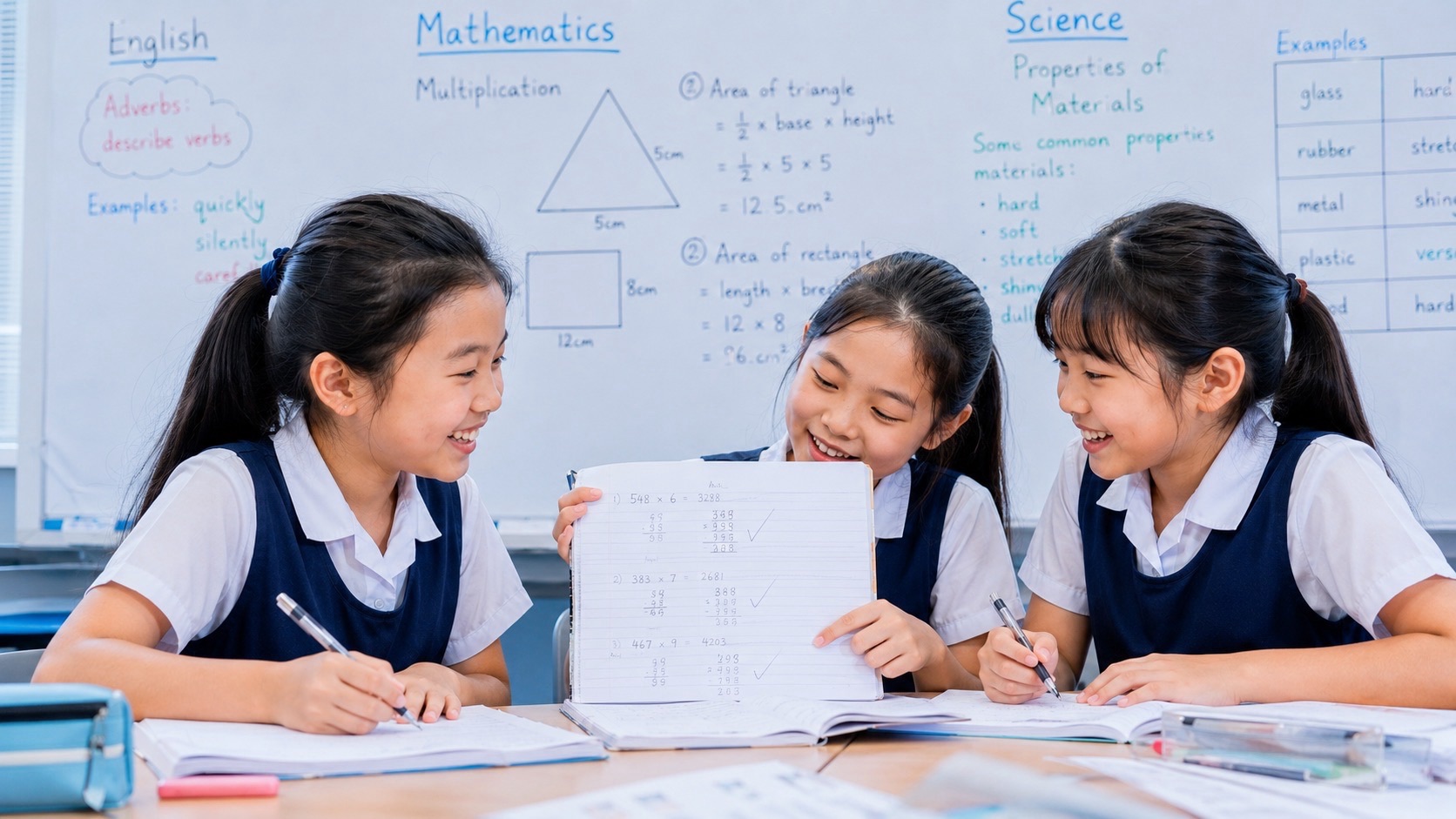
Primary 3 Science process skills help a child move from noticing something to explaining it with evidence. In Singapore, the first formal Primary Science year includes classifying living and non-living things, comparing materials, learning life cycles and investigating magnets. This guide focuses on the vocabulary that lets children observe, compare, group, measure, plan a small investigation and report what actually happened.
A child might know what a magnet looks like yet say that every shiny metal is attracted. Another may write that a plant ‘looks healthy’ without recording an actual observation. Those are different problems from spelling. The useful improvement is to ask: ‘What did you see?’, ‘What did you compare?’, ‘What is your evidence?’ and ‘Is that conclusion stronger than what the test showed?’
Quick information:
- For: Singapore Primary 3 Science, particularly inquiry and explanation skills.
- Core contexts: classification, material properties, life cycles, magnets and age-appropriate tests.
- Inside: 200 numbered process-skill terms, 10 topic sections, practical activities, corrected examples, a four-week plan and parent FAQs.
- Scope: an eduKate teaching list aligned with MOE’s approach; not an official ranked list of MOE or Google keywords.
- First exercise: ask the child to record three observations before offering a reason.
What MOE Primary 3 Science expects in plain language
The MOE Primary Three to Six Science Teaching and Learning Syllabus builds scientific ideas alongside ways of thinking and doing Science. Primary 3 introduces diversity of living and non-living things, diversity of materials, life cycles in plants and animals, and the interaction of magnetic forces. The purpose is not merely to recall names. A student should make relevant observations, compare features, classify by a stated rule and communicate findings accurately.
The distinction between observation and inference is particularly useful. ‘The paper clip moved towards the magnet’ reports what was seen. ‘The magnet exerted an attractive force on it’ explains the event using a scientific idea. Both statements can be appropriate, but they answer different questions. If a question asks for an observation, the child should not offer a speculative cause instead.
Similarly, a fair comparison makes the reason clearer. A child might test two pieces of cloth for absorbency. If one sample is much bigger, the amount of water absorbed may not tell us which material is more absorbent. Choosing similar sample sizes and a consistent method makes the result more meaningful. These habits will remain useful in P4, P5, P6 and later Science study.
Top 200 Primary 3 Science process-skill vocabulary words
The 200 terms below are divided into ten groups of twenty. Each word has a practical meaning and every group has a simple way to apply it. Some academic and measurement terms are helpful extensions; an entry being listed does not make it a compulsory P3 examination keyword.
1. Notice details before naming them
Two leaves look green from a distance, but one has a smooth edge and the other has tiny teeth. An observation must say what the child can actually see, not what the leaf is supposed to be.
Watch for: ‘This leaf is healthier’ is an inference unless the child has appropriate supporting evidence. ‘This leaf has dark green spots’ is a direct observation.
Activity: Find two safe leaves, describe their edges and surfaces, and make one sketch that shows the differences.
- observe — To use the senses or a tool to gather information carefully.
- notice — To become aware of a relevant feature or event.
- detail — A small feature that helps make a description specific.
- visible — Possible to see under the available conditions.
- audible — Possible to hear when sound reaches the ear.
- texture — How a surface feels or appears in its fine detail.
- outline — The external line defining an object’s shape.
- colour — An observable property related to the light an object reflects.
- shape — The external form of an object or organism.
- size — How large or small an item is in a stated comparison.
- surface — The outside area of an object that can be observed or touched.
- edge — The boundary along the side of an object or leaf.
- spot — A small area distinguishable from the surrounding surface.
- stripe — A long narrow band with a recognisable colour or pattern.
- symmetry — A balance of shape across a line or another reference.
- pattern — A repeated or systematic feature noticed in observations.
- change — A difference between an earlier and a later condition.
- movement — A change in position relative to a chosen reference.
- sequence — The order in which events or stages occur.
- description — A statement of observable or clearly identified features.
2. Use comparisons to answer a question
A coin and a plastic ruler have different textures, weights and shapes. A useful comparison chooses properties relevant to a problem rather than describing everything.
Watch for: A comparison must consider both objects. ‘The coin is heavy’ does not tell a reader whether it is heavier than the ruler.
Activity: Compare two containers for storing water. State two similarities, two differences and the most useful property.
- compare — To examine two or more cases for similarities and differences.
- contrast — To focus on differences between items or situations.
- similarity — A feature that two or more compared objects share.
- difference — A feature that distinguishes the compared objects.
- same — Matching on a stated feature or measurement.
- different — Not matching on a specified feature or measurement.
- more — A larger amount or degree in a comparison.
- less — A smaller amount or degree in a comparison.
- larger — Greater in stated size or dimensions.
- smaller — Less in stated size or dimensions.
- longer — Greater in measured length.
- shorter — Less in measured length.
- heavier — Having greater weight under the same gravitational conditions.
- lighter — Having less weight under the same gravitational conditions.
- equal — Having the same numerical or stated value.
- unequal — Having different numerical or stated values.
- closest — At the smallest distance among the choices compared.
- farthest — At the greatest distance among the choices compared.
- ranking — Placing items in order according to an explicit rule.
- criterion — A rule or feature used to decide which items belong together.
3. Classify living and non-living things
A battery-powered toy can move, yet movement is not enough to call something alive. A resting plant might show little movement but is living.
Watch for: Use a group of life processes, not one visible action. A robot that moves is still not a biological organism.
Activity: Classify a sprouting seed, rock, toy insect and earthworm, then explain the decision for the least obvious case.
- classify — To organise items into groups using clearly stated features.
- classification — The method or result of putting items into meaningful groups.
- category — A group of items sharing a specified characteristic.
- living thing — An organism that performs processes associated with life.
- non-living object — A thing that is not itself a biological organism.
- organism — An individual living being, such as a plant or animal.
- grow — To increase in size or develop during life.
- reproduce — To produce new organisms of the same kind.
- respond — To react to a stimulus or change in surroundings.
- respire — To release usable energy through processes in living cells.
- feed — To obtain food or useful nutrients from an outside source.
- breathe — To move air or another gas-containing medium for gas exchange.
- waste removal — The process of getting rid of substances no longer needed.
- life process — An activity performed by an organism as part of being alive.
- biological — Relating to living organisms or their processes.
- evidence of life — Information supporting the classification of something as living.
- exception — A case that seems not to follow a simple grouping rule.
- rule — A clearly defined condition applied to all classification choices.
- key feature — A distinguishing property especially useful in identifying a group.
- misclassification — Putting something into the wrong group because a rule was misused.
4. Inspect properties of common materials
A sponge absorbs water while a sealed plastic sheet resists water passing through. Both are useful, but for different tasks.
Watch for: ‘Absorbent’ and ‘waterproof’ are not synonyms. Neither tells us whether a material will break, bend or conduct heat.
Activity: Choose a material for a raincoat, a floor cloth and a clear window; connect every choice to the property required.
- material — The substance an object is made from.
- property — A feature of a material used to describe or choose it.
- flexible — Able to bend without breaking under the stated conditions.
- rigid — Resisting bending and tending to keep its form.
- waterproof — Preventing or strongly resisting water passage.
- absorbent — Able to soak up liquid into or onto a material.
- transparent — Letting light through clearly enough to see objects behind.
- translucent — Letting some light through while blurring the view.
- opaque — Not allowing light to pass through.
- durable — Able to remain useful despite repeated use or wear.
- brittle — Likely to break rather than bend when stressed.
- elastic — Able to return toward an original shape after deformation.
- magnetic — Able to interact strongly with an ordinary magnet in a given context.
- non-magnetic — Not showing substantial attraction to an ordinary magnet.
- smooth — Having few noticeable ridges or bumps.
- rough — Having a noticeably uneven surface.
- shiny — Reflecting light strongly from a surface.
- dull — Not reflecting light with a bright shine.
- porous — Containing tiny spaces through which substances may pass.
- suitable — Having properties that match a stated purpose.
5. Trace life cycles as ordered evidence
A child sees a caterpillar in a garden and later finds a butterfly. To explain a life cycle, the pupil must connect the recognised stages in the correct order.
Watch for: Not every insect has a pupa. A grasshopper’s life cycle does not follow the same stage names as a butterfly’s.
Activity: Make two cycle diagrams, one for a butterfly and one for a grasshopper. Highlight where their stage names differ.
- life cycle — The sequence of developmental and reproductive stages of an organism.
- stage — A recognisable period within a longer process of development.
- egg — A reproductive structure in which a young organism may develop.
- larva — An immature animal stage often quite unlike the adult.
- pupa — A stage in which certain insects transform before adulthood.
- caterpillar — The larval form of a butterfly or moth.
- chrysalis — The pupa of a butterfly.
- nymph — A young insect resembling a smaller and less developed adult.
- hatching — Emergence of a young animal from its egg.
- germination — The start of growth from a suitable seed.
- seedling — A young plant developing from a germinated seed.
- mature — To become developed enough for adult functions.
- adult — A developed stage of an organism’s life.
- offspring — A new organism produced by one or more parents.
- development — Progressive changes in form or ability over time.
- metamorphosis — Major change in body form during stages of development.
- timeline — Events or stages shown in their time order.
- before — Earlier than another event or stage.
- after — Later than another event or stage.
- repeat — To happen again in another part of a cycle.
6. Test magnets with clear rules
A magnet attracts a steel paper clip but usually does not attract an aluminium can. Children should test the material rather than guess from its shiny appearance.
Watch for: A magnet does not strongly attract every metal, and two magnets can repel when like poles face each other.
Activity: Use a safe bar magnet to test five ordinary objects and record which show attraction. Avoid very small magnets around younger children.
- magnet — An object that creates magnetic effects in surrounding space.
- magnetic material — A material strongly attracted by an ordinary magnet, such as iron.
- bar magnet — A straight magnet having two poles at opposite ends.
- horseshoe magnet — A U-shaped magnet with its poles relatively close together.
- north pole — A magnet’s labelled pole that repels another north pole.
- south pole — A magnet’s labelled pole that repels another south pole.
- attract — To exert a force pulling an object or another pole closer.
- repel — To exert a force pushing another pole away.
- magnetic force — A force arising from magnetic interaction.
- pole arrangement — The way magnetic poles face one another.
- orientation — The direction in which a magnet is turned or placed.
- magnetic field — The region around a magnet in which its effect can be observed.
- contact — Physical touching between objects.
- non-contact — An interaction that can occur without touching.
- paper clip — A small metal fastener often made from magnet-attracted steel.
- iron — A metal strongly attracted by ordinary permanent magnets.
- aluminium — A common metal not strongly attracted by a classroom magnet.
- steel — An iron-based alloy often attracted by an ordinary magnet.
- compass — An instrument with a magnetic needle showing a directional reference.
- test object — An item selected to examine a particular property.
7. Choose the right measuring tool
To compare plant height, a ruler is helpful; for a liquid’s volume, a measuring cylinder gives a more relevant measurement.
Watch for: Mass and weight are different. A ruler cannot measure the volume of an irregular solid directly without additional information.
Activity: Create a simple tool-to-quantity chart for length, mass, volume, time and temperature.
- measurement — A quantity found using a defined method and unit.
- quantity — An amount or magnitude that can be described or measured.
- unit — A common reference used to express a measurement.
- ruler — A marked tool for finding length or distance.
- measuring tape — A flexible tool with marks used to measure longer distances.
- measuring cylinder — A graduated container used to read a volume of liquid.
- balance — An instrument used to compare or measure mass.
- thermometer — A tool for measuring temperature.
- stopwatch — A timing device for measuring elapsed time.
- scale — A set of marks representing measurement values.
- marking — A line or symbol showing a position on a scale.
- length — The distance along a stated direction between two points.
- width — The distance across an object in a chosen direction.
- height — How tall an object is in a specified direction.
- volume — The space occupied by a substance or object.
- mass — The amount of matter in an object.
- temperature — A measured indication of hotness or coldness.
- duration — How long an event lasts.
- centimetre — A length unit equal to one-hundredth of a metre.
- millilitre — A volume unit equal to one-thousandth of a litre.
8. Organise observations without losing information
If a child measures a seedling for a week but writes only ‘big’ or ‘small’, the reader cannot compare the growth with confidence.
Watch for: Every table needs clear headings and units when numerical measurements are recorded. A neat chart cannot repair poor observations.
Activity: Make a simple table for three plants measured on three dates. Give each column a meaningful heading and unit.
- record — To store findings in writing, diagrams or another retrievable form.
- data — Information collected to examine a question or pattern.
- table — An arrangement of information in rows and columns.
- row — A horizontal line of entries in a table.
- column — A vertical line of entries under one heading.
- heading — A label explaining what a column or section contains.
- label — A word or phrase identifying a part of a drawing or table.
- diagram — A drawing showing selected structures or relationships.
- sketch — A simple drawing capturing relevant visible features.
- caption — Short explanatory text accompanying a picture or chart.
- symbol — A mark used to represent a type of object or idea.
- legend — An explanation of symbols or markings in a display.
- sample — A particular object or set chosen for examination.
- count — The number found by enumerating individual items.
- frequency — The number of times an event or result occurs.
- tally — A quick mark-based record used when counting occurrences.
- bar graph — A chart using bars to compare numbers among categories.
- axis — A reference line along which numerical values may be shown.
- interval — The spacing between consecutive points or values.
- total — The overall amount obtained by combining relevant counts.
9. Plan fair comparisons and handle surprises
Two beans grow to different heights. If they also had different soil, pots and amounts of sunlight, the child cannot say with certainty that the water amount caused the change.
Watch for: A fair test changes the relevant factor while keeping other influential conditions similar; repeating a test also helps evaluate consistency.
Activity: Plan a fair comparison of two safe absorbent materials. State what changes, what is measured and what stays similar.
- question — Something a learner wants to investigate or find out.
- investigation — An organised effort to answer a scientific question.
- prediction — A possible result proposed before observation.
- hypothesis — A tentative explanation that can be checked against evidence.
- factor — A condition that can influence an outcome.
- variable — A factor that may change in an investigation.
- controlled condition — A relevant circumstance kept similar between compared cases.
- fair test — A comparison designed to reduce unrelated influences.
- procedure — The planned steps used to carry out an activity.
- apparatus — The equipment used to make observations or conduct a test.
- trial — One attempt or run of a planned test.
- repeated trial — Another run using comparable procedures.
- consistent — Showing similar results under similar conditions.
- reliable — Giving dependable findings when checked appropriately.
- error — A mistake or deviation affecting a procedure or measurement.
- anomaly — An unexpected result differing from a general pattern.
- adjust — To make a specified change to improve or test a procedure.
- safety — The condition of keeping risks reasonably low during an activity.
- supervision — Guidance and oversight by someone responsible for the activity.
- limitation — A feature that prevents a result from establishing too much.
10. Say what the evidence supports
A child says, ‘A red object is always magnetic’. The experiment showed only one red object attracted to a magnet. The conclusion is wider than the evidence.
Watch for: A claim should be limited to the observations and tested conditions. Scientific language does not become true because it sounds confident.
Activity: Read three short science claims. Identify which can be supported by the actual observations and which need more testing.
- evidence — Observations or results relevant to a claim.
- claim — A statement that can be supported or challenged by information.
- inference — An interpretation based on given observations.
- explanation — A reasoned account of what causes or describes an outcome.
- conclusion — A statement drawn from the findings of an investigation.
- reason — A justification connecting a statement to supporting information.
- because — A word introducing an explanation or cause.
- therefore — A word signalling a conclusion that follows from stated reasons.
- cause — A factor that helps produce a change or event.
- effect — An outcome associated with an influencing condition.
- support — To provide evidence that makes a claim more credible.
- challenge — To question a claim using contrary evidence or reasoning.
- confirm — To establish support through an appropriate additional check.
- uncertain — Not determined conclusively by available evidence.
- possible — Able to happen or be true under some conditions.
- probable — More likely than other possibilities given the available evidence.
- justify — To provide reasons for a choice or claim.
- evaluate — To assess how strong or weak a claim or method is.
- communicate — To share scientific findings clearly through words or displays.
- revise — To change an explanation when better evidence becomes available.
Five worked examples: from a vague answer to a scientific one
Example 1: Is the toy alive because it moves?
Weak answer: ‘It moves, so it is living.’ Better answer: Movement alone is not sufficient evidence that something is living. A battery-powered toy can move when energy is supplied, while living organisms carry out a wider set of life processes. Compare what happens when the toy’s battery is removed with what a growing seed does over days. The correct classification uses several characteristics rather than one eye-catching feature.
Example 2: How do you know a cloth is absorbent?
Weak answer: ‘This cloth looks fluffy.’ Better answer: Use an appropriate test to observe whether the cloth takes in water. Compare equal-sized samples and keep the initial water amount and method similar. ‘Absorbent’ describes a material’s ability to take in liquid. Surface appearance alone is not a reliable conclusion about how much it absorbs.
Example 3: Why did only some objects move towards the magnet?
Weak answer: ‘Magnets attract metal.’ Better answer: Ordinary permanent magnets strongly attract materials such as iron and many steels. Some other metals, including ordinary aluminium, are not strongly attracted. Record each tested material and its result. If an object is not attracted, it does not prove that all objects of that colour, size or shape will behave similarly.
Example 4: Which life-cycle diagram is correct?
Weak answer: ‘All insects become pupae.’ Better answer: Different insect life cycles have different stages. A butterfly goes from egg to larva, pupa and adult. A grasshopper develops from egg through nymph stages to adult without the same pupal stage. The ability to compare two accurate sequences shows understanding beyond memorising one picture.
Example 5: Does more water always make a seedling taller?
Weak answer: ‘Yes, the tallest seedling had most water.’ Better answer: That observation alone does not prove the claim. Light, seed variety, soil and other conditions may differ. A useful investigation changes the amount of water while keeping other relevant factors similar. Record plant height over time, repeat observations and conclude only what the evidence supports.
The three-step language routine that improves Science answers
Begin with notice: the child says what changed or which feature can be seen. Ask for details such as colour, number, position, size or a visible stage in a process. This develops observation rather than guessing. If the child says ‘it is happy’ about a plant, help translate that impression into actual evidence: the leaves are upright, new shoots are present or the plant has grown taller.
Continue with compare: which feature differs, and did both cases receive the same conditions? If a magnet attracts one paper clip but not another object, the child should notice what material each is made from, not only its colour. If a plastic sheet keeps water out while a cloth absorbs it, ask which property makes each material suitable for a specific use.
Finish with explain and check: ask the student to connect the observation to a scientific idea. Encourage appropriate humility: ‘This result suggests …’ is better than an unjustified ‘This proves all …’. Another observation, a repeated test or a clearer comparison may be needed. That is a scientific habit, not a sign of uncertainty about every answer.
Children are more likely to retain a term when they use it in two contexts. After comparing two leaves, ask them to compare two classroom objects. After classifying animals, ask them to classify materials by transparency. The act of transferring the idea from one topic to another is a useful test of understanding.
Four-week Primary 3 investigation vocabulary plan
Week 1 — Look, compare and name
Study sections 1 and 2 in short sessions, perhaps five to ten words at a time. Use safe leaves, paper or household containers. Ask for direct observations, then similarities and differences. Practise the phrase ‘compared with’ so the child learns to consider both items. Draw a simple sketch and label two meaningful features. Do not turn the session into an elaborate report.
Week 2 — Sort living things and materials
Read sections 3 and 4. Give the child a mixture of photographs and familiar objects and ask for a consistent grouping rule. Introduce exceptions that reveal a weak rule, such as a moving toy or a motionless seed. For materials, select a purpose first—carrying water, letting light through, wiping a spill—and let the child choose an appropriate property. Make the reason clear.
Week 3 — Stages, magnets and measurements
Use sections 5 to 7. Arrange pictures of two insect life cycles, identify the differences, then test a small set of safe objects with a magnet. Be cautious with small magnets because they can be dangerous if swallowed. Record the results using a table and choose tools suited to the quantity being measured. Ask whether a claim came from direct observation or a later explanation.
Week 4 — Tables, tests and evidence
Use sections 8 to 10. Help the child design one safe comparison, record observations, and discuss which factors should remain the same. Encourage the child to say what the table shows before suggesting why it happened. Finish by revisiting five common errors from earlier weeks and asking the child to correct the reasoning independently.
Primary 3 Science process-skill questions parents ask
Are these 200 official MOE Primary 3 keywords?
No. They are an original teaching selection of content-related, general academic and inquiry words. The official syllabus describes scientific topics and practices, not this exact numbered list. Supporting academic terms may become more important later in primary school.
Should a P3 child know advanced terms such as hypothesis?
A child may encounter the word in wider learning, but it is not necessary to turn every home activity into an advanced investigation. Use plain language first: ‘What do you think will happen? Why?’ More formal vocabulary is helpful when it clarifies an action, not when it becomes an additional memory burden.
How do I teach observation without guessing?
Ask what a camera, ruler or thermometer could actually record. ‘The leaf is yellow at the edges’ is observable; ‘the plant will die’ predicts an outcome. After recording the observation, the child may explain a possible cause, but should identify what extra information would support it.
How do I make classification questions easier?
Start with the rule. Does the group consist of items that are living, absorbent, transparent or magnetic? Apply the same rule to every object. A child who keeps changing the rule halfway through a question may have memorised categories without understanding the chosen characteristic.
What is a suitable home experiment?
Safe short comparisons such as looking at different leaves, comparing paper and cloth for absorbing water, or trying an ordinary magnet on supervised materials can work. Avoid hot liquids, unknown chemicals, sharp objects and very small magnets. More complicated equipment is not necessary for learning the basic reasoning skills.
How does this help in Primary 4 to 6?
The same skills become essential in questions about light, heat, water cycles, human systems, electricity, forces and the environment. In later years children encounter more detailed concepts, but they still need to tell observation from explanation and support conclusions with evidence.
Continue learning and official source
See the MOE Primary Three to Six Science Teaching and Learning Syllabus for the formal scope and inquiry practices. Review Top 200 Primary 3 Science vocabulary: Living Things, Materials, Life Cycles and Magnets for the content concepts. For the next school level, use Primary 4 Science vocabulary: Plant Parts, Digestion, Light and Heat. The larger Primary Science Keywords P3–P6 hub gives a cross-level starting point.
Takeaway: teach the child to see first, compare fairly and explain with evidence. A clear observation today lays the groundwork for reasoning in tomorrow’s Science questions.