
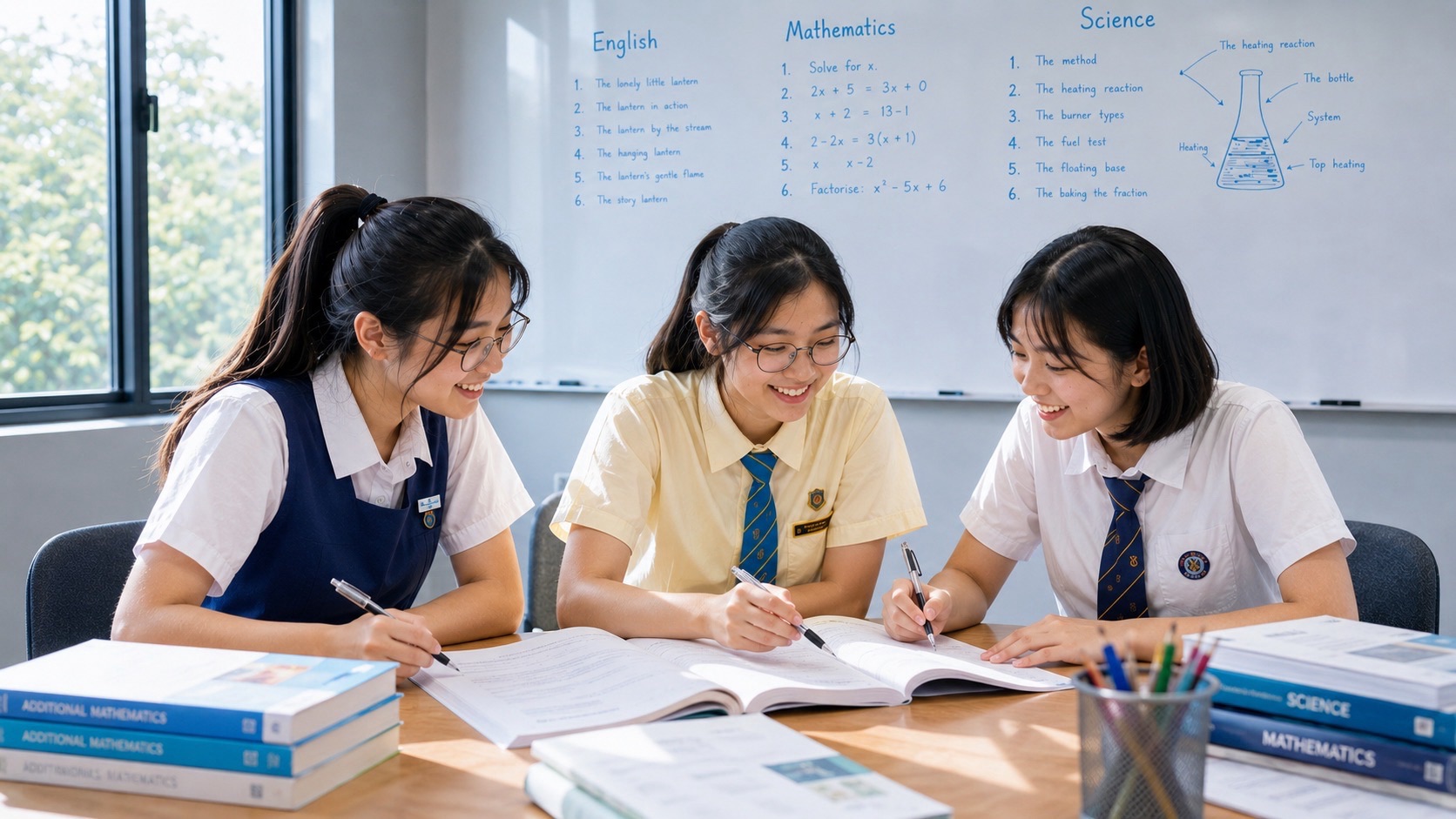
G2 Science small-group tuition for Serangoon students should develop clearer explanations, better investigation skills and the ability to solve unfamiliar Science questions without copying a model answer. eduKateSG’s established three-pupil tutorial format is based at 8 Fourth Avenue, Singapore 268674, near Sixth Avenue MRT; Serangoon families should verify the G2 Science timetable and availability before travelling.
The most useful question is what a pupil can now do independently after a lesson. Under Full Subject-Based Banding, G2 is a Science subject level, and performance depends on understanding concepts as well as reading evidence, using models and explaining observations. This guide helps Serangoon parents judge whether a smaller class will repair recurring learning gaps or simply add more work to a busy week.
- Check the child’s actual G2 subject assignment and school topic order, not only the Secondary 1 Posting Group.
- Use two marked Science questions to identify the misconception or answer-writing problem first.
- Expect each pupil in a three-person tutorial to attempt a question, explain the reasoning and revisit it later.
- Teach scientific precision through observations, evidence, diagrams, graphs and appropriate command words.
- Compare the entire Serangoon-to-Sixth-Avenue journey with alternatives and the learner’s need for rest.
- Treat SEC K223, K224 and K225 as later combined-Science options rather than three compulsory courses.
From Serangoon primary familiarity to lower-secondary precision
A student can leave Primary 6 recognising familiar Science words while still struggling in Secondary 1 with the formal language of investigations. Evaporation, reflection, food chains and electrical circuits are not entirely new. What changes is the demand to select evidence and explain why the scientific principle fits the given conditions. A pupil who has practised only keyword recall may experience this as a sudden jump in difficulty.
The tutor should inspect where the pupil stopped thinking scientifically. Did the answer omit the controlled variable? Was the ray diagram copied without understanding the arrow direction? Did the child say that a food-web species would vanish without checking alternative food sources? These are correctable problems, but each requires a different explanation and follow-up check.
A Serangoon home example: heat, temperature and the wrong explanation
A child notices that a metal railing and a wooden surface in the same shaded area feel different to the touch. The observation is not proof that the surfaces started at different temperatures. Materials may transfer thermal energy to and from the skin at different rates. The child should learn to separate the experience of feeling colder from a measurement of actual surface temperature.
A good tutor asks which observation the student can defend, what scientific property might be relevant and what measurements would be necessary before making a definite comparison. This illustrates an examination habit: do not let a familiar feeling replace the evidence that the question supplies.
Next, change one condition. If both materials are in direct sunlight, can the same conclusion be assumed? Not without knowing the new conditions. The learner should recognise that the principle remains useful but the evidence and starting temperatures still matter.
A worked investigation: which surface dries faster?
Imagine two equally sized wet cloths made from the same material, placed under different air-flow conditions while other relevant conditions are kept similar. The student is asked how to compare drying rates fairly. An incomplete answer says only that one cloth should be put near a fan. A stronger answer identifies the changed variable, the measured outcome and the conditions that must be controlled.
The tutor can then ask whether the conclusion would remain justified if the cloth sizes differed. This question exposes whether the pupil understands a fair test rather than simply memorising the phrase ‘keep everything the same’. The objective is to control variables relevant to the claim and acknowledge any remaining uncertainty.
A short teaching sequence progresses from identifying independent and dependent variables to justifying a control, then to designing a new comparison about a different physical process. Every child should attempt the transfer question alone.
The Serangoon Gardens connection: a short walk, a real scientific question
NParks identifies Haus Linear Park along Serangoon Garden Way as a green space for nearby residents. A family walking around Serangoon Gardens can ask what changes along a path shaded by trees or exposed to sunlight. These are everyday prompts for discussing energy, conditions and measurement; they are not evidence of a specific temperature difference without actual readings.
Ask the child to propose how a fair comparison could be made. Would temperatures be measured at the same time? Would the surfaces have similar properties? What happens if cloud cover changes? These questions teach the difference between an interesting hypothesis and a tested conclusion.
The same approach works with a simple observation of rainwater moving across a pavement. It may prompt thinking about surface conditions and runoff, but parents should not instruct children to enter drains, approach unsafe water or conduct unsupervised experiments. The conversation is enough.
Why a Serangoon tuition choice must account for travel
A page targeted at Serangoon residents does not establish an eduKateSG branch in Serangoon Central or Serangoon Gardens. The referenced tutoring centre is near Sixth Avenue MRT at Fourth Avenue. Families should verify where the specific G2 Science session takes place and calculate transport from their actual school or home.
A lesson may be academically strong but impractical after CCA, school homework and a long return trip. Parents should include travel, waiting and meal time in the decision, not compare only the advertised session duration. If the child has a serious but narrow misconception, school teacher consultation or another verified closer option may be more efficient.
An explanation exercise: food webs and unsupported predictions
Suppose a hypothetical food web shows that one predator eats two prey species. If one prey species declines, the student must not immediately conclude that the predator will die out. The tutor should ask the learner to identify feeding relationships and the significance of the second prey source. A prediction may be plausible without being certain.
Have each of three pupils write a response independently. One may focus on the remaining food source, another on possible competition and the third on missing information. The tutor can compare the explanations and ask every child to revise a statement so the conclusion is no stronger than the data. This combines the Interactions theme with the Practices of Science.
A practical weekly routine for Serangoon students
On the first study day, the child closes the book and explains one concept in thirty to sixty seconds. On another day, the child attempts a question using the same principle in a different diagram. Near the weekend, revisit a previously corrected error and ask why the original reasoning failed.
Keep the tasks narrow and relevant to school. If the topic is density, discuss mass and volume with correct units rather than add unrelated advanced Physics. If the topic is cells, the child should explain how a named structure supports a function, not merely list labels. Small, repeated acts of retrieval can reveal more than a long re-reading session.
Choosing between class, consultation and home practice
A three-person class can be a sensible investment when the child needs frequent individual feedback and is ready for peer discussion. For a learner who already understands the science and needs only a more orderly revision habit, the family may achieve enough through school guidance and short independent practice.
Ask the prospective tutor to name the two highest-priority misconceptions and explain how they will be retested after a delay. If the provider cannot do that or the journey makes the child chronically tired, the arrangement may be poor value even when the advertisement sounds impressive.
What G2 Science means under Full Subject-Based Banding
Full Subject-Based Banding was implemented across secondary schools beginning with the 2024 Secondary 1 cohort. G1, G2 and G3 are subject levels. Posting Groups help with school admission and initial subject placement, but a child’s subjects can be taken at different levels in accordance with the school’s decisions and applicable eligibility. G2 Science should therefore be selected and assessed as a real course, not as an assumed label attached to the student’s entire education.
The lower-secondary G2/G3 Science syllabus from MOE includes five themes: Scientific Endeavour, Diversity, Models, Interactions and Systems. It combines knowledge, scientific investigation, evidence, ethics and communication. Some outcomes are optional for G2, which means the tutor should match the actual course rather than import every G3 extension as though it were compulsory. Secondary 1 and Secondary 2 schools can organise topics in different sequences, so the child’s current assessment information matters.
When parents see the expression ‘new G2 syllabus’, they should distinguish three things: the student’s current lower-secondary school curriculum; subject-level opportunities under Full SBB; and the 2027 SEC upper-secondary examination syllabuses. These are connected but not identical. Understanding the distinction prevents families from buying an impressive-sounding course that does not actually address next term’s schoolwork.
Why more worksheets do not always produce a better Science result
A child may recognise a definition immediately when reading notes but fail to retrieve it in an assessment. Another may remember the right concept but omit the relevant experimental evidence. Another may understand the theory and lose accuracy through units, graph axes or a poorly interpreted command word. More time alone will not repair every one of these problems.
The first intervention is diagnosis. Ask the child to solve a question independently and narrate why each step seems correct. If the science is misunderstood, use a concrete counterexample, model and explanation. If the principle is correct but the writing is weak, teach concise causal sentences. If the student reads data poorly, practise axes, labels, trends and proportional conclusions. Each kind of mistake should have a separate treatment.
An error log should be short and useful. Record the original answer, the specific wrong assumption, a corrected explanation and one follow-up question attempted several days later. Copying a model solution is an early step, not proof of learning. The useful result is whether the child can use the idea with changed variables or a different diagram.
What effective three-student tuition should look like
A three-pupil tutorial should give every learner repeated chances to answer, compare ideas and receive individual feedback. The teacher can ask one pupil to interpret a figure, another to offer a scientific explanation and the third to challenge the evidence behind it. Then each child must write a separate solution without the group carrying them. That independent attempt matters more than the appearance of lively discussion.
Small numbers are useful only if the tutor actually observes each child’s reasoning. If a student silently copies the strongest pupil, the class ratio has not solved anything. If the three students have vastly different needs, the tutor should differentiate tasks or recommend a different arrangement. Parents should ask how students are grouped, what happens when one moves faster and how the tutor knows the quietest pupil understands.
Three-pupil learning is a teaching model, not a guarantee of grades. The skill of the tutor, the student’s readiness, how carefully mistakes are revisited and whether the learner receives enough rest all affect outcomes. Parents should look for a credible explanation of how teaching changes behaviour rather than accept a ranking claim based on promotional adjectives.
The five themes and how a tutor can connect them
Scientific Endeavour asks learners to frame testable questions and evaluate observations. Diversity investigates different kinds of matter, physical properties and separation techniques. Models include representations of light, cells and particles. Interactions consider forces, energy transfers, chemical changes and ecosystems. Systems include electrical and biological components working together. These themes organise concepts so a child can recognise patterns across chapters.
A separation question, for example, is not simply a request to memorise filtration or distillation. The child should identify what is dissolved or insoluble, which property allows separation and what the question actually wants collected. An electrical circuit question is not only a diagram-labelling test: the learner should explain how the path and components affect the system. A food-web question requires tracing relationships and considering alternatives.
A good tutor periodically connects these examples through scientific practices: ask what was observed, identify the underlying model, describe what can be inferred and recognise what has not been tested. This approach reduces the need to memorise every possible question as an unrelated answer.
How to read the command words and construct an answer
‘State’ generally asks for a concise fact or outcome. ‘Describe’ requires relevant features or a pattern in the given information. ‘Compare’ needs a consistent basis. ‘Explain’ requires a scientific reason connected to the observation. ‘Suggest’ invites a plausible answer supported by the scenario. Always read the whole question, because the command word alone cannot determine every marking requirement.
The student should practise a four-check routine: identify the command, locate the evidence, select the scientific principle and verify that the written answer performs the requested task. If asked to explain a graph trend, simply repeating that the line rises is usually a description, not a scientific explanation. If a graph shows change without identifying the cause, the learner must not invent an experimental condition.
Parents can help even without specialist knowledge. Ask the child to point to the evidence, say why the principle applies and identify the part of a correction that changed the reasoning. Five minutes of careful explanation is often more valuable than asking a tired child to complete another ten familiar questions.
Practical work, investigations and safety
Science includes laboratory work that should be performed in the proper supervised school setting. A tuition class can support the understanding behind experiments: identifying manipulated, responding and controlled variables; selecting a fair comparison; explaining measurement choices; reading apparatus and recognising limitations. It should not claim that paper worksheets can completely replace safe school practical experiences.
A careful explanation distinguishes observation from inference. ‘Bubbles appeared’ is an observation; the identity of a gas is not established merely by bubbles unless additional evidence is supplied. Likewise, a visible colour change may be evidence to consider but does not license an invented conclusion about every substance in the setup. Honest data reporting is part of scientific integrity.
Safe everyday examples such as shadows, condensation on a glass, or reading a weather table can support home conversations. Parents should not instruct children to perform hazardous chemical, electrical or unsupervised water experiments to make a point. Science is about thoughtful investigation, not risk-taking.
An illustrative 90-minute small-group Science session
Begin with brief retrieval of a prior topic without notes so the tutor can see what survived the preceding lesson. A short diagnostic then reveals one target misconception. The teacher explains the principle through a diagram, model or carefully chosen contrasting examples, stopping to ask each pupil to justify a key part.
Next, pupils complete independent questions. Rather than waiting for the final answer, the tutor checks the first incorrect mental step. A short discussion compares reasoning without turning it into a copy-the-best-student exercise. The final task changes the context and asks each learner to explain the principle independently.
This sequence is illustrative; it is not a claim that every G2 Science lesson has an identical duration or timetable. The reference eduKateSG tutorial format includes three pupils and lessons for the stated reference subject. Parents should confirm the actual G2 Science duration, current teacher, fees, makeup rules and available grouping before enrolling.
Six weeks of measurable learning
Week one should document the current baseline through a small set of independent questions involving one concept, a data display and an explanation. Record whether the student needs hints, misinterprets the command or repeats a misconception. Weeks two and three tackle the most harmful errors rather than attempting to reteach the whole syllabus.
Week four tests the same principles in new contexts, because repeating the worked example may produce false confidence. Week five adds a modest time limit and mixed questions to see whether correct reasoning remains reliable when topics are not labelled. Week six compares new independent responses with the first diagnostic and decides whether the method should continue or change.
Measure the number and nature of recurring mistakes, evidence used appropriately, scientific vocabulary, independent retrieval and the child’s confidence based on genuine understanding. Do not promise a particular score by a fixed date: school topics and examination formats influence grades, and a six-week review is primarily a learning diagnostic.
What parents need to know about 2027 SEC G2 Science
From 2027, the Singapore-Cambridge Secondary Education Certificate is used for the relevant graduating cohort. SEAB’s 2027 G2 Science subject combinations are K223 Science (Physics, Chemistry), K224 Science (Physics, Biology) and K225 Science (Chemistry, Biology). These are alternative upper-secondary combined-Science pathways, not three additional compulsory Science classes for every Secondary 1 student.
The available combination depends on the student’s school and the eventual subject choices. Multiple-choice and structured-response demands make factual knowledge and independent explanation both important. A tutor cannot promise a school subject offering, subject-level change or particular examination result. Parents should check the current SEAB syllabus and their school’s option information rather than rely on older N(A)-Level paper codes.
The lower-secondary student still needs a solid foundation in evidence, models and systems before final examination drills become the centre of revision. Forcing upper-secondary material too early can disguise a persistent misunderstanding with a larger workload.
The parent checklist for a responsible tuition decision
- Which school Science level is my child actually taking, and which topics will the next school assessment cover?
- Can the tutor show how a particular mistaken answer will be taught and retested?
- Is the proposed class really capped at three students, and who teaches it?
- How are differences in school pacing handled without leaving one learner behind?
- What does a useful four-to-six-week review report to parents?
- What are the full fees, notice period, lesson length, replacement arrangements and travel costs?
- Is this a problem that ordinary school support or a short home routine could solve instead?
When additional tuition is not the best move
If the child already follows Science lessons, asks the school teacher for clarification and corrects mistakes independently, a regular additional class may add little. A tired student may need rest and a better weekly timetable more than further instruction. A specific misunderstanding may be repairable through the school teacher or targeted short-term coaching.
Parents should view tuition as one possible intervention, not an automatic part of growing up. It is successful when the student becomes increasingly able to select a relevant idea, justify an answer, detect errors and learn without being told every next step.
Frequently asked questions for Serangoon families
Does a Serangoon student automatically need tuition when Secondary 1 begins?
No. The transition can be monitored through actual schoolwork and teacher feedback. Start tuition for persistent, demonstrated needs rather than as a universal rule.
Is there an eduKateSG G2 Science classroom in Serangoon?
This article does not claim one. The documented teaching address is 8 Fourth Avenue near Sixth Avenue MRT; ask the centre about the actual class.
Can G2 Science be studied alongside another subject at G3?
Full Subject-Based Banding permits different subject levels where the school’s applicable criteria and decisions allow it. Check the student’s individual subject assignment.
Will memorising model answers be enough?
No. Terms and examples matter, but a pupil must connect them to evidence and be able to transfer a principle to an unfamiliar context.
What should be reviewed after six weeks?
Independent reasoning, the pattern of corrected misconceptions, the ability to read data accurately and the effect of the tuition timetable on wellbeing.
Official guidance and useful parent reading
- MOE: Lower Secondary G2/G3 Science Syllabus
- MOE: Full Subject-Based Banding and the SEC transition
- SEAB: 2027 SEC G2 syllabuses for school candidates
- SEAB: Secondary Education Certificate information
- eduKateSG: Science combinations K223, K224 and K225 explained
- eduKateSG: G2 Science experimental evidence and explanations
- eduKateSG: Original Clementi three-student tutorial reference
- NParks: Haus Linear Park, Serangoon Garden Way
- NParks: Upper Serangoon Park
Arrange a parent–student consultation
Bring your child’s most recent Science scripts, current subject level, school topic list and a realistic family timetable. Ask how the first misconception will be addressed, how it will be retested and whether the actual three-student G2 Science class is a suitable match. The eduKateSG address is 8 Fourth Avenue, Singapore 268674, near Sixth Avenue MRT; no separate Serangoon centre is implied.
Contact eduKate Singapore or ask about G2 Science on WhatsApp.
Properly taught students learn to identify relevant evidence, explain more accurately and become steadily less dependent on adult prompting.