
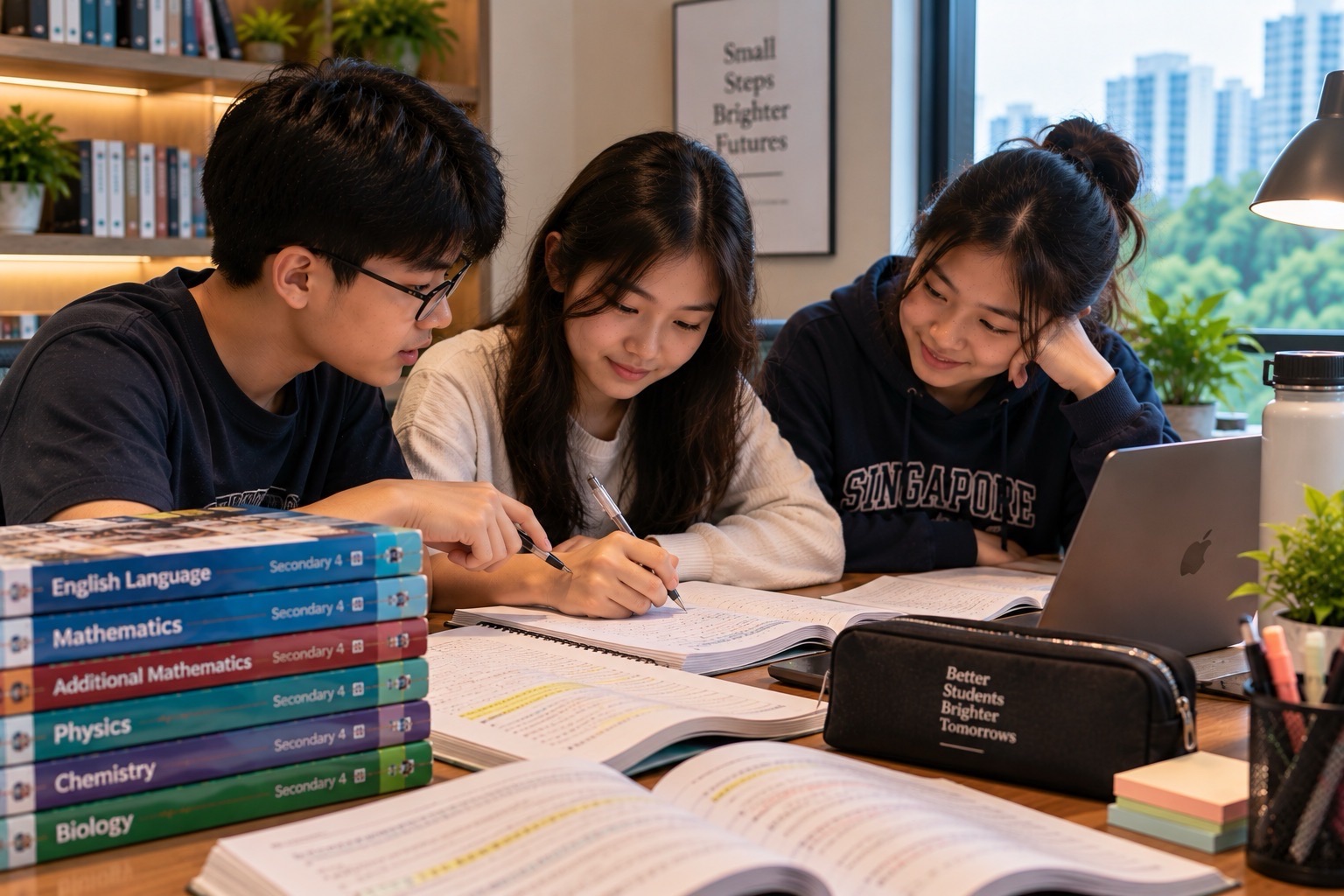
G2 Science small-group tuition for Tampines students should turn careful study into more accurate scientific claims, stronger examination explanations and a better grasp of investigations. eduKateSG’s documented three-student tutorial format is based at 8 Fourth Avenue near Sixth Avenue MRT, so Tampines families should verify the actual timetable, place, fee and suitability before planning a journey.
The problem a tutor must solve is specific. A child might recall Biology terms but misread a food web, understand particle theory but choose the wrong separation method, or know the chapter yet omit the evidence that an ‘explain’ question requires. This article shows how to diagnose those problems using schoolwork, connect G2 Science to everyday observation in Tampines and judge whether small-group tuition produces more than extra activity.
- G2 Science requires concepts and scientific practices; memorising more definitions is not the entire plan.
- Track repeated wrong answers by cause, not just by the percentage scored.
- A useful three-pupil session combines individual attempts, explanation, specific correction and later retesting.
- Local nature observations can spark questions; treat hypotheses as hypotheses, not proven facts.
- Tampines families should weigh travel, CCA and rest against the tuition benefit.
- Later G2 SEC Science combinations are K223, K224 and K225; school offerings and actual course choice matter.
The Tampines parent question: why does my child know the topic but miss the mark?
A student says the right scientific word but fails to answer the question. Consider ‘evaporation’: the child may know the definition but cannot explain why a given wet surface dries differently under changed conditions. Another student can describe an organism in a food web but cannot predict a plausible effect when one food source changes. Both may be trying hard; their missing skill is applying the principle to the actual evidence.
The efficient response is not automatically another booklet. The tutor should show the child exactly where the reasoning failed, whether from an incorrect scientific idea, a missed condition or a sentence that does not answer the instruction. The next task should be different enough to show whether the understanding can be reused independently.
Why a memorised keyword is not the same as an explanation
Science has technical vocabulary, and using it accurately is necessary. But the words must carry a logical relationship. Writing ‘conduction’ in an answer about a warm metal object may not explain which bodies exchange thermal energy and which direction energy transfers. The question may require a cause-and-effect statement linked to the described situation.
A strong tutor asks the student to say what was observed, select the principle and explain why it predicts the observation. The child should then answer a changed example with a different material or condition. If the explanation still works without a prompt, the learning is more likely to be useful in a school assessment.
A Tampines Eco Green example: observing biodiversity responsibly
NParks describes Tampines Eco Green, near Tampines Avenues 9 and 12, as an ecological park with bird hides, woodland and wetland habitats. Its paths can provide prompts for the lower-secondary themes of Diversity, Interactions and Systems. However, spotting a butterfly or bird during a walk is an observation, not proof of a population trend or the cause of the animal’s presence.
A parent can ask: What did you see? What can be inferred? What further observations would strengthen that conclusion? The child may suggest recording sightings at multiple times or comparing habitat conditions. This conversation teaches evidence without collecting organisms, interfering with wildlife or treating a family outing as an experiment. NParks advises visitors to leave the park by 7 pm because it has no lighting at night.
An investigation: why controls matter more than fancy apparatus
Imagine a classroom experiment comparing how quickly two identical pieces of wet fabric dry under different air-flow conditions. The student should identify what is deliberately changed, what is measured, and what relevant conditions should remain comparable. If both air flow and fabric size change, the result cannot be attributed confidently to air flow alone.
A tutor can ask the three pupils to propose a fair comparison separately, then inspect their suggestions for confounding variables. Each should explain why the proposed control matters. A new investigation involving a different physical process checks whether the learner understands fair testing as a general scientific method rather than a memorised fabric example.
What a strong Science graph answer looks like
When a graph is supplied, the first step is to read the axis names, units and scale. The second is to describe what the plotted data shows, including relevant numbers or intervals. Only after that should the child try to explain the pattern with a scientific mechanism, if the task and available evidence justify doing so.
For example, a graph of mass against time might show little change for a period and then a rapid change. Without information on the setup, the student should not invent a cause. In a small-group tutorial, the teacher can present two competing explanations and ask which one the data supports. The child then writes an independent response for a different graph.
Using the particulate model without confusing particles and processes
A learner may draw particles further apart in a gas than in a liquid but still wrongly claim that the particles themselves grow larger during a change of state. A tutor can ask what the dots represent, what is changing, and what remains the same. This turns a diagram from a decorative memory aid into a predictive model.
Then introduce an unfamiliar particle drawing and ask whether it shows a physical change or a different chemical arrangement, depending on the syllabus level and context. The student needs to justify the classification using represented features rather than saying ‘it looks like the other answer’. The aim is to understand the model’s meaning and limits.
Why ecosystems demand conditional thinking
In a food web, one population may interact with several food sources or predators. A learner who memorises a single food-chain arrow may overlook the wider network. The tutor can provide a hypothetical example, change one population and ask for plausible consequences grounded in specific feeding relationships.
The key is to avoid categorical conclusions unsupported by the data. If a predator has alternative prey, a decline in one food source need not mean immediate extinction. A child who acknowledges relevant alternatives is showing stronger reasoning than one who produces a dramatic but simplistic prediction.
Biology and systems: tracing the flow
Digestion, transport in living things and other biological systems require students to link structures with functions. Naming the parts can be the first step; explaining how they interact is the more demanding task. A tutor can hide the labels on a diagram, ask the child to reconstruct the process and identify what a change to one part might affect.
The explanation should match the child’s G2 syllabus, avoiding optional extensions that crowd out essential learning. A student with a secure conceptual map can more easily recognise a new diagram or unusual wording because the relationships, not just the labels, are familiar.
A sample three-pupil lesson focused on real errors
Begin with brief closed-book retrieval from last week’s topic. Give each student a concept check and have the teacher inspect the reasoning. Spend the next segment repairing one high-value misconception with a clear explanation or model. Then give each learner a structured question to attempt alone.
Use a short peer discussion to compare approaches, followed by a fresh question with one changed condition. End with a narrow piece of home practice and a plan to retest after several days. This is an illustrative design rather than a promise of an identical timetable in every eduKateSG Science session; parents should ask how the actual class operates.
Tampines travel and study balance
Tampines is a substantial journey from the documented tuition venue near Sixth Avenue MRT for many students. The exact door-to-door commitment depends on the starting point and travel arrangement, so parents should verify it rather than rely on an invented duration. Consider CCA, school dismissal time, dinner, return transport and whether the student can still sleep adequately.
A child who arrives exhausted may have little capacity for the demanding scientific discussions that justify a small group. Compare possible school support and locally verified alternatives with the actual eduKateSG offering; do not assume that the centre has a Tampines branch or provides an online G2 class without confirmation.
What to ask after the first month
Request a short review that names the child’s starting errors and shows one corrected answer plus a later independent attempt. Ask whether the student now reads axes, identifies variables, distinguishes observations from inferences and constructs an explanation that refers to evidence. If the child still needs the tutor to begin every question, the programme should adjust.
Also review workload and confidence. A good score increase accompanied by unsustainable fatigue is not an ideal long-term result. It may be time to reduce practice, change the lesson slot or focus on the single concept that remains weak.
Planning from Secondary 1 to the actual 2027 SEC combination
Families sometimes see the letters K223, K224 and K225 and assume their child must immediately study every Physics, Chemistry and Biology topic in the final examination. That is incorrect. These codes identify the G2 combined-Science syllabuses for the relevant 2027 SEC school candidates; the student’s own school’s upper-secondary offerings and choices determine which applies.
Lower-secondary learning should establish sound models, inquiry skills, accurate scientific language and reliable habits of correction. As subject selection approaches, ask the school about its available combinations and the child’s interests and readiness. A tutor can help with foundation and study skills, but cannot choose a combination on the school’s behalf or guarantee movement to a higher subject level.
A small home routine suitable for busy Tampines families
Pick one example per week from the child’s schoolwork. Have the child explain the original error and then answer a fresh variant without notes. On another day, ask what an everyday observation actually proves and what measurement would be needed for a stronger conclusion. Five focused minutes is a reasonable start.
Keep the tone curious rather than interrogative. Science should help a child understand the world more accurately, not convince the child that every walk, meal and school night is another examination.
Begin with the actual G2 Science learning outcomes
Full Subject-Based Banding allows students in Singapore secondary schools to learn different subjects at levels designated G1, G2 and G3, according to applicable eligibility and school decisions. Posting Group is used for admission and initial subject-level guidance; it should not be confused with an unchanging label for all of a child’s subjects. Check the individual student’s Science subject level, the current school’s topic schedule and the assessment requirements before making a tuition plan.
The MOE G2/G3 lower-secondary Science syllabus is organised around Scientific Endeavour, Diversity, Models, Interactions and Systems. The document identifies learning outcomes and, in places, G2 optional topics. The curriculum joins concepts with scientific practices and values. A commercial tuition worksheet should not be treated as the source of authority; the official syllabus and the school’s scheme of work come first.
The five themes span evidence-based investigation; properties, composition and separation of matter; particle, cell and light-ray models; forces, heat, changes and ecological relationships; and biological and electrical systems. The school’s sequence may differ from a tutorial’s default chapter order. A responsible tutor should adapt without sacrificing the child’s understanding of the relationships between topics.
The difference between Science content and scientific reasoning
A student may remember that a change occurs and still fail to explain why under the given conditions. The problem can be a missing concept, an inaccurate model, a misunderstood variable or a sentence that omits the causal link. These are different from a simple failure to memorise a keyword. A focused lesson separates them rather than treating every incorrect answer as an excuse to add another practice paper.
Scientific reasoning begins by identifying what is observed and measured. The student then chooses the relevant principle, applies it to the evidence and concludes within the limits of the information supplied. If a table only shows an association, the child should not automatically claim that it establishes the sole cause. The ability to say ‘not enough information is given’ when appropriate is a strength.
How three students should actually learn together
In a three-pupil tutorial, each learner should be accountable for an initial answer. A tutor might ask one child to identify a graph trend, another to select the applicable scientific principle and a third to test whether a proposed conclusion is supported. After discussion, all three answer a changed question without prompts. The new independent question reveals whether the idea was understood or only borrowed from a peer.
The tutor should read what each student actually wrote. A child who confuses heat with temperature needs conceptual correction; one who ignored the axis unit needs a reading habit; one who answered with vague wording needs practice constructing a clear scientific statement. A class of three helps only if feedback is specific and if quieter students cannot disappear into group agreement.
Parents should ask whether the advertised G2 group is currently operating, how learners are matched, whether the teacher changes between sessions and what happens if one student’s school is several chapters ahead. The existing eduKateSG teaching model is three students, but parents should verify G2 Science class details and fees rather than assuming every subject follows an identical arrangement.
A six-week test of progress without exaggerated promises
Use a small baseline at week one: one concept explanation, one graph or data interpretation and one practical-reasoning question, all done without prompts. Record the errors, not only the percentage. During weeks two and three, target the two most damaging misconceptions. During week four, require the student to apply the same principle in a different context. During week five, add moderate timing and mixed questions. During week six, compare another set of independent tasks with the original baseline.
Ask what changed: fewer repeat misconceptions, more accurate command-word responses, improved use of evidence, less dependence on hints and better retention after a few days. A school grade can fluctuate with the topics assessed and the child’s circumstances. That is why a tutor should not promise a fixed mark by a fixed date.
A useful G2 Science answer structure
Teach the student to read the instruction word before writing. ‘State’ generally calls for a concise answer; ‘describe’ asks for observable features or patterns; ‘explain’ asks for reasoning; ‘compare’ needs a consistent basis; and ‘suggest’ needs a plausible idea grounded in the situation. The full question determines the required depth, so the child must still read all the conditions.
Next ask four questions: What is given? What was changed or measured? Which scientific idea applies? Have I explained the relationship instead of merely naming it? The answers need not be written as a rigid four-part paragraph, but the thinking should happen. A good correction shows the precise missing step and then retests it with fresh material.
Laboratories, investigations and safe home practice
School Science includes supervised practical experiences, apparatus and safety procedures that ordinary worksheet tuition does not replace. Tutors can support the related thinking: identifying independent, dependent and controlled variables, choosing sensible measurements, reading instruments, recognising sources of error and honestly reporting results. They should not promise that a classroom demonstration is equivalent to a school laboratory.
At home, parents can ask brief questions about everyday phenomena rather than performing risky experiments. A shadow, a chilled drink, a plant’s surroundings or a weather graph can prompt useful discussions. The child can distinguish observation from interpretation, suggest a fair comparison and identify what evidence is missing. Keep such exercises short and protect curiosity.
The 2027 Singapore-Cambridge SEC and later G2 Science options
The Singapore-Cambridge Secondary Education Certificate begins with the relevant graduating cohorts in 2027 and combines the previous separate secondary examination qualifications. Students will sit subjects at their respective G1, G2 or G3 levels; the overall standards of the examinations do not change merely because of the new certificate name. This information matters when families encounter older N(A)-Level and O-Level materials.
SEAB lists three 2027 SEC G2 combined-Science subject options for school candidates: K223 Science (Physics, Chemistry), K224 Science (Physics, Biology) and K225 Science (Chemistry, Biology). These are later upper-secondary combinations, not compulsory simultaneous choices in Secondary 1. Available combinations depend on the school and student’s selected course. Confirm details with the school and the official syllabus index rather than relying on tuition advertising.
A lower-secondary student should not sacrifice their current conceptual foundation for years of premature exam drilling. In later years, tuition can align MCQ and structured-response practice with the actual selected combination. Any move from G2 to G3 remains a school decision informed by readiness and applicable criteria, not a result a tutor can guarantee.
Questions every family should ask before paying
- Can you show how you would diagnose one real wrong answer from my child’s Science paper?
- Does the teacher give each student independent tasks, not only shared examples?
- How are students from different schools and topic sequences grouped?
- What written evidence of progress will be shared after four to six weeks?
- What are all fees, session lengths, makeup rules and notice arrangements?
- Would school teacher consultation or a small home practice routine be enough instead?
- Can we verify the exact location, timetable, teacher and current class availability?
When not to buy another tuition session
If a student is understanding school lessons, correcting errors independently and managing assessments with a reasonable routine, tuition may be unnecessary. A child who is chronically tired or anxious may need less pressure, not another lesson. A narrow difficulty may be solved by the school teacher or by targeted short-term help. The strongest educational decision is the one that improves understanding while preserving a sustainable family schedule.
Small-group tuition is one possible instrument. Its purpose is to develop a student’s ability to ask better questions, judge evidence, explain accurately and increasingly learn without assistance.
Frequently asked questions from Tampines parents
Is G2 the same as Posting Group 2?
No. Posting Groups are admission-related groupings, while G1/G2/G3 are subject levels under Full SBB. The student’s actual Science subject level and school options are what matter.
Does the title mean eduKateSG operates in Tampines?
No. The established teaching address is 8 Fourth Avenue, near Sixth Avenue MRT. This article is intended for Tampines families comparing options.
Should the child learn all three SEC G2 Science combinations?
No. K223, K224 and K225 are alternative combined-Science syllabuses. Later options depend on school offerings and subject choices; a lower-secondary pupil focuses on the current curriculum.
Can tuition guarantee an SEC distinction or G3 promotion?
No. Tutors can provide instruction and feedback, while assessment outcomes and school subject-level decisions depend on several factors.
What is a good first target for a child who dislikes Science?
Choose one recurring mistake that can be corrected and independently retested, then build from that success. Confidence should come from understanding, not pressure.
Official information and useful parent guides
- MOE official Lower Secondary G2/G3 Science syllabus
- SEAB official 2027 SEC G2 syllabus list
- SEAB official SEC explanation
- eduKateSG: G2 Science experimental evidence parent guide
- eduKateSG: How later G2 Science combinations work
- eduKateSG: Reference guide to the three-student tutorial format
- NParks: Tampines Eco Green and visitor guidance
- NParks: Tampines Eco Green nature trails
Ask whether a G2 Science class is right for your child
Bring the child’s current Science subject level, recent marked scripts, school topic order and a realistic timetable. Ask what the first intervention would be, how improvement will be retested and whether the three-student group is a genuine fit. Confirm the available class, full fees and lesson arrangements rather than assuming another subject’s schedule applies.
Contact eduKate Singapore or ask about G2 Science on WhatsApp.
eduKateSG — 8 Fourth Avenue, Singapore 268674, near Sixth Avenue MRT. Good tuition improves a child’s ability to explain, evaluate and learn with increasing independence.