
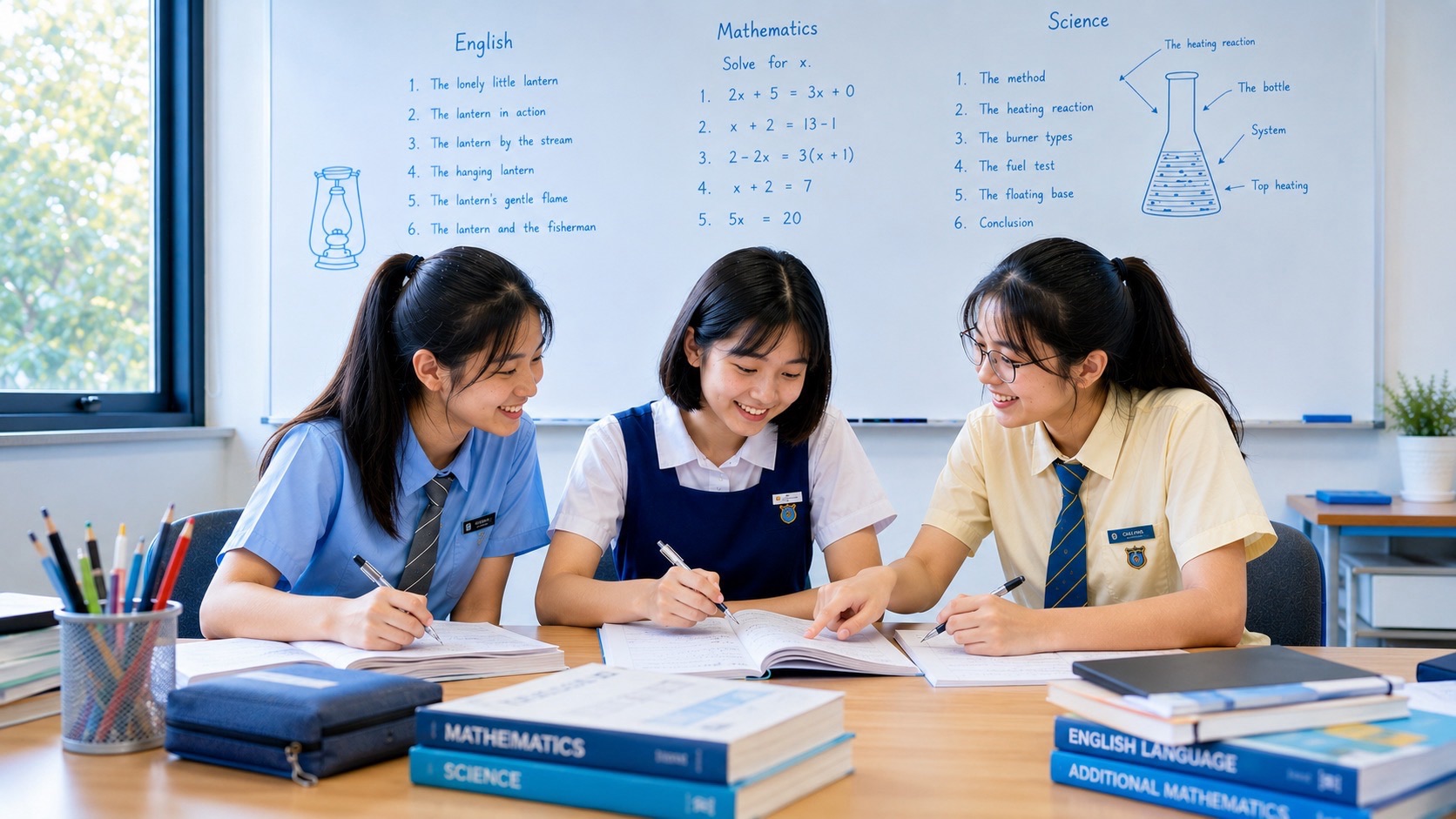
Tuition in Kaliningrad is often searched as репетитор Калининград, репетитор математика, репетитор по русскому языку, English or German lessons, and preparation for ОГЭ or ЕГЭ. Some families want to repair a learning gap; others are comparing school olympiads or seeking deeper humanities and science work. The correct decision is not simply which tutor has the longest list of former high-scoring pupils. It is what the child needs to understand and be able to do without continuous adult help.
A pupil may calculate a ratio correctly during a demonstration but fail when a similar relationship appears as a map scale. Another can summarise an historical passage yet cannot distinguish supported evidence from speculation. A third understands scientific vocabulary while being unable to interpret units on a graph. These are different learning problems and deserve different tutorials.
Kaliningrad’s educational setting includes a varied mix of languages, history, science and subject olympiads. The opportunity is to teach the pupil how ideas connect, not to make every student compete in every field.
This guide comes from eduKate Singapore. Our premium tuition groups contain three pupils and operate in Singapore, not Kaliningrad. We do not advertise an eduKate centre or local teaching staff in Kaliningrad Oblast. The principles can nevertheless help a family choose quality tuition in its own city.
The immutable tutorial reference is Secondary 1 Mathematics Tutor Clementi | Small Groups Tutorials. Its teaching spine is diagnosis before tuition, first principles, close feedback and independent learning continuity.
What sort of help is the family actually choosing?
Private subject tutoring, supervised homework, examination coaching and enrichment can look similar when listed in an advertisement. Their educational purposes differ.
A child who does not understand fraction equivalence needs concept teaching. A pupil who understands the material but makes repeated sign errors may need deliberate execution and checking practice. Another knows the current chapter but cannot organise revision and would benefit from a realistic routine.
A good first meeting begins with the child’s actual schoolwork completed without assistance. Ask the tutor to identify the first mistaken decision, explain its cause and choose the next task.
- Repair tuition teaches a missing concept and reconnects it to current work.
- Maintenance tuition strengthens retrieval, accuracy and method selection.
- Extension provides unfamiliar applications when readiness is secure.
- Homework help supports organisation without taking over the child’s tasks.
- Exam coaching uses current official specifications and acts on diagnosed errors.
An hour of responsive instruction can be more useful than multiple hours of passive copying. The quality of the child’s decisions matters.
Kaliningrad’s schooling: earlier ideas must survive later transitions
The usual Russian general-education progression consists of primary Grades 1–4, basic general education Grades 5–9, and senior general education Grades 10–11. The pupil’s actual institution and subject profile determine the appropriate curriculum and assessment pathway.
Primary maths develops number sense, fractions and the ability to explain a calculation. Middle school requires algebra, graph interpretation, geometry and longer problem statements. Senior students may need deeper mathematical reasoning, academic writing and preparation for qualifications.
The Kaliningrad City Administration provides school-education and olympiad information through its official website. A parent should use current school guidance and original teacher feedback rather than assume every secondary programme is identical.
The right tutor looks backwards to the prerequisite, forwards to the next chapter and sideways to other subjects that reuse the same skill. This protects learning continuity.
A 2026 municipal olympiad rule: there are many subject pathways
On 9 April 2026, the Ministry of Education of Kaliningrad Oblast approved the organisational and technological model for the municipal stage of the All-Russian School Olympiad. The model covers a broad set of subjects rather than just mathematics.
Its categories include mathematics, biology, physics, chemistry, economics, Russian, history, geography, law, languages, ecology, informatics and other disciplines. Informatics includes different profiles such as programming, information security, artificial intelligence and robotics.
The source is Kaliningrad Oblast Ministry of Education Order No. 401/1, 9 April 2026, in force from 20 April 2026. It is an organisational model, not a claim that every subject is available to every age or that private tuition guarantees access.
The city’s official olympiad task archive provides a 2026/27 selector with subject and stage categories. Families should check the actual event instructions, school eligibility and available tasks.
A strong tutor might use a past olympiad question to teach creative reasoning. But a child who cannot yet explain basic fractions may gain more from repairing that concept first. The best challenge fits readiness and interest.
The 2026 Grade 10 humanities opportunity
Kaliningrad Oblast also approved a 2026 regional humanities olympiad known as Умники и умницы Калининградской области. Its organising arrangements are separate from ordinary school exams.
The order dated 1 April 2026 describes participation by Grade 10 school pupils and links the programme to support involving Immanuel Kant Baltic Federal University.
See Kaliningrad Oblast Order No. 357/1, 1 April 2026. The fact that a regional humanities event exists does not mean it is an assessment every tenth-grader must take.
For a pupil interested in literature, history and social sciences, deeper reasoning may involve interpreting evidence, identifying the limits of a claim and building a coherent argument. More memorised facts alone are not necessarily the right preparation.
The tutor should ask whether a child is ready for enrichment or needs to strengthen ordinary reading and writing first. Both are valid educational needs.
ОГЭ 2027: official project documents and real learning gaps
FIPI published 2027 ОГЭ project demonstration papers, codifiers and specifications in August 2026. These describe proposed knowledge and task formats for Grade 9 candidates.
As of October 2026, the materials remain classified as projects. Tutors should check the official final versions and any relevant updates rather than assume all provisional details are already fixed.
The reference is the FIPI ОГЭ documentation page.
A maths paper can reveal a missing geometry concept, an incorrect equation, a misread chart or a copied sign. All may produce the same score loss, but the correction should differ.
The tutor should use an unaided diagnostic, teach the relevant principle and present a new question whose context is different. Timed practice then checks execution after understanding is available.
Exam technique is useful, but it should not conceal the fact that the learner still requires adult prompts to recognise the method.
ЕГЭ 2027: basic and profile mathematics are not interchangeable
The senior-school ЕГЭ mathematics examination has basic and profile variants, with different assessed content and depth.
FIPI’s 2027 ЕГЭ project materials provide demonstrations and specifications for the distinct maths levels. The current documents should be checked again when final versions are published.
Profile mathematics may involve advanced functions, geometry, transformations and longer reasoning chains. Basic mathematics requires preparation that fits its own qualification.
A younger student with weak fractional understanding does not automatically benefit from practising profile-level exam tricks. Early number relationships remain necessary in later algebra and graphical interpretation.
A thoughtful tutor should show the chain from the child’s current starting position to the assessed capability, and explain why each lesson is part of that chain.
A mathematics tutorial with fictional amber-pattern quantities
Kaliningrad’s association with amber creates a memorable setting for a classroom ratio problem. The values below are invented teaching figures and are not actual mineral measurements or commercial prices.
Imagine four identical model display strips holding a combined total of 72 paper amber-coloured tokens. How many tokens would seven equal strips contain?
One strip contains eighteen tokens, so seven contain 126. The relationship is proportional only because every strip contains the same number.
Now change the fictional arrangement. Four strips have eighteen tokens each, while the next three have only twelve each. The total is 72 + 36 = 108, not 126.
A pupil who simply repeats 72 divided by four and multiplied by seven will fail to notice the changed condition. The useful lesson is not harder arithmetic but recognising which rule fits.
Draw grouped strips, build a table and write T = 18n for the original equal-strip model. Ask the learner when that equation ceases to describe the total.
Reverse the question: nine equal strips contain 162 tokens. The pupil should explain the method rather than memorise the numerical answer.
This is a hypothetical classroom model, not information about actual amber products.
A Baltic Sea map: decimals, ratio and model limitations
Consider an imaginary map inspired by the Baltic coastal setting. The map uses a fictional scale of one centimetre representing 250 metres. It is not a real navigation chart.
If a line is 6.4 centimetres long, the represented distance is 6.4 × 250 = 1,600 metres. A student should convert this to 1.6 kilometres and explain the relation among the units.
Now change the scale so one centimetre represents 400 metres. The same 6.4-centimetre line represents 2,560 metres. Repeating the earlier answer would show failure to recognise the changed model.
Express the first relation as d = 250m, where m is map length in centimetres and d the represented metres. Create a table and ask the learner to reverse the calculation.
A map distance alone does not establish journey duration. The learner would need additional information about route and speed. Recognising that limitation is part of mathematical and scientific judgement.
The purpose is understanding a model and its assumptions, not making claims about actual Kaliningrad travel.
A third model: fixed cost and variable cost
Imagine a fictional educational materials service that charges a fixed 45 units plus 15 units per item. Its base formula is C = 45 + 15n.
For zero, one, two and four items, the totals are 45, 60, 75 and 105. Why does the graph begin at 45 rather than zero? Because the fixed amount remains even when n is zero.
Now introduce an invented discount of twenty units when at least four items are included. The original formula still provides a base cost but not the final payment in every case.
Reverse the base formula: when C is 135 units, solve 45 + 15n = 135 to obtain n = 6. Then ask what the discount would do to the actual charge.
These are imaginary classroom costs, not actual local service prices. The student is learning fixed and changing quantities, equation interpretation and conditional reasoning.
Fractions to algebra: why balancing matters
A child may know 3 × 8 = 24 and feel uncertain when the same relationship is written as 3x = 24.
Draw three equal groups totalling twenty-four, so each contains eight. Then explain why dividing both sides of the equality by three preserves the relationship.
Now introduce 3(x + 2) = 30. Three identical groups each contain x plus two. Dividing by three gives x + 2 = 10, so x = 8.
A memorised phrase like moving the three across the equals sign may lead to a correct answer in one easy example but conceal the reasoning. With fractions, negatives and brackets, that weakness becomes serious.
Ask the pupil to check by substitution and solve a different example without prompts. Sometimes a return to primary fraction models is the most efficient path to more secure secondary algebra.
More is explained in How Mathematics Works at eduKateSG.
The real problem hidden behind one school mark
A mark compresses the learner’s many skills into one number. Two Kaliningrad pupils with the same result may need entirely different tuition.
One lacks fraction equivalence. Another understands but cannot translate a worded comparison into the correct equation. A third can choose the right method but copies a sign incorrectly.
At eduKate we use learning continuity to describe how earlier concepts remain available and properly linked across topics, time and representations.
- Missing node: a prerequisite is unavailable.
- Broken edge: two familiar concepts cannot be joined.
- Weak link: a method works only in easy examples.
- Wrong rule: a shortcut is used outside its conditions.
- Routing problem: the student cannot select the method.
- Translation difficulty: words, graphs and equations do not align.
- Execution difficulty: signs, arithmetic or units spoil sound reasoning.
- Transfer problem: a changed context defeats the practised skill.
- Calibration gap: an implausible answer goes unchecked.
A good tutor asks for the pupil’s first unaided decision, listens to the explanation and changes the representation. The point where reasoning fails identifies the teaching target.
Russian literature and history: evidence should support the claim
Kaliningrad’s complex history can motivate meaningful reading and historical source work, but actual claims about the past should be supported by reliable evidence rather than a tutor’s improvised story.
Imagine the pupil writes, ‘The narrator was trustworthy.’ Ask what the narrator said, which details support the judgement and whether other information complicates it.
The paragraph should contain a claim, relevant evidence and a clear explanation. Adding more elaborate vocabulary cannot repair missing logic.
In history, the tutor can ask the learner to distinguish a documented event from an inference, place events in chronology and explain the relationship among causes and outcomes.
Use another passage or source after teaching the method. The pupil should produce a justified response without copying the first worked example.
English, German and other foreign languages
Kaliningrad’s municipal olympiad model includes different foreign-language subjects. But a pupil’s tutoring plan should follow the language actually studied and the current school curriculum.
An English learner may know that ‘although’ introduces contrast while connecting two sentences that do not actually contrast. A tutor should teach the function and ask for a new correct example.
A German learner may face a parallel problem with a connector such as obwohl. The target remains accurate communication, grammar and contextual meaning.
Vocabulary should be practised through examples, comparison, original sentence production and retrieval after a delay. A word list alone does not demonstrate independent language use.
International-school or specialised courses require their own relevant materials and should not be treated as identical to a routine foreign-language syllabus.
Science: ask what the evidence actually shows
A pupil can name a scientific process without being able to explain a new experiment. Consider two imaginary comparable plants exposed to different light conditions.
What changes? What should remain constant? Which observation would be measured, and what mechanism might explain it?
The student should connect conditions to a prediction and evidence, rather than repeat a polished scientific definition.
Science also requires mathematical graphs, proportions, units and clear writing. A weak graph scale can masquerade as a science difficulty even when the mechanism is understood.
A useful second question changes the experimental conditions to see whether the learner can still reason.
Informatics and robotics: the condition behind the code
The 2026 Kaliningrad municipal olympiad model explicitly includes multiple informatics profiles, including programming, robotics, information security and artificial intelligence.
For a school learner, the transferable foundation includes mathematical logic, attention to conditions and the ability to test a method at boundary cases. A tutor should not confuse memorised programming syntax with reasoning.
Imagine a fictional program in which a discount applies only when the quantity exceeds five. At five there is no discount; at six there is. Ask the pupil to show the rule in words, a table, a flowchart and pseudocode.
A program that fails at exactly five may reveal a logical comparison error rather than a missing command.
A strong tutor develops the student’s ability to debug reasoning rather than randomly change code until the result looks correct.
Why eduKate uses three-pupil premium tutorials
At eduKate Singapore, our premium teaching design groups three students. The tutor can examine each child’s working, ask frequent questions and correct individual errors while pupils compare alternative methods.
This is not an offer of classes in Kaliningrad. Families can use the same quality standards to compare local one-to-one tutors, small groups and online sessions.
One-to-one tuition can suit unusual gaps or individual pacing. A carefully matched group can support peer explanations. Online teaching works when pupils show genuine working and receive live, targeted feedback.
The quality of interaction matters more than the number printed in an advertisement. The learner must think, attempt and gradually need fewer prompts.
The learning cycle inside every purposeful tutorial
- Retrieve an earlier idea without announcing the method.
- Explain the missing principle with a simple accurate example.
- Let the pupil make an unaided attempt.
- Correct the cause of the mistake, not just the answer.
- Test an unfamiliar variation and withdraw hints.
- Return to the skill after a delay.
A pupil who can repeat the original answer while it is visible has not necessarily acquired the skill. Independent method choice after a delay is more convincing evidence.
Repair, maintain and progress: different teaching jobs
Repair rebuilds an earlier prerequisite and reconnects it to present schoolwork.
Maintain uses spaced retrieval, mixed practice and careful checking to stabilise what the pupil already knows.
Progress offers deeper challenges, different methods and unfamiliar applications for a learner who is ready. Acceleration without a secure foundation can create more gaps.
These routes are decisions about what to teach now, not permanent labels of a child’s ability.
A six-week parent plan for Kaliningrad
- Week 1: examine original unaided work and identify one recurring error.
- Week 2: repair the missing prerequisite.
- Week 3: change the representation and test method choice.
- Week 4: retrieve the earlier idea without hints.
- Week 5: mix old and new topics with appropriate exam-format work.
- Week 6: compare independent attempts with Week 1 and decide whether to continue, adjust or reduce support.
Look for better explanation, fewer prompts and more accurate self-checking, not merely more completed pages. Leave time for school, rest, reading and independent practice.
Questions to ask a Kaliningrad tutor
- Which exact grade, subject and current school programme do you teach?
- Can you explain one mistake from the child’s unaided working?
- Do you use current FIPI requirements for ОГЭ or ЕГЭ?
- If olympiad work is the goal, do you understand the correct age and subject eligibility?
- How do you distinguish a reading problem from a mathematical gap?
- How will you test retrieval and transfer after a week?
- What are the qualifications, safeguarding arrangements, group size, fees and cancellation terms?
Ask when tuition could reduce or end. A successful programme should make the student increasingly independent.
Frequently asked questions about tuition in Kaliningrad
Does every child need competition tutoring? No. It is optional enrichment for students with suitable interest and readiness.
Does Kaliningrad’s 2026 municipal olympiad order mean all subjects have identical procedures? No. It defines a regional organisational model. Eligibility and schedules must be checked for the specific subject.
Are the 2027 FIPI examination documents final? In October 2026 they are project materials and later final versions should be checked.
Can an invented amber or Baltic map example help maths? Yes, when its teaching quantities are accurate and distinguished from real measurements or prices.
Does eduKateSG operate a Kaliningrad tuition centre? No. Our premium three-pupil tutorials are Singapore-based.
Official sources and further reading
- Kaliningrad Ministry of Education: 9 April 2026 municipal olympiad model
- Kaliningrad city: 2026/27 olympiad task archive
- Kaliningrad 2026 Grade 10 humanities olympiad order
- FIPI: 2027 ОГЭ project specifications
- FIPI: 2027 ЕГЭ project specifications
- eduKateSG: How Mathematics Works
- eduKateSG: immutable Clementi tutorial reference
Year-specific school requirements and later examination changes should be confirmed with the pupil’s institution and responsible authorities.
Tuition | Kaliningrad: help the pupil own the method
The strongest tutor makes unfamiliar questions easier to understand. A fictional amber-strip model becomes proportional reasoning. A Baltic map becomes a ratio and units exercise. A historical paragraph becomes evidence-based interpretation, and a programming rule becomes clear logical reasoning.
For a child who is behind, repair the missing connection. For one who is coping, maintain it. For one ready for more, extend thoughtfully.
The educational result is the child who can choose, explain and check the next step without waiting for the tutor.
Less noise. More structure. Better learning continuity. Explore eduKateSG’s immutable tutorial reference and the nearby Tuition | Veliky Novgorod guide.