
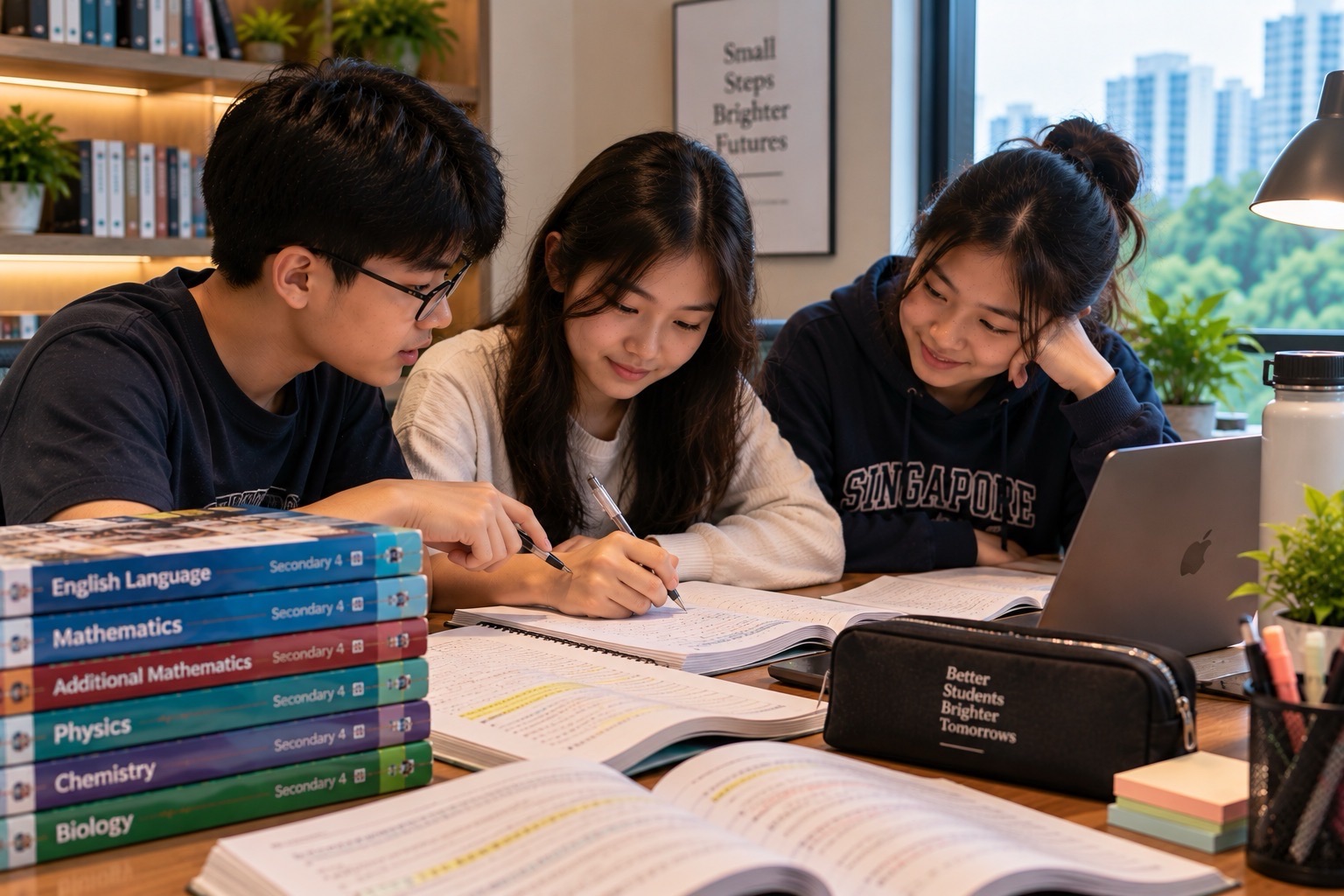
A student in Khor Fakkan may know the formula for a circle, understand how a fraction works and recognise an equation, yet become confused when a question asks about an arc or a sector. The problem is not necessarily a lack of effort. The child may be missing a connection between the geometric picture, the language of the question and the arithmetic used to answer it.
Parents comparing Mathematics tuition in Khor Fakkan, English tutors, Arabic lessons, Science support, home teaching or small-group tutorials should ask a practical question: what can my child now explain and solve without hints that was difficult before the lesson? A tutor who diagnoses the first misunderstanding can make a focused hour more useful than many routine worksheets.
This eduKate Singapore editorial guide is for families considering local tutoring in Khor Fakkan, Sharjah, United Arab Emirates. It does not claim that eduKate operates a physical teaching centre there. Our premium Singapore tutorial model deliberately uses three learners in a small group, with diagnosis before tuition, first-principles teaching, feedback and independent checking. Those are practical standards parents can use wherever their child studies.
Khor Fakkan offers a striking way to begin a geometry lesson
Sharjah’s official tourism authority describes Khor Fakkan’s amphitheatre and adjacent waterfall as well-known East Coast landmarks. The amphitheatre is inspired by Roman architecture, and the tourism authority describes the nearby waterfall as a constructed feature.
The authority reports an amphitheatre covering over 1,700 square metres and accommodating over 3,500 spectators, together with a man-made waterfall 45 metres high. These are published descriptions of the venue, not classroom dimensions.
A photograph of a curved amphitheatre can make a child curious about circles, arcs, sectors and symmetry. But the teacher should not treat the visible structure as a perfect geometric circle without evidence, or derive actual safety capacities from a simplified formula.
The tutor can use a clearly fictional circular diagram to teach the mathematical relationship, then ask the learner to solve a fresh example.
The place makes the concept interesting. Independent reasoning makes it educational.
Private-school curriculum matters in Khor Fakkan
Khor Fakkan is within Sharjah emirate, where the Sharjah Private Education Authority, or SPEA, regulates private schooling and oversees curriculum and assessment standards.
SPEA’s published school calendars distinguish schools following Indian and Pakistani curricula from other private-school curriculum categories. Its 2026–2027 calendar is a useful reminder that exam schedules, breaks and school years can vary.
For tuition, the teacher should identify the actual programme, year group, current textbook, language of instruction and examination requirements before setting work.
A British-curriculum child encountering circle geometry may need different presentation or timing from another pupil whose school approaches the topic in a different sequence.
Ask the tutor to map a proposed first lesson to the child’s course. A generic claim to teach “all subjects at all levels” cannot replace a concrete demonstration of fit.
A geometry mark can conceal different errors
Imagine two pupils who both lose marks on a circle question. The first confuses radius with diameter and uses twice the correct radius. The second identifies the radius correctly but reports an area result in centimetres rather than square centimetres.
The same score hides different difficulties. The first learner needs concept and diagram interpretation. The second needs a stronger understanding of the type of quantity being measured.
A third student may know both concepts but misread whether the question asks for a sector’s area or the length of its arc.
Good tutoring inspects the original working and asks what the pupil thought was being calculated.
A precise target such as “can find circumference but confuses arc length with sector area” is teachable. “Weak at geometry” is not a complete diagnosis.
A first consultation built around three questions
Start with a familiar school question the child can solve. Ask for an explanation of why the method works, not simply the formula’s name.
Next inspect one original wrong attempt. Which part of the diagram was labelled incorrectly? Was an older fraction concept missing? Did the learner choose the wrong measurement?
Then provide a new question at the correct level without announcing which formula to use. Watch how the child identifies the quantity requested and begins independently.
The tutor should avoid completing every step immediately. The first student attempt is valuable evidence.
A parent can then ask for one or two learning targets and a six-week review plan. The consultation should produce clarity rather than another reason for a pupil to fear mistakes.
A fictional amphitheatre circle: radius and diameter
Imagine an invented classroom diagram of a perfect circle with radius six centimetres. This is not a floor plan or measured dimension of Khor Fakkan Amphitheatre.
Its diameter is twelve centimetres, twice the radius.
The circumference is 2πr, or 12π centimetres. The area is πr², or 36π square centimetres.
A tutor should ask why the area and circumference results use different units. Circumference measures a boundary length; area measures the region inside.
Now double the radius to twelve centimetres. The circumference doubles to 24π, but the area increases fourfold to 144π.
A pupil who assumes that doubling every length simply doubles every measurement has discovered an important misconception.
Explain the relationship through diagrams and a fresh circle without the original numbers.
A sector is part of a whole circle
A complete turn contains 360 degrees. If a fictional circle is divided into four equal sectors, each central angle is ninety degrees.
For the invented circle of radius six centimetres, the full area is 36π square centimetres. One quarter of it is 9π square centimetres.
The tutor should connect the geometric fraction 90/360 with one quarter of the area.
Now change the sector angle to 120 degrees. The fraction is 120/360, or one third. The corresponding sector area is 12π square centimetres.
The learner should explain why this follows from part–whole reasoning rather than memorise a special formula for each angle.
Then use an unrelated circle diagram with a new radius and angle. That independent response proves more than copying the first example.
Arc length and sector area are different
In the fictional radius-six circle, the circumference is 12π centimetres. A ninety-degree arc is one quarter of the boundary, or 3π centimetres.
The ninety-degree sector’s area is 9π square centimetres. Both involve a fraction of a whole circle, but the quantities differ.
The tutor can ask the child to trace the arc with a finger, then shade the sector. One represents length; the other represents area.
If a question asks for the entire perimeter of a sector, it may also include two radii. For this ninety-degree sector, the total perimeter is 3π + 12 centimetres.
A pupil who reports 9π centimetres for the arc may be using the wrong whole.
A new sector question should check whether the learner can identify the requested measurement independently.
Angles become fractions, ratios and algebra
Suppose a fictional design contains three angles around a point in the ratio 2:3:5. The complete angle is 360 degrees.
There are ten equal ratio parts, so one part equals thirty-six degrees. The three angles are seventy-two, 108 and 180 degrees.
Let x represent the size of one part. The equation is 2x + 3x + 5x = 360, giving x = 36.
The tutor should connect the ratio bar with the equation and ask what x represents.
Now change the ratio to 1:3:4. The child should divide 360 by eight, then find the new angles independently.
This is not just a geometry drill. It connects arithmetic proportions with symbolic algebra and spatial reasoning.
A diagram must match the written conditions
A student may draw an angle that looks like ninety degrees and then assume it is exactly a right angle. A diagram is not always drawn to scale.
A tutor should ask what the question explicitly states. Is there a right-angle marker or a written condition? Is the angle a measured value or only visually suggested?
Similarly, a curved amphitheatre photograph does not provide all the geometric details needed to calculate a genuine area.
A good learner distinguishes an illustrative picture from a defined mathematical model.
Now give two fictional diagrams: one with a right-angle marker and another that merely looks square. The student should explain what can be concluded from each.
This habit helps students avoid treating visual impressions as mathematical proof.
A percentage change has a different base each time
Consider a fictional event-worksheet quantity of 200 units that increases by 20%, reaching 240. A later 20% decrease leaves 192, not 200.
The second change uses 240 as its base. The combined multiplier is 1.20 × 0.80 = 0.96.
A child who expects the changes to cancel may be confusing equal percentage changes with equal absolute changes.
A tutor can compare the result with adding forty units and then subtracting forty, which would return to 200.
Now reverse the increase task. If 240 is 120% of the original, the original is 240 ÷ 1.20 = 200.
These amounts are invented teaching numbers, not ticket prices, real event attendance or venue revenue.
The learner should name the relevant whole before calculating.
Do not confuse official capacity figures with a Maths model
Sharjah’s tourism authority reports that Khor Fakkan Amphitheatre can accommodate over 3,500 spectators and covers over 1,700 square metres.
A pupil might divide those rounded reported values and claim to have calculated exact usable seating space per person. That would not be justified. The quoted area and capacity do not by themselves give the geometry of individual seats, corridors, exits or circulation space.
A tutor can use this as a lesson in reading the source before calculating. Are the values exact or rounded? What does the area include? Is the question asking for an estimate or an engineering conclusion?
For a legitimate Maths problem, invent a separate classroom hall with explicitly defined dimensions and seat counts.
That separates sourced facts from the quantities necessary for a well-posed school exercise.
A fictional seating chart teaches rows and arithmetic sequences
Imagine a made-up school auditorium with five rows of seats: eight in the first row, ten in the second, twelve in the third, fourteen in the fourth and sixteen in the fifth.
There are sixty seats in total, because 8 + 10 + 12 + 14 + 16 = 60.
Ask the learner what pattern connects the rows. Each new row has two more seats than the previous.
For an older student, the number in row n can be expressed as 8 + 2(n − 1). Row six would contain eighteen seats under that fictional rule.
Now change the starting number and difference. Can the pupil construct the new sequence without relying on the previous example?
These are invented classroom numbers, not real seating arrangements at the amphitheatre.
From arithmetic sequences into graphs
Let n represent the row number in the fictional auditorium and s the number of seats. The rule s = 2n + 6 gives eight seats for row one, ten for row two and so on.
A tutor can build a table and plot the sequence as points. The gradient-like rate is two additional seats per row.
But the row number is discrete; a row numbered two and a half does not exist in the same physical interpretation. The points have meaning at whole-number inputs.
This is a useful moment to discuss how a mathematical rule and its context fit together.
Now introduce a different fictional sequence with three additional items in every new group. Can the learner identify a rule and explain its domain?
The aim is to understand patterns rather than mechanically draw a continuous line in every context.
The waterfall as an observation, not a rate measurement
The Sharjah tourism authority describes the adjacent Khor Fakkan waterfall as man-made and approximately forty-five metres high.
A pupil may be tempted to calculate how long water takes to reach the bottom from its height alone. A real artificial waterfall includes engineering and flow arrangements that the tourism description does not specify.
A tutor should explain that a school mechanics calculation requires an explicitly defined model with assumptions, such as a simplified free-fall scenario taught at the relevant level.
A general Science lesson could instead ask what information is missing before making a claim: source of water, movement, flow rate and observation conditions may matter.
The distinction between a sourced height and a complete physical model is valuable critical thinking.
A real landmark makes a question engaging, but a formula should not be applied without the conditions it needs.
A fictional flow-rate example
Imagine an unrelated classroom tank receiving six litres of water per minute at a constant rate. It begins with ten litres.
The mathematical model is V = 6t + 10, where V represents litres and t minutes.
At zero minutes the tank contains ten litres; after one minute sixteen; after two minutes twenty-two.
The tutor can plot the data and ask what the gradient and intercept mean. Six is a rate in litres per minute; ten is the starting volume.
Now change the rate to four while keeping the starting ten. The new graph rises less steeply but starts at the same point.
These are entirely invented numbers, not water-flow measurements or operating instructions for Khor Fakkan’s constructed waterfall.
A new context should test whether the student can interpret a linear model independently.
Averages need a careful interpretation
Imagine four fictional classroom performance counts of ten, twenty, thirty and forty. Their mean is twenty-five.
A second set of twenty-five, twenty-five, twenty-five and twenty-five also has mean twenty-five, but no variation.
The first set’s range is thirty; the second set’s range is zero.
A child who knows only the average formula may not realise what the mean hides. The tutor can use two bar charts and ask which statements describe both groups accurately.
Then change the context to Science observations, reading times or fictional seat counts.
A student who can interpret a new dataset has developed statistical understanding beyond arithmetic.
Scale drawings and area are not interchangeable
Imagine a fictional rectangular plan measuring four centimetres by three centimetres on paper, with one centimetre representing five metres.
The model dimensions are twenty by fifteen metres, giving area 300 square metres. The paper area is twelve square centimetres.
A pupil who multiplies twelve by five and reports sixty has applied the length scale to area incorrectly.
The tutor should show that both lengths are multiplied by five, producing a numerical area factor of twenty-five with appropriate unit conversion.
Now change the length factor to three. The area factor becomes nine.
The student should explain why before computing a new example. This structural connection helps with geometry far beyond one imagined building plan.
A bracket mistake can disrupt later algebra
Consider 3(x + 4) and 3x + 4. The first contains three groups each with x plus four; the second adds four once outside the three x groups.
The correct expansion of 3(x + 4) is 3x + 12.
A tutor can draw three groups to make the difference visible. Then ask for 2(y − 5), which expands to 2y − 10.
If the learner writes 2y − 5, the same misconception has returned. The tutor should revisit grouping rather than simply assign harder equations.
A fresh independent expansion shows more than a copied correction.
The meaning of brackets will matter in algebra, formulas and later functions.
A fraction bar changes what is grouped
Compare x/3 + 5 = 11 with (x + 5)/3 = 11.
For the first equation, subtract five to get x/3 = 6, giving x = 18.
For the second, multiply both sides by three to obtain x + 5 = 33, giving x = 28.
The two equations look similar but group the quantities differently.
A tutor can ask the pupil to translate each into words and explain what the fraction bar covers.
Then use a changed pair of equations without prompts. This connects fraction knowledge from earlier school stages to algebraic manipulation.
An independent answer suggests that the mental structure is becoming more secure.
Science: changing state and explaining it
A child sees a wet surface drying and writes that the water disappeared. A tutor can explain evaporation at the appropriate level: liquid water can enter the surrounding air as water vapour.
Drops forming on the outside of a sufficiently cool glass can involve the reverse type of change, condensation from vapour to liquid.
The pupil should distinguish what is observed from the mechanism that explains it.
Then change the scenario to a mirror becoming misty after a warm shower or a shallow dish gradually losing water.
Can the student choose the relevant process independently?
That is a more reliable measure of Science understanding than remembering two definitions in isolation.
Science experiments require fair comparisons
Imagine two fictional dishes containing equal initial quantities of water, one with a larger exposed surface area.
A tutor should ask which other conditions ought to remain as similar as possible: temperature, air movement, humidity, container material and observation interval can influence the outcome.
The student identifies the variable changed and the quantity measured.
A hypothetical result may support a proposed explanation under those conditions, but it does not establish that one factor explains all evaporation everywhere.
Now change the experiment to plant growth or material absorbency. Can the child identify the relevant variables without a list supplied by the tutor?
This is a transferable Science skill.
English comprehension: similar words, different evidence
A pupil reads that a waterfall is man-made and writes that the tourism source describes a completely natural cascade.
The problem is not advanced vocabulary; it is the loss of a key qualifier in the source.
A tutor can teach the learner to identify what the text states directly, what it merely suggests and what it does not say.
Then examine the question’s command word: describe, explain, compare and evaluate require different reasoning.
A fresh passage about a fictional school event should test whether the student selects accurate evidence without copying the original example.
Careful comprehension protects both factual accuracy and the quality of written explanations.
Writing a paragraph that makes a point
Consider the draft: “The amphitheatre is big. It is interesting. People enjoy it.” These statements do not yet explain a specific question.
A tutor can ask the learner to make a precise claim grounded in the supplied source and choose one relevant detail.
For example, a passage might describe a purpose-built performance venue with a specified audience capacity. The student can explain how the venue serves cultural events without inventing exact attendance at an unspecified performance.
The paragraph should contain a point, evidence and explanation. More sophisticated vocabulary can come after the reasoning is sound.
Now change the subject to a school Science experiment. Can the learner apply the same structure without a model paragraph?
Good writing tuition builds control of thought and language together.
Arabic comprehension: identify the skill the child needs
Arabic tuition may mean fluency, vocabulary, grammar, comprehension, composition or literary interpretation. These are connected but different learning targets.
A learner may read a passage accurately and still struggle to summarise the central idea. Another may understand the passage orally but write an incomplete answer in the required school register.
The tutor should inspect real schoolwork and ask for a short oral explanation before deciding which aspect needs teaching.
A guided response can identify the main point, select relevant details and express them concisely.
Then present a new passage and reduce hints. The independent answer is a better sign of learning than a polished paragraph copied from the tutor.
What a three-student tutorial changes
At eduKate Singapore, premium small-group tutorials contain three pupils. One may interpret the sector problem through fractions, another by shading a diagram and a third using an equation.
The tutor can compare those approaches while observing individual written work.
Peer explanations can be helpful, but discussion alone does not prove mastery. Every child should attempt a fresh geometry question independently.
Khor Fakkan parents choosing local small groups should ask how often every learner receives personal feedback and how a teacher notices quiet confusion.
Three students is a deliberate structure for attention, not a magic guarantee.
When individual tuition may be useful
Private tutoring can help a learner who needs intensive foundation repair, highly individual pacing or privacy when discussing mistakes.
But one-to-one is only effective when the child does significant thinking. Watching the tutor solve every question can create a neat notebook and fragile understanding.
Ask what the pupil tries first, how the teacher responds and whether a changed question is completed without hints.
The same concept should be checked after several days. If it has faded, the tutor should revise the explanation or retrieval plan.
A good private tutor aims to make assistance less necessary for the target skill.
Home tutoring, online learning or a centre
Home tuition can reduce journeys where a quiet study area is available. Online tutorials can work when teachers see original student calculations, diagrams and written answers and respond to mistakes.
A centre may provide structure and peer interaction, but transport and fatigue are part of the weekly cost.
The learner needs active practice in any format: reading the question, selecting a method, explaining a result and checking independently.
A polished presentation is not proof of learning. Parents should ask what unfamiliar task the student can now solve alone.
Choose a sustainable arrangement that supports the actual curriculum and pupil.
What a purposeful ninety-minute lesson includes
An illustrative session begins with short retrieval from earlier topics. The child works without seeing the old example.
The tutor then explains one important connection, such as the relationship between a fraction of 360 degrees and a circular sector.
Guided practice follows, with hints reduced as the pupil becomes more secure. Then the learner solves a changed problem independently.
Mixed practice combines prior and current material so the child must select the method without a chapter heading.
Finish with an error review and a manageable task for another day. The timing should adapt to age and readiness.
The goal is an observable change in capability, not simply an hour and a half of answered worksheets.
Repair, maintain and progress
Repair: A missing prerequisite blocks current learning. The tutor identifies it, teaches it and reconnects it to schoolwork.
Maintain: The pupil understands but performs inconsistently. Spaced retrieval, careful working and mixed questions build reliability.
Progress: A secure learner is ready for deeper reasoning, alternative methods and unfamiliar applications rather than racing mechanically through future chapters.
A child may need repair in fractions while progressing in English reading. The pathways describe specific skills, not the child’s entire ability.
A responsible tutor updates the route when independent work demonstrates readiness.
A six-week review instead of an indefinite promise
Week 1: Confirm the correct syllabus and record one or two targets from original student work.
Week 2: Teach the missing prerequisite using a clear model.
Week 3: Reconnect the idea to the current topic and begin reducing prompts.
Week 4: Check retrieval after several days without displaying the original answer.
Week 5: Change the numbers, diagram or context. The pupil chooses the method independently.
Week 6: Compare the fresh unaided response with the baseline and decide whether tuition should continue, change or reduce.
This is an accountability framework, not a promise of a particular examination mark in six weeks.
The parent’s evidence should be what the child can now do without help.
A useful progress note is specific
A tutor might write: “The student calculated the full circle’s area correctly but used that formula when asked for arc length. We traced the boundary and shaded the sector to distinguish the quantities, then checked a new diagram independently.”
This tells the parent the original misconception, teaching response and unaided result.
“Completed the circles chapter” reports activity, not capability.
A later lesson should check whether the distinction remains secure after a delay. If not, the retrieval or explanation should change.
Honest progress reporting helps families decide when extra teaching is still worthwhile.
Leave room for a reasonable schoolweek
Khor Fakkan families may balance school, homework, journeys, languages and other commitments. Additional tuition should not automatically fill every available evening.
A focused session and two short independent retrieval attempts on different days may suit some learners. Examination candidates may need longer mixed or timed practice according to readiness.
The child must practise using ideas without the tutor present. A thick workbook completed with continual adult guidance may hide continuing dependence.
Protect sleep, reading, family time and rest. A sustainable learning rhythm matters across school years.
Questions to ask a Khor Fakkan tutor
- Which actual curriculum, year group and assessment will you follow?
- What original student work will you inspect before choosing the topic?
- How do you distinguish a circle-geometry concept gap from a calculation slip?
- Will the child solve a different diagram independently after teaching?
- How do you connect fractions, angles, arc length, sectors and algebra?
- Can you explain what a fictional model assumes and what a source genuinely establishes?
- In a small group, how does every learner receive individual feedback?
- When would you recommend reducing or ending tuition?
Specific teaching demonstrations offer parents more than broad promises of grades.
When extra tuition may not be needed
A child who understands schoolwork, studies independently and progresses reliably may not require another academic class. Enrichment can be worthwhile with a clear target, but it should not be automatic.
If the pupil is exhausted by an overloaded timetable, more classes may remove time needed for consolidation. Broader concerns outside subject tutoring may call for school staff or appropriately qualified professionals.
A responsible tutor can recommend less support when the original gap is secure.
The purpose is independent capability, not permanent reliance on another lesson.
Frequently asked questions about tuition in Khor Fakkan
Does Sharjah’s private-school regulator cover Khor Fakkan?
Yes. Khor Fakkan is in the Emirate of Sharjah, and SPEA oversees the private education sector. Parents should check the child’s curriculum and the relevant school calendar.
Can the amphitheatre help teach geometry?
Yes, as a visual opening. Actual architectural measurements should not be inferred from a photograph; the worked circle and sector dimensions in this article are fictional.
Is the Khor Fakkan waterfall natural?
The official Sharjah tourism authority describes the nearby landmark waterfall as man-made. A tutor should preserve that distinction when discussing the source.
Is one-to-one always better than a group of three?
No. Individual lessons can suit intensive repair, while a well-managed small group offers peer explanations and individual checking.
Are past examination papers enough?
No. They support format familiarity and timing but do not repair every underlying concept.
What should parents observe before test scores improve?
Look for correct method selection, more precise explanations, appropriate units, independent starts and delayed recall.
When should tuition end?
When the agreed learning target is secure and the child can retain and apply it without repeated prompts, reducing or ending support may be sensible.
Official sources and the eduKate teaching route
The Sharjah Tourism guide to Khorfakkan Amphitheatre and Waterfall provides the landmark description and published measurements. SPEA’s curriculum and examinations department and official school calendars provide school regulation context. The circle dimensions, seat sequences, water-flow quantities and classroom calculations here are fictional and do not describe the venue’s engineering or operating arrangements.
The immutable eduKate reference is Secondary 1 Mathematics Tutor Clementi | Small Groups Tutorials. Continue with Tuition | Sharjah, Tuition | Fujairah and How Mathematics Works.
eduKate Singapore’s physical premium three-student tutorials operate in Singapore, not Khor Fakkan. The standard worth seeking anywhere is diagnose the learner’s starting position, teach the missing connection and check an unfamiliar problem independently.