
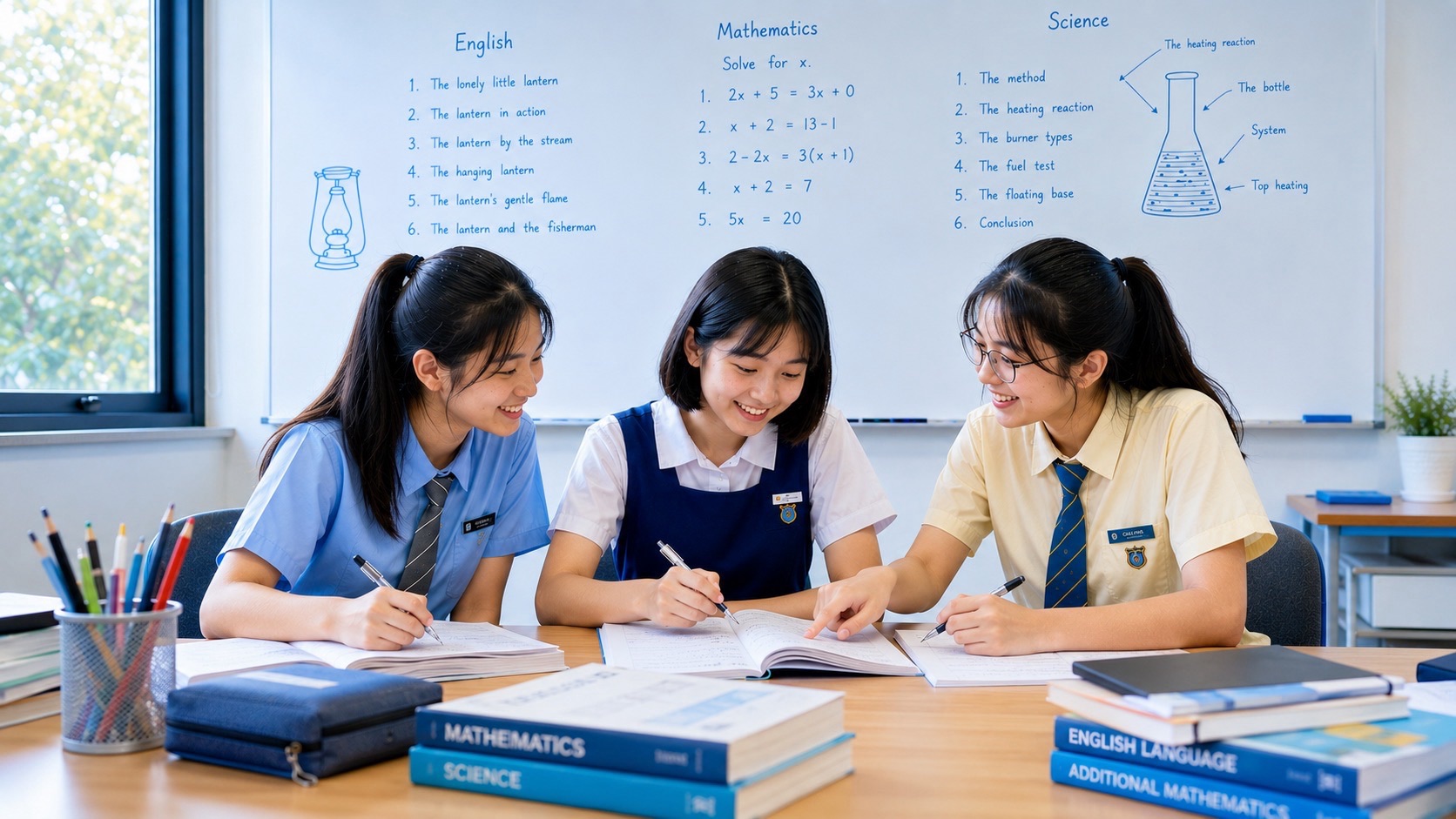
Tuition in Saint Petersburg is often searched as репетитор Санкт-Петербург, репетитор по математике, подготовка к ОГЭ СПб or подготовка к ЕГЭ СПб. A parent may also need English tutoring, Russian-language help or science tutorials. The first useful decision is not how many questions the tutor can assign. It is which part of the pupil’s learning needs to become reliable.
One pupil can manipulate a familiar equation but does not understand why the operation preserves equality. Another can recall a poem yet cannot support an interpretation with textual evidence. A third has strong subject knowledge and needs more accurate exam execution rather than a repeat of the whole syllabus.
These are different needs. The tutor should begin by examining original schoolwork and asking the student to explain the first step. A teaching plan built around an observed misconception will be more useful than simply promising a certain number of practice papers.
This guide is written by eduKate Singapore. Our premium three-pupil tutorials operate in Singapore, not Saint Petersburg, and we do not claim a local eduKate centre or offer in Russia. We share the teaching philosophy so families can make better decisions about appropriate local tutoring.
Our immutable instructional reference is Secondary 1 Mathematics Tutor Clementi | Small Groups Tutorials. It demonstrates why close observation, small-group dialogue, first-principles explanation and independent transfer deserve attention before exam speed.
Private Lessons, Homework Help and Exam Preparation: Know the Difference
A Saint Petersburg family can find individual tutors, small groups, online courses and examination academies. These formats describe how teaching might be delivered, but do not establish what the student will actually learn.
A subject tutor repairs understanding: fractions, algebra, literary interpretation or scientific reasoning. Homework help can make assignments manageable while building organisational habits. Assessment coaching develops familiarity with a specific examination structure and disciplined checking.
A child who knows how to solve an equation but loses marks through signs needs targeted accuracy practice. One who cannot explain the equation needs an earlier conceptual lesson. Both may have identical marks, so the tutor must inspect the working.
Ask the provider to demonstrate a short repair using one authentic mistake. The strongest explanation ends with the child trying a changed question without a prompt.
- Subject tuition: teach a missing principle or misconception.
- Homework help: support independent task completion and study routines.
- Exam preparation: use current official specifications, not unsourced predictions.
- Extension: develop deeper reasoning for a pupil who is ready.
The School Journey in Saint Petersburg
The standard Russian school framework includes primary grades followed by basic general education through Grade 9, and upper-secondary study through Grade 11 where applicable. Pupils may follow general or specialised pathways according to school arrangements.
The primary-to-secondary shift brings more symbolic mathematics, precise Russian academic language and specialised science. Older students also make decisions about subject depth, further education and the qualifications needed for their intended programmes.
For many Grade 9 candidates the relevant state final assessment is ОГЭ, while Grade 11 students preparing for higher-education applications may need ЕГЭ. These are not simply the same examination with harder numbers.
Saint Petersburg has its own regional assessment organisation and information services. A parent should use them alongside federal sources instead of relying only on a private tutor’s recollection of last year’s procedures.
The official Saint Petersburg State Final Assessment portal provides regional information, while the federal FIPI site hosts approved or draft subject-specific materials.
ОГЭ and ЕГЭ: Distinguish Confirmed 2026 Rules From 2027 Projects
At the time of this October 2026 guide, FIPI has published draft 2027 examination demonstration materials, subject specifications and codifiers for ОГЭ and ЕГЭ. A tutoring provider may use them for planned preparation, but should identify the documents as draft materials until approval is confirmed.
In Saint Petersburg, the regional portal carries information about state final assessments in Grades 9 and 11, including regional documents, candidate guidance and result procedures.
An exam preparation plan should use the correct subject and grade, the latest document status and the student’s actual starting point. Parents should be wary of a course advertised as definitively predicting the 2027 test questions.
Consult the city’s official GIA portal, FIPI’s ОГЭ draft and reference materials and FIPI’s ЕГЭ draft and reference materials.
The real value of a practice paper is discovering why a problem went wrong. Did the pupil misunderstand the model, forget the content, copy incorrectly or run out of time? Each reason requires different follow-up teaching.
2027 Upper-Secondary Changes: Do Not Mix Cohorts
Russia’s Ministry of Education has approved an updated upper-secondary educational standard, scheduled to begin on 1 September 2027 for new Grade 10 students. Grade 11 students in the 2027/28 year will continue under the previous standard.
The framework describes options for profiles including natural sciences, humanities, technology, social economics, agrotechnology and a universal pathway, with opportunities for more focused subject groups.
For a family in Saint Petersburg, this is a reason to check the child’s actual school’s future subject offerings. It is not a reason to force every Grade 7 pupil into a speculative advanced-exam course.
Strong reading, algebra, fractions, scientific explanation and the ability to learn independently are useful across those future choices. Tuition should build that runway rather than overpromise a precise pathway the pupil has not yet selected.
The Ministry’s September 2026 announcement explains implementation timing and profile options.
A Correct Answer Can Conceal a Fragile Connection
A student may solve a practice exercise correctly because the tutor has already selected the method. When the same relationship appears in another context, the pupil becomes uncertain. That tells us the skill may not yet be independent.
The learning problem can involve an earlier prerequisite, a missing link between two ideas or an inappropriate shortcut. Sometimes it is not conceptual at all: the learner may need a careful routine for signs, units and checking.
At eduKate we use learning continuity to describe whether knowledge remains reachable across time, different representations and unfamiliar problems. A single test mark compresses the entire skill system into a number that cannot reveal the cause by itself.
The tutor should ask for an unaided attempt, request a verbal explanation and then change the wording or diagram. The first unreliable step reveals what to teach next.
- Missing prerequisite: a fraction or number concept was never secure.
- Broken connection: two familiar ideas cannot be joined.
- Representation gap: words, equations and diagrams do not feel equivalent.
- Method choice: the pupil selects the wrong operation.
- Execution error: copied signs, quantities or units become incorrect.
- Retention gap: understanding disappears without a nearby model.
- Transfer gap: a changed question defeats the practised technique.
- Calibration gap: the learner does not notice an unreasonable result.
A Saint Petersburg Mathematics Tutorial: A Fictional Canal Bridge Plan
Here is a deliberately invented map-scale exercise inspired by the city’s canals and bridges. A model drawing uses the scale one centimetre to represent 25 metres. If a fictional path measures four centimetres on this map, what distance does it represent?
The calculation is four times twenty-five, giving 100 metres. Now ask for seven centimetres under the same scale. The represented distance is 175 metres.
The important concept is not the multiplication itself. It is the constant relation between map length and represented distance.
Change the map to a second hypothetical scale: one centimetre now represents 40 metres. The seven-centimetre line corresponds to 280 metres. A learner who only copied the earlier multiplication may still answer 175.
Use a table of lengths and distances, draw a simple proportional graph and introduce the formula d = 25m for the first scale. Ask the pupil to explain what d and m mean and how to reverse the relationship when given the real distance.
These numbers are classroom inventions, not measurements of any actual Saint Petersburg bridge or walking route. The purpose is to make proportional reasoning portable.
From Fraction Bars to Algebraic Equations
A pupil comfortable with 4 × 7 = 28 may be unsettled by 4x = 28. The underlying relationship remains four equal groups adding to twenty-eight. The symbol x is simply the unknown value of one group.
Ask the student to draw four matching boxes, each holding x objects. Dividing both sides by four preserves the equality and shows x = 7.
Next introduce 4(x + 2) = 36. Every group includes x plus two, so x + 2 = 9 and x = 7. Ask the pupil to verify this by substitution: four groups of nine total 36.
This explanation can survive fractions and brackets more reliably than a phrase such as ‘move the number’. A useful tutor chooses representations that reveal why the transformation is valid.
A short return to equivalent fractions or number lines may be the exact repair a secondary pupil needs. The point is continuity, not speed through the next workbook.
Learn more from How Mathematics Works at eduKateSG.
Russian Language and Literature: Beyond a Beautiful Model Essay
Saint Petersburg families may seek a Russian tutor for spelling, grammar, literary interpretation or writing. But the student who cannot develop an argument needs different teaching from the one who struggles with punctuation.
Consider the statement: ‘The narrator is trustworthy.’ The tutor asks what the narrator claims, what evidence supports it and whether the text includes details that might challenge that conclusion.
The learner now has a sequence: claim, evidence, explanation. More ornate wording before this structure exists will not repair the weakness.
An adult rewriting every essay may make the homework look impressive while preventing the child from gaining independent control. After one guided paragraph, give a different text and ask for an explanation without a script.
Accurate reading and reasoned interpretation also support social sciences, history and scientific written responses.
History and Cultural Texts: Reading Evidence Carefully
Saint Petersburg has many cultural and historical settings that can make learning enjoyable, but local atmosphere is not a substitute for curriculum accuracy. A history tutor should distinguish a factual claim, a source and an interpretation of that source.
A short document can be used to practise chronology, causes and consequences. Ask what is explicitly stated, which background knowledge is relevant and what conclusion can be justified.
Do not reward an elegant-sounding conclusion that goes beyond the evidence. The pupil should be able to explain which statement or data point supports a claim.
For a learner preparing for school or examination history work, the tutor must align this method with the current subject specification. More historical anecdotes are useful only when they strengthen the required reasoning.
The same careful thinking helps pupils evaluate online material rather than accept the first confident-looking answer.
English and Science Tutorials Share a Need for Transfer
English learning can involve grammar, reading, academic writing or oral communication. If a student memorises the translation for ‘however’ but places it between ideas that do not contrast, the problem is meaning rather than spelling.
A tutor should explain the relationship between the sentences and ask the pupil to write another pair of contrasting ideas independently.
In science, a student can name photosynthesis yet struggle to explain an experiment that changes light exposure. The teacher should ask what was controlled, what was measured and which mechanism could explain the result.
Both lessons succeed when a word, equation or graph remains connected to an idea the pupil can use in a new setting.
- English: practise vocabulary through meaning and original usage.
- Science: identify conditions, mechanism, prediction and evidence.
- Maths: represent quantities with correct scales and units.
- Feedback: target the actual misconception.
- Retrieval: repeat the idea later without giving away the method.
When Does a Three-Pupil Group Make Sense?
At eduKateSG in Singapore, our premium tutorials are limited to three pupils. The tutor can inspect individual written work while students learn from alternative explanations. Everyone should be invited to attempt and justify their reasoning.
This is a Singapore teaching model, not a Saint Petersburg service offer. Local families can use the same criteria when evaluating any small-group course.
One-to-one lessons are useful for unusual gaps or highly individual pacing. Small groups can work well when pupils are matched by stage and participate actively. Online instruction can help when the tutor sees real working and gives immediate feedback.
The useful measure is whether the child is intellectually active throughout the lesson. A small class of passive observers is not automatically good tuition.
The Five-Part Teaching Cycle
Begin with one retrieval question from last week. Do not announce the formula or chapter. This shows whether the pupil recognises the idea independently.
Teach the missing relationship through a clean example. Let the learner attempt a new question and correct the first wrong decision.
Remove prompts for a variation and ask the pupil to explain why the chosen operation is appropriate. Later, revisit the concept among other topics.
Repeated cycles of retrieval, explanation, attempt, correction and transfer build a durable learning system rather than endless dependence on model answers.
- Retrieve: what can the pupil remember?
- Explain: which principle was missing?
- Attempt: what does the pupil choose to do?
- Correct: why was an earlier decision wrong?
- Transfer: can the child use the idea elsewhere?
Repair, Maintain and Progress
A student who is falling behind needs repair: identify the earliest significant prerequisite and reconnect it to current work.
A pupil who understands but performs inconsistently needs maintenance through spaced retrieval, interleaved problems and careful checking.
A ready learner needs progress through unfamiliar applications, alternative methods and more precise explanations.
These are responsive teaching decisions, not permanent labels. The same child can need repair in maths and extension in reading.
A Six-Week Parent Review in Saint Petersburg
Begin with the child’s own written work and one specific target. Over several lessons, teach the relevant prerequisite, test it in changed questions and return after a delay.
The result to review is independent ability, not the raw number of lessons or worksheets purchased. A tutor should be able to recommend reducing tuition when the child no longer needs regular prompts.
Keep the plan compatible with school, travel, rest, reading and free time.
- Week 1: collect original work and identify the first recurring error.
- Week 2: repair the prerequisite beneath that error.
- Week 3: test a changed representation.
- Week 4: revisit the topic after a delay and classify mistakes.
- Week 5: mix current and older topics, with relevant assessment practice.
- Week 6: compare independent work and adjust the support.
Questions to Ask a Saint Petersburg Tutor
Ask a tutor to demonstrate how they would teach from one real error. Notice whether the explanation is precise, whether the pupil is allowed to try, and whether the tutor checks that the skill survives a changed task.
Do not choose solely on promises of grade increases. A credible teacher explains the method and the review point rather than guaranteeing an outcome they cannot control.
- Do you understand this student’s school stage and actual subject programme?
- If exam preparation is the goal, do you use official FIPI and Saint Petersburg guidance?
- Can you distinguish concept errors from reading or working errors?
- How much of the tutorial involves independent pupil attempts?
- When do you revisit an earlier skill?
- When would you recommend reducing the number of lessons?
- What are the actual qualifications, safeguarding procedures, fees, group size and cancellation conditions?
Frequently Asked Questions
Does Saint Petersburg have an official regional exam portal? Yes, the city maintains an official site for Grade 9 and Grade 11 state final assessments.
Are the 2027 FIPI materials all final as of October 2026? Draft specifications and demonstration variants have been published. Check the live FIPI pages for updates and approved documents.
Does every pupil need ОГЭ and ЕГЭ tuition? No. Begin from the student’s needs and school pathway, not from the assumption that every examination requires paid tutoring.
Can a tutor help with academic Russian writing? Yes, when teaching moves from vague claims to accurate evidence-based paragraphs the pupil can reconstruct alone.
Does eduKateSG operate in Saint Petersburg? No. This article shares our Singapore teaching philosophy.
Official References and Related eduKate Reading
School policy and assessment information should be confirmed for the student’s actual year and programme.
- Official Saint Petersburg Grade 9 and 11 assessment portal
- FIPI: ОГЭ draft demonstrations and specifications
- FIPI: ЕГЭ draft demonstrations and specifications
- Russian Ministry: 2027 upper-secondary standard
- eduKateSG: How Mathematics Works
- eduKateSG: immutable three-pupil tutorial design
Tuition | Saint Petersburg: Clarity Is the Real Time Saver
The strongest tuition turns a question into a relationship the student understands. A map scale becomes proportional reasoning. An equation becomes four equal groups. A literary judgement becomes an argument supported by evidence.
The objective is a learner who can select and explain a method independently. For the student who is behind, repair. For the student who is coping, maintain. For the student who is ready, extend.
Less noise. More structure. Better learning continuity.
Continue through eduKate Singapore’s immutable tutorial model and the related Tuition | Moscow guide.