
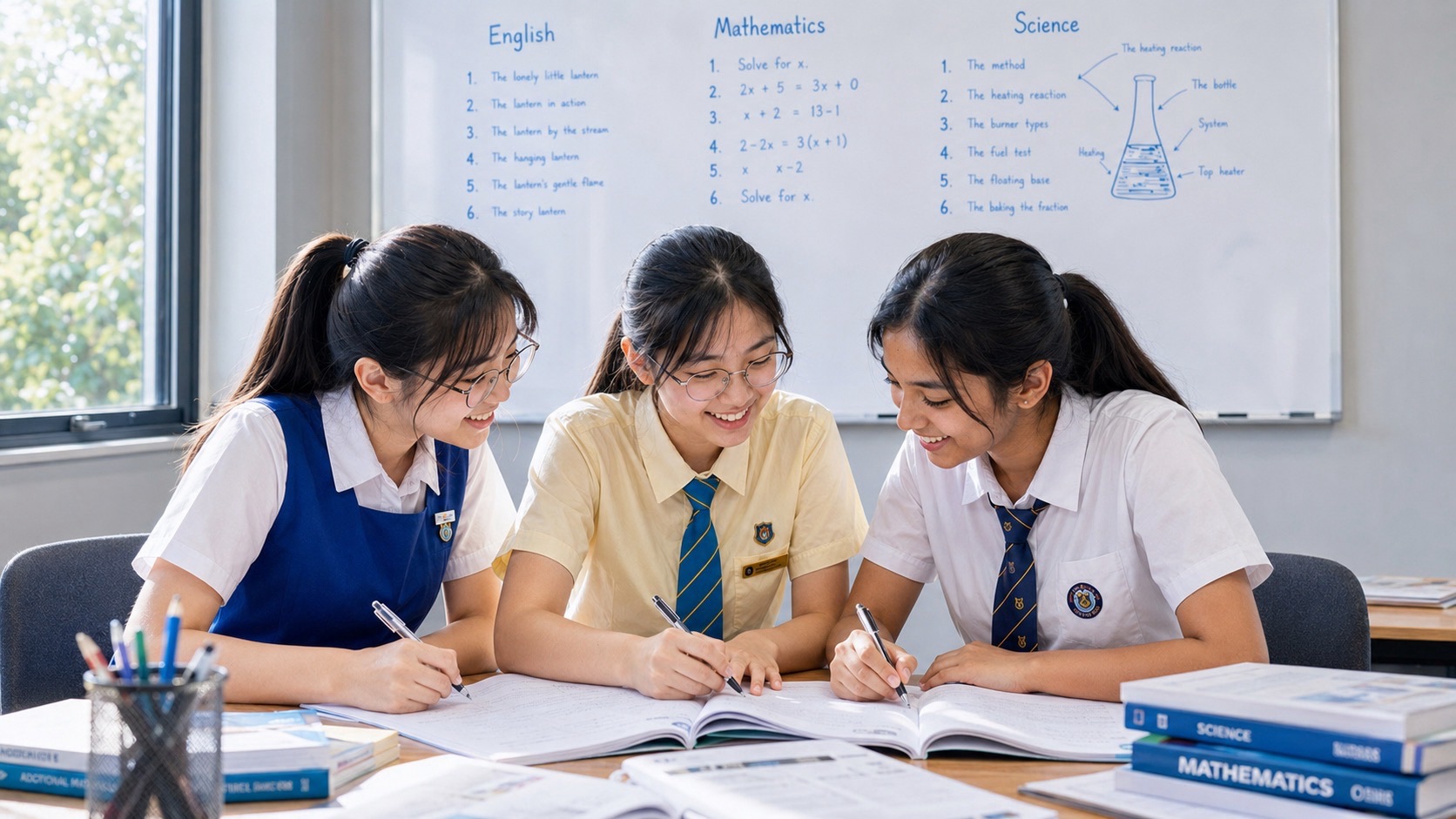
A Tampines parent could spend an entire afternoon moving between familiar places—school, Our Tampines Hub, a library visit, a CCA pickup and dinner—without leaving the town. Yet one question still follows the family home: should we add tuition for the child who is suddenly struggling with Mathematics, English or Science? The best starting point is not the number of centres nearby. It is understanding exactly why the current schoolwork has become difficult.
For parents comparing tuition in Tampines, Primary English, Mathematics, Science, PSLE preparation and Secondary G1/G2/G3 lessons each serve different needs. A child who can calculate accurately but chooses the wrong ratio model requires conceptual representation. One who reads fluently yet cannot justify an inference needs evidence-based comprehension. A Secondary student who knows Science definitions but cannot explain unfamiliar experiments needs causal reasoning. Good tuition is specific enough to distinguish those difficulties.
Tampines is a major regional centre, but not one identical neighbourhood. Families around Tampines Central, Tampines West, Tampines East, Tampines North, the Tampines Street 81 area and nearby Simei have different journeys and study routines. The town offers many public facilities and transport connections, including Tampines MRT on the East–West and Downtown lines, yet after-school convenience still depends on where the child is coming from and what time they can return home.
This guide takes parents through the most important decisions: when tuition is useful, how to examine actual mistakes, what to look for in a small group, and how learning needs change from early Primary school through the Secondary Education Certificate. The ambition is cheerful but serious. Tuition should help the pupil become capable of beginning unfamiliar work and checking it independently, not make the whole family’s week a race between classes.
Tampines as a regional centre is also a collection of distinct neighbourhoods
HDB’s Tampines town overview describes one of Singapore’s major regional centres, as well as neighbourhoods built in different stages. Its town-centre planning and community facilities do not erase the differences between a household in Tampines North and one around Tampines Street 81 or Simei.
The HDB Tampines Town Design Guide uses several sub-themes for different parts of the town: Green Tapestry in the north, Urban Nexus in the centre, Modern Village in the east, Community Playscape in the west, Waterside in the south and Garden in Simei. The descriptions help show why a broad town name is not a single after-school journey.
For tuition, the child may start at school, at a CCA activity or from a caregiver’s home. A parent choosing a classroom near Tampines MRT should calculate whether that route is practical after a regular school day, rather than assuming every address in Tampines is a convenient walk from the interchange.
The eduKateSG premium small-group reference describes a teaching location at 8 Fourth Avenue near Sixth Avenue MRT in Bukit Timah, by arrangement. This Tampines guide is written for Tampines families and does not imply a separate Tampines classroom. Confirm actual venue, session availability and travel requirements before making a commitment.
What does the first incorrect decision reveal?
Suppose a child receives a disappointing Mathematics paper. One problem is wrong because the pupil treated the new quantity as the original whole. Another is wrong because they copied the number incorrectly. A third reveals weak algebraic understanding. The same subject mark can contain different learning problems and require different kinds of teaching.
Ask the learner to explain what one question meant before showing the correction. Which details did they use? Why did they choose that method? At what moment did their plan become uncertain? A tutor who can see the first wrong decision can often teach more precisely than one who knows only the total score.
For English, inspect whether the pupil understands the passage, selects the appropriate textual evidence and explains what it means. For Science, ask whether the student knows the relevant concept and connects it to the particular observation. A correct keyword without the required causal link may not complete the answer.
A useful tutoring target is specific: “identifies the correct reference whole in percentage questions”, “explains an inference using exact evidence” or “states why the changed variable affects the result”. Such skills can later be tested without hints. “Must do better” is a hope rather than an instructional plan.
The town centre can support learning without requiring another class
HDB describes Tampines Town Centre as a regional shopping and community hub near the MRT station and bus interchange. It includes retail, food and public services, while Our Tampines Hub nearby offers sports, library and community facilities. Families have many opportunities to build a healthy learning routine without filling every opening with formal tutoring.
A library visit, for example, can support reading for pleasure and help a child develop the habit of exploring questions independently. A parent can discuss the meaning of a story or ask how a writer supports a claim without making every book an examination exercise. Quiet reading complements school English, even though it cannot substitute for all syllabus-specific instruction.
Community sport and recreation have value too. They give children a chance to move, participate and recharge. A student who returns to schoolwork with better attention may learn more efficiently than one who has completed an extra tired hour of repetitive exercises.
When tuition is genuinely needed, the family can still protect these activities. The best class is one that solves a meaningful learning difficulty while allowing room to read, practise independently, eat, sleep and enjoy the rest of growing up.
When another lesson is unnecessary—and when it becomes useful
A student making steady progress, able to explain concepts and beginning homework independently may not need extra academic tuition. Sometimes parents respond to the availability of classes rather than the presence of a problem. That can create an overloaded week with little educational return.
A meaningful case for tutoring develops when the same difficulty persists despite classroom teaching and manageable home revision. Perhaps the learner repeatedly misrepresents ratios, cannot support English inferences or leaves the scientific mechanism out of explanations. A tutor who can inspect working and give targeted feedback can help bridge those gaps.
There is also the learner whose grades appear acceptable because adults supply every first step. The homework page is full, but independent performance is fragile. For this child, tuition should aim to reduce reliance on prompts rather than become another place where answers are completed by a teacher.
Set an initial goal and plan to review it. When the pupil can apply the concept to fresh questions, retrieve it after a delay and maintain progress through school and self-study, the amount of outside tutoring may be reduced. This is a successful educational outcome.
Primary 1: the first foundations are about meaning
A Primary 1 pupil is learning that symbols represent quantities and words carry meaning. A child who recites numbers quickly may not fully understand place value; another may read a sentence aloud without knowing why an event in the story happened.
Use drawings, blocks and number lines to make equal groups and parts of a whole visible. Ask what each number represents and why a simple operation changes the quantity. The child who can explain a relationship is building the basis for fractions and later algebra.
In English, read a story and invite the pupil to describe a character’s action with reference to the text. Avoid immediately replacing every imperfect sentence with an adult’s polished model. Meaningful communication begins with the child’s own attempt.
Formal tuition is not compulsory for every young child. Where school learning is going well, conversation, reading and play can be highly valuable. If a persistent difficulty exists, choose developmentally appropriate instruction that is patient and allows independent discovery.
Primary 2: teach a child to ask why a method works
By Primary 2, children often gain speed at routine tasks. That fluency is useful, but understanding becomes clearer when the pupil can explain why a regrouping step is valid or what makes an English inference reasonable.
In Mathematics, show a relationship through objects, a drawing and a number sentence. Ask how the three representations match. In English, ask the child to identify the sentence that supports a conclusion about a story. These tasks invite reasoning without requiring unnecessarily advanced material.
A tutor should offer a changed problem after explaining the first one. The pupil then attempts it before receiving help. A wrong answer can reveal that the idea needs another representation rather than simply more repetition.
Parents can reinforce this with “What made you choose that?” or “How do you know?” rather than only asking for the final answer. A child who starts giving reasons is becoming more confident and capable.
Primary 3: when the word problem no longer tells you the operation
Primary 3 pupils may be accurate at arithmetic but struggle when a story contains several quantities. The question now requires choosing a representation and deciding which operation matches the relationship. The topic heading may not reveal the solution.
A tutor can teach the pupil to read the question, identify what is known, label the unknown and draw a suitable model. But the next question should let the child choose rather than receive a completed diagram.
English comprehension also requires more attention to inference, while Science begins asking children to move from observation to explanation. The student should identify the evidence or condition that makes an answer appropriate.
Progress appears when the pupil can explain the first decision and transfer it to a question that looks different. A child who corrects a mistaken model independently is developing an important academic habit.
Primary 4: the need to combine skills grows
Primary 4 work can require children to combine earlier ideas within one problem. Mathematics may involve multiple operations, English may use contrast and implied meaning, and Science can demand a causal explanation of a result.
Teach a consistent starting routine: identify the demand, select relevant information, choose a representation and try an answer. The tutor models the routine but should gradually remove hints.
A pupil who can copy the correct model answer immediately after a demonstration may still hesitate at school. Changed examples with different surface details reveal whether the learner understands the concept deeply enough to apply it.
Parents can praise accurate reasoning and honest correction rather than speed alone. A child who notices a wrong quantity or unsupported inference is beginning to manage their own learning.
Primary 5: fix the old skill that new chapters depend on
Primary 5 can reveal weaknesses that were less visible earlier. Fractions, ratio and percentage questions become interconnected. English comprehension requires more nuanced interpretations, while Science open-ended responses need the correct causal relationships.
A student who calculates accurately but chooses the wrong original whole needs conceptual teaching. A learner who quotes relevant text without explaining it needs inference practice. A Science pupil who recalls facts but cannot apply them to a changed experiment needs a more precise method of explanation.
A well-matched tutorial should repair the most consequential foundation first, then practise the idea in changed contexts and revisit it after a delay. More advanced worksheets are not automatically better when the prerequisite idea remains unstable.
Protect a balanced week. Primary 5 should strengthen a child for PSLE without making every afternoon feel like an examination emergency. Rest, reading and independent practice need space.
Primary 6 and PSLE: diagnose before assigning another paper
Full PSLE practice papers help students with timing, stamina and moving between topics. But their educational value depends on what happens after marking. If the same misconception appears in several papers, the next task should target that error rather than simply add another full paper.
For Mathematics, distinguish concept gaps, wrong models, calculation mistakes and checking. In English, identify whether the answer fails at inference, evidence or expression. In Science, look for the missing link between a scientific concept and the result.
A child who cannot begin a ratio question needs help understanding the relationship before speed practice. Another who solves correctly but runs out of time may require staged timed tasks. These problems call for different strategies.
Tampines parents can use PSLE Mathematics Tuition | Tampines Central, PSLE Mathematics Tuition | Tampines West or PSLE Mathematics Tuition | Tampines Street 81 for more focused local Mathematics coverage.
English: a fluent reader can still need to learn inference
English learning is more than knowing advanced words. A student may read aloud confidently and understand the literal story yet fail to explain what a character’s action implies or how a contrast affects the writer’s meaning.
A tutor should ask for exact evidence and an explanation of its significance. A quotation copied from the passage is only part of the answer. The pupil needs to show why the words support the claim.
In composition, the student’s actual writing determines the teaching priority. A lively narrative may lack structure; a carefully planned essay may have unclear sentences; another response may use elaborate expressions that do not suit the topic. Feedback should allow the pupil to revise independently rather than copy the tutor’s finished version.
For Secondary English, see Secondary 1 English Tuition | Tampines East, Secondary 1 English Tuition | Tampines West and the Tampines and Pasir Ris English developmental guide.
Mathematics: the model should match the quantities
A student can perform a calculation perfectly but apply it to the wrong quantities. Consider a price increasing from $80 to $100. The increase is $20, or 25% of the original $80. Dividing by the new $100 produces 20%, a coherent calculation that answers a different question.
Teach the pupil to identify the whole, the parts, what changed and what is being asked before calculating. In ratios and fractions, each part of a diagram should be labelled meaningfully. Copying a bar model without understanding its quantities is another form of memorisation.
In Secondary algebra, solving 4(x−2)=20 gives x=7. A tutor should explain why expansion and equal operations on both sides preserve equality, then ask the student to check the result. Changed coefficients or negative signs test whether the principle is understood.
Mathematics tuition should combine conceptual explanation, fluent execution, varied application and delayed retrieval. Families can explore Secondary 1 Mathematics Tuition | Tampines for a focused subject pathway.
Science: make the cause visible in the answer
A Science pupil may know the word “condensation” but give a weak explanation for droplets on a cold glass. The learner needs to identify water vapour in surrounding air, cooling near the surface and its conversion into liquid. Simply naming the process may not answer why the droplets appeared.
For experimental questions, ask what was changed, what was measured and which conditions were controlled. Understanding why those controls matter is more valuable than memorising the label “fair test” without interpreting the comparison.
After a guided example, alter the experiment and ask for a prediction. If the student can apply the same mechanism independently, the learning has become more flexible. If the answer depends on copying the exact wording of a model, the concept needs deeper explanation.
Ordinary observations of shadows, plants and moisture can encourage curiosity. Parents need not turn every outing into formal tuition. Learning to distinguish evidence from assumption can begin through relaxed conversation.
Tampines Eco Green: good for curiosity, not a substitute for school Science
HDB’s Tampines town overview describes Tampines Eco Green as a natural area with habitats including freshwater wetlands and secondary rainforest. It gives families a chance to notice biodiversity and environmental conditions without inventing a laboratory in the park.
A child might observe differences in plants, birds or wet ground. Ask what they actually saw and what additional information might be needed to explain why. Those questions help separate observation from inference, a useful skill in Science.
The same attention to evidence is relevant in English and Mathematics too. A writer’s implication must be supported by textual clues, and a model must correspond to the quantities stated. Recognising what information can and cannot justify is part of disciplined reasoning.
A park visit should still be enjoyable. Good tuition supports curiosity and gives children precise conceptual tools when appropriate. It should not turn every walk, library visit or family meal into another school assignment.
Secondary 1: school becomes more complex in several ways
Secondary school introduces more teachers, a larger set of subjects and greater responsibility for organising homework. Mathematics becomes more symbolic, English comprehension more analytical and Science explanations increasingly precise. A successful Primary student may need time to develop a new system.
Look for older knowledge underneath the current difficulty. Fractions, negative numbers and equality are important in algebra. Reading accuracy matters in worded Mathematics and Science tasks. Evidence-based inference becomes a larger part of English.
Teach a reusable beginning routine: read the demand, select relevant information, choose a method, attempt and check. The tutor models it, then gradually removes prompts so the child practises making decisions.
Parents can help by maintaining a short weekly review without taking over every task. A pupil who can identify one area of uncertainty and choose a practice question is developing useful independence.
G1, G2 and G3: actual subject levels matter
Under Full Subject-Based Banding, Secondary pupils may take relevant subjects at G1, G2 or G3 levels according to school arrangements. A learner may offer subjects at different levels, so tutors should select materials based on the actual subject and current readiness rather than one label for the whole pupil.
SEAB confirms that the Singapore-Cambridge Secondary Education Certificate examination begins in 2027, combining and replacing the previous N(T), N(A) and O-Level examinations. The SEC reflects subjects and levels taken. Parents can consult the official school-candidate syllabuses for details.
A class far beyond the child’s current syllabus may create unnecessary frustration, while repeated easy questions may provide limited growth. A tutor should ask what school topics have been covered, examine actual working and adjust challenge accordingly.
Subject levels are not complete statements about a child’s intelligence or future. Good tuition builds accurate understanding, self-confidence and independent skills at the actual level being studied.
Upper Secondary and Additional Mathematics: choosing methods matters
By Secondary 3 and 4, students may know individual procedures but struggle when a question combines them. A pupil can factorise correctly when the worksheet says “factorise”, yet hesitate when factorisation appears inside a longer unfamiliar problem.
For students offering Additional Mathematics, algebraic foundations are crucial. Weaknesses in sign control, indices and equation manipulation may affect several later chapters. The tutor should repair those underlying skills before assigning more advanced mixed questions.
Ready pupils can be stretched by comparing two solution methods, explaining why a shortcut works or detecting an invalid mathematical argument. This is genuine intellectual extension rather than merely racing through more chapters.
The same method-selection habit appears in English and Science. The learner must choose the appropriate evidence or mechanism when the problem’s appearance changes.
Three-student tutorials: close attention should produce independence
The published eduKateSG Clementi reference describes premium tutorials of up to three students, generally around one and a half hours weekly. A small group can permit close inspection of each pupil’s working and opportunities to compare approaches.
Class size alone cannot guarantee educational value. Three pupils can still spend a lesson copying the tutor’s model answer. Ask how the class ensures independent attempts, how learning levels are matched and how the tutor responds to repeated errors.
A productive lesson might begin with retrieval of earlier knowledge, introduce a concept, allow independent attempts and test a variation. The tutor should identify the missing decision rather than only mark the final response.
One-to-one tutoring can suit highly specific needs; larger classes may help independent students who need structured revision. Choose a format by teaching fit and the child’s growing capability, not by status alone.
The Tampines week must allow time for the learning to stick
A family near Tampines MRT may find the regional centre easy to access, but a child living around Tampines North or Simei may start from another part of town. Even within the same estate, school and CCA locations can make the journey quite different.
Mark school, transport, meals, homework and sleep before placing tuition in the calendar. Then reserve a brief retrieval task within a day or two and one changed question later in the week. These opportunities make an explanation more durable.
For Mathematics, the pupil might explain a model without notes; for English, justify an inference in a new paragraph; for Science, predict the effect of an altered variable. Short tasks can be meaningful when the child must think independently.
Protect room for reading, sports and family conversation. A packed diary may make a pupil busy without giving them the attention to learn well.
An error log can become a map of better decisions
An error log should describe what went wrong and how the next attempt will change. The phrase “careless mistake” is too vague if the real cause is a wrong reference whole, a misread instruction, an unsupported inference or an omitted Science mechanism.
Write the mistaken decision in one sentence, followed by a better one and a future review date. The child should understand the correction sufficiently to explain it, not merely copy it.
After several days, use a fresh question. If the pupil catches the same risk independently, the correction has become useful knowledge. If the old hint is still required, the tutor may need to revisit the underlying concept.
Include a positive space for self-correction. Students who identify implausible numerical answers or unsupported conclusions are becoming stronger reviewers of their own work.
What should change during the first month?
Begin tuition with one representative question the child cannot solve independently. Agree on a clear target, such as choosing an equation from a word problem, supporting English inferences with evidence or explaining an experimental result causally.
The tutor should teach the concept, allow a new attempt and revisit it after a delay in a different context. Parents may notice clearer explanations, fewer repeated mistakes and less need for the first hint before grades change.
School papers vary in topic mix and difficulty, so a universal grade guarantee would not be responsible. Compare related skills over time and ask for feedback about one priority, one improvement and the next task.
If the pupil becomes capable of self-study, review whether external tuition can be reduced. The purpose is lasting independence, not continuing a programme after its original need has changed.
The first consultation should show what kind of teaching is offered
Bring recent marked assessments and ordinary homework, along with subject-level information for Secondary students. Ask the child to explain a question they could not answer. The tutor’s response should reveal how they diagnose rather than simply how many worksheets they provide.
Ask how different learners are grouped, what happens after a wrong attempt, when older topics are revisited and how progress will be tested in changed questions. These details show whether the programme supports meaningful independent thinking.
Then confirm fees, physical venue, lesson duration, travel and current class openings. A Tampines-facing article does not mean there is an eduKateSG classroom in Tampines Central or North. The reference teaching venue is in Bukit Timah.
Agree on a review date. A well-matched class should make a previously difficult skill easier to perform without help, and the plan should adjust when the student’s needs change.
Why a town with so many learning options needs a clear priority
Tampines offers families many places to study, gather and participate in activities. That convenience is valuable, but the number of choices can make parents anxious: perhaps there is always one more tuition subject, revision class or enrichment programme that should be added. The child’s own schoolwork is a better guide than the fear of missing out.
Start by identifying a repeated difficulty that matters for current learning. A student who cannot identify the correct percentage whole needs a specific Mathematics explanation. A pupil who quotes evidence without making the inference explicit needs targeted English feedback. A Science learner who cannot connect variables and observations needs a different kind of practice.
Then ask what existing support already provides. School teachers, independent revision and family reading can contribute to some needs. Specialist tutoring becomes more compelling when a misconception persists or the learner needs close feedback on reasoning. Not every weakness warrants a permanent weekly appointment.
Choose a small initial plan and review its impact. This is especially useful for large towns where it is easy to attend several nearby classes without stopping to ask whether the child has time to retain what was taught. Purpose, not programme count, is the important measure.
Tampines North and Tampines Central are different study days
A child living in Tampines North may have a different journey to the regional centre from one who lives near Tampines MRT or Tampines East. A family around Street 81 or Simei has another route. It is tempting to describe every option as conveniently “in Tampines”, but that label says too little about an actual weekday after school.
Ask where the pupil begins. School dismissal, CCA and a caregiver’s home can all change the starting point. Then calculate travel to the class and the return home, including a meal. A timetable that looks effortless on a Saturday tour can become demanding on a Tuesday when the child is tired.
Even the best tutor cannot make up for a week with no independent follow-up. Reserve a short retrieval task after the lesson and a changed question later in the week. The learning method must work from the child’s real timetable rather than a theoretical schedule with unlimited available hours.
Families should also distinguish new housing and future transport plans from facilities operating today. Confirm current venue, routes and class opening directly. A locality guide is not a promise of a nearby tuition branch, and a parent’s convenient commute is not always the child’s easiest learning journey.
What a truly independent homework attempt should look like
When a learner opens a question, a common habit is to look immediately for a familiar worked example. This can be useful when reviewing, but it can also prevent the child from practising how to choose a method. A tutor should occasionally set a fresh task without announcing which chapter it belongs to.
The student first identifies what the question asks, selects the relevant information and attempts a representation. In Mathematics, that might be a diagram or equation; in English, the key evidence supporting an inference; in Science, the changed condition and observed result. These early choices make understanding visible.
If the pupil hesitates, provide a small hint that preserves the thinking task. “What is the original whole?” is more useful than telling them the formula. “Which sentence provides evidence?” is better than supplying the interpretation. A hint can direct attention without removing responsibility.
After feedback, give a slightly different example with fewer prompts. The child’s ability to attempt that variation tells the tutor more about learning than a page of correctly copied solutions. Over time, independent starts become a dependable habit rather than a moment of luck.
How to use the Tampines library without making it another tuition centre
Our Tampines Hub includes a regional library and several community facilities. A family can benefit from this environment without attaching a formal assessment to every visit. Reading independently and following personal curiosity help children build familiarity with language, information and sustained attention.
For a young reader, ask what was interesting in a story rather than immediately distributing comprehension questions. For an older learner, discuss why an author believes something or which facts support a claim. This can reinforce the habit of evidence-based interpretation while allowing reading to remain enjoyable.
A student with a genuine comprehension gap may still need specialist teaching. The tutor can explicitly explain how inferences work and provide school-aligned practice. Enjoyable reading and targeted instruction serve complementary purposes: one nurtures a relationship with language, while the other addresses particular assessment skills.
Protect such activities when adding tuition. An educationally serious family does not need to turn every library visit into another worksheet session. The wider aim is a curious child who is increasingly capable of finding, evaluating and understanding information independently.
An error log that distinguishes slips from misconceptions
It is tempting to describe every lost mark as “careless”. But copying a number incorrectly is not the same as misunderstanding a fraction, choosing a poor diagram or failing to explain an inference. A tutor should classify the earliest incorrect decision because the repair depends on the cause.
Use a compact record with three elements: what went wrong, what the child should do differently and when to try a similar question again. A Mathematics entry might note the incorrect percentage base. An English entry might describe a quotation that was not linked to meaning. A Science entry might identify a missing causal mechanism.
Several days later, offer a fresh example. If the pupil notices and avoids the old error independently, the correction has become useful knowledge. If the same hint is necessary, the tutor can revisit the concept and teach it through another representation.
Include successes in self-correction. A child who checks that an algebraic answer satisfies the original equation or questions an unsupported English inference is making a valuable intellectual decision. That habit supports future schoolwork more than a perfectly copied model answer alone.
A first-month review that protects both progress and wellbeing
Before tuition begins, choose a representative question the child cannot yet manage independently. Agree on the skill that should improve over several sessions. The teaching should explain the concept, give an independent attempt, vary the question and return to the idea after a delay.
Parents can notice whether the student begins work more confidently, selects better models, explains reasoning more precisely or catches repeated errors earlier. School marks are important but vary with assessment difficulty and topic mix, so compare related work rather than treating one new score as a complete judgement.
Ask for concise feedback from the tutor: one current learning priority, one observed improvement and one manageable task to practise. An overloaded homework pack can make it harder to see what is being learnt, particularly when the child already faces school and CCA commitments.
At the review point, ask whether the plan still fits. Perhaps the child needs deeper applications, perhaps an old foundation remains fragile or perhaps tutoring can become lighter because independence has improved. A responsive plan respects the learner rather than maintaining appointments by habit.
A parent’s final checklist before enrolling in Tampines tuition
Bring marked assessments, a normal homework page, the actual school year and the current subject level for Secondary students. Ask your child to explain what makes one representative question difficult. The tutor should begin with that evidence, not a universal promise of marks.
Ask what will happen during a lesson when the pupil cannot begin. Does the teacher inspect the student’s reasoning and offer a targeted hint? Are earlier concepts revisited? Does the tutor use changed questions to check transfer? How are small-group classmates chosen and encouraged to participate?
Confirm the actual venue and the journey from the child’s school or CCA, as well as current fees, duration and available sessions. A Tampines page may be relevant to a family without the described class being physically situated in Tampines. Practical clarity matters as much as educational method.
Finally, choose an observable goal and a review date. The strongest tuition arrangement makes it easier for a student to recognise what a question demands and choose an appropriate next step. The child’s growing independence is the result worth paying attention to.
Questions Tampines parents often ask
Is tuition near Tampines MRT convenient for every family? No. Tampines North, East, West and Simei households may have different school-to-class routes.
Does eduKateSG run a Tampines branch? This guide does not claim one. The reference teaching location is near Sixth Avenue MRT in Bukit Timah.
What if my child has strong grades? Tuition may be unnecessary when the learner understands and works independently. Extension should serve a meaningful goal.
Can English tuition help inference? Yes, when it teaches accurate evidence selection and the explanation connecting evidence to meaning.
Why do Mathematics errors repeat after drills? The underlying quantity relationship or representation may still be unclear.
What improves Science open-ended answers? A precise link among observations, conditions and scientific mechanisms.
Should a Primary 1 pupil take tuition? Only for a genuine learning need using developmentally appropriate teaching.
How many PSLE papers should we complete? There is no universal quota. Full papers and targeted repair serve different purposes.
Are G1, G2 and G3 the same? No. Teaching should follow the actual subject level and school sequence.
When does SEC begin? The new examination begins in 2027, with official information from SEAB.
Is Additional Mathematics for all Secondary students? No. It is an offered subject that requires secure prerequisites.
Do small groups automatically produce better marks? No. Class compatibility, feedback and independent practice matter.
Should we choose weekdays or weekends? Choose a time when the child is alert and can later consolidate learning.
How quickly should tuition show progress? Timelines vary; look for clearer independent reasoning before assuming marks will change.
Can tutoring be reduced later? Yes. Greater independence can be an excellent outcome.
What should parents bring to a consultation? Recent marked work, typical homework, current subject levels and a realistic weekly timetable.
Tampines has plenty of opportunities; choose the one that builds a learner
Tampines offers community life, transport, libraries and a wide range of educational options. A parent does not need to choose all of them. The right tuition helps the child overcome a real bottleneck and creates time for the new skill to become independent.
For local subject pathways, explore Tutors and Tuition in Tampines, Awesome Schools in Tampines and Primary 3 Mathematics Tuition | Tampines. Each answers a different parent question.
Begin with schoolwork, identify one meaningful learning target and choose teaching that addresses it. Protect a manageable timetable with retrieval and rest. Celebrate the child who recognises a mistake before an adult points it out.
Families considering eduKateSG premium small-group tutorials can arrange a parent–student consultation to discuss subject fit, current availability and actual teaching location. The educational ambition is a confident child who can approach unfamiliar problems with increasingly sound judgement.