
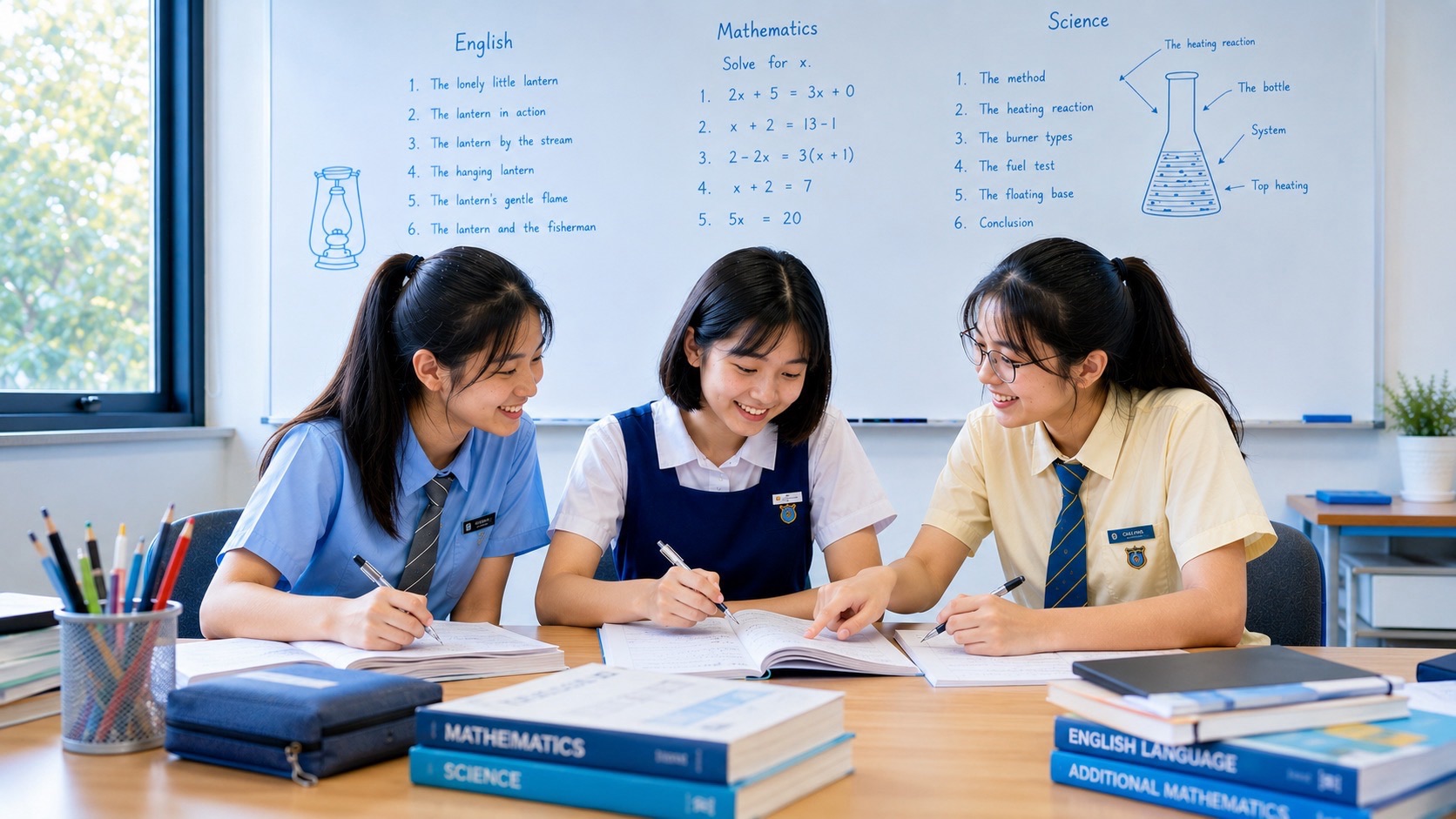
Tuition in Vladimir often begins with searches such as репетитор Владимир, репетитор по математике Владимир, Russian essay help, English tutoring, подготовка к ОГЭ and подготовка к ЕГЭ. Some families want to help a pupil catch up after the transition to algebra. Others are deciding whether an interested child should take on advanced science, literature or subject olympiads. The best first question is not how many exercises are assigned. It is what the child will be able to explain and do without the tutor afterwards.
A learner may calculate fractions correctly when the workbook names the chapter but fail to recognise them inside a scale drawing. Another can recite history facts about a building yet cannot distinguish a primary source from a later interpretation. A third knows the words of a poem while writing a claim with no textual evidence. All three need teaching, but not necessarily the same kind.
Vladimir’s historic white-stone architecture makes an unusually rich setting for geometry, measurement and evidence-based interpretation. Its actual education system also follows national school stages and examination requirements. A city-centred tuition guide should connect both without inventing local services or confusing fictional maths measurements with real heritage information.
This article shares the teaching approach of eduKate Singapore. Our premium tutorials use groups of three pupils and operate in Singapore, not Vladimir. We do not advertise local eduKate teachers, a physical branch or classroom lessons in this city.
The immutable instructional reference is Secondary 1 Mathematics Tutor Clementi | Small Groups Tutorials. Its useful principles are diagnosis before tuition, clear first-principles explanation, targeted feedback and independent transfer.
What Teaching Job Does the Family Really Need?
A private tutor might repair a missing subject idea, coach examinations, supervise homework, teach a foreign language or extend a student who is ready for deeper work. Those are legitimate activities, but they are different tasks.
A child who cannot understand why two fractions are equivalent needs part–whole reasoning. One who understands fractions but makes recurrent sign errors needs accurate execution and checking. Another who solves textbook equations with the chapter heading visible may need practice recognising the method in unfamiliar questions.
Ask a candidate tutor to examine schoolwork the child attempted without help. Where did the first reasoning error occur? Does the pupil know the prerequisite? Did they misread the question? Was the right method applied incorrectly?
The answer should lead to a specific lesson and an independent test, not merely another package of sixty problems.
- Repair the exact missing prerequisite.
- Maintain skills with mixed retrieval and self-checking.
- Progress through unfamiliar, deeper questions when readiness is secure.
- Support homework organisation without taking over the pupil’s decisions.
- Prepare for official assessments with the relevant current documents.
How Vladimir’s School Stages Increase the Demand for Reasoning
General education in Russia ordinarily includes primary Grades 1–4, basic general education Grades 5–9 and senior general education Grades 10–11.
A child who learns to compare fractional parts in primary school needs that meaning again in proportionality, algebra and geometry later. A pupil who understands short texts needs to build longer written arguments with clear evidence as the curriculum advances.
A Grade 9 assessment and a Grade 11 assessment have different purposes and specifications. A pupil following an advanced mathematics pathway also needs a different level of challenge from one working on the basic mathematics qualification.
School materials and teacher feedback should inform the tutor’s programme. The pupil’s personal skill profile matters more than a generic promise to teach ‘secondary maths’.
A Verified Vladimir Reference: The Golden Gate and White Monuments
The UNESCO World Heritage Centre documents the White Monuments of Vladimir and Suzdal, including the Golden Gate and the Cathedral of the Assumption in Vladimir.
The UNESCO World Heritage description identifies the Golden Gate as a surviving work of Vladimir’s twelfth-century fortifications and discusses the region’s distinctive white-stone architectural tradition.
This is an authoritative cultural source, not a measurement sheet for student exercises. A tutor can use the architecture to introduce questions about symmetry, arches, area, scale and how historians interpret surviving structures.
A student should learn to distinguish a historic fact supported by UNESCO from an imaginary dimension introduced solely for mathematics. That discipline is itself transferable: knowing what is given, what is assumed and what remains unknown.
Vladimir’s geography and architecture can motivate learning in mathematics, history and art, but the actual teaching should focus on a specific skill the child needs.
What Changed for the 2026/27 School Olympiad in Vladimir Oblast?
Vladimir Oblast’s Institute for Education Development hosts current materials for the school stage of the All-Russian School Olympiad. It identifies the regional Ministry of Education’s Order No. 1102 dated 27 August 2026 concerning school and municipal stages.
The official VIRO33 2026/27 school-stage directory also includes methodological recommendations for subjects such as mathematics, physics, chemistry, geography, history, literature, informatics and languages.
An education-administration document from the Murom district independently lists the same regional 27 August 2026 order and its own local school-stage orders. The regional order is relevant across Vladimir Oblast, while particular city and school participation instructions must be checked separately.
See the Murom education office’s regional-order index for that cross-check.
These documents establish current school-year coordination but do not imply every subject follows identical dates or every pupil must participate. Families should choose enrichment only when the child’s interest, preparation and school eligibility make it appropriate.
A good olympiad tutor teaches the reasoning behind a solution and then changes the problem. Simply memorising unusual tricks may create short-lived familiarity rather than a flexible mathematical mind.
The 2026/27 Regional Stage Is Not the School Stage
The national Ministry of Education issued Order No. 692 on 8 October 2026 relating to the regional stage of the 2026/27 All-Russian School Olympiad. This is different from Vladimir Oblast’s school and municipal arrangements.
The official national documentation can be reviewed through the All-Russian Olympiad documents directory.
Parents should not use a regional-stage date as though it were the deadline for every child entering the school stage. Different competitions, subjects and stages have their own rules.
For a pupil who is academically secure, an appropriate olympiad problem can develop creativity and willingness to justify an unusual method. A child struggling with ordinary fractions may instead need a short fundamental repair before the enrichment becomes useful.
ОГЭ 2027: A Draft Assessment Does Not Teach the Missing Concept
FIPI published 2027 ОГЭ project demonstrations, codifiers and specifications in August 2026. The documents remain described as projects in October 2026; parents should check final publications and school guidance later.
The official starting point is FIPI’s ОГЭ 2027 materials.
A practice paper may show wrong answers in algebra, geometry, graphs, Russian comprehension or other subjects. The score alone does not identify whether the student lacked knowledge, misunderstood the question or simply copied a number incorrectly.
An effective tutor inspects the pupil’s reasoning, teaches the earliest missing relationship and checks it through an independently attempted variation. Time-limited work becomes useful when the method is understood.
A child who relies on a chapter heading to know which method to use still needs practice with mixed, unfamiliar exam questions.
ЕГЭ 2027: Basic and Profile Mathematics Need Different Instruction
At senior-school level, ЕГЭ mathematics has basic and profile variants with different depth and task requirements. The pupil’s actual route should determine the material.
FIPI’s 2027 ЕГЭ project specifications provide distinct demonstration variants. The documents are drafts at the current date and later official changes should be checked.
A profile learner may need more advanced functions, algebra and multi-step geometry. A basic mathematics student needs a suitable programme for that qualification, not a more difficult course assigned merely for appearance.
Both still depend on earlier number sense, fractions, signed values and equation interpretation. A good tutor makes the prerequisite chain clear rather than jumping straight into examination tricks.
A Vladimir Geometry Tutorial: An Imaginary Golden Gate Arch
Vladimir’s Golden Gate offers an appealing cultural starting point. All measurements in the following exercise are fictional, invented for mathematics and not actual dimensions of the historic gate.
Imagine a rectangular classroom model measuring twelve metres wide and ten metres high. Its area is 12 × 10 = 120 square metres.
Within it, an imaginary rectangular opening measures four metres wide and seven metres high. Subtract its area, 4 × 7 = 28, from the model’s total to obtain ninety-two square metres of remaining material.
Ask why the unit is square metres and why subtraction, not division, is appropriate. The missing opening is an area, not an independent length.
Now change the opening’s position without changing its dimensions or overlap conditions. Does the remaining material area change? No, because the total and removed areas are unchanged.
Present the same information in a sketch and a table. Ask the student to explain what would change if an additional opening overlapped the first one. The simple subtraction could double-count a removed region, so the model must be adjusted.
This teaches area, subtraction, assumptions, representation and mathematical judgement. It is not an architectural survey of Vladimir’s real monument.
From Scale Drawings to Fractions and Ratios
Imagine a different fictional drawing of a white-stone building with a scale of one centimetre to two metres. A line 6.5 centimetres long represents thirteen metres.
A student should explain why 6.5 × 2 = 13 and what each unit measures. Convert the represented thirteen metres into 1,300 centimetres to check the unit relationship.
Now change the fictional scale to one centimetre for three metres. The same 6.5-centimetre line represents 19.5 metres. The pupil must not repeat the old answer merely because the drawing length is unchanged.
Build a table and the expression L = 2d for the original scale, with d the drawing length and L the represented length in metres.
Reverse the problem: a represented twelve-metre length occupies six centimetres on the original drawing. The learner should justify division and check the answer by substitution.
These invented figures do not describe real Vladimir monuments. The educational result is the ability to translate relationships among words, numbers, diagrams and symbolic equations.
A Third Maths Example: Fixed and Changing Quantities
Suppose a fictional school heritage project uses a fixed setup charge of fifty units and another fifteen units for each model constructed. The base expression is C = 50 + 15n.
For zero, one, two and four models the totals are 50, 65, 80 and 110. A pupil should be able to plot the graph and explain why it begins at fifty rather than the origin.
Now introduce an imaginary twenty-unit surcharge when the order contains more than four models. The original equation still describes the base amount, but not every final payment.
Reverse the base formula: a total of 155 corresponds to 50 + 15n = 155, so n = 7. The student should then apply the added rule only if the question asks for the final payment.
These are invented classroom amounts, not Vladimir museum fees or actual service prices. The teaching point is modelling fixed and variable quantities and reading conditions.
The Fractions-to-Algebra Bridge Must Be Strong
A child can know 4 × 8 = 32 and still hesitate when the same relationship is written as 4x = 32. Algebra has introduced a symbol; it has not changed the quantity relationship.
Use four equal boxes totalling thirty-two. Each box contains eight. Explain why dividing both sides of the equation by four preserves equality.
Next solve 4(x + 2) = 40. Each group contains x plus two, so x + 2 = 10 and x = 8.
A shortcut such as ‘move the four to the other side’ might provide an answer without explaining why it works. Brackets, fractions and negative values make that hidden weakness more serious.
Ask the pupil to check by substitution and then solve a changed question without hints. Returning to a simple fraction or group model can make an advanced-looking equation less mysterious.
Related mathematical foundations appear in How Mathematics Works at eduKateSG.
Why the Same School Mark Can Conceal Completely Different Gaps
Two Vladimir pupils may receive the same mathematics mark, although one does not understand fractions, another cannot translate a story into an equation and another makes a sign error after selecting the right method.
At eduKate, learning continuity means preserving useful connections across time, subject matter and new representations.
A tutor should examine the original working rather than use a school score as if it were a complete diagnosis.
- Missing node: an essential prerequisite is insecure.
- Broken edge: separately known ideas cannot be combined.
- Wrong shortcut: a method is applied outside valid conditions.
- Routing difficulty: the student cannot choose a method.
- Translation gap: words, diagram, table and formula do not align.
- Execution gap: arithmetic, units or signs interrupt sound reasoning.
- Retrieval gap: the idea disappears after the model example is removed.
- Transfer gap: a changed setting defeats the trained technique.
- Calibration gap: the child cannot tell whether the result makes sense.
History: Distinguish a Source From a Classroom Illustration
Vladimir’s historic monuments offer an exceptional opportunity to teach evidence-based reasoning. UNESCO’s heritage description can help identify established features and their documented significance, while a tutor’s fictional geometry drawing serves a different purpose.
A pupil should ask whether a historical statement is supported by the source, an inference from it or simply an imagined detail of a teaching example.
Suppose the student claims that a particular design feature reveals the builders’ priorities. Which observed architectural features support that interpretation? Could there be another explanation?
A strong history or humanities tutor helps the child move through claim, evidence and reasoning. The skill transfers to literature and science because evidence must match the conclusion.
Russian Writing: An Argument Needs More Than an Attractive Phrase
A pupil may know a literary story and still write, ‘The narrator was courageous,’ without explaining which action demonstrates courage.
The tutor asks what happened, what risk was involved and which textual evidence supports the judgement.
A clear paragraph contains a point, relevant evidence and explanation. Difficult vocabulary cannot substitute for missing reasoning.
After showing the method once, ask the child to interpret a new passage independently. That changed task reveals whether the skill has been learned.
English Tuition: Vocabulary Should Express Meaning
English lessons may target grammar, reading, speaking or academic writing. The tutor should diagnose the specific skill rather than assign a generic vocabulary list.
A student may know that ‘although’ introduces contrast but use it between two statements that do not contrast. Explain the relationship and ask for an original sentence.
Revisit the structure after a delay in an unfamiliar passage. A pupil who uses it accurately without prompts demonstrates more than short-lived memory.
For international and bilingual programmes, use the actual curriculum to distinguish language development from literature or English-medium subject work.
Science and Informatics: Every Model Has Assumptions
A learner may memorise a physics formula and use it in unsuitable conditions. For example, an imaginary object travelling at constant speed of five metres per second for six seconds covers thirty metres.
If the speed varies, the original simple multiplication may no longer represent the journey. Ask which information has changed and what would be needed to model the result.
In informatics, a fictional discount applies only if a count is greater than five. It does not apply at exactly five. Testing this boundary before coding develops logical reasoning.
The best science tutor connects mechanism, units, observation, prediction and evidence. Correct terminology without a causal explanation is not enough.
- State the model’s relevant assumptions.
- Identify quantities and units.
- Check an example and a boundary case.
- Change one condition.
- Explain why the original method still works or fails.
- Connect the conclusion to evidence.
Why the Three-Pupil Model Can Help a Tutor See Reasoning
At eduKate Singapore, premium tutorials have three pupils. The teacher can inspect each student’s workings and offer targeted feedback while the group supports comparison of methods.
This is a Singapore programme, not an offer of classes in Vladimir. Parents can apply the same teaching criteria to one-to-one, group or online tutoring.
Individual support may fit unusual gaps; a well-matched group can encourage explanation; online tuition can work when genuine written attempts and live correction are available.
The group size alone is not the educational outcome. The pupil must reason, attempt and increasingly own the next step.
A Tutorial Should Begin With Retrieval and End With Transfer
Begin with a short question from earlier learning without naming the method. Teach the exact missing relationship using a clear example, then let the student attempt a new problem.
Correct the reason for any mistake. Change the representation and withdraw hints so the pupil chooses the operation independently.
Return to the idea at a later lesson among mixed topics. Understanding that survives time is stronger than success immediately after a demonstration.
- Retrieve earlier knowledge.
- Explain the missing principle.
- Observe an independent attempt.
- Correct the root error.
- Test unfamiliar transfer.
- Return after a delay.
Repair, Maintain and Progress
Repair is for the child falling behind because a prerequisite is missing. Restore the earlier idea and reconnect to the present lesson.
Maintain strengthens a known skill through spaced retrieval, mixed work and careful checking.
Progress offers deeper unfamiliar problems and alternative explanations for a pupil who is ready. Accelerating before prerequisites are secure can create more gaps.
These are temporary teaching routes, not permanent labels of ability.
A Six-Week Parent Plan for Vladimir
Six weeks creates a review point where a family can compare the child’s independent work rather than rely solely on an examination score.
The routine should leave time for normal school, independent practice, family life and rest. More tutoring hours do not automatically create stronger understanding.
- Week 1: identify one recurring error from original unaided work.
- Week 2: repair the earlier skill needed for the current topic.
- Week 3: change the problem representation and test method choice.
- Week 4: retrieve the idea after a delay.
- Week 5: mix old and new work with appropriate assessment-style tasks.
- Week 6: compare independent performance and decide whether to adapt, reduce or continue support.
Seven Questions to Ask a Vladimir Tutor
An effective provider can demonstrate how a real mistake changes the explanation, the practice and the check for progress. A promise of a particular grade before diagnosis is not sufficient.
Ask when help could reduce or end. Increased independence is a sign the teaching has worked.
- Which actual grade and school curriculum do you teach?
- Do you know the subject’s current ОГЭ or ЕГЭ specifications?
- If the aim is olympiad enrichment, is the challenge appropriate to the pupil’s readiness?
- Can you identify the first wrong decision from unaided work?
- How much time does the child spend reasoning independently?
- What will you test again after a week?
- What are the qualifications, safeguarding arrangements, class size, fees and cancellation conditions?
Frequently Asked Questions
Does Vladimir Oblast have a 2026/27 olympiad order? Yes. The region’s Institute for Education Development lists the 27 August 2026 education-ministry Order No. 1102.
Are UNESCO monuments a source for actual historical facts? The UNESCO heritage description is an authoritative starting point; invented classroom measurements must be distinguished from those facts.
Are FIPI’s 2027 projects final in October 2026? The published materials remain projects; check later final documents.
Should every pupil attend an advanced maths tutor? No. Diagnose the learning need and select challenge according to readiness.
Does eduKateSG have a Vladimir tuition branch? No. Our premium three-pupil programme operates in Singapore.
Official Sources and Further Reading
School schedules, examinations and participation rules should be checked with the pupil’s institution and competent authority for the actual year.
- UNESCO: White Monuments of Vladimir and Suzdal
- Vladimir Oblast Education Development Institute: 2026/27 olympiad materials
- Murom education office: regional Order No. 1102 cross-reference
- FIPI: 2027 ОГЭ project specifications
- FIPI: 2027 ЕГЭ project specifications
- eduKateSG: How Mathematics Works
- eduKateSG: immutable Singapore tutorial reference
Tuition | Vladimir: The Learning Result Should Be Independent Reasoning
The best tutor leaves the pupil with a usable method rather than a completed worksheet. A fictional Golden Gate drawing becomes geometry and unit reasoning. A scale sketch becomes proportionality. A heritage source becomes an evidence-based interpretation, and a physics formula becomes a model with conditions.
For the learner who has fallen behind, repair the missing link. For one who is coping, maintain it. For one ready for depth, extend thoughtfully.
The educational return is the student who can see what an unfamiliar problem requires and justify the next step with fewer hints.
Less noise. More structure. Better learning continuity. Continue with eduKateSG’s immutable three-pupil tutorial model and Tuition | Tula.