
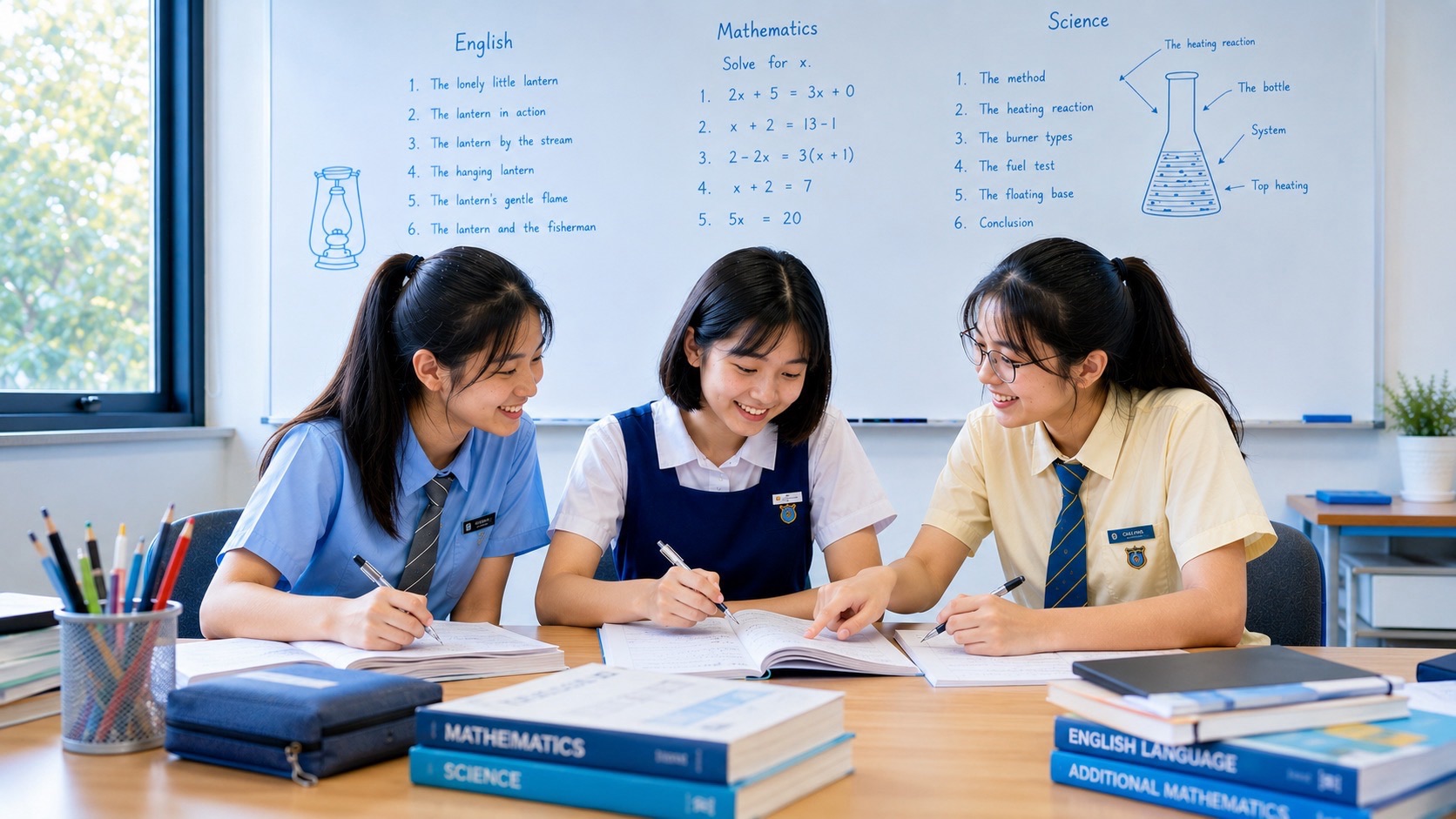
Tuition in Voronezh is often searched as репетитор Воронеж, репетитор математика, подготовка к ОГЭ, подготовка к ЕГЭ, репетитор по русскому языку, and English, physics or informatics tutoring. Some parents want to repair a child’s mathematics foundation. Others are considering a subject olympiad or deeper science study. A good programme begins with the student’s independent working, not a promise to complete the greatest number of extra worksheets.
A pupil may understand a formula while watching a demonstration but fail when the question changes its assumptions. Another can calculate ratios yet draw a graph that represents a different relationship. A third remembers a literary passage but struggles to use evidence in a written argument. These pupils may have the same score and need completely different kinds of tuition.
Voronezh’s educational context includes its municipal 2026/27 school-olympiad system, with official orders on subject participation, local coordination and safe administration. For a family exploring enrichment, this is a more useful starting point than vague promises about competition success.
This guide shares the eduKate Singapore philosophy. Our premium small-group tutorials are designed for three pupils and operate in Singapore, not Voronezh. We do not claim a local eduKate centre or tutors working in the city. The teaching method can help parents evaluate the instruction they find locally or online.
The immutable editorial reference is Secondary 1 Mathematics Tutor Clementi | Small Groups Tutorials. Its principal argument is that the pupil’s starting position must be made clear before choosing teaching and practice.
What is the educational job of a tutor?
Private tutoring can repair an insecure concept, improve accuracy, support reading comprehension, organise homework or prepare a student for formal assessment. A student already secure in the current work might benefit from extension.
Those are different services. A child who cannot explain equivalent fractions should not automatically begin with timed examination papers. A student who knows the fraction relationship but loses minus signs may need careful execution and self-checking. Another who can solve problems when a chapter heading names the method may need practice selecting methods in mixed tasks.
A useful tutor should inspect work completed without assistance. Ask where the first wrong decision occurred, why it happened and what independent variation would prove the understanding has changed.
- Repair: rebuild the missing prerequisite and connect it to the current chapter.
- Maintain: use delayed retrieval, mixed practice and better checking.
- Progress: extend a ready pupil with unfamiliar and deeper applications.
- Homework support: organise tasks without replacing the student’s decisions.
- Exam preparation: use applicable official materials and correct errors precisely.
An effective programme should eventually make the learner less dependent on the tutor. It should not need a permanently full diary of appointments to demonstrate value.
Voronezh’s school pathway and the importance of prerequisites
General education in Russia ordinarily consists of primary Grades 1–4, basic general Grades 5–9 and senior general Grades 10–11.
In primary years, numeracy, reading, fractions and the ability to explain a calculation are essential. In middle school, these become algebra, geometry, graphs and scientific measurement. Senior students may follow different academic programmes or assessment routes, so the tutor should know the actual syllabus.
If an older student is struggling with algebraic fractions, revisiting primary fraction equivalence may be the best teaching decision. If a science pupil misreads graph units, repairing the mathematical representation may improve several science chapters.
The local school and current teacher feedback should guide the work. A child may be strong in one skill and insecure in another. The next lesson should follow the weakest relevant connection, not a broad label such as secondary mathematics.
Voronezh’s 2026/27 olympiad framework is already published
Voronezh’s municipal digital education portal provides an unusually detailed record for the 2026/27 All-Russian School Olympiad.
The regional Ministry of Education issued Order No. 853 dated 20 July 2026 on the regional competition procedures. Order No. 989 dated 2 September concerns comprehensive safety arrangements for the 2026/27 school olympiad, and Order No. 1000 dated 4 September amended the earlier organisational order.
The Voronezh city education and youth-policy administration issued Order No. 968 dated 4 September 2026 on conducting the school stage. City Order No. 971 of the same date concerns safety in the local competition arrangements, while Order No. 1012 dated 14 September covers the quota of school-stage winners and prize recipients.
The authoritative Voronezh 2026/27 All-Russian School Olympiad portal provides links to these orders, subject requirements, school-stage and municipal-stage calendars, appeals and published results where applicable.
This is important context for a family with a child interested in mathematics, physics, biology, languages or informatics. It is not a guarantee that a particular pupil can attend every subject or stage. The actual school and organiser should confirm the participant’s eligibility, dates and venue conditions.
The olympiad can teach reasoning without becoming a race
Subject olympiads can be an excellent opportunity for well-prepared pupils to encounter unfamiliar challenges and compare solution strategies.
For mathematics, a tutor can present a problem, ask for two distinct methods and then change a condition. The learner should identify which method still works and why.
For physics, the same habit might require checking whether a speed is constant. For writing, it might mean defending an interpretation with evidence. For informatics, it might mean testing a program at an unusual boundary value.
The national Ministry of Education’s Order No. 692 of 8 October 2026 sets the 2026/27 regional-stage olympiad schedule. The regional stage is not identical to Voronezh’s school or municipal stages; parents should keep those pathways distinct.
Not every child needs competition tutoring. A pupil whose ordinary fractions are insecure may need a calm foundational repair before an advanced course becomes useful.
ОГЭ 2027: distinguish the paper’s appearance from its underlying content
FIPI published 2027 ОГЭ project demonstration variants, specifications and codifiers on 26 August 2026. They describe proposed assessment tasks and subject requirements.
The correct source is FIPI’s ОГЭ 2027 documentation. In October 2026, these are still project documents, and families should check later final versions.
A practice paper can show that a pupil lost marks because of weak algebra, misread a geometry diagram, selected the wrong method or calculated inaccurately. But the mark alone cannot identify the mental cause.
Ask the tutor to examine how the child attempted the question. Teach the underlying principle using a simpler example, then test it with an unfamiliar task without clues.
Once the learner can choose the method independently, timed papers are useful for practising execution, pacing and checking. Before that, repeated assessments may simply measure the same misconception again.
ЕГЭ 2027: basic and profile mathematics are different paths
For senior-school students, ЕГЭ mathematics includes separate basic and profile variants. These differ in scope and the mathematical reasoning required.
The official 2027 ЕГЭ project documents include different maths demonstrations and specifications. The pupil’s examination route and later final updates should determine the programme.
A profile maths student may require deeper algebraic transformations, functions, geometry and multi-step reasoning. A basic maths candidate should not be pushed through an unrelated advanced syllabus simply to make a tuition package look challenging.
A tutor should explain the prerequisite chain from today’s numerical knowledge to the future assessment. Fractions, signed numbers, ratios, reading and accurate interpretation remain important.
Exam preparation should be both ambitious and appropriate. The learner’s actual current understanding decides the next step.
A Voronezh maths tutorial: fictional aircraft-model measurements
Voronezh’s aviation and engineering associations offer a memorable setting for a mathematics lesson. The following quantities are invented classroom values, not actual aircraft specifications, flight plans or technical instructions.
Suppose four identical model aircraft components have a combined mass of 360 grams. How much would seven identical components weigh?
The pupil divides 360 by four to obtain 90 grams per component. Seven equally weighted components have a total mass of 630 grams.
Ask why this relationship works: each component is assumed to have the same mass. Now change the hypothetical design. Four pieces still weigh 90 grams each, but three additional pieces weigh 60 grams each.
The total becomes 360 + 180 = 540 grams. A pupil who blindly repeats the original calculation will give 630, because they missed the changed unit-mass condition.
Represent the first situation through a bar diagram, table and equation M = 90n, where n is the number of equal components and M the total mass in grams.
Reverse the task. How many identical 90-gram components would make 810 grams? The answer is nine, and the learner should explain why division fits.
This is proportional reasoning and recognition of a model’s conditions, not a practical aircraft design specification.
Fixed costs, variables and a changed rule
Imagine an invented school project with a fixed preparation charge of 50 units plus 12 units for every identical paper model.
Write C = 50 + 12n, where n is the number of models and C the hypothetical base total. For zero, one, two and four models, the totals are 50, 62, 74 and 98 units.
A pupil should understand why the graph begins at 50 rather than zero. The initial amount is fixed and does not disappear when the number of models is zero.
Now introduce an imaginary extra charge of twenty units for orders containing more than five models. The original equation still describes the base cost but not every final payment.
Ask the child to solve C = 110 under the base rule. The equation 50 + 12n = 110 gives n = 5. Then ask whether the additional rule applies at exactly five.
A student who understands the strict greater-than condition sees that five is not more than five. This connects algebra, precise reading and logical reasoning.
The prices are invented teaching figures, not actual Voronezh workshop or school charges.
The fraction-to-algebra bridge remains essential
A learner may know that four equal groups of seven total twenty-eight but feel uncertain when that relationship is expressed as 4x = 28.
Draw four identical boxes, explain why each contains seven and then show that dividing both sides of an equation by four preserves equality.
Now introduce 4(x + 3) = 40. Each group contains x plus three, so x + 3 = 10 and x = 7.
A memorised instruction to move numbers across the equals sign can produce fast results without explaining what makes the operation valid. The weakness becomes evident when negative numbers, brackets or fractions appear.
The pupil should check the solution by substitution and then solve a changed example without hints.
If the child cannot make this transition, revisit fraction bars or numerical equal-group models. Restoring an early connection is often the fastest route to understanding later algebra.
For a broader introduction, see How Mathematics Works at eduKateSG.
Why the same school score can hide opposite learning needs
A numerical mark compresses a complicated pattern of abilities into one result. Two pupils can lose the same number of maths marks although one does not understand fractions, another misreads the comparison and a third makes a sign error after selecting the correct method.
At eduKate, learning continuity means earlier ideas remain accessible and connected when tasks change their subject, wording, notation and difficulty.
- Missing node: an essential prerequisite is not secure.
- Broken edge: familiar concepts cannot be combined.
- Weak link: the method only works in a simple demonstration.
- Wrong rule: a shortcut is applied under invalid conditions.
- Routing difficulty: the pupil cannot choose a suitable approach.
- Translation difficulty: words, drawings, graphs and equations do not align.
- Execution difficulty: signs, units or arithmetic spoil sound working.
- Transfer difficulty: a changed example defeats an apparently known method.
- Calibration difficulty: the pupil fails to check whether the answer is plausible.
The tutor should examine an unaided first step and then change the representation. The point where reasoning fails is more useful than a label of being weak at mathematics.
Informatics: teach the boundary before the code
A pupil interested in programming may memorise conditional syntax but misunderstand the decision it expresses.
Suppose a fictional program marks an item when its quantity is greater than five. At five, the condition is false; at six, it is true. This is not the same as greater than or equal to five.
Ask the learner to express the rule in plain words, a table, a flowchart and pseudocode. All representations should produce the same answers for zero, five and six.
A student who understands the boundary can debug a program logically rather than change symbols at random.
This combines mathematical inequalities, language comprehension and computational reasoning. A strong informatics tutor develops that chain instead of teaching syntax as disconnected tricks.
Russian literature: a summary is not an argument
Voronezh’s literary associations can be useful for teaching thoughtful reading, but the aim is to connect the words of a text to a defensible interpretation.
A pupil may remember the plot of a passage while writing ‘The narrator was responsible’ with no supporting evidence.
Ask which decision suggests responsibility, what other options existed and what detail in the text supports the conclusion. A good paragraph joins a point, evidence and an explanation of why the evidence matters.
An elegant phrase cannot replace missing reasoning. A tutor should show one example, then give a different text and ask for an independent response.
These habits support Russian language, literature, history and science writing because claims should be connected to evidence.
English language: words have meaning in context
English tuition may target vocabulary, spoken communication, grammar, reading or writing. The tutor should diagnose the exact target rather than assign every pupil the same list of complicated words.
Consider a child who knows ‘although’ as a contrast word but uses it between statements that do not contrast. The teacher should explain the relationship, provide an appropriate model and ask for a new original sentence.
Revisit that function in an unfamiliar passage after a delay. Correct independent use is more convincing than immediate copying.
International-school and foreign-language programmes may have different tasks. Teaching should follow the actual curriculum.
Physics and biology: explanations need assumptions
A pupil may memorise that distance equals speed multiplied by time and still misuse it when speed varies.
Use a fictional object travelling at four metres per second for six seconds at constant speed. The modelled distance is twenty-four metres. Ask what makes the relationship valid and why the units give metres.
Change the conditions so the speed is not constant. The pupil should explain why the same simple multiplication may no longer describe the journey.
In biology, a student may name photosynthesis but struggle to explain an experiment comparing two similar plants receiving different light conditions.
The tutor should connect changed condition, scientific mechanism, predicted observation and evidence. More correct words are useful only when they make this explanation more accurate.
Science also draws upon graphs, ratios and units. A weak mathematical representation can masquerade as a science problem.
A three-pupil group creates room to observe thinking
At eduKate Singapore, premium groups have three students. Each learner can attempt a problem and explain, while the tutor watches individual working and corrects misconceptions. Classmates can also compare alternative methods.
This is a Singapore programme, not a Voronezh enrolment offer. Parents evaluating local tutors can apply the same criteria whether the format is one-to-one, small group or online.
Individual tutoring can suit unusual gaps. A carefully matched small group can encourage peer explanation. Online tuition can work when written working is visible and the teacher offers live, precise feedback.
The essential feature is not the class-size label. It is how frequently the learner attempts, explains, receives targeted correction and needs fewer prompts over time.
Six jobs in a purposeful tutorial
- Retrieve an earlier concept without announcing the method.
- Explain the exact missing relationship using a clear example.
- Observe an independent first attempt.
- Correct the actual cause of the error rather than merely replacing the answer.
- Change the context or representation and withdraw hints.
- Return to the concept after a delay and test retention.
This learning cycle turns tuition into a system of increasingly durable knowledge rather than a weekly emergency rescue for unfinished homework.
Repair, maintain and progress
Repair is for a pupil falling behind because a prerequisite is insecure. Restore the earlier concept and reconnect it to current schoolwork.
Maintain is for a learner who understands but performs inconsistently. Use mixed practice, delayed retrieval and reliable checking.
Progress is for a student ready for deeper challenge. Alternative solutions and unfamiliar applications develop capability without premature acceleration.
These are different teaching routes, not permanent labels of children.
A six-week Voronezh parent plan
- Week 1: inspect real unaided work and identify one repeated misconception.
- Week 2: repair the earliest important prerequisite.
- Week 3: change the representation to test independent method selection.
- Week 4: retrieve the skill after a delay.
- Week 5: mix old and new problems, with relevant official-format tasks where helpful.
- Week 6: compare the student’s independent performance with Week 1 and decide whether to continue, adapt or reduce support.
Look for clearer written reasoning, fewer hints and an ability to notice a wrong result. Grades may respond later; a responsible tutor should not guarantee a particular mark.
A suitable programme preserves time for school, reading, family life, rest and independent practice. More hours booked do not automatically produce more learning.
Questions to ask a Voronezh tutor
- Do you know the pupil’s exact grade, subject and current school syllabus?
- Can you identify the first mistake in an original unaided solution?
- Are your ОГЭ and ЕГЭ materials aligned with current official FIPI documents?
- For olympiad work, do you know the pupil’s school-stage and subject eligibility?
- How do you distinguish a concept gap from a reading or execution error?
- What will the child solve independently during and after the lesson?
- What are the qualifications, safeguarding arrangements, fees, group size and cancellation rules?
Ask when the learner could reduce tuition. A student who no longer needs the tutor for an ordinary task is demonstrating valuable progress.
Frequently asked questions about tuition in Voronezh
Are 2026/27 school-olympiad orders already published? Yes. Voronezh’s official portal lists regional and municipal orders from July to September 2026.
Do all competition stages have the same schedule? No. The school, municipal and regional stages have separate organisers and requirements.
Are FIPI’s 2027 ОГЭ and ЕГЭ documents final in October 2026? They are projects and families should monitor final versions.
Does every child need advanced engineering tutoring? No. Choose based on the learner’s interests and readiness, not the city’s industrial reputation.
Does eduKateSG have a Voronezh tuition centre? No. Our premium three-pupil programme operates in Singapore.
Official sources and further reading
- Voronezh municipal 2026/27 olympiad documents and schedules
- National Ministry of Education: 2026/27 regional-stage order
- FIPI: 2027 ОГЭ project documents
- FIPI: 2027 ЕГЭ project documents
- eduKateSG: How Mathematics Works
- eduKateSG: immutable three-pupil teaching reference
Parents should confirm school-specific and examination rules through the student’s institution and current authorities.
Tuition | Voronezh: knowledge that works when the problem changes
Good tuition does not merely reproduce the teacher’s answer. A fictional component-mass problem becomes proportional reasoning. A fixed fee becomes algebra and a graph. A programming boundary becomes a clear logical rule, and a literary opinion becomes an evidence-based argument.
For the pupil who is behind, repair. For one who is coping but inconsistent, maintain. For one who is ready for more, extend thoughtfully.
The real return is a child who can choose, explain and check the next step with fewer prompts.
Less noise. More structure. Better learning continuity. Explore eduKateSG’s immutable Singapore tutorial model and the neighbouring Tuition | Ryazan guide.