
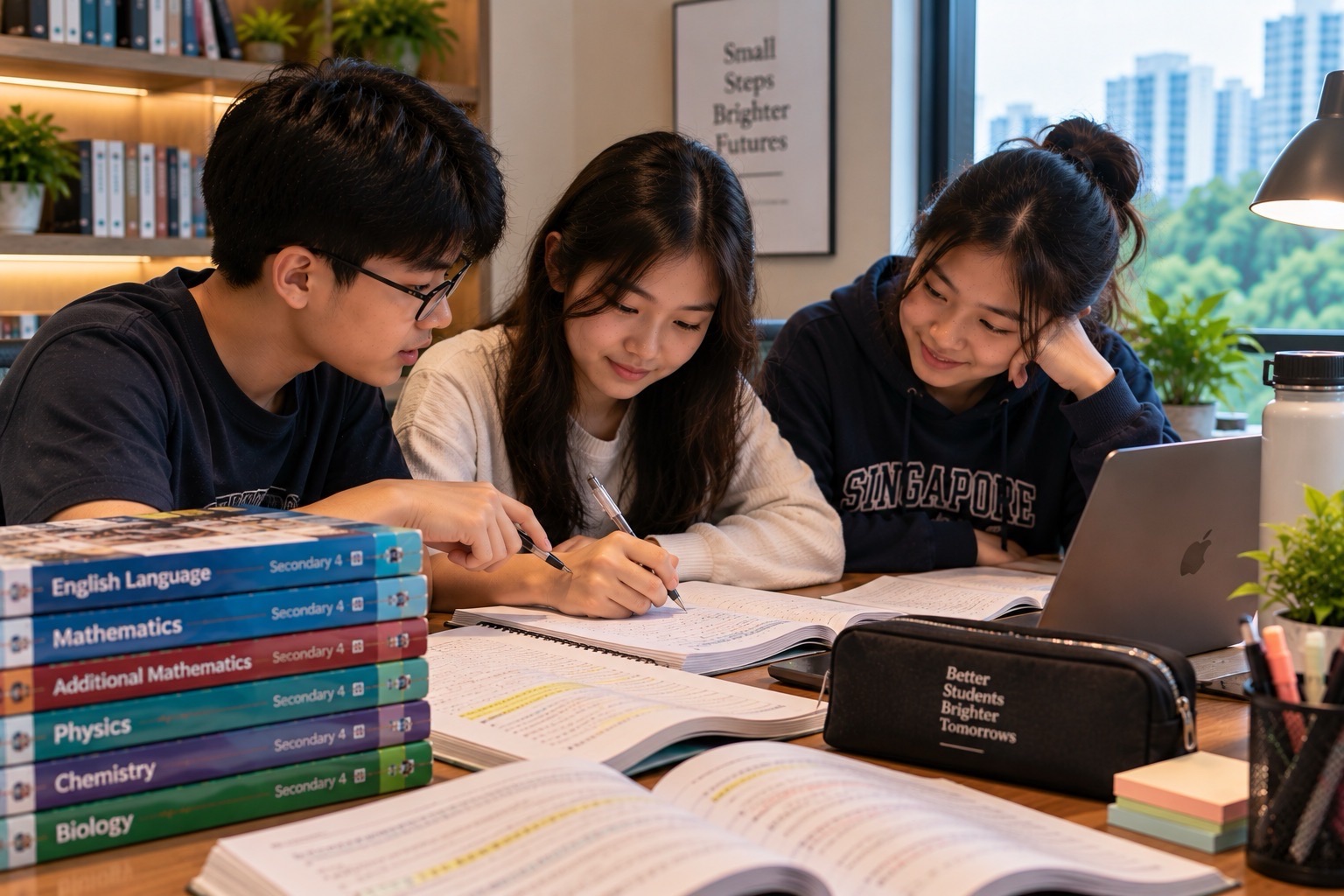
Home tuition in Bukit Timah or small-group tuition near Sixth Avenue MRT? Parents often start with that question when a child needs a tutor. Home tuition offers a familiar setting, no student commute and the possibility of continuous one-to-one attention. A small group adds a shared learning rhythm, individual written attempts and the chance to hear another student explain a difficult idea. Neither option is automatically better: the right choice depends on the learning problem, the child’s ability to study independently and the weekly timetable.
At eduKate Singapore, our Bukit Timah tutorial model is a group of up to three students at 8 Fourth Avenue, Singapore 268674, near Sixth Avenue MRT. Lessons are ordinarily 1.5 hours weekly, subject to class fit and a confirmed timetable. This is a centre-based small-group programme, not a promise of a home-tutoring service. If your child needs individual teaching at home, this guide will still help you evaluate that alternative fairly.
The quickest sensible decision is to take one recent piece of marked work, identify the first step the student could not complete without help, and ask: Which setting would make that thinking visible and teachable? A lesson format should be chosen to solve a specific problem—not because a private tutor sounds more prestigious, because a class is nearby, or because everyone in the child’s year has already joined tuition. Start with this guide and use Bukit Timah Tuition Hub for the relevant school year and subject.
Quick Answer: Home Tutor or Three-Student Tuition Class?
| The family is dealing with… | A good starting choice | Reason to check |
|---|---|---|
| A highly individual prerequisite gap or unusual pace | Consider a one-to-one home tutor. | The teacher may need sustained observation of one learner’s thinking before choosing the next task. |
| Confident understanding but unstable accuracy or recall | Consider a well-matched three-student group. | Short individual attempts, shared examples and spaced review may offer the right rhythm. |
| A learner who copies model answers and waits for prompts | Compare both formats carefully. | Over-help can occur in home lessons; hiding behind a fast classmate can occur in groups. |
| Heavy CCA and difficult afternoon journeys | Examine home tuition or a better-time class. | Travel fatigue can cancel the advantage of otherwise strong instruction. |
| A child who learns by comparing explanations | A small, carefully managed group may help. | Hearing a different approach can uncover more than memorising the teacher’s steps. |
| A learner who needs intensive individual writing feedback | An individual format may fit initially. | Drafting, marking and redrafting need careful observation and generous response time. |
| A child doing well without tuition | Consider maintaining self-study. | Extra tuition is not a requirement or an achievement in itself. |
These are starting points rather than rules. A very good home tutor can teach independent learning; a very good group tutor can diagnose a specific misconception. An unsuitable match can make either format disappointing. The decision becomes more reliable when you examine a real piece of student work.
First Decide What Is Actually Going Wrong
A parent’s phrase ‘weak in Mathematics’ may refer to completely different problems. One child does not understand fractions, another understands but forgets procedures, a third reads word problems too quickly, and a fourth can solve questions at home but becomes inaccurate under time pressure. They might receive the same test score. They should not automatically receive the same tuition.
Begin with the earliest unstable move. For a Mathematics question, that could be translating a sentence into an equation. For English, it could be selecting evidence that answers the question rather than copying a relevant-looking quotation. For Science, it might be identifying the changed variable before writing a conclusion. The tutor’s first job is to see where independent reasoning goes off course.
Write the learning problem in one sentence: ‘My child knows how to expand a bracket when shown, but does not recognise when expansion is needed in mixed questions.’ That sentence is useful because it describes an observable capability. ‘My child needs a more expensive tutor’ does not describe any skill that can be taught.
Next ask how often the problem appears. One unexpected mistake should not become a label. A repeated error over several independent attempts deserves closer attention. A student whose knowledge is solid but whose school week is overloaded may need a change in routine before a new teacher is introduced.
A Simple Three-Minute Diagnostic Conversation
- Ask the child to choose a school question they found difficult and describe the first point of uncertainty. Avoid correcting it immediately.
- Look at the uncorrected attempt. Which idea, instruction or representation caused the first departure from a valid method?
- Ask the child to explain the next step, not just give the answer. Listen for a reason that can be checked.
- Change one feature of the problem. Can the same relationship still be used, or does the learner rely on the familiar surface?
- Record whether the child solved the changed version independently, with a small hint, or only after a full demonstration.
This short diagnosis will not settle every educational question. It is enough to turn a vague enrolment search into a more useful discussion with either a private tutor or a small-group teacher.
What Home Tuition Actually Gives a Bukit Timah Family
A home tutor comes to the learner, so the student avoids travelling to a centre. After school and CCA, that convenience may be considerable. A one-to-one format can also give the tutor more time to inspect an individual student’s line of working, stop at an unexpected gap and reorganise the lesson without having to protect a shared class schedule.
Suppose a Secondary 2 student has missed several steps in fractions and algebra. In a home lesson, the tutor might discover that the child is still confusing subtraction of negative numbers. The lesson can temporarily return to the number line and inverse operations, then reconnect that idea to the original algebraic question. There is no need to move to the next topic because two other students are waiting.
But the same closeness can create a hidden risk. If the tutor is always a few centimetres away and supplies the next hint immediately, the student may appear to complete difficult work while making very few independent decisions. The home lesson has become a well-supported performance, not yet independent learning. This problem is solved by deliberately including quiet work, delayed hints and tasks the student must initiate alone.
The home itself may be an advantage or a distraction. A familiar table can reduce stress for one child; for another, siblings, devices, noise or the expectation that a parent is nearby may make it difficult to focus. Parents should judge the actual environment rather than assume that ‘home’ automatically means comfortable or effective.
Where a home tutor can have the strongest advantage
- Intensive repair when several prerequisite skills need to be untangled one at a time.
- A highly individual pace, including situations where a shared weekly syllabus would not fit.
- Detailed feedback on writing, solution construction or a specialised assessment task.
- Unusual school or family schedules that make fixed centre attendance genuinely difficult.
- Short-term intervention to diagnose a problem and establish a stable strategy before the learner returns to ordinary study or a suitable group.
These strengths depend on the tutor’s skills, availability and the child’s response. A private tutor is not necessarily more experienced merely because the session is one-to-one. Parents should still ask for a clear teaching plan, real feedback and signs of independent progress.
What a Three-Student Class Can Add
A small group of three gives the tutor two useful responsibilities at once: teach a shared idea and check each learner’s individual thinking. The presence of other students is not a substitute for a teacher’s attention. It can make the learning richer when the tutor uses differences carefully.
Imagine three Primary 5 children studying ratio. One pupil draws a bar model, the second thinks in parts, and the third tries to manipulate the numbers directly. The tutor may use all three approaches to discuss what a ratio part means. The essential step is still a private attempt from each child on a changed example. Otherwise the lesson only shows that one confident student has understood.
There is another benefit that parents sometimes overlook: during the minutes when the tutor is checking someone else’s work, the student must keep thinking. In an effective class this creates productive independence. The child learns to read the question, check a previous step, attempt a reasonable next move and prepare a precise question. Those habits are useful long after the tuition lesson has ended.
The group also gives language to confusion. A student who hears a classmate ask, ‘Why did you divide by five?’ may realise that they had the same uncertainty. This can be especially helpful in Mathematics and Science, where different representations reveal whether the concept is understood. In English, comparing two interpretations can show why evidence makes one reading stronger than another.
However, a small class works only if the group is reasonably matched. A student who needs to revisit Primary 4 division while two other pupils are preparing for a difficult Secondary assessment will not benefit just because the room contains only three people. The school year, current topic, prerequisite knowledge, confidence and pace all matter.

Three Students Does Not Mean Thirty Minutes Each
It would be misleading to assume that a 90-minute three-person class contains exactly 30 minutes of teaching per child. Much of the instruction is shared, and a shared explanation may be educationally useful for all three. The more important question is whether each pupil receives enough individual diagnosis, targeted feedback and time to attempt work alone.
Ask the tutor to describe a typical moment when two students understand and the third does not. Does the third child receive an alternative representation, a simpler prerequisite task or a deliberate check? Does the group then move on only after the child can complete a related question? The answer tells you more than the advertised ratio alone.
The Important Difference: Tutor Attention Versus Student Thinking
Parents understandably want attention. Yet the number of minutes the tutor speaks to a child is not the same as the number of useful decisions the child makes. In a private lesson, a teacher may talk continuously while the child writes only a few words. In a well-run small group, the pupil may spend more time reading, reasoning and checking their own working.
Neither extreme is desirable. A child left alone with no guidance can practise the wrong method repeatedly. A child guided at every step can become dependent. Good tutoring adjusts the level of support: explain when necessary, ask a focused question, allow a genuine attempt, respond to the specific mistake and step away as the learner grows.
Choose the lesson in which the student is helped enough to learn—but not helped so much that the tutor does the learning.
A useful observation is the first two minutes after a new question appears. Does the child recognise the task, decide how to start and make a sensible first attempt? Or does the hand go up immediately for another example? Strong tutoring works toward a more capable first two minutes.
A Mathematics Comparison: The Same Error in Two Settings
Consider 4(x − 2) = 20. A Secondary student may write 4x − 2 = 20 because they distribute the multiplier only to x. A home tutor can stop at that line and use four groups of x minus two to explain why both terms must be multiplied. A small-group tutor can demonstrate the same relationship and have three pupils each use a different representation before checking their individual work.
In both cases, the student should ultimately recognise that 4x − 8 = 20, then obtain 4x = 28 and x = 7. Substitution gives 4(7 − 2) = 20. The mathematical content does not change with the class format. What changes is how the teacher finds the error and how the student’s reasoning is tested.
The crucial next question is not another copy of 4(x − 2) = 20. Ask the child to solve 3(y + 5) = 27 without a model. Distribute to obtain 3y + 15 = 27, then 3y = 12 and y = 4. Ask why the number five becomes fifteen. If the child can explain and check it, the lesson has produced evidence of transfer. If not, the teacher needs to revise the explanation.
For a learner who becomes overwhelmed by symbolic notation, the individual format may provide the necessary time for counters, diagrams and incremental changes. For a learner who benefits from comparing valid methods but struggles to recall them later, the three-student class may be a productive match. The result, not the label, should guide the choice.
An English Comparison: More Talking Is Not Always Better
Take an inference question: a character checks the clock, looks toward the door and puts a half-written letter away. A weak answer is ‘She is afraid’ with no support. A stronger attempt identifies the observed behaviour, offers a reasonable interpretation and acknowledges that the text does not state the feeling directly.
A private English tutor might work slowly through how the child selects a quotation and builds a reason. The student may draft, receive specific comments and redraft. In a group of three, pupils might each propose an inference, then compare which one is best supported by evidence. The tutor should not declare a winner and move on; every learner needs to create a complete answer of their own.
The same principle applies to composition. A paragraph should be judged by whether the idea is coherent, the details serve that idea and the sentences make the meaning clear. The tutor’s correction should identify the exact writing decision to improve. Red ink without explanation may make a page look thoroughly checked without teaching much.
A child who is extremely reluctant to speak may need a low-pressure introduction before peer discussion. Another child may find that hearing a classmate hesitate and improve makes speaking feel less threatening. Parents should ask how both kinds of learners are supported.
A Science Comparison: Evidence Needs an Independent Check
Consider an experiment comparing how quickly sugar dissolves in cold and warm water. A student says, ‘Warm water always works faster.’ The tutor can ask what was measured and which factors were controlled: type and amount of sugar, volume of water, stirring and timing. The scientific claim should follow the actual observations rather than a remembered slogan.
One-to-one teaching is useful if the learner does not yet understand the meaning of a variable. Group teaching may be especially useful when three pupils compare proposed controls and explain why an unfair comparison cannot establish the effect of temperature alone. In both settings, each pupil should independently identify the changed variable and measured outcome for a new, age-appropriate experiment.
This matters because Science assessments do not only reward definitions. Students also need to read diagrams, distinguish observations from explanations, interpret tables and communicate a supported answer. The right tuition format is the one that makes those habits reliable.
Primary 1 to Primary 6: Age Changes What Good Tuition Looks Like
For a very young child, the first problem may not be academic difficulty at all. The school day may already be long; reading may still feel effortful; after-school attention may be limited. A Primary 1 parent should not assume the child needs ninety extra minutes simply because another family has begun tuition. Observe whether the child enjoys school, understands age-appropriate work and has time for rest and play.
When a Primary 2 child repeatedly reverses place value or has difficulty reading instructions, a patient tutor can help identify the exact issue. The choice between home and a small group should consider how well the pupil can focus outside home, tolerate transitions and attempt work without continual reassurance.
Primary 3 and Primary 4 bring more connected concepts: multiplication and division appear in new contexts, reading comprehension requires stronger inference, and Primary Science introduces more explicit observation and explanation. A group can make explanation social and memorable if individual understanding is checked. A private tutor may be appropriate when missing literacy or number foundations are highly individual.
For Primary 5 and Primary 6, exam preparation becomes more visible. However, doing complete PSLE-style papers before fixing a weak ratio idea or missing vocabulary connection often wastes precious time. Ask the tutor how they decide when a child is ready for timed mixed practice and when a conceptual lesson would produce more value.
For parents focusing on PSLE English, see PSLE Bukit Timah English Tuition: Small Group or Private Tutor? for the specialised version of the question. This article remains a cross-subject choice guide, not a substitute for a Primary syllabus.
Secondary 1 to Secondary 4: Programme Fit Matters More
Secondary 1 introduces new routines, longer school days and more abstract content. A family deciding about a tutor may be responding to weak Primary foundations, unfamiliar algebra, general anxiety about the move, or the desire for structured extension. Those are different needs. The student’s current subject level and school sequence should be part of any discussion.
With Full Subject-Based Banding, relevant Secondary subjects can be studied at G1, G2 or G3 levels. An appropriate group does not merely contain students of the same age; it should use material compatible with their actual subject level and readiness. Parents may consult MOE’s Full Subject-Based Banding information for the wider policy.
In Secondary 2, a student may appear to cope until algebra, graphs, geometry and more demanding multi-step tasks begin to interact. A specific missing prerequisite might justify temporary one-to-one repair. If the foundations are intact and the issue is retrieval or inconsistent practice, a well-matched regular group may be sufficient.
Secondary 3 and Secondary 4 introduce heavier subject depth and examination demands. E-Mathematics and Additional Mathematics should not be assumed to require identical support. Nor should a tutor claim that the right answer for a Science graph is the same as the right answer for an English argument. Subject-specialist feedback matters more as the tasks become sophisticated.
Families should also identify the child’s graduating cohort: the current 2026 GCE examinations are distinct from the SEC qualification beginning in 2027. The correct examination route and syllabus affect question selection and timing. Use SEAB’s official SEC information as the current official reference rather than relying on old advertising terms.
A companion page, Secondary 1 Bukit Timah Mathematics: Small Group or One-to-One After PSLE?, covers that particular transition in more detail.
The Real Bukit Timah Travel Question: Will the Child Have Energy Left?
One advantage of home tuition is obvious: the student does not have to travel to an additional venue. That may matter greatly when school ends late or the child has CCA. But a private tutor still requires a quiet home setting and a mutually workable appointment time. Parents should not assume that flexibility is limitless.
For eduKate Singapore’s centre-based format, the Bukit Timah location is 8 Fourth Avenue, Singapore 268674, near Sixth Avenue MRT on the Downtown Line. Actual class days and available places should be confirmed before a family plans a journey. A reference to Bukit Timah, Beauty World or King Albert Park does not mean tuition is held in those neighbourhoods; the teaching address should remain clear.
The correct comparison counts the full trip: leaving school or home, walking, possible train or bus transfers, waiting, the 90-minute tutorial, returning and beginning normal evening responsibilities. A family based near the Downtown Line may find the route convenient; another family with the same straight-line distance may face a tiring sequence of transfers.
Ask the child to help evaluate a realistic week. Would arriving after a rushed meal leave them alert enough for algebra or composition? Would Saturday tuition displace rest, reading and family time? If weekday CCA finishes unpredictably, will a fixed centre slot still work? Logistics become educational because attention is finite.

How to Compare Costs Without Misleading Yourself
A private home tutor usually quotes by the hour; a centre may quote by the lesson, four weeks, a calendar month or a term. Some fee structures include materials, while others list registration, books, deposits or make-up conditions separately. Comparing only the first visible number can lead to the wrong conclusion.
Put both proposals onto the same sheet: lesson length, expected number of sessions, monthly or term cost, extra charges, missed-lesson rules and transport expense. Then ask how much targeted teaching the learner is likely to receive. The question is not simply who is cheaper per hour but whether the programme has a credible mechanism for improving the child’s actual difficulty.
Never divide a three-student lesson by three and assume the child receives only a third of a class. Shared explanation can be useful. Equally, do not assume that every minute of private tuition is valuable merely because the tutor is continuously present. The correct unit of comparison is useful learning and independent progress, supported by transparent total cost.
We keep current commercial fees separate from this decision guide. For how to compare price structures in general, use the Tuition Fees Singapore guide. Ask each provider for a current quote in writing before enrolling; a published website price is not necessarily your confirmed bill.
The Parent’s Seven-Question Interview
- What exact skill would you test first? A credible tutor should describe a diagnostic action rather than promise to cover every chapter.
- What happens when the student makes the same mistake twice? Look for a change in explanation, representation or practice—not simply more repetitions.
- How often will my child complete work without prompts? Independent attempts should be deliberately designed into both private and group lessons.
- How does a three-person group handle different readiness? Ask how students are matched and how an individual gap is repaired while others work.
- Which current school level and syllabus will the material follow? For Secondary students, confirm G1/G2/G3 where relevant and the 2026 GCE or 2027 SEC route.
- How will you show progress after several lessons? Expect examples of original work, changed tasks and the student’s ability to correct errors independently.
- What are the true fees and timetable conditions? Ask for the exact charges, class duration, tutor, venue, absence policy and whether the format can change when needs change.
If the answer to every question is a claim about better marks, you are still missing the teaching plan. A grade is an outcome affected by many things. A useful tutor can explain the sequence of changes the learner must make before that outcome becomes more likely.
Three Realistic Family Scenarios
Scenario A: The Child Needs Foundation Repair but Is Very Tired
A Primary 6 pupil finds ratio confusing and is already attending several after-school activities. Their weekly timetable has little spare travel time. A short, clearly structured home lesson could be sensible if a capable tutor can work individually through the prerequisite and the family has a quiet space. But the decision should include a review: after the child can identify the whole, one ratio part and a changed question independently, is the same intensity still needed?
A well-matched small group at an accessible time could also work. The reason to choose home tuition is not that it must be academically stronger. It may simply protect the child’s energy while a specific problem is repaired.
Scenario B: The Child Understands at Home but Freezes With Mixed Questions
A Secondary 1 learner can follow worked algebra examples but cannot select a method when different topics appear together. The child can sit independently, tolerate peers and explain answers aloud. In this case, a small group might create the right discipline: each learner attempts a mixed problem without a chapter label, compares approaches and gets targeted feedback.
A one-to-one lesson could solve the same issue if the tutor avoids giving away the method. Ask both providers to demonstrate the progression from shown example to fresh independent attempt. Choose the teacher who can actually produce that progression.
Scenario C: A Strong Student Wants Deeper Challenge
A Secondary 3 pupil already achieves secure results and enjoys reasoning. Neither a large generic remedial class nor intensive private drilling is automatically appropriate. A small, compatible group may offer richer problem discussion and multiple approaches. An individual subject specialist may offer more focused extension in a particular area. In both settings, the challenge should deepen thinking, not simply race through next year’s chapters.
The family may also decide not to add tuition. For a learner who can already plan, practise and self-correct, reading, projects, school enrichment and independent learning can provide meaningful growth without another weekly commitment.
A Four-Week Trial of the Learning Process, Not a Grade Guarantee
When a suitable class or tutor has been chosen, the first review should focus on whether the teaching model works for the learner. Four weeks is an illustrative review window, not a promise that all academic gaps can be repaired in that time. Large gaps may take much longer, while small procedural issues may become clearer quickly.
| Point in the review | Ask the tutor | Ask the student |
|---|---|---|
| Before starting | What is the specific baseline question and why is it difficult? | Can you show the first attempt as it happened? |
| After the first lesson | What was the earliest significant misconception? | What did you learn to explain, not just remember? |
| After two or three lessons | Can the learner attempt a changed task unaided? | What do you now try before asking for a hint? |
| After several lessons | Is the original target improving and staying available? | Can you solve a similar but unfamiliar question without the notes? |
| At the review | Should the format, pace, frequency or teaching target change? | Does this lesson help you study more independently between meetings? |
The review can end in several legitimate decisions: continue the plan, adapt the level, switch to more individual support, move into a group, reduce lesson frequency, or stop because the original problem has been resolved. Tuition is an intervention, not a permanent identity.
When Neither Format Is the Best First Step
Sometimes a child is struggling because they have been ill, are adjusting to a school move, have too little sleep or are carrying an unsustainable schedule. More tuition does not automatically solve those conditions. Sometimes school feedback or a brief meeting with the subject teacher will clarify the difficulty more efficiently.
If the issue appears to be a significant learning or wellbeing need, begin with appropriate school or professional support rather than assuming a generic group or home tutor can meet every requirement. Tutoring may be complementary, but it should not be represented as a substitute for specialist assessment or support.
Conversely, a confident learner who is studying independently, understands feedback and has time for meaningful practice may not need tuition now. Parents can revisit the decision if the circumstances change. A good tutor should be comfortable with that answer.
Frequently Asked Questions: Private Tutor or Small-Group Tuition in Bukit Timah
Is home tuition better than a tuition centre in Bukit Timah?
Not as a general rule. Home tutoring can offer very individual pacing and save travel. A suitable small group can offer structured practice, peer explanation and a regular learning rhythm. Look at the child and the actual teaching process.
How many students are in eduKate Singapore’s Bukit Timah classes?
The established tutorial format is up to three learners. Ask whether a suitable place is available for the relevant school year, subject and level.
Where are the small-group tutorials held?
The Bukit Timah centre is at 8 Fourth Avenue, Singapore 268674, near Sixth Avenue MRT. Confirm the current appointment and lesson arrangements before visiting.
Does eduKate Singapore provide a home tutor?
This article describes the existing centre-based three-student tuition model and compares it with home tuition as an alternative. It does not promise that a home-tutoring service is available; enquire directly about current arrangements.
Do three students get enough attention?
They can when the tutor checks each child’s own working, asks individual questions and matches the learners well. Class size alone does not guarantee good teaching.
Is a one-to-one lesson always faster?
No. One-to-one pacing can be flexible, but excessive prompting may hide weak recall. The learner still needs independent practice and later transfer checks.
Which format is better for a shy child?
It depends on whether the child needs a calmer one-to-one introduction, a thoughtfully managed small group or support for a separate language or confidence issue. Ask how the tutor handles hesitation without embarrassment.
What if my child is very weak in Maths?
Start by identifying the earliest missing concept. A deep, unusual prerequisite gap may favour targeted individual repair; a well-matched three-pupil class may also work if the tutor can provide the necessary explanation and follow-up.
Can a strong pupil benefit from small-group tuition?
Yes, if the group offers real extension and comparison of methods. High achievers also need independent time and should not be given extra worksheets simply because they finish quickly.
Is small-group tuition suitable for Secondary 1 G1, G2 and G3?
Only where the actual subject level and student readiness are appropriately matched. Ask the provider to explain the grouping and school-syllabus alignment.
Is tuition necessary for every PSLE student?
No. Many learners can prepare well through school teaching, appropriate home routines and self-study. Tuition is useful when it addresses a specific need that is not currently being met.
Should parents choose tuition by distance?
The journey matters, especially after school or CCA, but so does teaching fit. Compare the full weekly schedule with the student’s attention and rest needs.
Should I ask for a trial lesson?
You can ask whether a trial or consultation is available and what it involves. Do not assume a free trial or open placement exists. Use it to assess teaching clarity and learner fit rather than expecting an immediate grade change.
How long are the small-group lessons?
The established Bukit Timah format normally uses 90-minute weekly lessons. Confirm the exact subject timetable, duration and terms.
Which is cheaper: private home tuition or small-group tuition?
The price per learner often differs because tutor time is shared in groups. Compare current written quotes, duration, fees, travel, policies and whether the teaching actually addresses the student’s problem.
How quickly should we see improvement?
Look for earlier evidence—clearer reasoning, more accurate changed-task attempts and less prompting—before relying on school grades. There is no guaranteed timetable for academic progress.
What should parents bring to a consultation?
Bring a recent marked school task, an original independent attempt if possible, the current subject level and topic sequence, plus realistic available days.
How do I enquire about a Bukit Timah small-group class?
Share the child’s school year, subject, current difficulty and suitable days with eduKate Singapore. Ask for the actual tutor, available group, fee and timetable before committing.
Useful Next Reading: Choose the Specific Route
- Tutor for Bukit Timah: Small Group Tuition Near Sixth Avenue MRT — location, class format and a wider Primary–Secondary parent guide.
- Bukit Timah Tuition Hub — find the appropriate school year and subject pathway.
- Home Tuition vs Tuition Centre guide — the Singapore-wide comparison of learning models.
- Private Tuition vs Group Tuition — how peer learning and individual pacing differ.
- Tuition Centre vs Private Tutor — a general format-selection framework.
- Tuition Fees Singapore guide — interpreting fee structures and the real cost of tuition.
- Secondary 1 Mathematics Tutor Clementi: Small Groups Tutorials — a detailed worked example of the three-pupil teaching method.
- SEAB’s official SEC information — official examination pathway information for the 2027 graduating cohort.
Arrange a Parent–Student Consultation for Bukit Timah Tuition
If a tutor in Bukit Timah is the next appropriate step, start by telling us what your child is trying to learn—not merely which grade you would like to see. Bring a marked question, show the first independent attempt and tell us which part was difficult. We can then discuss whether an existing three-student tutorial is a suitable fit, and clarify current availability and terms.
eduKate Singapore, Bukit Timah: 8 Fourth Avenue, Singapore 268674, near Sixth Avenue MRT. Class format: up to three students. Typical lesson: 1.5 hours weekly. Enrolment: by enquiry and suitable class placement. Ask directly for the current tutor, subject, date, fees and attendance policy.
Ask eduKate Singapore about a suitable small-group class. Read the Tutor for Bukit Timah: Small Group Tuition Near Sixth Avenue MRT for the complete first-step overview, or choose a subject through the Bukit Timah Tuition Hub.
The right tutor is the one who helps the child become less dependent on tutoring—not the one who can make every answer look correct while standing beside the student.