
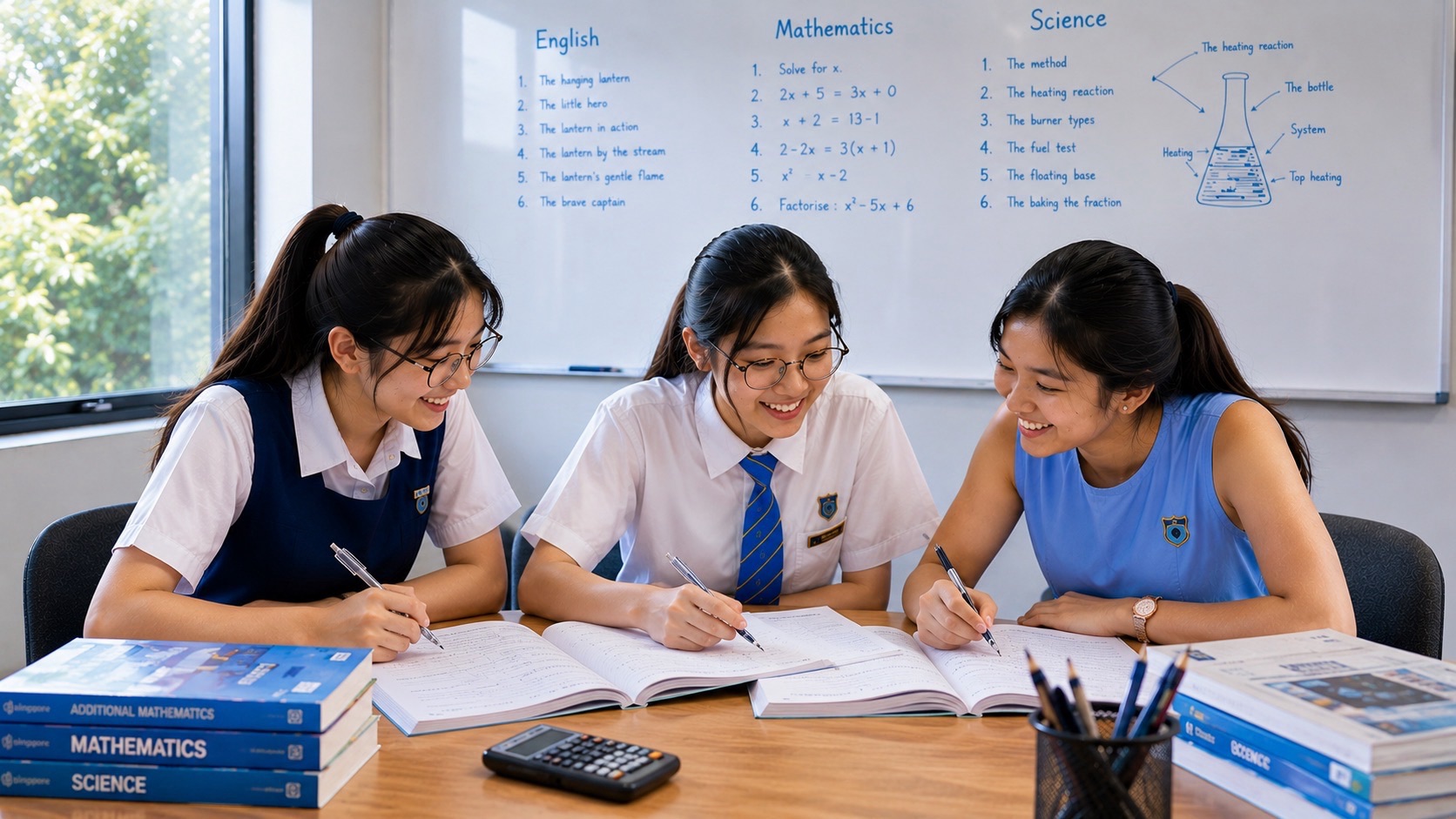
Tutors for Alexandra students should help a child connect what they notice, understand and can explain with the work they need to complete independently. At eduKateSG, families can enquire about 3-pax small-group tutorials near Sixth Avenue MRT, matched to the student’s subject, level and current learning needs.
A curious child may ask excellent questions and still struggle to organise an answer. A practical learner may see how something works but need help representing the relationship on paper. A suitable tutor should recognise both the strength and the missing step.
Our small-group tutorial model normally uses 1.5-hour weekly lessons, with explanation, guided practice, independent attempts and focused correction. Confirm the exact programme, tutor, class placement and availability during a consultation.
This guide serves Alexandra families considering our Bukit Timah teaching location. It does not announce a separate Alexandra classroom.
Arrange a parent–student consultation with eduKate Singapore
A Tutor Should Connect Curiosity With Clear Work
Parents may notice a child who enjoys building, comparing, reading or asking why. Those interests are valuable, but they do not automatically tell the family how the student will handle a particular school question.
The task may require a diagram, a precise calculation, selected evidence or an explanation of a relationship. The child can understand part of the situation while still needing help with that form of response. A tutor should investigate the connection rather than dismiss either side of the picture.
A student who can build a rectangle with tiles may still confuse its boundary with the space it covers. A child who notices a change in a plant may still be uncertain about which evidence supports a scientific explanation. A reader who sees a character’s dilemma may still omit the reasoning from a written answer.
The first teaching job is to identify what must become more explicit. Is the student missing the concept, the representation, the language or the method of checking? Each possibility suggests a different next task.
Choose a tutor who can explain that next task in ordinary language. A family should not have to accept a broad description such as weak foundations without being shown the particular relationship the child needs to learn.
The Hidden Problem: Recognising a Situation Is Not the Same as Solving the Task
A familiar context can make a question feel easy before the student has identified what it asks. A child recognises a garden, a timetable or a shopping situation and begins calculating from the most noticeable numbers.
The tutor should pause before the arithmetic. Which quantity is required? What information is relevant? What relationship connects the known values? The surface story can be familiar while the underlying task is new.
The same issue appears in English. A student recognises a familiar theme and writes an answer that would fit many stories, rather than the passage in front of them. In Science, a familiar object can prompt a memorised concept that does not explain the actual observation.
A good tutor separates recognition from reasoning. The child should learn to identify the demand before choosing the response. A familiar setting is an entry point, not permission to skip the question.
This distinction helps parents understand why a student can sound knowledgeable and still lose marks. The tutor’s role is not simply to add more facts. It may be to teach how existing knowledge is selected and represented.
Alexandra Gives the Guide a Location, Not a Single Student Profile
A neighbourhood name does not tell a tutor how a child learns, which schoolwork is difficult or how much support the family can provide. Those details need to come from the student’s actual circumstances.
NParks describes Alexandra Canal Linear Park as a connection from Commonwealth Avenue through the Strathmore and Dawson area to Tanglin Road. It provides a concrete local setting for discussing observation, routes and representation without assuming that every family uses the same starting point.
In a lesson, a tutor could use a simple invented route or a clearly labelled diagram to ask what information is needed to compare two journeys. That is a proposed teaching activity, not a claim that a particular child has completed a field lesson there.
The educational value lies in the question: what do we know, what are we estimating and what would need to be checked? The child learns to distinguish observation from assumption.
For tutor selection, the same discipline applies. Do not assume the closest station, the easiest collection arrangement or the right class from the area name alone. Ask for the actual departure point, school programme and learning need.
Why We Use 3-Pax Small-Group Tutorials
Three students create opportunities for individual observation alongside useful discussion. The tutor can ask one child to represent a problem, another to explain the relationship and a third to test the proposed method independently.
The format works towards a clear purpose: making thinking visible. It should not become a lecture delivered to fewer people. Every learner needs an opportunity to attempt, explain and receive feedback that addresses their own work.
One student may understand a diagram but struggle with the equation. Another may manipulate the symbols accurately without understanding the diagram. A third may be ready to compare two representations. The tutor should respond to those differences rather than assume that all three need the same explanation.
Parents can ask how waiting time is used. While one student receives help, are the others attempting a purposeful task or simply waiting? Small-group teaching still requires organisation and a reasonable match between the students’ needs.
A child requiring continuous individual support may need another arrangement. A secure learner should receive purposeful extension rather than extra routine pages. The consultation should establish whether the proposed group can provide the right teaching balance.
Start With the Actual Subject, Level and Schoolwork
Tell the tutor which subject requires support, the student’s school year, the current topics and the main concern. Include original attempts rather than only completed corrections. The tutor needs to see the thinking that produced the result.
For Secondary students, add the actual subject level and examination year. SEAB’s SEC guidance identifies the Singapore-Cambridge Secondary Education Certificate from 2027, with subjects taken at G1, G2 or G3.
A student should not be placed using age alone. The tutor needs to know the course and the standard of work being studied. Different schools may also introduce topics in different sequences, so exposure should not be confused with readiness.
For Primary learners, identify the component causing difficulty. A child may need help with inference rather than reading aloud, mathematical representation rather than arithmetic, or Science explanation rather than factual recall.
Confirm exact class coverage before enrolling. This guide discusses several possible tutoring needs. It does not describe one ninety-minute class that promises to teach all Primary and Secondary subjects together.
Primary English: Observe Carefully, Then Choose the Right Words
A Primary English tutor should help the student connect language to evidence. An accurate ordinary word can be stronger than an impressive word that describes something the passage does not show.
An original inference exercise
Consider this practice passage: “Nora noticed that one corner of the model kept lifting. Instead of adding more decorations, she removed the loose strip, checked the base and pressed the corner down again.” The question asks what her actions show about how she approached the task.
The passage supports the idea that Nora attends to the underlying problem before continuing the decoration. A student could describe her as careful or methodical, provided the explanation connects the word to the actions.
The tutor should not accept a claim that she is a professional designer or always succeeds at practical work. Those details are not established. The exercise teaches the difference between a supported interpretation and a story added by the reader.
Explain the connection, not only the label
“Nora is careful” is a conclusion. The written answer becomes stronger when the student explains that she checks and repairs the base before adding decoration. The tutor can ask which action makes the description reasonable.
If the child understands the action but lacks the vocabulary, teach the word in context. If the vocabulary is known but the evidence is missing, teach the reasoning. Those are different needs, even when the final answer is short in both cases.
Carry the principle into composition
In composition, a character’s quality should become visible through a relevant decision or action. A tutor can help the student replace repeated labels with a clear event that demonstrates the point.
The aim is not to ban descriptive words. It is to make description meaningful. A useful lesson leaves the student able to ask whether the reader has enough evidence to understand the character, rather than simply accepting the writer’s announcement.
Primary Mathematics: The Boundary and the Space Inside Are Different
A tutor can use geometry to inspect whether the student distinguishes related quantities. Perimeter and area both concern a shape, but they answer different questions. The units and operations should follow the quantity being measured.
Consider two original rectangular designs. The first measures 8 cm by 3 cm. Its perimeter is 22 cm and its area is 24 square centimetres. The second measures 7 cm by 4 cm. Its perimeter is also 22 cm, but its area is 28 square centimetres.
The comparison shows that the same perimeter does not force the same area. A student who assumes otherwise needs to inspect the relationship rather than memorise another formula. A diagram or arrangement of unit squares can make the distinction visible.
The tutor can ask which quantity would matter for placing a border around the rectangle and which would matter for covering its interior. These are illustrative design questions, not measurements of any actual Alexandra park feature.
Next, change one dimension and ask the student to predict which quantities will change before calculating. The explanation is useful even when the arithmetic is simple. It reveals whether the learner is thinking about the shape or merely searching for a formula.
A good tutor does not rush to a more complicated composite shape before this distinction is secure. Difficulty should be added in a way that develops understanding rather than conceals a missing foundation.
From a Diagram to a Calculation and Back Again
A student may solve a diagram-based problem successfully and struggle when the same information is written in sentences. Another may use a formula correctly but be unable to explain what the variables represent.
The tutor should connect the representations. Ask the child to identify where each number appears in the diagram, what each operation measures and how the answer can be checked against the original situation.
For the two rectangles, the student can trace the boundary to explain perimeter, then count or organise unit squares to explain area. The formal calculation should become a concise representation of that relationship.
When the answer is unreasonable, return to the representation. Did the student use a length where a width was needed? Were the units mixed? Was the question asking for the boundary while the calculation found the interior?
This creates a checking method that is more useful than simply repeating the same arithmetic. A tutor should teach the student how to return to meaning when the calculation no longer seems to fit.
Primary Science: Curiosity Needs a Fair Comparison
A child may propose an interesting explanation after observing a change. A Science tutor should help the student distinguish that starting idea from a conclusion supported by an investigation.
Imagine an illustrative question comparing two plant setups. One receives a different amount of light, but the question also describes differences in plant type and watering. The tutor can ask whether the observed difference can confidently be attributed to light alone.
The student should notice that more than one condition differs. A fairer comparison for the stated question would need the other relevant conditions controlled. The exercise does not claim a real experimental result; it asks the learner to examine the design.
The tutor can then present a clearer hypothetical setup and ask which outcome should be measured. The student separates the condition being changed from the observation used to evaluate the effect.
This reasoning matters before writing a polished answer. A sentence containing scientific terminology does not become well supported if the comparison itself cannot answer the question. The tutor should make the limitation understandable rather than reward confident guessing.
A Science Explanation Should State What Connects the Evidence
A student may describe an observation accurately and still leave the explanation incomplete. The tutor should ask what relationship links the condition in the question to the outcome being discussed.
One useful teaching task is to compare two responses. The first repeats the result. The second identifies a relevant concept and connects it to the given conditions. The student explains why the second response answers more of the question.
The comparison should not be reduced to counting words. A longer answer can repeat the same observation several times. A shorter answer can be complete when it includes the necessary relationship accurately.
Parents can ask the tutor to show the missing connection in one original answer. The explanation should be specific enough to guide the child’s next attempt. “Use better Science language” is less useful than identifying what the sentence needs to explain.
A later task should change the surface of the question. The tutor can then see whether the student learned how to connect evidence and concept or merely remembered the wording of the correction.
Secondary English: Evidence Does Not Always Support the Biggest Claim
Secondary writing often requires a student to make a point, support it and explain its significance. The tutor should inspect how far the evidence justifies the claim rather than focus only on the fluency of the sentence.
In an illustrative paragraph, a student describes enjoying one outdoor learning activity and concludes that all lessons should take place outside. The experience may support a benefit of observation in that activity. It does not establish the same arrangement for every subject or task.
The tutor can ask for a more precise claim and a clear explanation of when the example applies. A qualification should improve accuracy, not make the argument indecisive. The student is learning to match the conclusion to the evidence.
In comprehension, the same care prevents the learner from attributing a motive the passage does not establish. In summary, it helps the student select the ideas relevant to the actual question rather than compress every interesting detail.
Bring the component causing difficulty to the consultation. A strong oral response does not eliminate a writing problem, and accurate grammar does not prove secure interpretation. A suitable tutor should be able to identify the particular decision requiring work.
Secondary Mathematics: Know Whether the Task Asks for an Expression or a Solution
A tutor should teach students to read the mathematical task precisely. Simplifying an expression, factorising it and solving an equation are related activities, but they do not ask for the same output.
For a learner studying this material, consider the expression x² − 5x + 6. It factorises as (x − 2)(x − 3). That factorisation does not, by itself, say that x must equal two or three. No equation has yet been stated.
If the task is instead to solve x² − 5x + 6 = 0, the zero-product relationship gives x = 2 or x = 3. The equation supplies the condition that makes those solutions relevant.
A student who writes solutions when asked only to factorise may know the procedure but be reading the task imprecisely. A student who cannot identify suitable factors has a different need. The tutor should distinguish the two before assigning the next practice.
For Additional Mathematics, confirm that the tutor teaches the relevant course and can connect current topics to the student’s algebraic foundations. The example above illustrates task interpretation; it is not a claim that every Secondary level studies identical material at the same time.
Our Teaching Sequence: Observe, Represent, Explain and Check
The tutor begins by observing the student’s attempt. What information was selected? Which quantity or claim was identified? At what point did the learner need support? A broad concern becomes useful when it leads to one specific teaching action.
Where appropriate, the idea is represented more clearly. A diagram, short comparison or manageable numerical example can expose the relationship. The representation should help the student return to the full task, not become an unrelated activity.
The student explains and attempts the method. Feedback addresses the first important error while preserving what was already correct. The tutor should avoid replacing a valid alternative approach simply because it differs from the demonstration.
The What Works Clearinghouse study guide recommends connecting concrete and abstract representations and returning to learning over time. A later independent question helps the tutor inspect whether the relationship remains available without the original explanation.
The final check can change the context or representation. If the student recognises the same idea, the tutor can reduce support or extend the task. If not, the next explanation can address the specific part that did not transfer.
What Happens During a 90-Minute Tutorial
A possible lesson begins with a short return to an earlier target. The student attempts the question before reviewing the old model. This gives the tutor a view of what remains available and what needs attention.
The central explanation follows. The tutor makes the relationship clear and asks questions that require the learner to do more than agree. A student should be able to identify what the representation shows or why the operation is valid.
Guided practice gives room to try while feedback is nearby. The tutor can pause at a meaningful error, explain the principle and ask for another attempt. Students also need time to think without every hesitation being interrupted.
Independent work reduces the help. A mixed or changed question then tests recognition and method selection. While one student receives feedback, the others should have a defined task suited to their own readiness.
The closing review explains the continuation work and the skill it is intended to check. This is a possible rhythm, not a fixed script. The tutor should adjust when a prerequisite proves weaker than expected or when the students are ready for a different challenge.
Three Pathways for Different Learning Needs
The following situations are hypothetical. They describe teaching decisions rather than actual Alexandra pupil outcomes. A student may need a different pathway in each subject or component.
Repair a concept or representation
A learner confuses perimeter with area. The tutor returns to the boundary and interior of a simple shape, uses clear units and asks the student to explain what each calculation measures. The repair should then be used in the current school task.
Stabilise the choice of method
Another learner understands both quantities but chooses the wrong formula when the question is presented as a word problem. The tutor inspects how the demand is being read and uses changed examples to make the selection more deliberate.
Extend the reasoning
A secure learner compares several rectangles with the same perimeter and explains why the areas differ. The tutor can increase the challenge through comparison and justification rather than simply adding more routine calculations.
The pathway should change when the evidence changes. Repair is not a permanent identity. Extension is not a reward for being labelled strong. Each describes the most useful teaching job at that point.
Using Everyday Context Without Inventing Evidence
A local setting can make an example easier to discuss, but the tutor should distinguish real information from invented practice data. A diagram of a rectangular garden is a useful teaching model only when the student knows whether its measurements are hypothetical.
This distinction matters beyond Mathematics. A child observing a public space may notice that two areas look different. That observation can generate a question, but it does not by itself establish the cause of the difference.
The tutor can ask what additional information would be needed. Were the observations made at the same time? Are the conditions comparable? What measurement would answer the question more clearly?
These are proposed reasoning prompts, not instructions to turn every family outing into fieldwork. A classroom diagram or short written scenario can serve the same teaching purpose. The important habit is separating what is known from what is assumed.
Parents can look for that habit when evaluating a tutor. Does the tutor acknowledge the limits of an example and explain the assumptions? Precise teaching should make the evidence clearer, not make invented detail sound factual.
Corrections Should Give the Student a Better Check
A correction is more useful when it changes what the student will inspect next time. A restored answer is only the visible result. The learner also needs to understand the decision that produced the error.
For Mathematics, that might mean checking whether the unit is a length or an area, whether the task asks for an expression or a solution, or whether the known quantity represents the whole. The prevention habit should match the error.
For English, the check may concern the evidence behind a description or the missing connection in a paragraph. For Science, it may concern whether more than one condition changed in a supposed comparison.
Ask the student to explain the correction without looking at the model answer. The explanation does not need to sound technical. It needs to be specific enough to guide another attempt.
A later changed question can show whether the check has become usable. If the same prompt is still needed, the tutor should examine why rather than assume that completing the correction finished the learning.
Home Practice Should Be Clear Enough to Start
The student should leave the lesson knowing the purpose of the continuation task, which materials to use and what to record when stuck. A large assignment without a clear first step can hide the very difficulty the tutor needs to see.
One proposed task might ask the child to identify the quantity required before doing the calculation. Another might ask for a short explanation of why a comparison is fair. A third might revisit one corrected sentence in a new context.
These are possible task forms, not a fixed workload for every age. The tutor should select the amount according to the current target and the student’s school commitments. More work is not automatically more informative work.
Parents can help by checking that the instruction is understood and preserving the independent attempt. Where help is supplied, note it. A correct page completed with extensive guidance should not be mistaken for a task the student could manage alone.
If the child repeatedly cannot begin, the next lesson should investigate the instruction, prerequisite or task size. The response should be more precise than simply assigning another set of the same work.
Teaching Ahead Should Follow Understanding, Not Replace It
A tutor may introduce a topic before school when the student is ready. The useful question is what that introduction is intended to develop and which prerequisites it assumes.
A child uncertain about area and perimeter may not benefit from a more complicated composite figure yet. A student unable to distinguish an expression from an equation may need that language clarified before a new algebraic procedure is added.
Sometimes the right extension remains within a familiar topic. Comparing cases, finding a counterexample or explaining a limitation can deepen control without moving to the next chapter.
Ask the tutor what the student can now do independently and what the advance task will require. The decision should follow that evidence rather than another family’s pace or a claim about being many chapters ahead.
What Progress Should Look Like
Start with the original teaching target. If the child confused two quantities, inspect whether later work distinguishes them. If the problem was unsupported explanation, compare whether the response now connects the evidence to the conclusion.
Keep the conditions visible. Was the question familiar? Were notes open? Did the tutor supply a diagram or a first step? Those details affect what the attempt demonstrates and should be considered before comparing scores.
A useful review can show the original work, a later independent attempt and a changed task. The tutor explains what became more secure and what still needs support. The student can also describe which question they now ask themselves before beginning.
Grades remain important, but identical improvements cannot responsibly be promised to every child within a fixed period. Starting gaps, attendance, practice and school assessments differ. Ask for evidence and a clear next teaching decision.
The review should lead to action: continue, adjust the representation, revise the practice, reduce support, extend the task or reconsider class fit. A description of progress is useful when it changes what the tutor and student do next.
When Should an Alexandra Family Consider Tutoring?
A consultation may help when a child understands a situation but repeatedly struggles to represent it, when written answers leave out important reasoning or when the same correction is needed across several tasks.
It may also clarify whether a strong practical or curious learner needs purposeful extension. Interest alone does not require tuition. The additional lesson should have a clear teaching purpose that the family and student can understand.
One weak assessment deserves inspection before it becomes a decision to add a programme. The issue may be concentrated in one topic or in how the question was read. The response should fit that evidence.
Equally, a passing mark does not settle a concern about dependence. A child may achieve a result while adults supply much of the homework thinking. A suitable tutor examines both performance and the amount of support required.
Planning the Journey from Alexandra to Sixth Avenue
Alexandra families should begin with the student’s actual departure point rather than assume one station serves every address. Use the LTA network map and current journey information to compare suitable connections.
A route beginning near Queenstown MRT is different from one beginning farther along the Alexandra corridor. A child leaving school may have another starting point again. Compare the complete journey on the intended lesson day, including the first and last walks.
The location described in our tutorial information is 8 Fourth Avenue, Singapore 268674, near Sixth Avenue MRT. Consultations are by appointment.
Confirm the address, lesson time and collection plan before visiting. The neighbourhood in this guide identifies the families it serves; it does not establish a local branch. A teaching arrangement should be clear academically and practical enough to sustain.
Class Details and Consultation Preparation
The small-group format accommodates up to three students, with lessons normally lasting 1.5 hours weekly. Enquire about the appropriate Primary English, Mathematics or Science programme, Secondary English or Mathematics programme, or suitable Additional Mathematics support.
Bring recent marked work, an original independent attempt, current school topics and relevant teacher comments. Include one manageable task and one that repeatedly requires help. The contrast can reveal which representation or decision becomes difficult.
Describe the support already supplied at home. A child may have understood the calculation after an adult drew the diagram. That is useful evidence of what the representation helped with and what the student still needs to learn to produce independently.
Discuss current fees, materials, attendance arrangements and any trial availability directly. The consultation should clarify the teaching plan and practical commitment before the family settles into a regular class.
Frequently Asked Questions
My child is curious and practical. Why can written work still be difficult?
The tutor should inspect the step between understanding the situation and representing it on paper. The difficulty may concern the concept, diagram, language or task demand. The child’s curiosity remains a strength; the lesson should identify the particular connection that needs teaching.
Should a tutor use everyday examples?
They can be useful when they clarify the relationship being taught. The tutor should distinguish real information from invented practice data and return to the formal task afterwards. A familiar setting should support reasoning rather than distract from what the question asks.
Does this article announce an Alexandra branch?
No. The arrangement described is for students travelling to the Bukit Timah location near Sixth Avenue MRT. Confirm the actual teaching address, programme and appointment details before visiting.
Can a three-student class accommodate different approaches?
It can when the students’ needs are reasonably compatible and the tutor plans meaningful work for each learner. Different valid methods can become useful discussion material. The tutor should still check individual attempts rather than assume that agreement with a peer demonstrates independent understanding.
What if my child confuses similar concepts?
Ask the tutor to compare them explicitly. Perimeter and area, observation and explanation, or expression and equation answer different questions. A focused contrast can reveal what the child has misunderstood and provide a clearer target than general extra practice.
Will the tutor teach ahead?
Where appropriate, pre-teaching follows readiness. The tutor should explain which prerequisites the new work assumes and what the student will attempt afterwards. Moving to a new chapter should not replace repair of the relationship currently causing difficulty.
What should extension involve?
Purposeful comparison, explanation or unfamiliar application. A secure student might test whether a rule always works or explain why two representations describe the same relationship. The tutor should name the capability being developed rather than simply increase routine volume.
How do we know whether the arrangement is working?
Review the original target using comparable independent work and note the support provided. Ask what became more secure, what remains uncertain and what changes next. Include the practical routine in the review, rather than judging the whole arrangement from one test mark.
Helpful Reading for Alexandra Parents
For subject-specific guidance, read Primary 5 Mathematics Tuition for Alexandra, Primary 6 Mathematics Tuition for Alexandra and PSLE Mathematics Tuition for Alexandra. The Mathematics Learning Hub provides further routes by stage and topic.
A Tutor Who Helps the Student Make the Connection
Good tutoring should help a student connect the situation to the representation, the evidence to the explanation and the method to the question. The work becomes clearer because the relationships become clearer.
For Alexandra families, choose a tutor who can recognise the child’s existing strengths and identify the next teachable step. The objective is not to replace curiosity with a worksheet routine. It is to help the learner use that curiosity with greater precision and independence.
Speak with eduKateSG about tutoring for an Alexandra student