
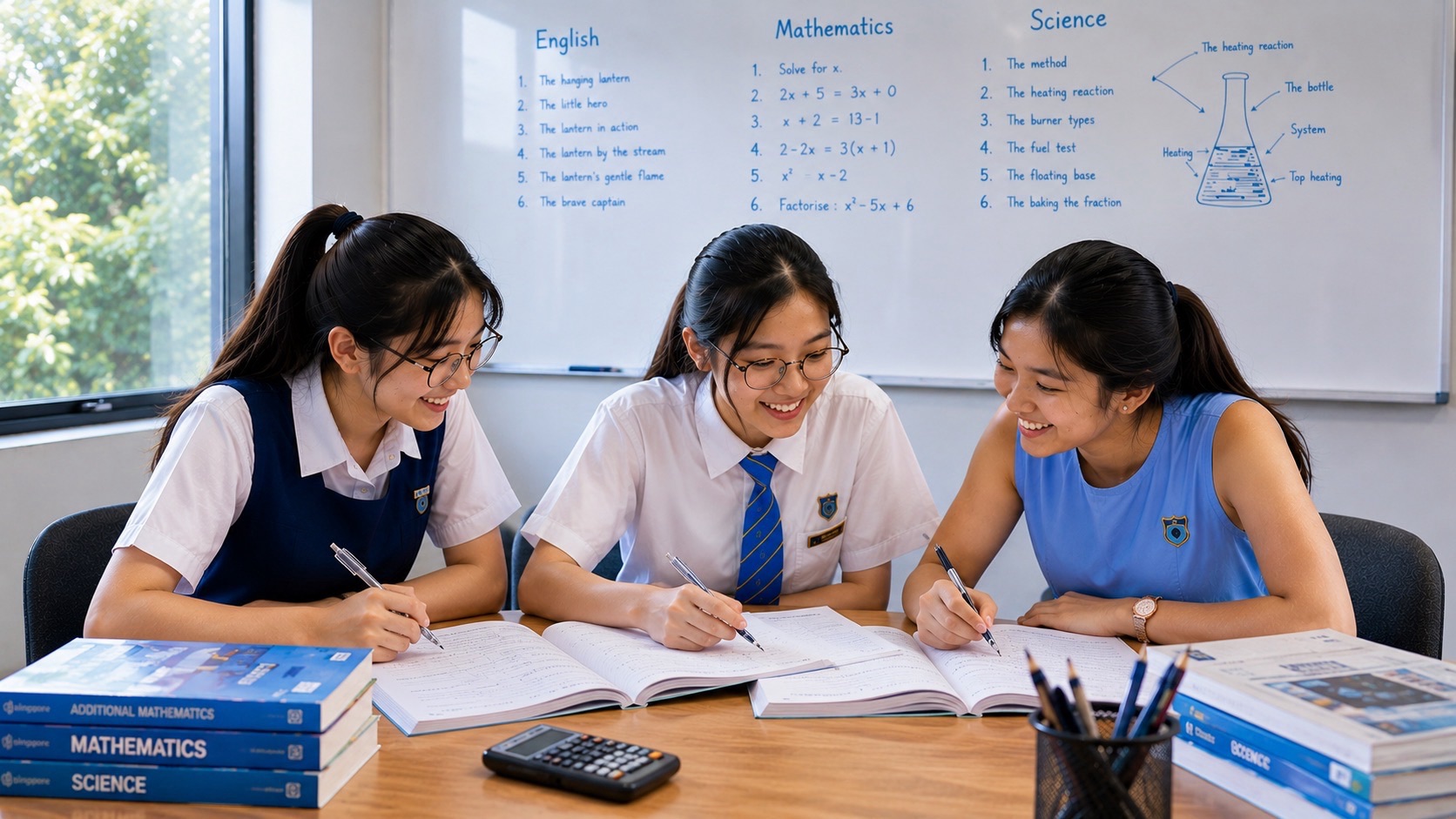
Tutors for Bedok families should help students build consistency before examination pressure exposes every weak point at once.
Many students do not fail because they never understand.
They fail because understanding appears and disappears.
A method works on Monday, is uncertain on Thursday and is gone by the time the test arrives. A composition improves after correction, but the next piece repeats the same weakness. A Science concept is remembered in one chapter and forgotten when the question changes context.
Good tutoring should make learning more stable.
At eduKateSG, our 3-pax small-group tutorials use retrieval, error analysis, guided practice, interleaving and independent application to turn temporary understanding into more dependable performance.
Lessons are 1.5 hours weekly. We support Primary and Secondary students in English and Mathematics, Primary Science, and Additional Mathematics for suitable upper-secondary students.
The goal is not one excellent lesson.
The goal is learning that survives the week.
See eduKateSG small-group tuition programmes
Arrange a parent–student consultation
Chat with eduKateSG on WhatsApp
Consistency Is a Learning Skill
Parents often describe a student as inconsistent.
The word can sound like a personality description.
Usually it is more useful to treat inconsistency as a system problem.
What changes between the good performance and the weak one?
Perhaps the student can answer when the chapter is obvious but not when topics are mixed. Perhaps the student can work accurately when untimed but loses control during tests. Perhaps the method is remembered only while the notes are open.
The tutor needs to identify the condition under which performance breaks.
Then practice can be designed around that condition.
Why Retrieval Matters
Learning that can only be recognised is fragile.
Students need opportunities to retrieve information without seeing the answer first.
Retrieval can be simple.
- reconstruct a formula from memory;
- explain yesterday’s concept without opening notes;
- write the first step of a method;
- define a vocabulary word in the student’s own language;
- identify the scientific relationship in a new diagram;
- outline a composition paragraph before looking at a model.
These tasks feel harder than rereading because they expose what is missing.
That difficulty is useful.
The tutor can then repair the missing piece before the assessment exposes it.
What We Diagnose
English
We separate vocabulary, grammar, comprehension, inference, evidence selection, paragraph development, composition structure, summary and oral communication.
Mathematics
We examine number fluency, fractions, algebra, signs, diagrams, formula selection, sequencing, presentation and checking.
Science
We look at concept knowledge, application, experimental variables, data interpretation, cause-and-effect reasoning and scientific language.
Performance
We also observe whether the student loses accuracy under time pressure, avoids difficult tasks, relies on answer keys or forgets material after short delays.
Why Three Students Help Build Consistency
A 3-pax class lets the tutor revisit earlier learning without losing sight of the current school topic.
The tutor can check one student’s retrieval while another attempts independent work, then rotate attention closely enough to notice patterns.
Students also see that consistency is built through repetition with variation, not through one perfect explanation.
- old work can be revisited frequently;
- individual error patterns remain visible;
- students answer often;
- working can be checked closely;
- pace can be adjusted;
- stronger students can receive extension;
- students needing repair can return to prerequisites.
The group is small enough for continuity.
Primary English: Make Strong Language Repeatable
A student may write one excellent composition and then return to weak habits.
The tutor’s job is to identify what made the stronger piece work.
Was the opening clearer? Were details more specific? Were sentences better controlled? Did the student plan before writing?
Those strengths must become repeatable.
We therefore revisit vocabulary, grammar, comprehension and writing structures in different contexts so students learn principles rather than one-off solutions.
Primary Mathematics: Stable Methods Before Speed
Mathematics consistency depends on foundations.
A student who is uncertain with fractions or ratio may appear strong on routine questions and collapse when several steps are combined.
We build accuracy first, then increase pace.
The student should know not only what to do, but how to check.
A dependable method is more valuable than a fast method that fails whenever the surface changes.
Primary Science: Retrieve the Relationship
Science concepts need to become available without the textbook open.
Students should be able to identify the relevant relationship in a new situation and explain why it applies.
We revisit concepts across different diagrams, experiments and question forms so the student learns the principle rather than one memorised sentence.
Secondary Tutoring: Stability Under Greater Load
Secondary school increases the number of subjects and the length of reasoning chains.
A weak habit that once cost one mark can begin affecting several steps.
Secondary English
Students need dependable reading, inference, evidence, summary and writing control.
Secondary Mathematics
Algebra, graphs, geometry, trigonometry and statistics require accurate working across multiple steps.
Additional Mathematics
A-Math requires stable algebraic fluency and enough retrieval strength that earlier techniques remain available while new topics are added.
The eduKateSG Stability Loop
1. Teach
Make the concept clear.
2. Practise
Build an accurate first version of the method.
3. Retrieve
Revisit after a delay.
4. Mix
Place the idea among other possible methods.
5. Vary
Change wording, numbers or representation.
6. Review
Identify what failed.
7. Repeat
Return until the method becomes dependable.
Consistency is built by surviving variation.
What Happens in a 90-Minute Lesson
- retrieval from previous lessons;
- diagnosis of current gaps;
- clear concept instruction;
- guided practice;
- independent application;
- mixed-topic work;
- error review; and
- focused continuation work.
The lesson changes as the student moves from repair toward stability and then extension.
Repair, Stabilise and Extend
Repair
An earlier gap is blocking current work.
We rebuild the prerequisite.
Stabilise
The student understands but performance varies.
We strengthen retrieval, accuracy and mixed application.
Extend
The student is secure.
We increase unfamiliarity, transfer and independent reasoning.
What Progress Looks Like
- older methods are remembered more reliably;
- the same mistakes appear less often;
- test performance becomes less volatile;
- the student can work without reopening notes immediately;
- homework starts more independently;
- working becomes clearer;
- the student can explain why an answer is wrong; and
- unfamiliar questions become more manageable.
The direction is from occasional success toward dependable performance.
When a Bedok Family May Need Tutoring
- results swing sharply between tests;
- the student understands during lessons but forgets later;
- corrections do not survive into the next assignment;
- school pace is exposing an earlier gap;
- the student depends heavily on model answers;
- the student needs a smaller environment with denser feedback; or
- the student is strong and needs purposeful extension.
Consistency is easier to build before examination pressure becomes severe.
From Bedok to Sixth Avenue
eduKateSG’s Bukit Timah teaching location is at 8 Fourth Avenue, Singapore 268674, near Sixth Avenue MRT on the Downtown Line.
Bedok is on the East–West Line. Students can travel toward Bugis, transfer to the Downtown Line and continue to Sixth Avenue.
For families making the journey, the route creates a clear transition from the ordinary school day into a focused tutorial block.
Location: eduKateSG, 8 Fourth Avenue, Singapore 268674
Nearest MRT: Sixth Avenue MRT, Downtown Line
Attendance: By appointment
Class Details
Format: 3-pax small-group tutorials
Duration: 1.5 hours weekly
Levels: Primary and Secondary
Subjects: English, Mathematics, Primary Science and Additional Mathematics for suitable Secondary students
Teaching features include retrieval, interleaving, error analysis, guided practice, independent application, school-assessment alignment and carefully paced pre-teaching.
Frequently Asked Questions
Do you support students from Bedok?
Yes. Students from Bedok can attend our small-group teaching location near Sixth Avenue MRT, subject to a suitable class placement.
What if my child is inconsistent rather than weak?
Then the teaching focus is usually stabilisation: retrieval, mixed practice, checking and repeated performance under changing conditions.
Do you teach ahead?
Yes, when the foundation is ready. Pre-teaching should improve later school learning, not simply add more chapters.
Can a 3-pax class support a struggling student?
Yes, when class fit is appropriate and the tutor can protect enough individual attention for repair.
What if my child is already strong?
Then extension should increase transfer, depth and independent decision-making.
How quickly will grades improve?
There is no fixed responsible timeline. Progress depends on the starting gap, attendance, practice and assessment timing.
Does every student need tuition?
No. Tuition is useful when it solves a real learning problem or provides purposeful extension.
Tutors for Bedok Families
Good tutoring should make success less accidental.
A method should not work only while the tutor is beside the student.
A concept should not disappear after the weekend.
A strong correction should affect the next piece of work.
For students who need repair, we rebuild.
For students who need consistency, we stabilise.
For students who are ready, we extend.
The objective is learning that survives time, variation and pressure.
Arrange a Parent–Student Consultation
Speak with us about your child’s level, current results, learning patterns and upcoming assessments.
eduKateSG
8 Fourth Avenue
Singapore 268674
Near Sixth Avenue MRT
3-pax small-group tuition
By appointment
Properly taught kids shine a bright light into the future.