
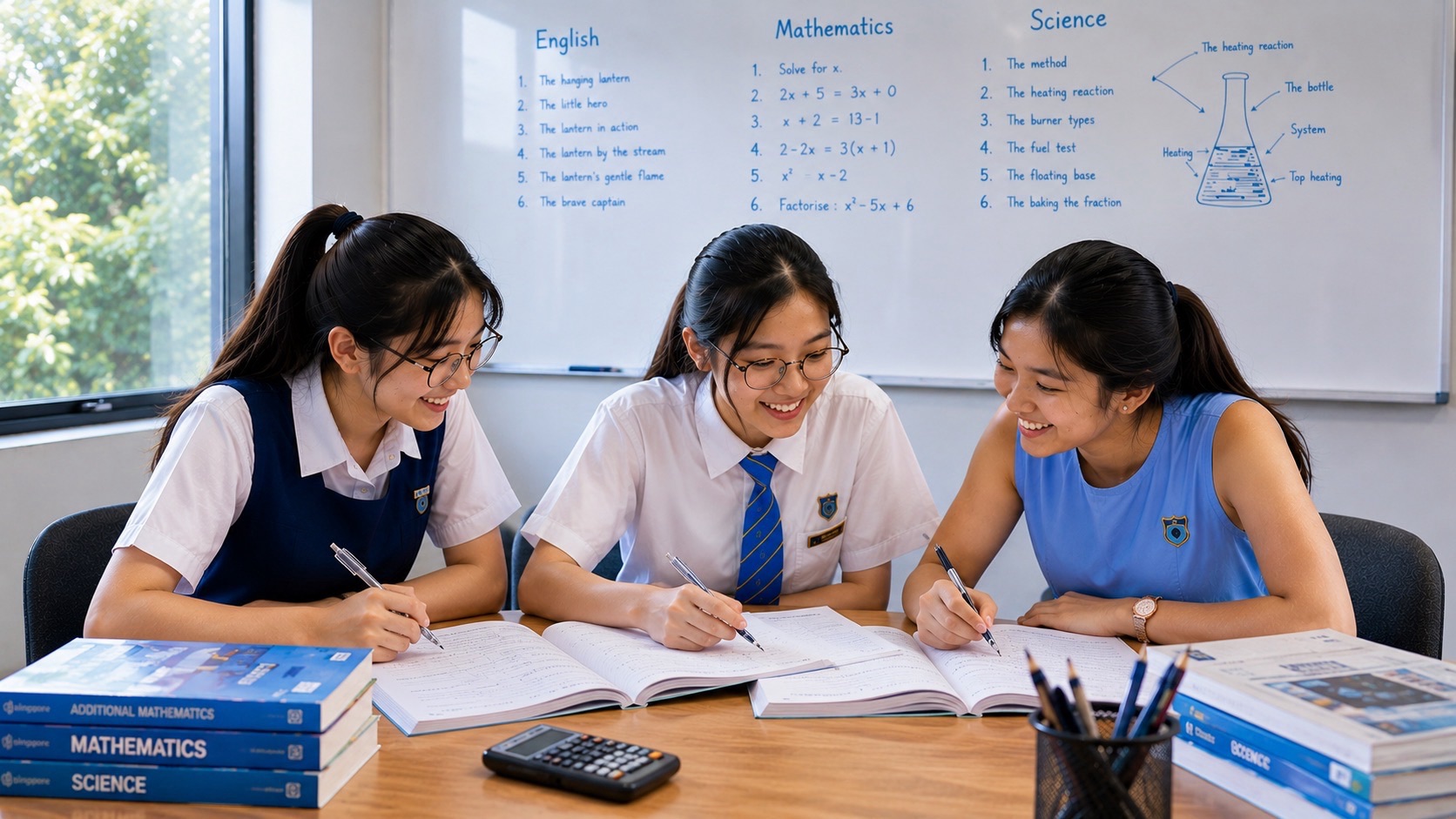
Tutors for Bencoolen families should help students use relevance filtering deliberately. A capable learner needs more than procedures: the student needs a way to inspect whether thinking is still on track.
At eduKateSG, our 3-pax small-group tutorials use relevance filtering as one part of diagnosis, explanation, guided practice, retrieval, mixed application, correction and independent retry.
Lessons are normally 1.5 hours weekly at our Bukit Timah teaching location at 8 Fourth Avenue, Singapore 268674, near Sixth Avenue MRT. We support Primary and Secondary students in English and Mathematics, Primary Science, and suitable Additional Mathematics students.
The aim is not to make one worksheet easier. It is to make the learner more capable when the tutor is no longer beside them.
See eduKateSG small-group tuition programmes
Arrange a parent–student consultation with eduKate Singapore
Relevance Filtering: Decide What Deserves Attention
Many questions contain more information than the student needs immediately. Some details establish context, some define constraints, some provide evidence and some are deliberately distracting. Relevance filtering is the ability to decide which information should influence the current step.
The goal is not to ignore details casually. It is to identify the role of each detail before allowing it to shape the solution. Strong students do not react equally to every visible number, sentence or label. They allocate attention according to function.
A Six-Step Relevance Routine
- State the target first.
- Classify major details as evidence, constraint, context or possible distractor.
- Use evidence and constraints that directly affect the next step.
- Keep contextual information available without forcing it into the method.
- Recheck ignored information before finalising.
- Explain why each selected detail matters.
The explanation requirement keeps filtering from becoming guesswork. Students should be able to connect the chosen information to the target, method, claim or constraint.
Mathematics: Not Every Number Must Be Used
Primary word problems can contain descriptive numbers or information belonging to another part. Students who believe every visible number must enter the calculation often create unnecessary operations. The learner starts with the target and asks which quantities are structurally linked to it.
Secondary Mathematics may provide several equations, graph features or geometric facts. Some information is useful immediately; other information becomes useful only after an intermediate result is found. In Additional Mathematics, symbolic expressions can contain many features, and the student must select the mathematical object that controls the quantity being asked about.
English: True Information Is Not Automatically Relevant Evidence
A comprehension answer can quote a true sentence from the passage and still fail because the sentence does not support the inference being asked. Students classify details by function: evidence, setting, contrast, cause, effect or qualification.
In writing, an interesting example should remain only if it advances the claim. Relevance is determined by the argument, not by how memorable the example is or how much effort the student spent finding it.
Science: Separate Causal Evidence From Setup Detail
Science questions often include several conditions. Some are controlled variables that make the comparison fair; others are observations or measurements that support the conclusion. Students need to know which details explain the result and which details simply preserve the setup.
This prevents explanations from becoming lists of every fact mentioned. A strong response selects the information that performs a causal or evidential job and connects it clearly to the outcome.
Existing Bencoolen Mathematics Pages
Bencoolen already has level-specific Mathematics pages in the eduKateSG ecosystem. This broader Tutors | Bencoolen page remains the general tutoring and learning-system owner while those pages keep their narrower jobs.
PSLE Mathematics Tuition | Bencoolen
Primary 5 Mathematics Tuition | Bencoolen
Primary 6 Mathematics Tuition | Bencoolen
Filtering Under Time Pressure
Relevance filtering reduces the amount of information held actively in working memory. Students can mark the target, isolate controlling details and begin. Before finalising, they return once to ignored information to ensure no hidden condition was missed.
The same habit works as an editing tool. Mathematics calculations that do not contribute can be removed; English examples that do not advance the claim can be cut; Science facts that do not explain the observed result can be excluded. The remaining work becomes leaner and easier to inspect.
How Relevance Filtering Becomes an Independent Habit
For Bencoolen students, relevance filtering is first taught slowly enough for the reasoning to be visible. The tutor names what is being noticed, why it matters, and which tempting alternative is being rejected. This matters because expert thinking can look effortless from the outside even when it depends on several hidden checks.
The next stage reduces support. A full instruction becomes a short prompt, then a cue, then nothing. The learner must decide independently whether the habit is useful. If the student performs only when the strategy is announced, the learning is still tied to the lesson rather than to the structure of the problem.
We then introduce spacing. The same kind of reasoning is revisited after several days, when the immediate memory of the worked example has faded. Delayed retrieval gives better evidence that the student owns the idea rather than merely recognising something that was just taught.
Interleaving adds another test. Questions from different topics are mixed so the student must choose a method instead of receiving it from the worksheet heading. This is closer to examination conditions, where the first challenge is often identifying what kind of problem is actually present.
Representation is varied as well. A relationship first shown in words may later appear as a diagram, graph, table or equation. In English, a reasoning pattern can move from comprehension into writing. In Science, the same control habit can reappear in a different topic with different surface vocabulary.
The student is also asked to explain when the strategy would not apply. This boundary statement is important. A learner who knows only how to execute a method can still misuse it. A learner who understands its conditions can choose it more intelligently.
Timed practice comes later. We do not rush a fragile habit merely to make it look fluent. Once the reasoning is stable, the student learns to compress the check so it supports speed instead of competing with it. Strong performance is not the absence of checking; it is efficient checking placed at high-value moments.
Corrections are then classified. Was the issue a reading failure, missing prerequisite, wrong representation, unsupported assumption, retrieval lapse or execution error? Naming the first wrong decision gives the student a more useful repair target than simply copying the final answer.
A changed example tests the repair. Numbers, wording or context are altered so the learner cannot rely on visual memory. If the same control habit reappears, transfer is beginning. If the student needs the original page to remember what to do, the skill is not yet secure.
The long-term target is reduced dependence. Relevance Filtering should become part of the student’s own academic operating system: notice, choose, act, check, recover and explain. That is the point at which the value of tutoring extends beyond the exact lesson in which the strategy was first introduced.
A final test is explanation from memory. The Bencoolen learner should be able to describe the purpose of relevance filtering, demonstrate it on a fresh problem and identify one situation where it would be inappropriate or insufficient. That combination—use, transfer and boundary awareness—is stronger evidence of learning than completing another near-identical example immediately after the tutor has shown the method.
Parents can look for the same transfer outside tuition: fewer rescue prompts, clearer explanations of why a method was chosen, more purposeful corrections, and a greater willingness to stop when an answer conflicts with the structure of the question. These behavioural signs matter because they show that the student is beginning to manage learning decisions rather than merely finishing assigned work. Marks remain important, but independent control is what makes improvement more durable across new topics and future assessments.
Why 3-Pax Tutorials Matter for Bencoolen Families
A class of three creates enough space for individual diagnosis while still allowing students to hear another approach, explain an idea aloud and compare methods. That balance matters because learning problems are rarely visible from the final answer alone.
One student may know the concept but rush the reading. Another may read accurately but depend on prompts. A third may understand during the lesson yet fail to retrieve the method a week later. Those are different problems and should not receive the same correction.
In a 3-pax tutorial, the tutor can inspect working, ask each learner to explain a decision, vary the next question and watch whether the idea transfers. The group remains small enough for targeted feedback but large enough for useful academic discussion.
The long-term goal is not to make the tutor indispensable. It is to make the student more capable of starting, checking, correcting and extending work independently.
Learn → Understand → Memorise → Test
Our teaching sequence can be summarised as Learn → Understand → Memorise → Test. These are connected stages rather than four isolated activities.
Learn means meeting the idea clearly. Understand means being able to explain the relationship, not merely repeat a line from notes. Memorise means making the essential knowledge retrievable without rebuilding it from zero every time. Test means using the knowledge under changed conditions, including unfamiliar questions.
The Relevance Filtering habit is especially useful because it exposes whether understanding is organised. A student who can only repeat a worked example may appear confident until the surface changes. A student who understands the relationship can use relevance filtering to orient the new problem before choosing a method.
Tutoring should therefore move beyond completion. We want to know what the learner can reconstruct without the page open, what still requires a prompt and what breaks when the context changes.
Using the Fencing Method
The Fencing Method helps students define what belongs inside the problem and what does not. Before solving, the learner identifies the known information, the target, the relevant rule or concept and the boundaries that must not be crossed.
For Bencoolen students, we can combine the fence with relevance filtering. The student states what is known, marks what is uncertain and decides what should remain true while the work develops.
This reduces two common failures. The first is wandering into irrelevant information. The second is using a familiar method simply because it was recently taught, even when the current question requires something else.
The tutor initially models the fence explicitly. Later, prompts are reduced. The student should eventually be able to create the boundary independently under school assessment conditions.
Diagnosis Before More Practice
More practice is useful only when the practice is aimed at the correct problem. Ten additional questions can reinforce a misunderstanding if the learner keeps applying the same unstable rule.
We therefore begin with evidence. Recent schoolwork, original attempts, teacher comments and a short diagnostic conversation help reveal where control is being lost.
The tutor asks whether the issue is knowledge, interpretation, retrieval, sequencing, accuracy, speed, confidence, or transfer. Sometimes two or three factors interact.
The Relevance Filtering lens gives us another diagnostic signal. We can see whether the student can form a sensible expectation before acting, explain why a method should work and detect when the final result conflicts with the original structure.
A precise diagnosis makes the next hour of teaching more valuable than a generic worksheet pack.
What a 90-Minute Tutorial Can Look Like
A lesson may begin with a short retrieval set from earlier work. The tutor checks not only the answers but also how quickly the student recognises the type of problem and whether the method is being reconstructed or merely remembered from a recent example.
The central teaching segment then repairs or extends one important idea. Explanations are kept clear enough for the student to restate them in their own words.
Guided practice makes relevance filtering explicit. The learner is asked to pause before the main solution and state the relevant structure, expectation, constraint or checkpoint.
Independent practice then changes the surface features. Numbers, wording, representation or context may be altered so the student cannot rely on visual memory alone.
A final review returns to an earlier question. The student explains what changed in their thinking, records the error pattern if one appeared and identifies what should be retrieved during the week.
The lesson therefore moves from evidence to explanation, guided use, independent use and retrieval. Completion is a by-product of learning, not the only objective.
Primary English
In Primary English, relevance filtering helps students decide what an answer must accomplish before they start writing. Comprehension questions often look simple because the passage contains familiar words, but the scoring demand may depend on inference, cause, comparison or evidence.
The tutor teaches students to identify the function of the question, locate the relevant evidence and write only as much as needed to answer precisely. Vocabulary is learned through meaning, collocation and use rather than isolated definition copying.
For writing, students plan the purpose of a paragraph before polishing sentences. This protects structure from being lost inside attractive but irrelevant language.
Primary Mathematics
In Primary Mathematics, relevance filtering gives the learner a checkpoint before multi-step work begins. The student identifies the relationship, chooses a representation and decides what would count as a sensible result.
We pay close attention to fractions, ratio, percentage, measurement, geometry and word-problem structure because weaknesses in these areas often travel forward into Secondary Mathematics.
The tutor also asks students to explain why a step is valid. A correct line copied from a model is less valuable than a method the learner can reconstruct in a changed question.
Primary Science
In Primary Science, relevance filtering helps students organise explanations around conditions, observations, concepts and mechanisms. The learner should know what relationship the question is testing before writing a long answer.
We distinguish observation from explanation, evidence from assumption, and memorised phrases from concepts that actually fit the setup.
A good Science response is not rewarded for sounding complicated. It should use the correct idea, apply it to the stated conditions and make the causal link clear.
Secondary English
In Secondary English, relevance filtering can be used before comprehension answers, summary decisions and essay paragraphs. The student identifies the job of the response before drafting the wording.
For essays, we focus on claim, evidence, explanation, qualification and connection to the question. For comprehension, we focus on the exact inferential demand and the evidence needed to support it.
Students are encouraged to make their reasoning visible. A polished sentence without a clear function is still fragile.
Secondary Mathematics
In Secondary Mathematics, relevance filtering becomes increasingly important because algebra, graphs, geometry, statistics and multi-step applications can continue for many lines before an error becomes obvious.
Students learn to connect symbolic work with numerical sense, units, graphical behaviour and logical constraints. Each representation can be used to check the others.
We also teach students to present working clearly enough that an error can be located. Good working is not decoration; it is part of the student’s debugging system.
Additional Mathematics
For suitable upper-secondary students, Additional Mathematics makes the relevance filtering habit even more valuable. Algebraic manipulation, functions, trigonometry, differentiation and integration all reward learners who can see structure before performing long procedures.
A strong student should be able to explain what an expression, graph or derivative is telling them before completing every exact step.
The tutor gradually raises the difficulty by changing conditions, combining topics and asking for method comparison rather than only repeated execution.
Repair, Stabilise and Extend
Repair
When foundations are unstable, we reduce complexity and rebuild the prerequisite knowledge needed for relevance filtering to be meaningful. The student sees clear examples, explains the relationship and practises short transfers before returning to longer tasks.
Stabilise
When the student understands but is inconsistent, we increase retrieval spacing and vary the surface. The aim is to make the correct decision appear without heavy prompting.
Extend
When the learner is already strong, relevance filtering becomes a tool for judgement. The student compares methods, tests edge cases, explains exceptions and predicts how the problem would change under a new condition.
Different students can therefore work toward the same independent-learning goal from different starting points.
Error Analysis and Correction
Corrections are most useful when they identify the first wrong decision rather than only the final wrong answer.
We classify errors into categories such as misreading, missing prerequisite, wrong representation, sign or unit mistake, unsupported assumption, method mismatch, incomplete explanation, retrieval failure and time-pressure execution.
The Relevance Filtering framework helps because it gives the student something to compare against. When the work behaves differently from the original expectation, the learner has a reason to investigate rather than simply move on.
After correction, a similar but not identical question is used later. This tests whether the repaired idea survives beyond the page on which it was explained.
What Progress Should Look Like
- the student starts difficult work with a clearer plan;
- working is organised enough for errors to be located;
- the learner notices some unreasonable answers without waiting for the tutor;
- comprehension responses match the function of the question more closely;
- Science explanations use clearer causal links;
- Mathematics methods are retrieved from structure rather than copied from memory;
- corrections become more specific and less repetitive;
- older topics remain available through retrieval practice; and
- the student requires fewer rescue prompts when the surface of a question changes.
Progress is not measured only by immediate marks. We also look for better judgement, stronger retrieval, cleaner explanations and greater independence.
What Parents Can Bring
- one or two recent marked school papers;
- an original attempt before correction;
- current worksheets or topic lists;
- teacher comments tied to a specific task;
- examples the student can complete independently;
- examples that repeatedly require help; and
- the upcoming assessment scope where available.
A small sample of authentic work is usually more useful than a large stack of rewritten notes because it shows the student’s actual decision-making.
Planning the Weekly Journey From Bencoolen
Bencoolen families considering our Bukit Timah teaching location should plan around the student’s real school dismissal time, CCA commitments, meals, travel and recovery. A class that looks convenient on a map can still be a poor arrangement if the student arrives mentally exhausted every week.
Parents should compare current public-transport options from the student’s actual starting point and lesson time before committing to a routine. Routes and schedules can change.
The decision should consider class fit, subject support, timing, travel load and the student’s ability to sustain the week. Distance is only one part of the learning system.
Class Details
Format: up to three students in a small-group tutorial.
Duration: normally 1.5 hours weekly.
Location: eduKateSG, 8 Fourth Avenue, Singapore 268674, near Sixth Avenue MRT.
Attendance: by appointment and subject to class fit and availability.
Families can enquire about Primary English, Mathematics and Science, Secondary English and Mathematics, and suitable Additional Mathematics support. Confirm the exact programme, tutor, current fees and availability directly.
Frequently Asked Questions
Do you support students from Bencoolen?
Yes. Bencoolen families can enquire about suitable small-group classes at our Bukit Timah teaching location near Sixth Avenue MRT. Placement depends on subject, level, learning needs and current availability.
Does eduKateSG have a branch in Bencoolen?
This guide is written for Bencoolen families considering tutoring. It does not establish an additional eduKateSG teaching branch in Bencoolen. Confirm the teaching address before travelling.
Do you teach ahead of school?
Where appropriate, yes. Pre-teaching should follow readiness and should not replace necessary repair of current foundations.
Can a 3-pax class support a struggling student?
It can when the class fit is suitable and the tutor can preserve enough individual attention for diagnosis, explanation, guided practice and correction. Some needs may require a different arrangement, which should be discussed during consultation.
What if my child is already strong?
Then extension should deepen transfer, explanation, unfamiliar problem solving and independent judgement rather than simply increase routine volume.
How quickly should results improve?
There is no responsible fixed promise. Progress depends on the student’s starting point, attendance, practice, school demands, assessment timing and the size and type of the learning gap.
Tutors for Bencoolen Families
Good tutoring should leave the student with more than completed work.
The learner should understand the problem more clearly, know what to practise next and require less rescue over time.
The Relevance Filtering habit is one route toward that independence because it gives the student a way to organise, inspect and challenge their own thinking.
For students who need repair, we rebuild.
For students who need consistency, we stabilise.
For students who are ready, we extend.
The long-term direction is stronger independent capability.
Arrange a Parent–Student Consultation
Speak with us about your child’s level, current results, learning patterns and upcoming assessments. Bring a small sample of original work so the discussion can focus on the decisions the student is actually making.
Properly taught kids shine a bright light into the future.
A Deeper Practice Architecture
A useful tutoring system does not practise relevance filtering only once. The idea has to reappear across time and across subjects so the learner recognises it as a general thinking tool rather than a one-lesson trick.
The first encounter can be slow and explicit. The tutor may write the checkpoint beside the question, model the reasoning aloud and show exactly what evidence supports the decision.
A later question removes some support. The student must generate the checkpoint independently. Another lesson changes the topic so the same habit is used in a different surface context.
Spacing matters because a skill that works only five minutes after explanation has not yet become durable. Retrieval after several days gives better evidence of ownership.
Interleaving also matters. Students should sometimes decide which method or idea is relevant rather than being told by the worksheet heading. Real examinations do not always announce the required move.
Finally, the learner should explain the habit to someone else. Teaching a method exposes gaps that silent recognition can hide. If the student cannot explain why the checkpoint is useful, the habit may still be procedural rather than understood.
This repeated cycle is how a tutoring technique becomes part of the student’s own academic operating system.
Independence Is the Final Test
A tutor can make a difficult question feel easy by giving the right hint at the right moment. That may be useful during teaching, but it is not the final evidence of learning.
The stronger test is whether the student can begin without the hint, notice when work is drifting, recover after an error and explain the corrected method.
We therefore treat relevance filtering as a temporary scaffold that should eventually become internal. The tutor prompts it first, the student shares responsibility next, and later the learner initiates the check independently.
When that transfer happens, the value of the lesson extends beyond the exact worksheet used in class.
That is the standard we are working toward.