
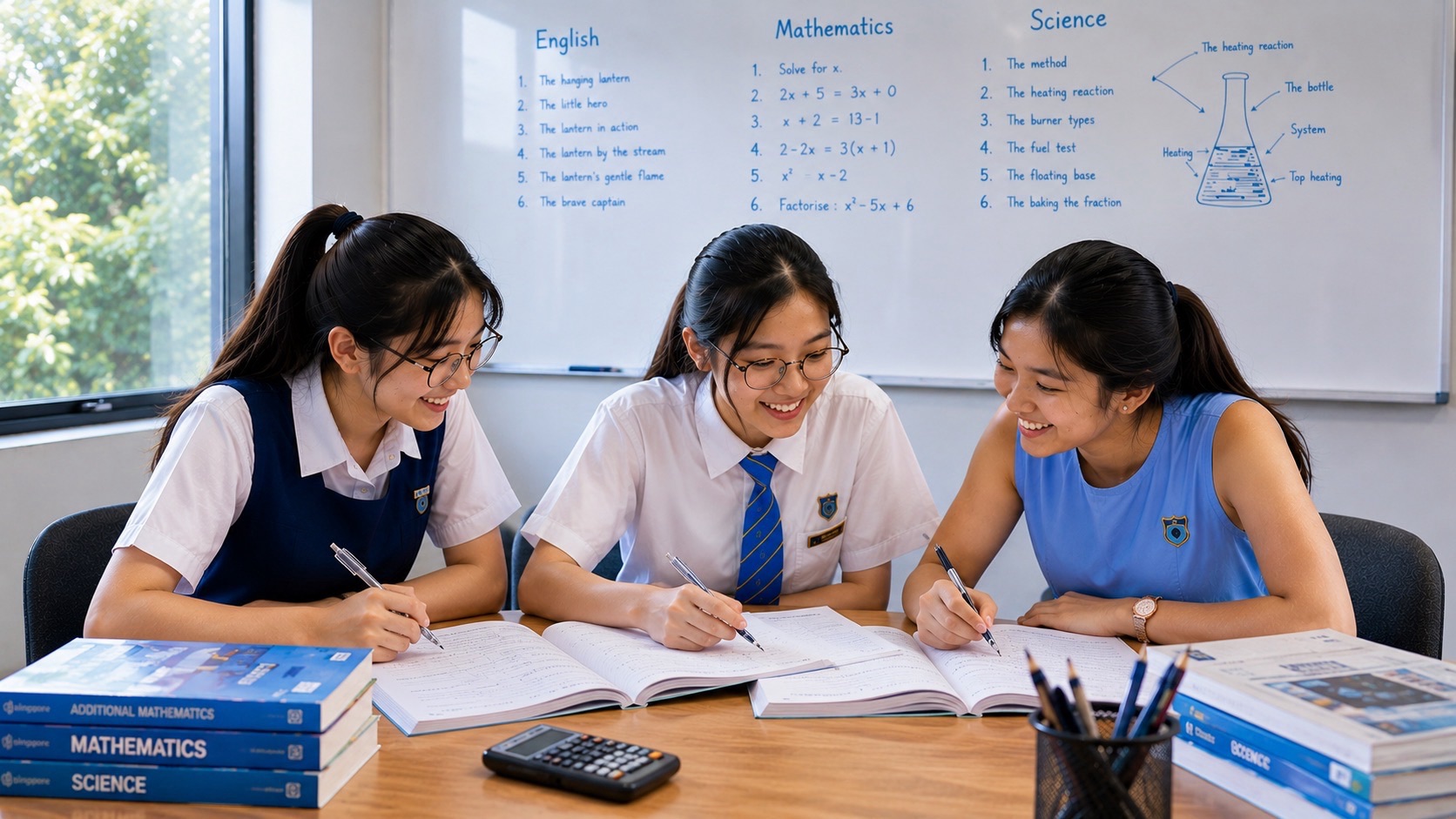
Tutors for Bright Hill families should help students produce answers that are complete without becoming padded.
Too little information leaves the reasoning unfinished.
Too much information can hide the answer, waste time and create new opportunities for error.
At eduKateSG, our 3-pax small-group tutorials teach students to recognise the minimum complete structure required by the task.
Lessons are normally 1.5 hours weekly at our Bukit Timah teaching location near Sixth Avenue MRT.
The aim is not short answers for their own sake.
The aim is sufficiency: enough reasoning to be complete, no unnecessary material that weakens control.
See eduKateSG small-group tuition programmes
Complete and Concise Are Not Opposites
Students sometimes believe that a strong answer must be long.
Others become so focused on brevity that they omit the explanation.
A tutor should help the learner identify the minimum complete structure.
In English, that may be claim plus evidence plus explanation.
In Mathematics, it may be enough working to show the relationship and answer.
In Science, it may be condition, concept and resulting effect.
Once those essential parts are present, extra material should have a clear purpose.
The Hidden Problem: Padding Can Conceal Weak Reasoning
A long paragraph can feel impressive while avoiding the core question.
A page of Mathematics working can conceal that the first relationship was wrong.
A Science answer can contain many correct facts without explaining the actual observation.
A tutor should ask what the answer would lose if one sentence or line were removed.
If nothing important disappears, that material may be padding.
If the reasoning collapses, that part was essential.
Why 3-Pax Tutorials Help Answer Sufficiency
Three students often produce answers of different lengths.
The tutor can compare them.
One may be too short.
Another may be complete and efficient.
A third may include several unnecessary details.
The group can discuss what the middle answer contains that the short one lacks, and what it avoids that the long one adds.
The lesson becomes concrete rather than abstract advice to be concise.
Primary English: Complete the Evidence Chain
Consider this original sentence: “Rina noticed that her partner had forgotten the permission form, placed her own bag down and walked back to the office with her.”
A student may write, “Rina is helpful.”
That may be too short if the question requires support.
A complete answer connects the trait to the action: Rina is helpful because she stops what she is doing and accompanies her partner back to the office.
Adding unrelated description about the office or the weather would not strengthen the inference.
The tutor teaches completeness without padding.
Primary Mathematics: Show Enough Working to Preserve the Relationship
Consider this original problem: four identical folders and a separate $8 fee cost $40 altogether.
A complete solution may show $40 − $8 = $32, followed by $32 ÷ 4 = $8.
That is enough working to reveal the relationship.
Writing every mental arithmetic step may be unnecessary.
Writing only the final answer of eight dollars may be too little when the method needs to be visible.
The tutor helps the student find the useful middle.
Primary Science: Include the Missing Link
A student may write, “The plant grew taller because it received more light.”
Whether that is complete depends on the specific setup and concept being tested.
The tutor should ask which link the question requires.
If the answer needs a mechanism, naming the observation and repeating the condition may not be enough.
If the concept has already been clearly established, adding unrelated background facts may be unnecessary.
Sufficiency is tied to the task.
Secondary English: Build Leaner Paragraphs
Secondary writing often improves when each paragraph has a clear function.
A claim should answer the question.
Evidence should support the claim.
Explanation should show why the evidence matters.
Qualification should appear only when it improves accuracy.
The tutor can ask students to remove sentences that merely restate earlier points.
This creates writing that feels controlled rather than thin.
Secondary Mathematics and Additional Mathematics
Efficient working becomes increasingly important under time pressure.
Students need enough written structure to support accuracy, checking and method marks where relevant.
They do not need to copy every trivial intermediate thought.
In Additional Mathematics, compressed working is safe only when the student can still track signs, substitutions and transformations.
A tutor should teach compression after control, not before it.
The eduKateSG Sufficiency Loop
1. Identify the task
What exactly must the answer contain?
2. Build the essential structure
Which components are required?
3. Add the decisive evidence or working
Make the reasoning visible.
4. Test completeness
Would a reader understand why the answer is valid?
5. Remove redundancy
Delete material that adds no new value.
6. Preserve checkability
Do not compress so far that errors become invisible.
7. Finish
Stop when the answer is complete.
What a 90-Minute Tutorial Can Look Like
A lesson may begin with three sample answers: too short, sufficient and overextended.
Students identify the difference.
The tutor then teaches or repairs the relevant concept.
Guided practice asks for a complete answer using a defined structure.
Independent work removes the structure and asks the student to judge sufficiency alone.
A timed task then tests whether the learner can remain complete without over-writing.
Repair, Stabilise and Extend
Repair
The student omits essential reasoning because the concept itself is not secure. The tutor rebuilds the relationship.
Stabilise
The student understands the content but alternates between under-answering and over-answering.
Extend
The student can produce concise, complete responses and adapt the level of detail to the task.
What Progress Should Look Like
- answers become shorter without losing meaning;
- students stop repeating the same point;
- Mathematics working remains visible but less cluttered;
- Science explanations contain the necessary causal link;
- English paragraphs become more controlled;
- timed work becomes more efficient; and
- students know when an answer is finished.
When a Bright Hill Family May Need Tutoring
A consultation may be useful when the student writes too little to show reasoning, writes far more than the question needs or loses time because they do not know when an answer is complete.
It may also help a strong student who needs greater precision and economy under timed conditions.
Planning the Journey from Bright Hill to Sixth Avenue
Bright Hill families should compare current public-transport options from the student’s actual starting point and intended lesson time.
The weekly arrangement should support careful, efficient work rather than rewarding excessive volume.
Class Details
Format: up to three students in a small-group tutorial.
Duration: normally 1.5 hours weekly.
Location: eduKateSG, 8 Fourth Avenue, Singapore 268674, near Sixth Avenue MRT.
Attendance: by appointment.
Families can enquire about Primary English, Mathematics and Science, Secondary English and Mathematics, and suitable Additional Mathematics support. Confirm the exact programme, tutor, current fees and availability directly.
What Parents Can Bring
- recent marked school papers;
- one original attempt before correction;
- current worksheets and topic lists;
- teacher comments tied to a specific task;
- examples the student can complete independently;
- examples that repeatedly require help; and
- one example where the student used too much or too little evidence.
A small sample of original work is usually more informative than a large stack of already corrected pages.
Frequently Asked Questions
Do you support students from Bright Hill?
Yes. Students from Bright Hill can enquire about suitable small-group classes at our Bukit Timah teaching location near Sixth Avenue MRT, subject to class fit and availability.
Does eduKateSG have a branch in Bright Hill?
This guide is written for Bright Hill families considering tutoring. It does not establish an eduKateSG branch in Bright Hill. Confirm the teaching address before travelling.
Do you teach ahead of school?
Where appropriate, yes. Pre-teaching should follow readiness and should not replace necessary repair of current foundations.
Can a 3-pax class support a struggling student?
It can when the class fit is suitable and the tutor can preserve enough individual attention for diagnosis, guided practice and repair.
What if my child is already strong?
Then extension should deepen transfer, explanation, unfamiliar problem solving and independent judgement rather than simply increase routine volume.
How quickly should results improve?
There is no responsible fixed promise. Progress depends on the starting point, attendance, practice, school demands, assessment timing and the size of the learning gap.
Tutors for Bright Hill Families
Good tutoring should leave the student with more than completed work.
The learner should understand the problem more clearly, know what to practise next and require less rescue over time.
For students who need repair, we rebuild.
For students who need consistency, we stabilise.
For students who are ready, we extend.
The long-term direction is stronger independent capability.
Arrange a Parent–Student Consultation
Speak with us about your child’s level, current results, learning patterns and upcoming assessments.
Properly taught kids shine a bright light into the future.