
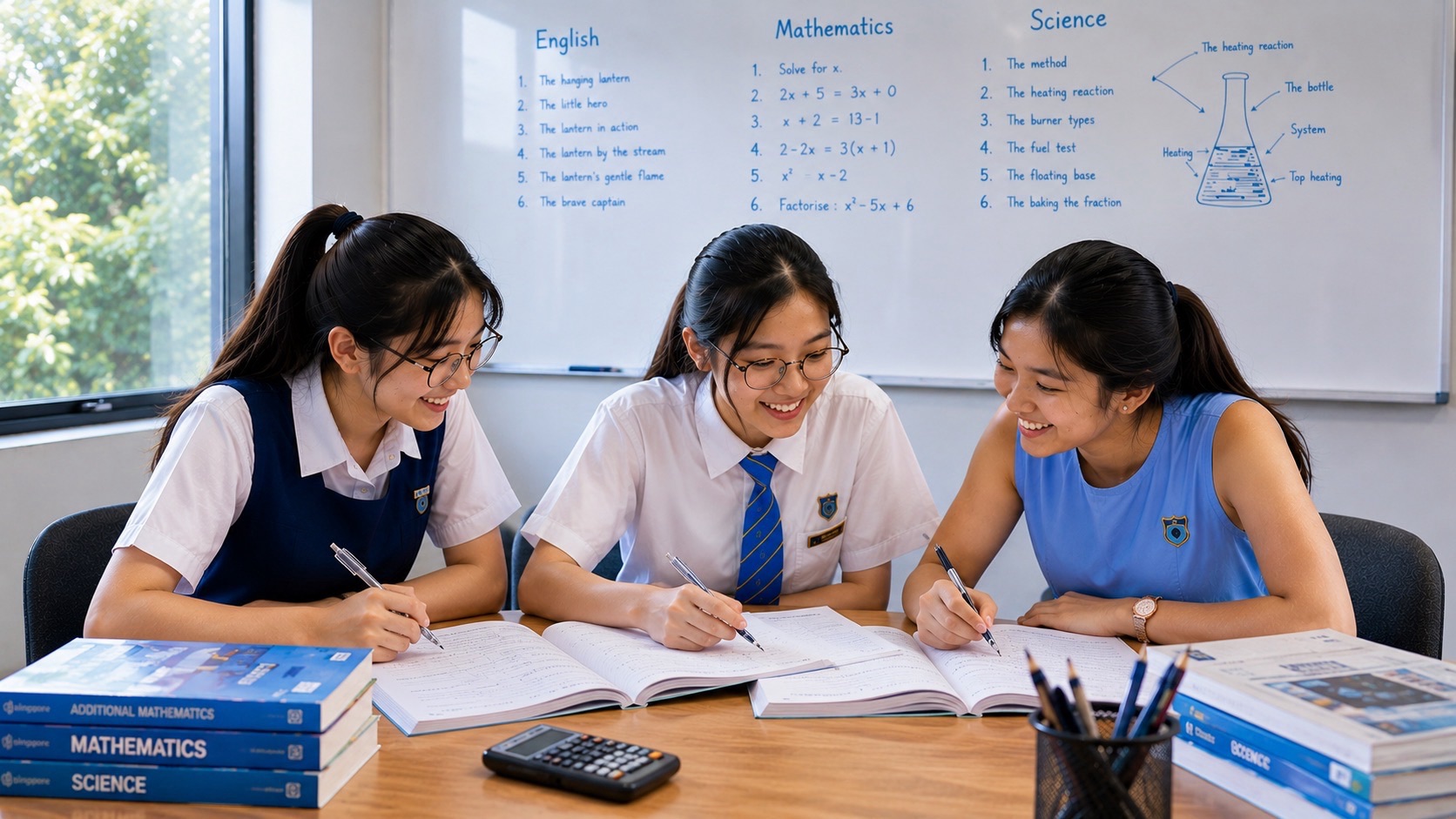
Tutors for Bukit Batok Street 36 families should help students preserve equivalence through every transformation. At eduKateSG, our 3-pax small-group tutorials use this as one part of a broader system of diagnosis, explanation, retrieval, guided practice, transfer and independent correction.
Students often know how to transform an expression, sentence or explanation but forget to ask whether the transformed version still means the same thing. Equivalence is the discipline of changing form without changing the underlying relationship.
Lessons are normally 1.5 hours weekly at our Bukit Timah teaching location at 8 Fourth Avenue, Singapore 268674, near Sixth Avenue MRT. We support Primary and Secondary students in English and Mathematics, Primary Science, and suitable Additional Mathematics students, subject to class fit and availability.
The aim is not simply to finish more questions.
The aim is to help the learner control the reasoning.
See eduKateSG small-group tuition programmes
Arrange a parent–student consultation with eduKate Singapore
Preserve Equivalence Through Every Transformation
In Mathematics, equivalence is explicit: two expressions or equations may look different while representing the same value or solution set.
In English, paraphrasing changes wording while preserving meaning.
In Science, a diagram, verbal explanation and data pattern may express the same causal relationship in different forms.
The learner should know what must remain invariant while the form changes.
Why Equivalent Does Not Mean Visually Similar
Students often use appearance as a shortcut. Two expressions that look similar may not be equivalent, while two very different forms may represent the same relationship.
A reliable learner checks the transformation rule rather than trusting visual familiarity.
This supports algebra, paraphrasing, formula manipulation and explanation writing.
Equivalence gives students a precise question to ask after every major transformation: did I preserve the meaning?
The Equivalence Check
- State the original relationship.
- Identify the transformation being applied.
- Name what must remain unchanged.
- Perform one transformation at a time.
- Check the new form against the original relationship.
- Use substitution, reversal, paraphrase or evidence comparison where appropriate.
The check should become faster with practice, but the principle remains the same: form may change; meaning must not drift.
Primary English: Paraphrase Without Meaning Drift
Students are often asked to answer in their own words.
Changing vocabulary is useful only if the original meaning survives.
A weak paraphrase may turn possibility into certainty, remove a condition or intensify an emotion.
The tutor teaches students to compare meaning, not just vocabulary.
Primary Mathematics: Equal Relationships
Equivalent fractions, ratio forms and number sentences help students see that one relationship can have several appearances.
The learner checks whether the transformed quantities preserve the same proportion or value.
This builds a foundation for later algebraic equivalence.
Students begin to distinguish valid transformation from arbitrary change.
Primary Science: Same Mechanism, Different Wording
A scientific explanation can be stated in different words while preserving the same causal mechanism.
Students practise rewriting explanations without dropping the condition or the causal link.
This reduces dependence on memorised model-answer sentences.
The meaning becomes retrievable even when the exact wording is forgotten.
Secondary English: Summarise Without Distortion
Summary writing requires compression while preserving essential meaning.
Students identify the invariant idea before shortening the wording.
A concise sentence that changes the claim is not a successful summary.
Equivalence therefore becomes a reading and writing control skill.
Secondary Mathematics: Algebraic Equivalence
Equation solving depends on valid transformations that preserve the solution set.
Students learn why the same operation must maintain equality rather than relying on phrases such as move it to the other side.
Substitution back into the original equation acts as an equivalence check.
The reasoning remains stable even when the algebra becomes more complex.
Additional Mathematics: Manipulate Without Losing the Object
Trigonometric identities, algebraic transformations and function manipulation all depend on equivalence.
Students are asked to justify the transformation and identify any domain restrictions or conditions.
A correct-looking simplification is not accepted merely because it is shorter.
The transformed form must still represent the same mathematical object under the valid conditions.
Why Bukit Batok Street 36 Families May Need More Than More Practice
Practice becomes powerful when the student is practising the right decision. A large number of similar questions can create speed, but it can also hide whether the learner understands the relationship that makes the method valid.
The preserve equivalence through every transformation framework gives us a way to inspect the student’s reasoning before, during and after the answer. We can see what the learner noticed, what was assumed, what changed between steps and what checkpoint should have been used earlier.
This makes correction more precise. Two students can lose the same mark for different reasons, so they should not automatically receive the same worksheet or explanation.
The goal is to repair the first unstable decision and then test whether the repair survives a changed question.
Why 3-Pax Tutorials Help
A class of three provides enough individual attention for close diagnosis while preserving the value of peer comparison.
One student may choose a diagram. Another may use algebra. A third may notice a hidden constraint. The tutor can compare these routes before the final answers are revealed.
That comparison is particularly useful for preserve equivalence through every transformation because students can see that strong problem solving is not simply faster execution. It is deliberate control over structure, evidence and checking.
The small group also supports prompt fading. The tutor models the strategy first, shares responsibility next and then removes the cue so the learner has to initiate the same thinking independently.
Learn → Understand → Memorise → Test
Our learning sequence can be summarised as Learn → Understand → Memorise → Test.
Learn introduces the idea clearly. Understand connects examples to the underlying relationship. Memorise makes essential facts, formulas, vocabulary and structures retrievable. Test asks the student to use the knowledge when the surface changes and the topic is not announced.
The preserve equivalence through every transformation habit is valuable during testing because it reveals whether the learner has a portable mental model or only a memory of a familiar page.
A student who can reconstruct the relationship after a delay, under changed wording or in a mixed-topic paper is much closer to examination-ready control.
Primary English
In Primary English, preserve equivalence through every transformation helps students decide what the question requires and whether the answer they are building still matches that requirement.
Comprehension responses may require direct retrieval, inference, cause, comparison, evidence or explanation. These functions look similar on the page but demand different reasoning.
For composition writing, students use the same control habit to keep a paragraph serving its narrative purpose rather than drifting into attractive but irrelevant detail.
Primary Mathematics
In Primary Mathematics, preserve equivalence through every transformation helps students control fractions, ratio, percentage, measurement, geometry and word problems by focusing on the relationship before the operation.
We ask what each quantity represents, what is known, what is unknown and what must remain consistent throughout the solution.
Changed examples then test whether the learner can rebuild the route instead of replaying one memorised sequence.
Primary Science
In Primary Science, preserve equivalence through every transformation helps students connect the stated conditions to the correct concept. The learner identifies what changed, what stayed controlled, what was observed and what mechanism can explain the observation.
This reduces answers that contain correct scientific vocabulary but do not fit the setup.
Students also learn to distinguish observation from explanation and evidence from assumption.
Secondary English
In Secondary English, preserve equivalence through every transformation supports more disciplined comprehension and essay writing. Students identify the logical job of the response before drafting the wording.
For essays, we work with claim, evidence, explanation, qualification and connection to the question. For comprehension, we focus on the exact inferential demand and the evidence that supports it.
The aim is purposeful language, not complexity for its own sake.
Secondary Mathematics
In Secondary Mathematics, preserve equivalence through every transformation helps students maintain control through algebra, graphs, geometry, statistics and multi-step applications.
Symbolic work is connected to numerical sense, units, diagrams and graphical behaviour so one representation can check another.
Students are trained to stop when the work becomes inconsistent instead of continuing mechanically for another page.
Additional Mathematics
For suitable upper-secondary students, Additional Mathematics makes preserve equivalence through every transformation especially useful because several methods may be valid while differing in clarity, algebraic load and error risk.
Functions, trigonometry, differentiation and integration all reward students who can identify structure before performing long procedures.
Where possible, we compare methods and ask what each route reveals about the problem.
Using the Fencing Method
The Fencing Method helps students define the problem boundary before acting. The learner identifies what is known, what is unknown, what is allowed to change, what assumptions require support and what conditions must remain true.
The preserve equivalence through every transformation strategy then operates inside that fence. This keeps the learner from importing an irrelevant rule, unsupported inference or unstated variable simply because it would make the problem easier.
For Mathematics, the fence may contain quantities, units and relationships. For English, it may contain the exact question and the evidence in the passage. For Science, it may contain the experimental conditions and observations.
The written fence is temporary. With practice, the student should be able to perform the same boundary check quickly and mentally.
What a 90-Minute Tutorial Can Look Like
A lesson may begin with a short mixed retrieval set. We observe not only whether answers are correct, but how the student decides what to do.
The tutor then teaches or repairs one important concept. Students explain the relationship in their own words and see worked examples that make the hidden decisions visible.
Guided practice makes preserve equivalence through every transformation explicit. The learner states the target, one relevant relationship and one checkpoint before completing the solution.
Independent practice changes numbers, wording, diagrams or representation so visual memory is not enough.
A delayed question near the end of the lesson tests whether the learner can retrieve the same structure with less support.
The final review identifies one error pattern and the cue that should be noticed next time.
Repair, Stabilise and Extend
Repair
When foundations are weak, we reduce complexity and rebuild the prerequisite relationship before adding speed.
Stabilise
When the student understands but is inconsistent, we use spacing, retrieval and mixed practice so the preserve equivalence through every transformation habit has to be generated rather than copied.
Extend
When the learner is already strong, we compare methods, test edge cases, vary representations and ask for explanation under time pressure.
The destination at every stage is more independent capability.
Error Analysis
Useful correction identifies the first wrong decision, not only the final wrong answer.
- the task was misread;
- a prerequisite was missing;
- the wrong representation was chosen;
- an assumption entered without support;
- a sign, unit or boundary condition was ignored;
- the learner knew the concept but could not retrieve it;
- the method was correct but poorly controlled under time pressure;
- the final answer was accepted without a reasonableness check.
After repair, a similar but not identical question tests whether the new decision survives beyond the page on which it was explained.
What Progress Should Look Like
- paraphrases preserve meaning more accurately;
- equation transformations are justified rather than memorised;
- students use substitution and reversal checks more often;
- Science explanations survive rewording without losing causal links;
- summary writing becomes more precise;
- students notice when a transformation changes more than intended;
- algebraic shortcuts become less fragile;
- different-looking forms are compared by relationship rather than appearance.
Progress is not measured only by immediate marks. We also look for better judgement, stronger retrieval, cleaner explanation and less dependence on external correction.
What Parents Can Bring
- one or two recent marked school papers;
- an original attempt before correction;
- current worksheets or topic lists;
- teacher comments tied to a specific task;
- questions where the student knew the topic but lost control;
- examples the student can complete independently;
- the upcoming assessment scope where available.
A small sample of authentic work is usually more useful than a large stack of rewritten notes because it shows the student’s actual decision-making.
Planning the Weekly Journey From Bukit Batok Street 36
Bukit Batok Street 36 families considering our Bukit Timah teaching location should plan around the student’s actual school dismissal time, CCA commitments, meals, travel and recovery.
Parents should compare current public-transport options from the student’s real starting point and intended lesson time before committing to a routine. Routes and schedules can change.
The right arrangement should be sustainable across the school week, not merely possible on paper.
Class Details
Format: up to three students in a small-group tutorial.
Duration: normally 1.5 hours weekly.
Location: eduKateSG, 8 Fourth Avenue, Singapore 268674, near Sixth Avenue MRT.
Attendance: by appointment and subject to class fit and availability.
Families can enquire about Primary English, Mathematics and Science, Secondary English and Mathematics, and suitable Additional Mathematics support. Confirm the exact programme, tutor, current fees and availability directly.
Frequently Asked Questions
Do you support students from Bukit Batok Street 36?
Yes. Bukit Batok Street 36 families can enquire about suitable small-group classes at our Bukit Timah teaching location near Sixth Avenue MRT. Placement depends on subject, level, learning needs and current availability.
Does eduKateSG have a branch in Bukit Batok Street 36?
This guide is written for Bukit Batok Street 36 families considering tutoring. It does not establish an additional eduKateSG teaching branch in Bukit Batok Street 36. Confirm the teaching address before travelling.
Do you teach ahead of school?
Where appropriate, yes. Pre-teaching should follow readiness and should not replace necessary repair of current foundations.
Can a 3-pax class support a struggling student?
It can when the class fit is suitable and the tutor can preserve enough individual attention for diagnosis, explanation, guided practice and correction.
What if my child is already strong?
Then extension should deepen transfer, method comparison, unfamiliar problem solving and independent judgement rather than simply increase routine volume.
How quickly should results improve?
There is no responsible fixed promise. Progress depends on the student’s starting point, attendance, practice, school demands, assessment timing and the size and type of the learning gap.
Tutors for Bukit Batok Street 36 Families
Good tutoring should leave the student with more than completed work.
The learner should understand the problem more clearly, use preserve equivalence through every transformation with less prompting and know what to practise next.
For students who need repair, we rebuild.
For students who need consistency, we stabilise.
For students who are ready, we extend.
The long-term direction is stronger independent capability.
Arrange a Parent–Student Consultation
Speak with us about your child’s level, current results, learning patterns and upcoming assessments. Bring a small sample of original work so the discussion can focus on the decisions the student is actually making.
Properly taught kids shine a bright light into the future.
Independent Control Under Time Pressure
The real test of preserve equivalence through every transformation comes when time is limited and the tutor is not present. Students need a compressed version of the strategy that can be used in seconds rather than minutes.
We therefore train one short cue, one high-value checkpoint and one recovery action. The cue starts the reasoning, the checkpoint tests whether the work is still plausible, and the recovery action tells the student what to do if the answer no longer fits.
Timed practice is reviewed for decision quality as well as marks. We ask which cues the learner initiated independently, which warning signals were missed and whether the checking routine itself became too slow.
The objective is not perfection. It is better allocation of attention. Students should know when to keep moving and when the work has produced enough evidence that something deserves inspection.
As the same error patterns are repaired, the checking routine becomes shorter. That is a sign of increasing control, not reduced care.
Independent Control Under Time Pressure
The real test of preserve equivalence through every transformation comes when time is limited and the tutor is not present. Students need a compressed version of the strategy that can be used in seconds rather than minutes.
We therefore train one short cue, one high-value checkpoint and one recovery action. The cue starts the reasoning, the checkpoint tests whether the work is still plausible, and the recovery action tells the student what to do if the answer no longer fits.
Timed practice is reviewed for decision quality as well as marks. We ask which cues the learner initiated independently, which warning signals were missed and whether the checking routine itself became too slow.
The objective is not perfection. It is better allocation of attention. Students should know when to keep moving and when the work has produced enough evidence that something deserves inspection.
As the same error patterns are repaired, the checking routine becomes shorter. That is a sign of increasing control, not reduced care.
Independent Control Under Time Pressure
The real test of preserve equivalence through every transformation comes when time is limited and the tutor is not present. Students need a compressed version of the strategy that can be used in seconds rather than minutes.
We therefore train one short cue, one high-value checkpoint and one recovery action. The cue starts the reasoning, the checkpoint tests whether the work is still plausible, and the recovery action tells the student what to do if the answer no longer fits.
Timed practice is reviewed for decision quality as well as marks. We ask which cues the learner initiated independently, which warning signals were missed and whether the checking routine itself became too slow.
The objective is not perfection. It is better allocation of attention. Students should know when to keep moving and when the work has produced enough evidence that something deserves inspection.
As the same error patterns are repaired, the checking routine becomes shorter. That is a sign of increasing control, not reduced care.
Independent Control Under Time Pressure
The real test of preserve equivalence through every transformation comes when time is limited and the tutor is not present. Students need a compressed version of the strategy that can be used in seconds rather than minutes.
We therefore train one short cue, one high-value checkpoint and one recovery action. The cue starts the reasoning, the checkpoint tests whether the work is still plausible, and the recovery action tells the student what to do if the answer no longer fits.
Timed practice is reviewed for decision quality as well as marks. We ask which cues the learner initiated independently, which warning signals were missed and whether the checking routine itself became too slow.
The objective is not perfection. It is better allocation of attention. Students should know when to keep moving and when the work has produced enough evidence that something deserves inspection.
As the same error patterns are repaired, the checking routine becomes shorter. That is a sign of increasing control, not reduced care.
Independent Control Under Time Pressure
The real test of preserve equivalence through every transformation comes when time is limited and the tutor is not present. Students need a compressed version of the strategy that can be used in seconds rather than minutes.
We therefore train one short cue, one high-value checkpoint and one recovery action. The cue starts the reasoning, the checkpoint tests whether the work is still plausible, and the recovery action tells the student what to do if the answer no longer fits.
Timed practice is reviewed for decision quality as well as marks. We ask which cues the learner initiated independently, which warning signals were missed and whether the checking routine itself became too slow.
The objective is not perfection. It is better allocation of attention. Students should know when to keep moving and when the work has produced enough evidence that something deserves inspection.
As the same error patterns are repaired, the checking routine becomes shorter. That is a sign of increasing control, not reduced care.
Independent Control Under Time Pressure
The real test of preserve equivalence through every transformation comes when time is limited and the tutor is not present. Students need a compressed version of the strategy that can be used in seconds rather than minutes.
We therefore train one short cue, one high-value checkpoint and one recovery action. The cue starts the reasoning, the checkpoint tests whether the work is still plausible, and the recovery action tells the student what to do if the answer no longer fits.
Timed practice is reviewed for decision quality as well as marks. We ask which cues the learner initiated independently, which warning signals were missed and whether the checking routine itself became too slow.
The objective is not perfection. It is better allocation of attention. Students should know when to keep moving and when the work has produced enough evidence that something deserves inspection.
As the same error patterns are repaired, the checking routine becomes shorter. That is a sign of increasing control, not reduced care.
Independent Control Under Time Pressure
The real test of preserve equivalence through every transformation comes when time is limited and the tutor is not present. Students need a compressed version of the strategy that can be used in seconds rather than minutes.
We therefore train one short cue, one high-value checkpoint and one recovery action. The cue starts the reasoning, the checkpoint tests whether the work is still plausible, and the recovery action tells the student what to do if the answer no longer fits.
Timed practice is reviewed for decision quality as well as marks. We ask which cues the learner initiated independently, which warning signals were missed and whether the checking routine itself became too slow.
The objective is not perfection. It is better allocation of attention. Students should know when to keep moving and when the work has produced enough evidence that something deserves inspection.
As the same error patterns are repaired, the checking routine becomes shorter. That is a sign of increasing control, not reduced care.
Independent Control Under Time Pressure
The real test of preserve equivalence through every transformation comes when time is limited and the tutor is not present. Students need a compressed version of the strategy that can be used in seconds rather than minutes.
We therefore train one short cue, one high-value checkpoint and one recovery action. The cue starts the reasoning, the checkpoint tests whether the work is still plausible, and the recovery action tells the student what to do if the answer no longer fits.
Timed practice is reviewed for decision quality as well as marks. We ask which cues the learner initiated independently, which warning signals were missed and whether the checking routine itself became too slow.
The objective is not perfection. It is better allocation of attention. Students should know when to keep moving and when the work has produced enough evidence that something deserves inspection.
As the same error patterns are repaired, the checking routine becomes shorter. That is a sign of increasing control, not reduced care.
Independent Control Under Time Pressure
The real test of preserve equivalence through every transformation comes when time is limited and the tutor is not present. Students need a compressed version of the strategy that can be used in seconds rather than minutes.
We therefore train one short cue, one high-value checkpoint and one recovery action. The cue starts the reasoning, the checkpoint tests whether the work is still plausible, and the recovery action tells the student what to do if the answer no longer fits.
Timed practice is reviewed for decision quality as well as marks. We ask which cues the learner initiated independently, which warning signals were missed and whether the checking routine itself became too slow.
The objective is not perfection. It is better allocation of attention. Students should know when to keep moving and when the work has produced enough evidence that something deserves inspection.
As the same error patterns are repaired, the checking routine becomes shorter. That is a sign of increasing control, not reduced care.