
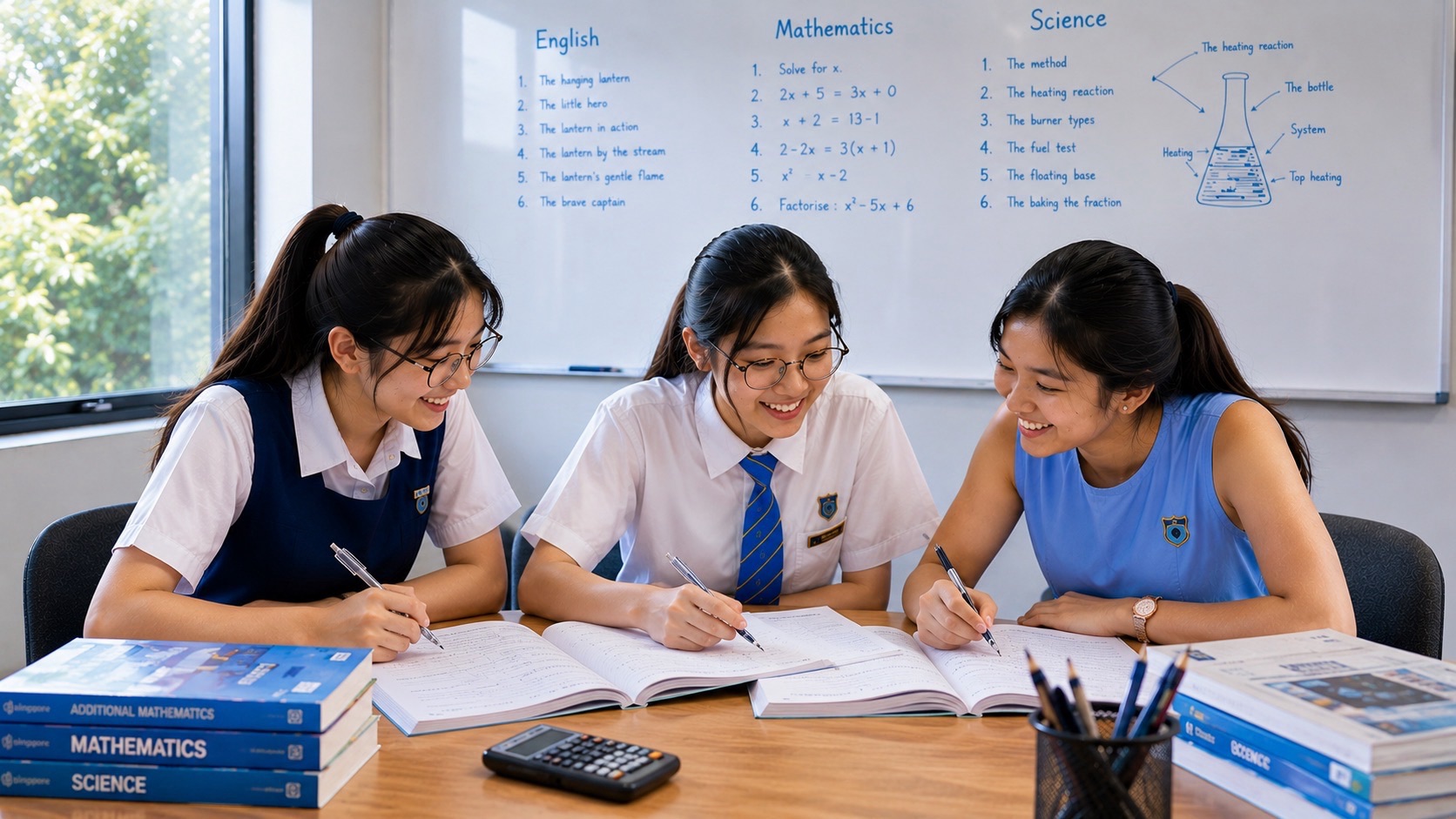
Tutors for Changi Village families should help students retain a clear learning thread across the days between lessons.
A weekly tutorial can be productive and still fail to accumulate if the student cannot reconnect with the learning once the classroom is gone.
At eduKateSG, our 3-pax small-group tutorials end with a deliberate handover: what was learned, what must be retained, what the student should attempt next and what evidence to bring back.
Lessons are normally 1.5 hours weekly at our Bukit Timah teaching location near Sixth Avenue MRT.
The goal is continuity.
The student should not have to rebuild the entire lesson every week before progress can continue.
See eduKateSG small-group tuition programmes
A Good Lesson Needs a Good Exit
Tutoring often focuses on the opening and middle of the lesson.
Diagnosis, explanation and practice receive attention.
The final five minutes can become a hurried summary.
That is a missed opportunity.
The end of the lesson is the handover to the student’s independent week.
A tutor should make the handover clear.
What idea matters most? Which error should the student watch? Which task should be attempted without notes? When should the answer be checked?
The Hidden Problem: Students Can Leave Understanding More Than They Can Reconstruct
Immediately after an explanation, the idea feels available.
The tutor’s wording, the worked example and the classroom context are still present.
Several days later, those cues are gone.
A student may remember that the lesson made sense without remembering how to reconstruct the method.
A good handover therefore includes retrieval.
Before leaving, the student should explain the central relationship in their own words and know what later task will require them to retrieve it again.
Why 3-Pax Tutorials Help Weekly Continuity
Three students give the tutor enough time to check each learner’s exit understanding.
One may need to verbalise the method.
Another may need to mark a specific correction.
A third may be ready for an extension task during the week.
The tutor can personalise the handover without creating a large individual programme that overwhelms the student.
The continuation should be small enough to complete and meaningful enough to inform the next lesson.
Primary English: Leave With a Reusable Question
Consider this original sentence: “Nora had already left the classroom, but returned when she remembered that the group’s presentation cards were still on the table.”
A student may infer that Nora is responsible.
The tutor can finish the lesson with one reusable question: which action in the passage proves the character word?
During the week, the child applies that same question to a different short passage.
The continuation does not recreate the whole lesson.
It carries one useful habit forward.
Primary Mathematics: Leave With the Relationship, Not the Example
Consider this original problem: three-fourths of a quantity is 27. What is the whole quantity?
Three equal parts total twenty-seven, so one part is nine.
Four parts total thirty-six.
Before leaving, the student should explain the relationship without looking at the worked example.
The continuation task changes the fraction and the known quantity.
The tutor is checking whether the student retained the principle rather than the numbers.
Primary Science: Leave With the Reasoning Chain
A Science lesson can end with the student stating the chain from memory.
What changed? What was observed? Which concept explains it?
The weekly task can use a different diagram and ask the same three questions.
This keeps the reasoning form active while the surface changes.
The next lesson begins by reviewing what survived, not by assuming that the previous explanation remains available.
Secondary Students Need Stronger Lesson-to-Week Handover
Secondary workloads are too large for tuition to exist as an isolated ninety-minute island.
The student needs a small continuity system.
In English, that may be one paragraph revision or evidence-selection task.
In Mathematics, it may be a retrieval problem followed by one mixed application.
In Additional Mathematics, it may be re-deriving an important method or revisiting a high-risk symbolic step.
The continuation should connect directly to the lesson target.
The eduKateSG Continuity Handover
1. Name the learning
What relationship or skill mattered most today?
2. Identify the risk
What is the student most likely to forget or repeat incorrectly?
3. Retrieve before leaving
Explain or perform the core idea without the original model.
4. Set one continuation task
Choose a small task with a clear purpose.
5. Attempt after a gap
Let retrieval become necessary.
6. Preserve the attempt
Bring back evidence of what the student managed independently.
7. Reconnect next lesson
Use that evidence as the starting point for the next cycle.
What a 90-Minute Tutorial Can Look Like
A lesson may begin by reconnecting with the previous week’s continuation task.
The tutor checks what survived without reteaching automatically.
The current concept is then taught, followed by guided and independent practice.
A changed question tests transfer.
The final portion of the lesson is used for retrieval and handover.
The student should be able to state the target and the purpose of the continuation task before leaving.
Repair, Stabilise and Extend
Repair
The previous learning did not survive because the concept itself remained unstable. The tutor rebuilds.
Stabilise
The student understands during lessons but loses the thread between them. Retrieval and continuity become the focus.
Extend
The student retains learning across the week and is ready for more independent transfer between lessons.
What Progress Should Look Like
- less time is spent reconstructing the previous lesson;
- continuation tasks are understood more clearly;
- older corrections remain available;
- students arrive with more useful questions;
- weekly learning accumulates rather than resets;
- parents need to recreate fewer tuition explanations at home; and
- independent study becomes more coherent.
When a Changi Village Family May Need Tutoring
A consultation may be useful when the student understands during tuition but seems to start from zero again the following week, cannot explain what was learned once home or completes continuation work without knowing its purpose.
It may also help a strong student who needs a more independent bridge between weekly lessons and schoolwork.
Planning the Journey from Changi Village to Sixth Avenue
Changi Village families should compare current public-transport options from the student’s actual starting point and intended lesson time.
Because the journey can be substantial, the weekly arrangement should be sustainable enough that the lesson can produce continuity rather than becoming an isolated high-effort event.
Class Details
Format: up to three students in a small-group tutorial.
Duration: normally 1.5 hours weekly.
Location: eduKateSG, 8 Fourth Avenue, Singapore 268674, near Sixth Avenue MRT.
Attendance: by appointment.
Families can enquire about Primary English, Mathematics and Science, Secondary English and Mathematics, and suitable Additional Mathematics support. Confirm the exact programme, tutor, current fees and availability directly.
What Parents Can Bring
- recent marked school papers;
- one original attempt before correction;
- current worksheets and topic lists;
- teacher comments tied to a specific task;
- examples the student can complete independently;
- examples that repeatedly require help; and
- a short description of how the child starts work when no adult is beside them.
A small sample of original work is usually more informative than a large stack of already corrected pages.
Frequently Asked Questions
Do you support students from Changi Village?
Yes. Students from Changi Village can enquire about suitable small-group classes at our Bukit Timah teaching location near Sixth Avenue MRT, subject to class fit and availability.
Does eduKateSG have a branch in Changi Village?
This guide is written for Changi Village families considering tutoring. It does not establish an eduKateSG branch in Changi Village. Confirm the teaching address before travelling.
Do you teach ahead of school?
Where appropriate, yes. Pre-teaching should follow readiness and should not replace necessary repair of current foundations.
Can a 3-pax class support a struggling student?
It can when the class fit is suitable and the tutor can preserve enough individual attention for diagnosis, guided practice and repair.
What if my child is already strong?
Then extension should deepen transfer, explanation, unfamiliar problem solving and independent judgement rather than simply increase routine volume.
How quickly should results improve?
There is no responsible fixed promise. Progress depends on the starting point, attendance, practice, school demands, assessment timing and the size of the learning gap.
Tutors for Changi Village Families
Good tutoring should leave the student with more than completed work.
The learner should understand the problem more clearly, know what to practise next and require less rescue over time.
For students who need repair, we rebuild.
For students who need consistency, we stabilise.
For students who are ready, we extend.
The long-term direction is stronger independent capability.
Arrange a Parent–Student Consultation
Speak with us about your child’s level, current results, learning patterns and upcoming assessments.
Properly taught kids shine a bright light into the future.