
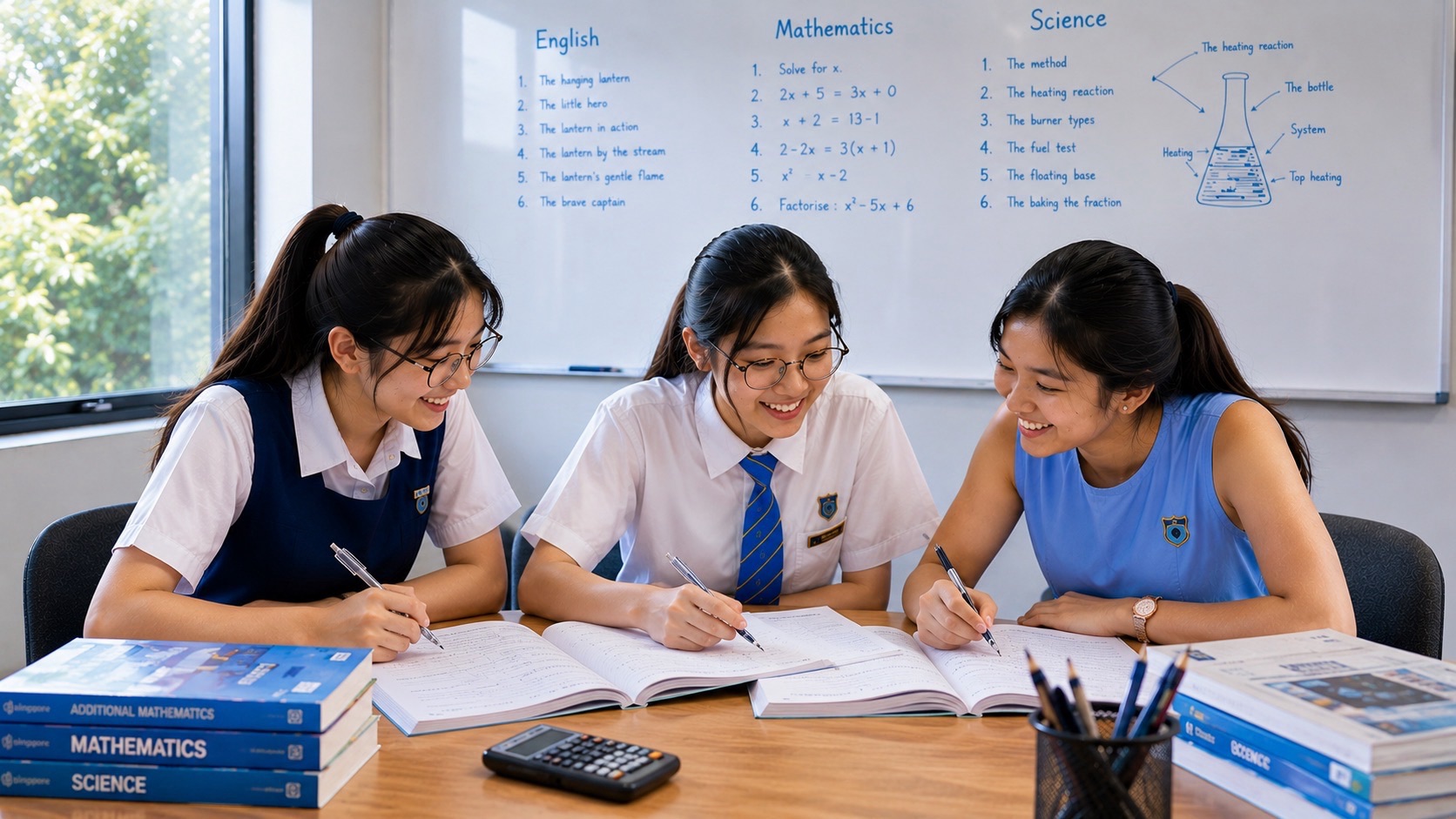
Tutors for Commonwealth families should help students make routine work easier so attention can be saved for the difficult parts.
Fluency matters because every subject places demands on working memory.
If a student uses too much attention decoding ordinary instructions, recalling basic facts or checking every small operation, less capacity remains for the real problem.
At eduKateSG, our 3-pax small-group tutorials build understanding first, then accuracy, retrieval, fluency and transfer.
Lessons are normally 1.5 hours weekly near Sixth Avenue MRT.
The aim is not speed for its own sake.
The aim is controlled fluency.
See eduKateSG small-group tuition programmes
Fluency Creates Thinking Space
A fluent reader can devote more attention to meaning because ordinary decoding requires less effort.
A student with secure number facts can devote more attention to the structure of a word problem.
A Science student who can retrieve a core concept quickly can focus on applying it to unfamiliar evidence.
Fluency therefore creates thinking space.
But speed should come after understanding.
A fast incorrect method is not fluency.
A tutor should first protect the relationship, then build accurate repetition, and only then increase pace.
The Hidden Problem: Students Can Practise Speed Before Accuracy
Timed practice can be useful.
It can also make an unstable method more unstable.
A student who repeatedly rushes negative signs, misreads command words or skips units may simply produce those errors faster when a timer is added.
The tutor should decide whether the current bottleneck is understanding, accuracy or pace.
These need different lessons.
Once the method is accurate and explainable, controlled timing becomes more meaningful.
Why 3-Pax Tutorials Help Fluency
A small group allows the tutor to see whether a student is slow because the concept is unclear or because the method is not yet automatic.
One student may need a concept repaired. Another may need retrieval. A third may need timed application.
The tutor can keep the target precise.
Students can also explain methods to one another, which prevents fluency from becoming mindless repetition.
Primary English: Fluency in Reading and Expression
English fluency is not rushing.
It means common language operations are controlled enough that the student can think about meaning.
A child who spends too much attention decoding ordinary words has less capacity for inference.
A child who struggles to construct basic sentences has less capacity for developing complex ideas.
The tutor therefore builds vocabulary, grammar and sentence control alongside comprehension and composition.
Fluency should support meaning, not replace it.
Primary Mathematics: Accuracy Before Pace
Consider this original problem: six equal packets cost $42. What does one packet cost?
The arithmetic is simple: $42 ÷ 6 = $7.
The tutor can then change the task: six packets and a separate $6 delivery fee cost $48.
Now the student must recognise that the delivery fee is separate before dividing.
The arithmetic remains easy, but the representation is more demanding.
A fluent student should not rush directly into division simply because six and forty-eight are visible.
Fluency includes recognising the structure.
Primary Science: Fluent Recall, Careful Application
Science students benefit from quick access to core concepts.
But fluent recall should not turn into keyword matching.
The tutor asks the student to identify the evidence before choosing the concept.
Once the relationship is clear, fluent vocabulary helps the student express the explanation precisely.
Knowledge should become both available and usable.
Secondary Learning Increases the Value of Fluency
Secondary school increases subject load and complexity.
Students need older skills while learning new ones.
In English, vocabulary and sentence control support higher-level interpretation and writing.
In Mathematics, algebraic fluency reduces the load of routine transformations.
In Additional Mathematics, secure algebra creates room for the more demanding structure of the question.
The tutor should therefore protect basic fluency without allowing it to become rote practice detached from understanding.
The eduKateSG Fluency Sequence
1. Understand
Make the relationship clear.
2. Execute accurately
Perform the method without rushing.
3. Retrieve
Return after a delay.
4. Vary
Use different numbers, wording or representations.
5. Mix
Place the method among alternatives.
6. Add pace
Introduce timing gradually when accuracy is stable.
7. Review
Check whether precision survives the increased pace.
What Progress Should Look Like
- routine work becomes faster without becoming sloppier;
- the student has more attention available for difficult steps;
- older methods are retrieved more quickly;
- working remains clear under pressure;
- unfamiliar questions create less hesitation;
- homework takes less wasted time; and
- timed assessment performance becomes more stable.
When a Commonwealth Family May Need Tutoring
A consultation may be useful when the student is accurate but excessively slow, fast but careless, or using so much effort on routine steps that difficult questions become overwhelming.
It may also help a strong student who needs more challenging application after foundations are fluent.
Travelling from Commonwealth to Sixth Avenue
Commonwealth families should check current public-transport information from the student’s actual starting point and at the relevant time of day.
The lesson should fit the weekly routine without turning the journey into another source of rushing.
Class Details
Format: up to three students in a small-group tutorial.
Duration: normally 1.5 hours weekly.
Location: eduKateSG, 8 Fourth Avenue, Singapore 268674, near Sixth Avenue MRT.
Attendance: by appointment.
Families can enquire about the appropriate Primary English, Mathematics or Science programme, Secondary English or Mathematics programme, or suitable Additional Mathematics support. Confirm the exact class, subject, tutor, current fees and availability directly.
What Parents Can Bring
- recent marked school papers;
- one original attempt before correction;
- current worksheets and topic lists;
- teacher comments that identify a specific concern;
- examples the student can complete independently;
- examples that repeatedly require help; and
- a brief description of what study looks like at home.
A small amount of well-chosen work often tells us more than a large folder of completed worksheets.
Frequently Asked Questions
Do you support students from Commonwealth?
Yes. Students from Commonwealth can enquire about suitable small-group classes at our Bukit Timah teaching location near Sixth Avenue MRT, subject to class fit and availability.
Does eduKateSG have a branch in Commonwealth?
This article is written for Commonwealth families considering tutoring. It does not establish an eduKateSG branch in Commonwealth. Confirm the teaching address and appointment details before travelling.
Do you teach ahead of school?
Where appropriate, yes. Pre-teaching should follow readiness and should not replace necessary repair of current foundations.
Can a 3-pax class support a struggling student?
It can when the class fit is suitable and the tutor can preserve enough individual attention for repair.
What if my child is already strong?
Then extension should deepen transfer, explanation, unfamiliar problem solving and independent judgement rather than simply increase routine volume.
How quickly should results improve?
There is no responsible fixed promise. Progress depends on the starting point, attendance, practice, school demands, assessment timing and the size of the learning gap.
Tutors for Commonwealth Families
Good tutoring should leave the student with more than completed work.
The student should understand the learning problem more clearly, know what to practise next and require less rescue over time.
For students who need repair, we rebuild.
For students who need consistency, we stabilise.
For students who are ready, we extend.
The direction is always toward stronger independent capability.
Arrange a Parent–Student Consultation
Speak with us about your child’s level, current results, learning patterns and upcoming assessments.
Properly taught kids shine a bright light into the future.