
Tutors for Novena families should help students become precise under pressure.
Novena sits within a busy central corridor where school, transport, medical institutions, offices and family routines can place many demands close together.
For students, the problem is not always understanding the lesson.
Sometimes the problem is keeping that understanding accurate when time, fatigue and assessment pressure arrive.
Good tutoring should therefore build precision as well as knowledge.
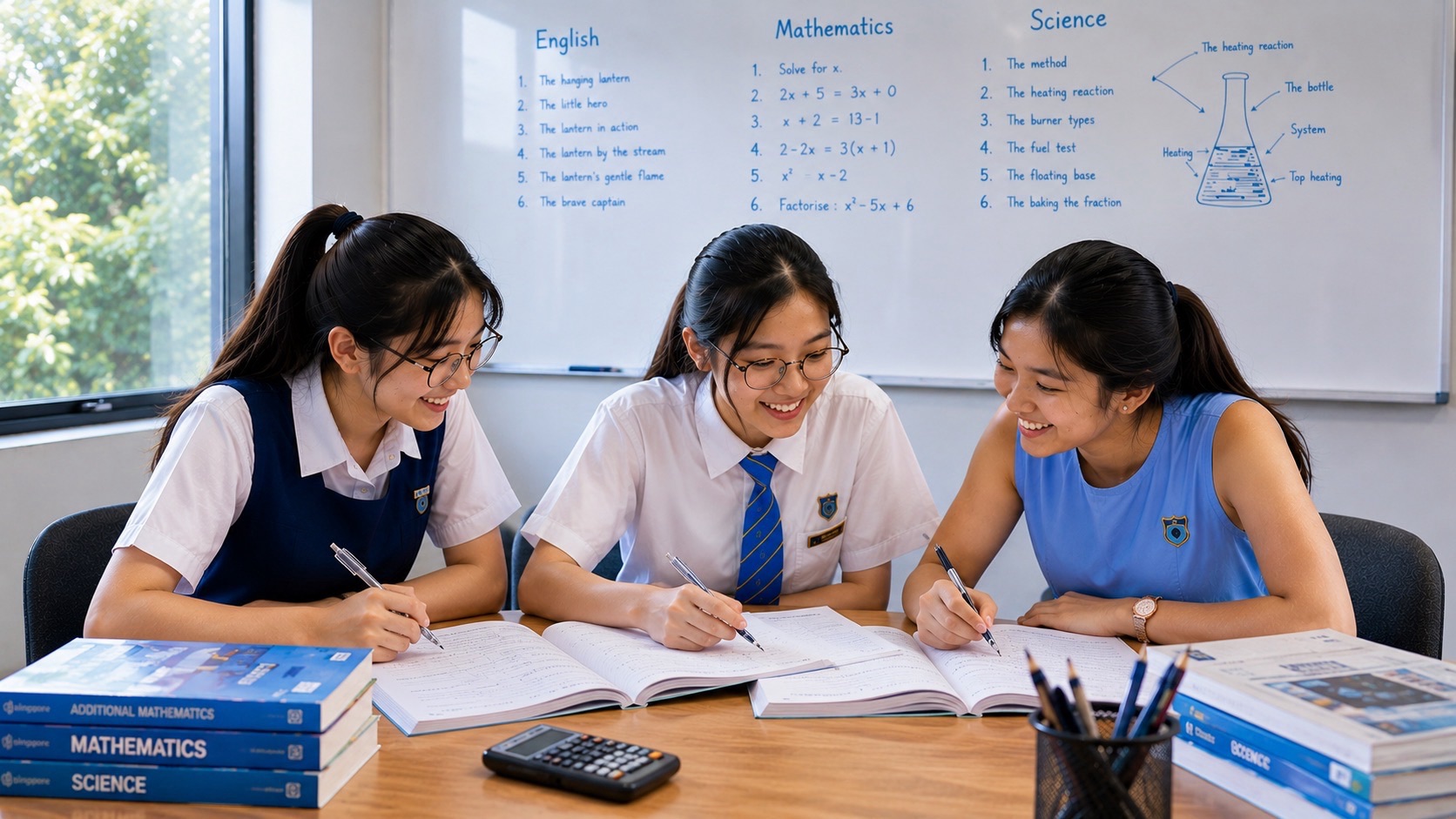
At eduKateSG, our 3-pax small-group tutorials use diagnosis, clear explanation, guided practice, retrieval, mixed application, error analysis and independent work to help students perform more reliably.
Lessons are 1.5 hours weekly. We support Primary and Secondary students in English and Mathematics, Primary Science, and Additional Mathematics for suitable upper-secondary students.
The tutor should not only ask, Does the student know this?
The tutor should also ask, Can the student still do it accurately when the conditions become less comfortable?
See eduKateSG small-group tuition programmes
Arrange a parent–student consultation
Chat with eduKateSG on WhatsApp
Knowledge and Execution Are Different
A student can understand a concept and still lose marks.
The question may be misread. The student may rush the final step. A unit may disappear. Evidence may be selected too broadly. A Science explanation may be correct in principle but imprecise in wording.
These are execution problems.
Execution matters because examinations measure what the student can produce under specific conditions, not only what the student understands in conversation.
A good tutor should train both.
Precision Is Built Through Small Habits
Students often think accuracy is a personality trait.
It is more useful to treat accuracy as a collection of habits.
- reading the command word;
- checking units;
- keeping algebraic signs visible;
- showing enough working to trace an error;
- selecting exact evidence;
- using precise scientific language;
- reviewing the answer against the question;
- leaving enough time for checking.
Each habit is teachable.
The tutor’s job is to identify which habits produce the largest number of avoidable losses.
What We Diagnose
English
We separate vocabulary, grammar, comprehension, inference, evidence selection, sentence control, paragraph development, summary and oral organisation.
Mathematics
We inspect number fluency, fractions, algebra, signs, diagrams, formula choice, sequencing, notation and checking.
Science
We look at concept knowledge, application, variables, data interpretation, causal reasoning and language precision.
Performance under pressure
We also observe whether the student changes behaviour when timed, tired or confronted with an unfamiliar question.
The breakdown point becomes part of the teaching plan.
Why 3-Pax Tutorials Help Build Precision
A small class gives the tutor enough visibility to catch small errors before they become habitual.
The tutor can inspect not only the answer but the line where control was lost.
Students also see how peers organise work differently.
- one student may solve correctly but present poorly;
- another may read carefully but calculate inaccurately;
- another may be accurate but too slow.
These differences create useful discussion.
Precision does not mean every student needs the same correction.
Primary English: Precision in Meaning
Primary English students often lose marks because an answer is almost right.
The evidence may be relevant but incomplete. The sentence may communicate the general idea but miss the exact meaning. A composition may have strong vocabulary but weak control over sequence.
We train students to make meaning more exact.
This includes careful reading, specific evidence, accurate sentence construction and clearer development.
Primary Mathematics: Precision in Working
Mathematics rewards clear structure.
A student who shows organised working can trace errors more easily and check more intelligently.
We train students to protect signs, units, operations and intermediate steps.
The goal is not to make every solution long.
The goal is to make the reasoning visible enough to remain under control.
Primary Science: Precision in Explanation
Science answers need exact relationships.
A vague response may mention the correct concept without explaining the mechanism.
We help students connect evidence, concept and effect precisely.
This improves both understanding and answer quality.
Secondary Learning Increases the Cost of Small Errors
Secondary work contains longer chains of reasoning.
A small error near the beginning can affect several later steps.
Secondary English
Students need precise evidence, controlled summary, accurate interpretation and stronger writing structure.
Secondary Mathematics
Algebra, graphs, geometry, trigonometry and statistics require accurate symbolic handling.
Additional Mathematics
A-Math makes precision especially important because one sign, exponent or algebraic manipulation can alter an entire solution.
The eduKateSG Precision Loop
1. Understand
The concept must first make sense.
2. Execute
The student applies the method in a clear form.
3. Inspect
The tutor identifies the first point where accuracy changes.
4. Correct
The student repairs the specific habit.
5. Retry
The same idea is attempted again.
6. Add pressure
Time, variation or unfamiliarity is increased gradually.
7. Review
The student checks whether precision survived.
This builds performance that remains stable under more realistic conditions.
What Happens in a 90-Minute Lesson
- retrieval from earlier lessons;
- diagnostic checks;
- clear concept instruction;
- guided practice;
- independent application;
- mixed-topic questions;
- error analysis; and
- focused continuation work.
Timed work may be introduced selectively when the student is ready.
Repair, Stabilise and Extend
Repair
The student has a conceptual or procedural weakness causing repeated errors.
Stabilise
The student understands but accuracy changes under pressure.
Extend
The student is secure and ready for more unfamiliar, demanding work.
Precision becomes more important as the student moves from repair toward extension.
What Progress Looks Like
- avoidable mistakes decrease;
- working becomes easier to check;
- the student reads questions more carefully;
- evidence selection becomes more exact;
- Science explanations become more precise;
- timed performance becomes more stable;
- the student notices errors earlier; and
- assessment results become more dependable.
When a Novena Family May Need Tutoring
- the student understands concepts but loses too many marks through execution;
- results fall sharply under time pressure;
- working is difficult to follow;
- the same small errors repeat;
- school pace has exposed an unstable foundation;
- the student needs a smaller environment with faster feedback; or
- the student is strong and needs demanding extension with greater precision.
The strongest students are not those who never make mistakes.
They are those who control the conditions that make mistakes more likely.
From Novena to Sixth Avenue
eduKateSG’s Bukit Timah teaching location is at 8 Fourth Avenue, Singapore 268674, near Sixth Avenue MRT on the Downtown Line.
Novena is on the North–South Line. Students can travel one stop to Newton, transfer to the Downtown Line and continue to Sixth Avenue.
The route is straightforward and creates a clear transition into a focused tutorial block.
Location: eduKateSG, 8 Fourth Avenue, Singapore 268674
Nearest MRT: Sixth Avenue MRT, Downtown Line
Attendance: By appointment
Class Details
Format: 3-pax small-group tutorials
Duration: 1.5 hours weekly
Levels: Primary and Secondary
Subjects: English, Mathematics, Primary Science and Additional Mathematics for suitable Secondary students
Teaching features include diagnosis, precision training, retrieval, interleaving, guided practice, independent application and assessment alignment.
Frequently Asked Questions
Do you support students from Novena?
Yes. Students from Novena can attend our small-group teaching location near Sixth Avenue MRT, subject to a suitable class placement.
Can tuition help with careless mistakes?
Yes, when careless is broken into specific error types and each pattern is given a concrete prevention routine.
Do you use timed practice?
Yes, selectively. Timing is added when understanding and basic execution are sufficiently stable.
Do you teach ahead?
Yes, when the foundation is ready. Pre-teaching should improve later school performance rather than simply increase syllabus speed.
What if my child is already strong?
Then extension should increase transfer, depth, precision and independent judgement.
How quickly will grades improve?
There is no fixed responsible timeline. Progress depends on the student’s starting point, attendance, practice and assessment timing.
Does every student need tuition?
No. Tuition is useful when it solves a real learning problem or provides purposeful extension.
Tutors for Novena Families
Good tutoring should make strong performance more repeatable.
Understanding matters.
Execution matters too.
For students who need repair, we rebuild.
For students who need consistency, we stabilise precision.
For students who are ready, we extend.
The objective is a student who can remain clear, accurate and controlled even when the task becomes demanding.
Arrange a Parent–Student Consultation
Speak with us about your child’s level, current results, recurring errors and upcoming assessments.
eduKateSG
8 Fourth Avenue
Singapore 268674
Near Sixth Avenue MRT
3-pax small-group tuition
By appointment
Properly taught kids shine a bright light into the future.