
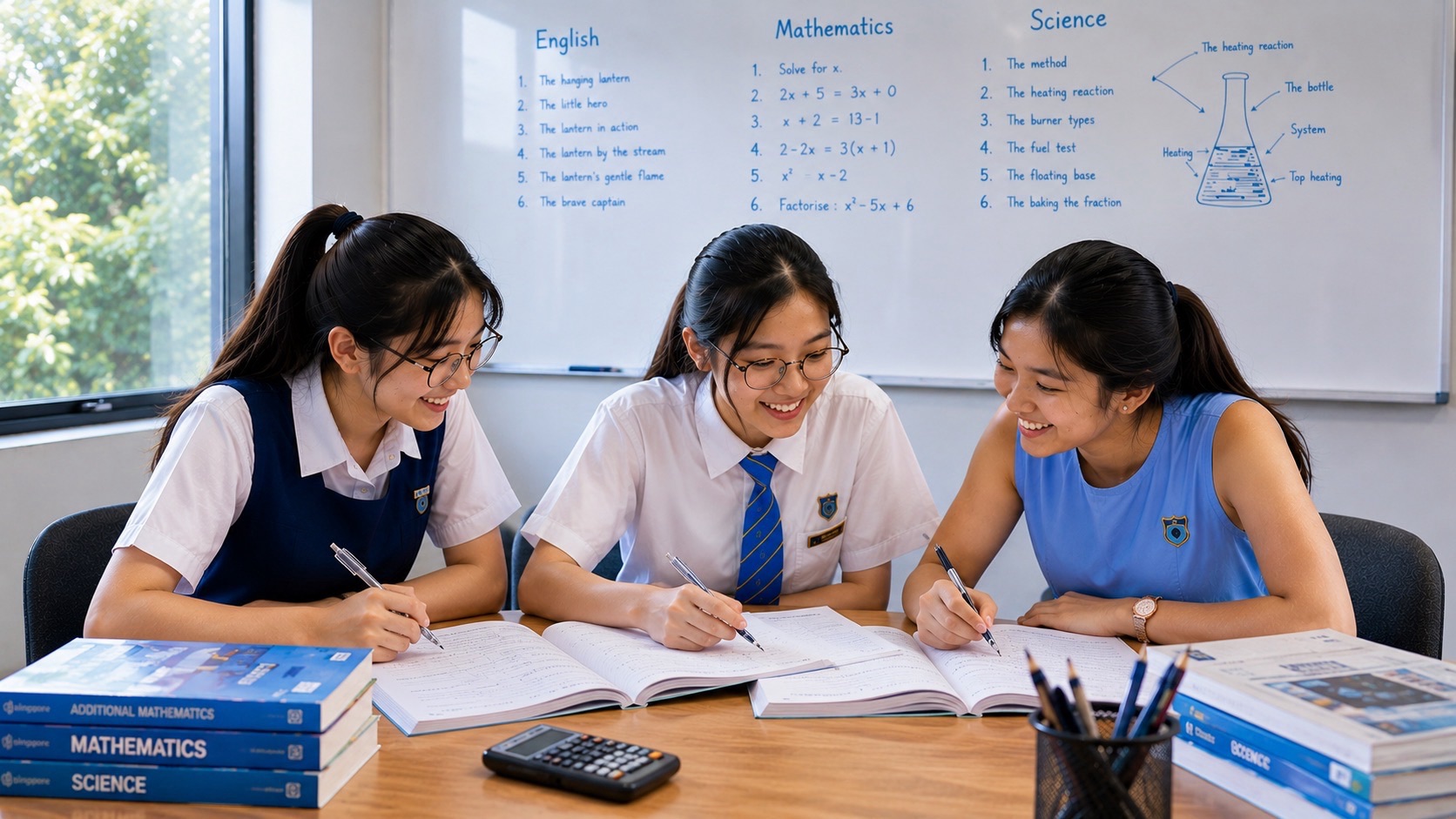
Tutors for Pandan Gardens families should help students learn what to do after the first answer is wrong.
Many students can perform while everything goes smoothly. The more revealing moment comes when the method fails.
Does the student inspect the work, identify the first unstable step and try again? Or does the student erase everything, guess or wait for the tutor to rescue the question?
At eduKateSG, our 3-pax small-group tutorials treat recovery as part of academic capability.
A student does not need a school life without difficult questions. The student needs a reliable way to respond when difficulty appears.
See eduKateSG small-group tuition programmes
The Second Attempt Tells Us a Great Deal
A first attempt shows what the student notices immediately.
A second attempt shows whether the student can learn from the first.
Suppose a Mathematics student chooses the wrong operation. After feedback, can the student explain why the first operation was unsuitable? Can a similar question be solved without the same mistake?
Suppose an English student gives an unsupported inference. After correction, can the student locate evidence independently in a different passage?
Suppose a Science student confuses observation and explanation. Can the student separate them in the next question?
The tutor should not only fix the answer.
The tutor should teach the recovery process.
Why Constant Correction Is Not the Same as Self-Correction
A student can receive excellent feedback and remain dependent on it.
The missing transition is internal monitoring.
At first, the tutor may notice the missing sign, weak evidence or incorrect assumption.
Over time, the student should begin noticing these patterns earlier.
The tutor’s external checking role gradually becomes the student’s internal checking habit.
This is one reason repeated error categories matter.
A student who knows, “I often misread what the ratio total represents,” has a more useful checking target than a student who is simply told to be careful.
Why 3-Pax Tutorials Help Recovery
A small group creates enough space for mistakes to be visible without turning every error into a performance in front of a large class.
Students see peers try, correct and retry.
The tutor can intervene closely enough to prevent repeated misconception while still leaving the student responsible for the parts already within reach.
- frequent individual attempts;
- close observation of where reasoning changes;
- specific error classification;
- immediate retry after correction;
- later retrieval to test whether the repair survived;
- peer explanation; and
- gradual reduction of rescue prompts.
Primary English: Make Revision a Thinking Process
English correction should improve future language, not merely polish the current page.
Consider this original response: “He was scared because he was worried.”
The tutor should ask whether the answer has added evidence or simply repeated the feeling using another word.
A stronger revision begins with the passage.
What did the character do? Which detail suggests fear? How can that evidence be connected to the interpretation?
The student learns that revision means changing the reasoning as well as changing the sentence.
In composition, the same principle applies. A weak paragraph may need a clearer consequence, not more adjectives.
Primary Mathematics: Trace Back to the First Wrong Move
Consider this original equation-style relationship for an older Primary learner: four equal boxes and a separate $2 fee total $26.
If the student divides 26 by four immediately, the error begins before the arithmetic.
The tutor should ask what the $2 represents.
Once the student sees that the fee is separate, subtracting it first becomes meaningful.
The corrected answer is six dollars per box.
A recovery task then changes the numbers or the position of the unknown.
The student should demonstrate that the relationship—not the memorised sequence—has been repaired.
Primary Science: Correct the Logic, Not Only the Vocabulary
A Science student may write a sophisticated sentence containing the right keyword and still give an invalid explanation.
The tutor should strip the answer back to the logic.
What happened? What caused it? What evidence supports that claim?
Then the scientific wording is rebuilt around the correct relationship.
This teaches the student that precise terminology serves the explanation; it does not replace it.
Secondary Learning Requires Better Recovery
Secondary students face longer tasks and more abstract reasoning.
One failed first approach should not automatically become a failed question.
In English, the student may need to revise an interpretation after rereading evidence.
In Mathematics, the student may need to trace an equation back to the first invalid transformation.
In Additional Mathematics, a single symbolic mistake can affect several later lines. The student needs a disciplined way to locate it.
The eduKateSG Recovery Loop
1. Preserve the attempt
Keep enough of the original work to see what happened.
2. Locate the first unstable step
Find where the reasoning left the valid path.
3. Name the error
Concept, reading, recall, arithmetic, notation, language, organisation or time pressure?
4. Repair
Teach the relevant principle.
5. Retry
Reconstruct without copying the corrected answer.
6. Vary
Use a different-looking question to test transfer.
7. Revisit
Return later to check whether the repair became durable.
What Progress Should Look Like
- the same errors recur less often;
- the student notices mistakes before being told;
- corrections are explained rather than copied;
- working becomes easier to trace;
- one failed attempt no longer causes the whole task to collapse;
- the student asks more precise questions; and
- assessment performance becomes more stable.
When a Pandan Gardens Family May Need Tutoring
A consultation may be useful when the student repeatedly makes the same error, copies corrections without learning from them, or becomes unable to continue after one mistake.
It may also help a strong student who needs more demanding transfer and self-monitoring.
Travelling from Pandan Gardens to Sixth Avenue
Pandan Gardens families should check current public-transport information and the complete journey from the student’s real starting point.
The weekly arrangement should be sustainable during normal school weeks rather than relying on ideal travel conditions.
Class Details
Format: up to three students in a small-group tutorial.
Duration: normally 1.5 hours weekly.
Location: eduKateSG, 8 Fourth Avenue, Singapore 268674, near Sixth Avenue MRT.
Attendance: by appointment.
Families can enquire about the appropriate Primary English, Mathematics or Science programme, Secondary English or Mathematics programme, or suitable Additional Mathematics support. Confirm the exact class, subject, tutor, current fees and availability directly.
What Parents Can Bring to the Consultation
- recent marked school papers;
- one original uncorrected attempt where possible;
- current worksheets and topic lists;
- teacher comments that refer to a specific difficulty;
- examples of work the student can do independently;
- examples of work that repeatedly requires help; and
- a brief description of what homework looks like at home.
The contrast between successful and difficult work is often more informative than a folder containing only weak results.
Frequently Asked Questions
Do you support students from Pandan Gardens?
Yes. Students from Pandan Gardens can enquire about suitable small-group classes at our Bukit Timah teaching location near Sixth Avenue MRT, subject to class fit and availability.
Does eduKateSG have a branch in Pandan Gardens?
This article is written for Pandan Gardens families considering tutoring. It does not establish an eduKateSG branch in Pandan Gardens. Confirm the teaching address and appointment details before travelling.
Do you teach ahead of school?
Where appropriate, yes. Pre-teaching should follow readiness and should not replace necessary repair of current foundations.
Can a 3-pax class support a struggling student?
It can when the class fit is suitable and the tutor can preserve enough individual attention for repair. The consultation should consider how much support the student currently needs.
What if my child is already strong?
Then extension should deepen transfer, explanation, unfamiliar problem solving and independent judgement rather than simply increase routine volume.
How do you handle careless mistakes?
We do not treat careless as a complete diagnosis. Reading, concept, recall, arithmetic, notation, copying, language, organisation and time-pressure errors require different responses.
How quickly should results improve?
There is no responsible fixed promise. Progress depends on the starting point, attendance, practice, school demands, assessment timing and the size of the learning gap.
Tutors for Pandan Gardens Families
Good tutoring should leave the student with more than completed work.
The student should understand the learning problem more clearly, know what to practise next and require less rescue over time.
For students who need repair, we rebuild.
For students who need consistency, we stabilise.
For students who are ready, we extend.
The direction is always toward stronger independent capability.
Arrange a Parent–Student Consultation
Speak with us about your child’s level, current results, learning patterns and upcoming assessments.
Properly taught kids shine a bright light into the future.