
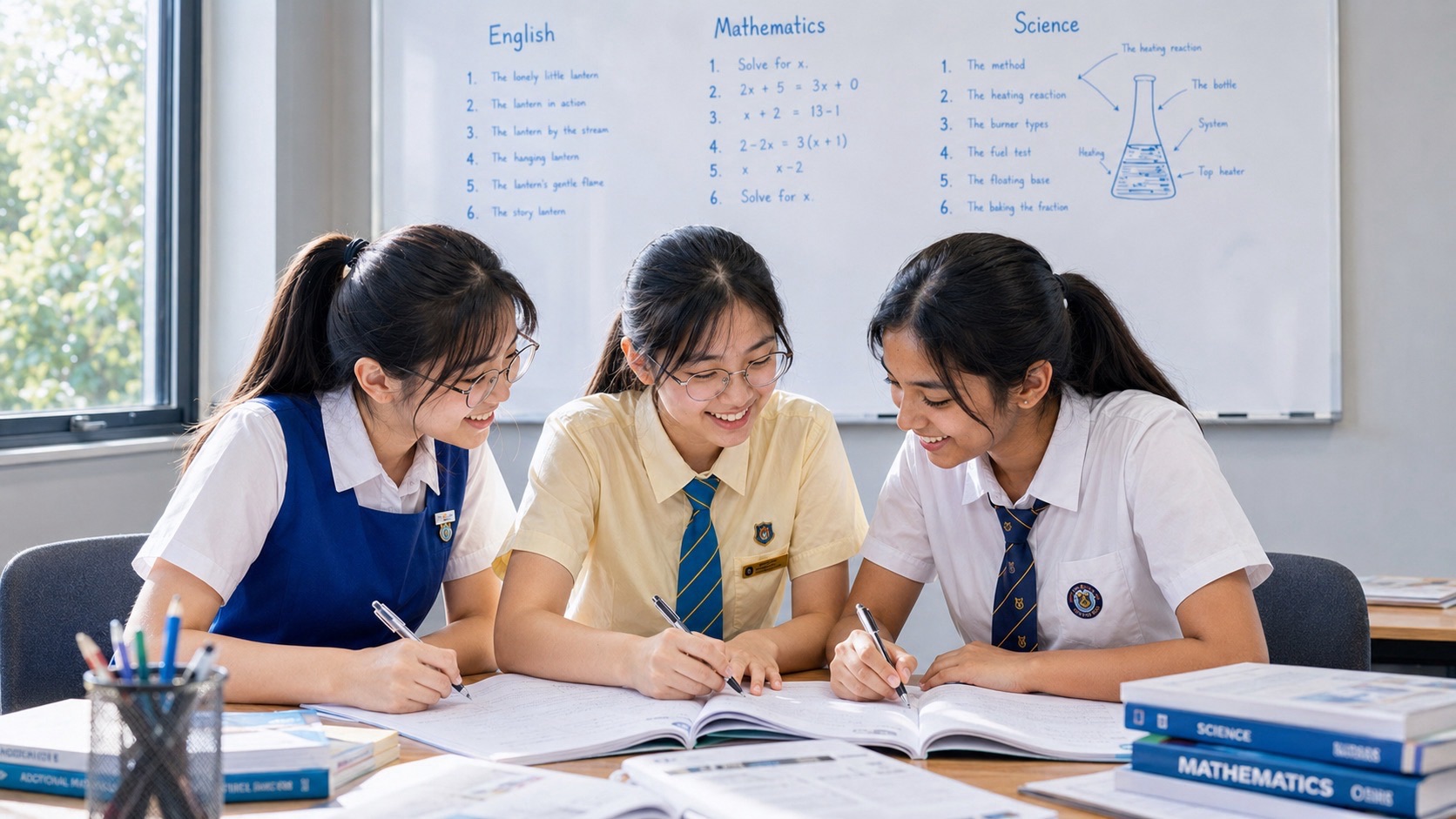
Tutors for Pasir Ris families should help students make long-range progress visible.
Some learning problems are obvious. A student fails a test, cannot understand algebra or repeatedly leaves comprehension questions blank.
Other problems are quieter.
The student is passing, but every new chapter requires the same rescue. Work is completed, but old material is forgotten. Parents see effort but cannot tell whether capability is actually growing.
Good tutoring should make progress easier to observe.
At eduKateSG, our 3-pax small-group tutorials use diagnosis, retrieval, deliberate practice, error review and transfer to build learning that lasts beyond the immediate worksheet.
Lessons are 1.5 hours weekly. We support Primary and Secondary students in English and Mathematics, Primary Science, and Additional Mathematics for suitable upper-secondary students.
The objective is not a sequence of isolated good weeks.
The objective is a stronger learner over time.
See eduKateSG small-group tuition programmes
Arrange a parent–student consultation
Chat with eduKateSG on WhatsApp
Progress Should Accumulate
A good learning system should leave something behind.
After a month, the student should have more than completed worksheets.
There should be stronger recall, cleaner methods, better question reading, more accurate language and greater independence.
After a term, those gains should combine.
The student should not need to relearn every earlier topic from zero.
This is accumulation.
Tutoring works best when each lesson connects to what came before and prepares what comes next.
Why Short-Term Rescue Can Become a Trap
Emergency tuition can be useful before an assessment.
But if every school test creates the same emergency, the system is not becoming stronger.
The student may be depending on last-minute compression.
A tutor should help move the student from rescue toward maintenance.
That means revisiting old work before it is forgotten, correcting recurring errors before they spread and teaching students how to organise practice across time.
The best sign of progress is that fewer emergencies are required.
What We Track Across Lessons
Retrieval
Can the student recall the method after a week or several weeks?
Error recurrence
Are the same mistakes appearing less often?
Transfer
Can the student use the idea when the question changes?
Independence
Does the student require fewer prompts to begin?
Accuracy
Are avoidable losses becoming less frequent?
Explanation
Can the student say why a method works?
These signals give a richer picture than one isolated score.
Why 3-Pax Tutorials Support Long-Term Tracking
In a group of three, the tutor can remember the student’s patterns in enough detail to connect one week to the next.
That continuity matters.
A repeated error can be identified quickly. An older strength can be reused in a new topic. A student who is ready can move from repair to extension without waiting for an entire class to change pace.
- frequent individual questioning;
- close inspection of written work;
- retrieval of older topics;
- faster correction of recurring errors;
- adjustable pace;
- peer explanation and comparison; and
- clearer movement from supported work toward independence.
Primary English: Build Skills That Compound
Vocabulary compounds when words are reused.
Grammar compounds when sentence control becomes automatic.
Comprehension compounds when students learn to identify evidence and inference across many passages.
Composition compounds when planning, specificity and paragraph development become habits rather than special techniques used only before examinations.
We therefore revisit language in new contexts rather than treating every worksheet as a separate event.
Primary Mathematics: Protect the Foundations That Future Topics Need
Mathematics is cumulative.
Fractions influence ratio and percentage. Number relationships support algebra. Geometry requires accurate measurement and interpretation.
A weak foundation may not stop the student immediately, but it increases the cost of future learning.
We therefore repair prerequisite weaknesses early and revisit them after the current chapter has moved on.
The goal is not only to pass the next test.
The goal is to reduce the number of future topics that feel unnecessarily difficult.
Primary Science: Build a Reusable Concept Network
Science should become a network of relationships rather than a collection of isolated answers.
Systems, cycles, energy, interactions and diversity connect across many question forms.
Students learn more efficiently when they recognise that a new question often reorganises an idea they already know.
We train that recognition through varied application and explanation.
Secondary Learning Rewards Accumulated Foundations
Secondary school makes cumulative weakness more visible.
Students need older skills while new chapters continue arriving.
Secondary English
Vocabulary, inference, evidence selection, summary and writing control all become more demanding when texts and tasks become more complex.
Secondary Mathematics
Algebra, equations, graphs, geometry, trigonometry and statistics build on earlier numerical and symbolic foundations.
Additional Mathematics
A-Math makes accumulation especially obvious. Weak algebraic habits repeatedly return in later topics.
Strong tutoring therefore protects foundations while still moving forward.
The eduKateSG Long-Range Loop
1. Diagnose the present
Identify the immediate learning problem.
2. Repair the prerequisite
Fix the earliest important weakness.
3. Teach the current concept
Build understanding of the new work.
4. Retrieve older learning
Keep useful methods alive.
5. Interleave
Mix topics so recognition becomes independent of chapter order.
6. Transfer
Apply learning in new forms.
7. Review progress
Decide whether the next stage is repair, stabilisation or extension.
The loop keeps the student moving forward without abandoning the foundations behind them.
What Happens in a 90-Minute Lesson
- retrieval from previous lessons;
- diagnosis of the current bottleneck;
- clear concept teaching;
- guided practice;
- independent application;
- mixed older-and-current questions;
- error review; and
- focused continuation work.
The lesson is part of a sequence, not an isolated event.
Repair, Stabilise and Extend
Repair
An accumulated gap is blocking present work.
We rebuild the foundation.
Stabilise
The student understands but performance is inconsistent.
We strengthen retrieval, accuracy and execution.
Extend
The student is secure.
We increase unfamiliarity, depth and transfer.
The pathway changes as the student changes.
What Long-Term Progress Looks Like
- fewer repeated mistakes;
- less dependence on notes for familiar work;
- better retention of older topics;
- faster recognition of question structure;
- clearer working and writing;
- greater independence at the start of tasks;
- less need for last-minute rescue;
- more stable assessment performance; and
- better recovery when a difficult question appears.
These are signs that learning is accumulating rather than resetting.
When a Pasir Ris Family May Need Tutoring
- the student repeatedly relearns the same material;
- every test requires emergency revision;
- old topics disappear when new ones arrive;
- the student understands in the moment but forgets later;
- school pace has exposed a growing foundation gap;
- the student needs a smaller environment with denser feedback; or
- the student is already strong and needs structured long-term extension.
The earlier a cumulative problem is identified, the less expensive the repair becomes.
From Pasir Ris to Sixth Avenue
eduKateSG’s Bukit Timah teaching location is at 8 Fourth Avenue, Singapore 268674, near Sixth Avenue MRT on the Downtown Line.
Pasir Ris is on the East–West Line. Students can travel toward Bugis, transfer to the Downtown Line and continue to Sixth Avenue.
For families making the journey, the travel itself can create a boundary between the ordinary school day and a focused tutorial block.
Location: eduKateSG, 8 Fourth Avenue, Singapore 268674
Nearest MRT: Sixth Avenue MRT, Downtown Line
Attendance: By appointment
Class Details
Format: 3-pax small-group tutorials
Duration: 1.5 hours weekly
Levels: Primary and Secondary
Subjects: English, Mathematics, Primary Science and Additional Mathematics for suitable Secondary students
Teaching features include diagnosis, retrieval, interleaving, transfer, error analysis, guided practice, independent application and school-assessment alignment.
Frequently Asked Questions
Do you support students from Pasir Ris?
Yes. Students from Pasir Ris can attend our small-group teaching location near Sixth Avenue MRT, subject to a suitable class placement.
Is tuition worthwhile if the student is already passing?
It can be when the student’s performance is fragile, old topics are being forgotten or the family wants purposeful extension. Passing alone does not tell us whether learning is stable.
Do you teach ahead?
Yes, when the foundation is ready. Pre-teaching should make future school learning easier rather than simply increase syllabus speed.
Will you keep revising old topics?
Yes, selectively. Retrieval and interleaving help important earlier skills remain available while new work is introduced.
Can a 3-pax class help a struggling student?
Yes, when class fit is appropriate and the tutor can preserve enough individual attention for repair.
What if my child is already strong?
Then extension should develop transfer, depth, unfamiliar problem solving and independent judgement.
How quickly will grades improve?
There is no fixed responsible timeline. Progress depends on the starting point, attendance, practice and assessment timing.
Does every student need tuition?
No. Tuition is useful when it solves a real learning problem or provides purposeful extension.
Tutors for Pasir Ris Families
Good tutoring should leave a trail of stronger capability behind it.
A concept learned this month should help next month.
A correction made this term should reduce future errors.
A study method should become easier to use without supervision.
For students who need repair, we rebuild.
For students who need consistency, we stabilise.
For students who are ready, we extend.
The objective is progress that accumulates.
Arrange a Parent–Student Consultation
Speak with us about your child’s level, current results, learning patterns and upcoming assessments.
eduKateSG
8 Fourth Avenue
Singapore 268674
Near Sixth Avenue MRT
3-pax small-group tuition
By appointment
Properly taught kids shine a bright light into the future.