
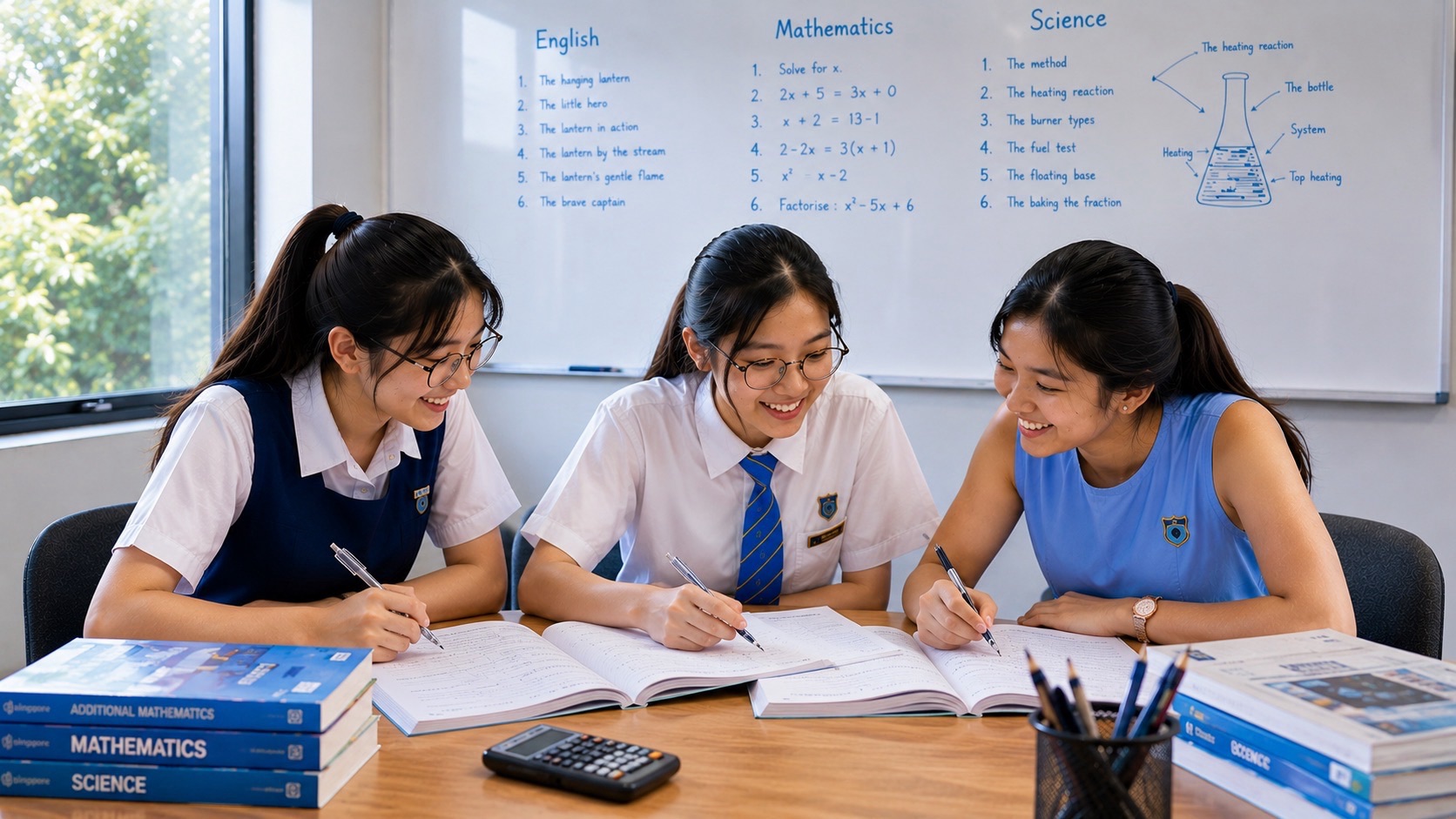
Tutors for Pioneer families should help students become better at restarting difficult work without waiting for someone else to supply the first move.
A child may understand a lesson while the tutor is speaking and still freeze later at home. That difference is important. It tells us that explanation has not yet become an independent starting method.
At eduKateSG, families can enquire about 3-pax small-group tutorials near Sixth Avenue MRT. Lessons are normally 1.5 hours weekly, with the subject, level, tutor and placement confirmed during a consultation.
The purpose of tutoring is not to make the tutor permanently responsible for every difficult beginning. The tutor should gradually teach the student how to enter the problem alone.
Arrange a parent–student consultation with eduKate Singapore
The First Step Is Often the Real Difficulty
Parents often see a blank page and assume the child knows nothing.
Sometimes the student knows a great deal but cannot decide how to begin.
In Mathematics, the student may understand the formula but fail to recognise which information belongs inside it. In English, the student may understand the passage but not know which sentence contains the evidence. In Science, the concept may be familiar but the student may not know which variable matters.
A good tutor teaches a first move.
Read the question. Identify the demand. Mark the known information. Choose a representation. Attempt one step. Then inspect whether the step still makes sense.
This sequence reduces blank-page hesitation because the student has something concrete to do before the whole solution is visible.
Why Constant Rescue Can Create Dependence
When an adult supplies the first step every time, the student may begin to wait for it.
The worksheet gets completed, but the learning system becomes dependent on an external starter.
A tutor should therefore use prompts carefully.
A prompt is useful when it helps the student learn how to proceed. It becomes less useful when the same prompt remains necessary indefinitely.
Good tutoring reduces the prompt as the student becomes ready.
What a Tutor Should Diagnose
- Does the student understand the concept?
- Can the student identify a useful first step?
- Does the student retrieve the method after a delay?
- Can the student recognise the same structure in a different-looking task?
- Does one mistake cause the student to abandon the whole question?
- Are prompts becoming lighter over time?
These questions reveal whether the problem is knowledge, recognition, recovery or independence.
Why 3-Pax Small-Group Tutorials Help
A group of three gives the tutor enough visibility to observe how each student begins.
One student may identify the first move immediately. Another may need a diagram. A third may need a reminder of an earlier prerequisite.
The tutor can respond to these differences while still preserving peer discussion.
Students also hear other learners explain how they started. This can reveal that the first move is a decision that can be learned, not a mysterious insight that only strong students possess.
Primary English: Teach the Student How to Enter the Task
In Primary English, the first useful move may be identifying the command word, audience, purpose or evidence.
Consider an original comprehension example: “Ibrahim returned the library book before school even though he knew the librarian would not arrive until later.” A student may say Ibrahim was responsible.
The tutor should ask what action supports that idea and whether the answer can be expressed more precisely.
The student learns to begin by locating evidence before searching for an impressive adjective.
In composition, the first move may be identifying what changes in the scene. A student who knows the central event can begin planning around cause, decision and consequence instead of filling the introduction with generic description.
Primary Mathematics: Create a Reliable Starting Routine
Consider this original problem: six identical tickets and a booking fee of $6 cost $42 altogether. What does one ticket cost?
The student should identify the separate booking fee before dividing the repeated amount. Subtract $6 from $42 to get $36, then divide by six. Each ticket costs $6.
The important learning target is not the number six. It is the structure: repeated equal quantities plus one separate amount.
A tutor can then change the numbers or ask the student to represent the relationship visually. The student learns how to start even when the surface changes.
Primary Science: Start With the Comparison
Science questions often become easier when the student begins by identifying what is being compared.
In an illustrative experiment, the tutor can ask which condition changed, what was observed and which factors were kept the same.
The student then chooses the scientific concept that explains the observation.
This gives the child a route into unfamiliar questions instead of relying on the hope that a familiar keyword will appear.
Secondary Learning Requires Stronger Self-Starting
Secondary students receive more complex tasks and less step-by-step support.
SEAB explains that the Singapore-Cambridge Secondary Education Certificate begins in 2027, with subjects examined at G1, G2 or G3. Families should provide the student’s actual subject level and examination year when enquiring.
A tutor should know what the student is studying and how much independent interpretation the subject requires.
In Secondary English, self-starting may mean deciding what evidence is relevant before writing. In Mathematics, it may mean selecting a representation before manipulating equations. In Additional Mathematics, it may mean recognising the algebraic structure before applying a memorised technique.
The eduKateSG Starting Loop
1. Read the task
What is actually being asked?
2. Identify the known information
What evidence, quantities or conditions are available?
3. Choose a representation or method
What first move creates structure?
4. Attempt one step
Do enough to generate evidence about whether the route is sensible.
5. Inspect
Does the result still match the question?
6. Continue or recover
If the method works, continue. If it fails, locate the first unstable step and restart.
What a 90-Minute Tutorial Can Look Like
The lesson may begin with a short retrieval task that requires the student to start without seeing a worked example.
The tutor then explains the main concept and demonstrates a useful first move where necessary.
Guided practice follows, but the student should perform the actual reasoning. Later, the prompt is reduced.
A changed question tests whether the student can still identify the starting structure.
The lesson closes with an error review and a continuation task that the student understands well enough to begin independently.
Repair, Stabilise and Extend
Repair
The student cannot start because an important prerequisite is missing. The tutor repairs that foundation and reconnects it to the current work.
Stabilise
The student can start sometimes but relies too heavily on familiar cues. Mixed practice and retrieval help make the method more dependable.
Extend
The student starts confidently and is ready for unfamiliar applications, comparison of methods and greater independence.
What Home Practice Should Reveal
Home practice should show whether the student can restart the learning without the tutor beside them.
A short retrieval task can therefore be more informative than a large set completed immediately after the lesson.
If the child becomes stuck, record where the problem begins.
“I understand the question but cannot decide which value represents the whole” is useful information. It gives the tutor a specific decision to examine.
Parents do not need to supply every missing step. Preserve enough of the independent attempt for the next lesson.
What Progress Should Look Like
- the student begins work with less hesitation;
- prompts become lighter;
- older methods are retrieved more reliably;
- the student can explain the first step;
- one error is less likely to stop the entire question;
- unfamiliar tasks create less avoidance;
- homework requires less rescue; and
- assessment performance becomes more stable.
When a Pioneer Family May Need Tutoring
A consultation may be useful when the student repeatedly waits for the first hint, cannot restart methods at home, gives up quickly on unfamiliar questions or carries the same foundation gap into several topics.
It may also be useful when a secure student needs more purposeful extension.
The decision should follow the student’s work, not the assumption that every child needs additional tuition.
Travelling from Pioneer to Sixth Avenue
Pioneer is on the East–West Line. Families should use current public-transport information to compare the complete journey to Sixth Avenue from the student’s actual starting point and at the relevant time of day.
eduKateSG’s Bukit Timah location is at 8 Fourth Avenue, Singapore 268674, near Sixth Avenue MRT. Consultations are by appointment.
This article is for Pioneer families considering tutoring. It does not announce an eduKateSG branch in Pioneer.
Class Details
Format: up to three students in a small-group tutorial.
Duration: normally 1.5 hours weekly.
Enquire about the appropriate Primary English, Mathematics or Science programme, Secondary English or Mathematics programme, or suitable Additional Mathematics support.
Frequently Asked Questions
Does eduKateSG have a Pioneer branch?
No branch is established by this article. The arrangement discussed here is for students travelling to our Bukit Timah location near Sixth Avenue MRT.
Can tuition help a child who always needs the first hint?
Yes, when the tutor identifies why the child cannot start and gradually teaches a reliable first-step routine rather than supplying the same hint indefinitely.
Do you teach ahead?
Where appropriate, yes. Pre-teaching should follow readiness and should not replace necessary repair of current foundations.
What if my child is already strong?
Then extension should develop transfer, explanation and independent judgement rather than simply increase routine volume.
How quickly should results improve?
There is no responsible fixed promise. Progress depends on the starting point, attendance, practice, school demands and assessment timing.
A Tutor Who Teaches the Student How to Begin
A strong learner does not always know the whole answer immediately.
The stronger skill is knowing how to enter the problem, generate evidence and keep moving.
For Pioneer families, look for tutoring that gradually returns that responsibility to the student.