
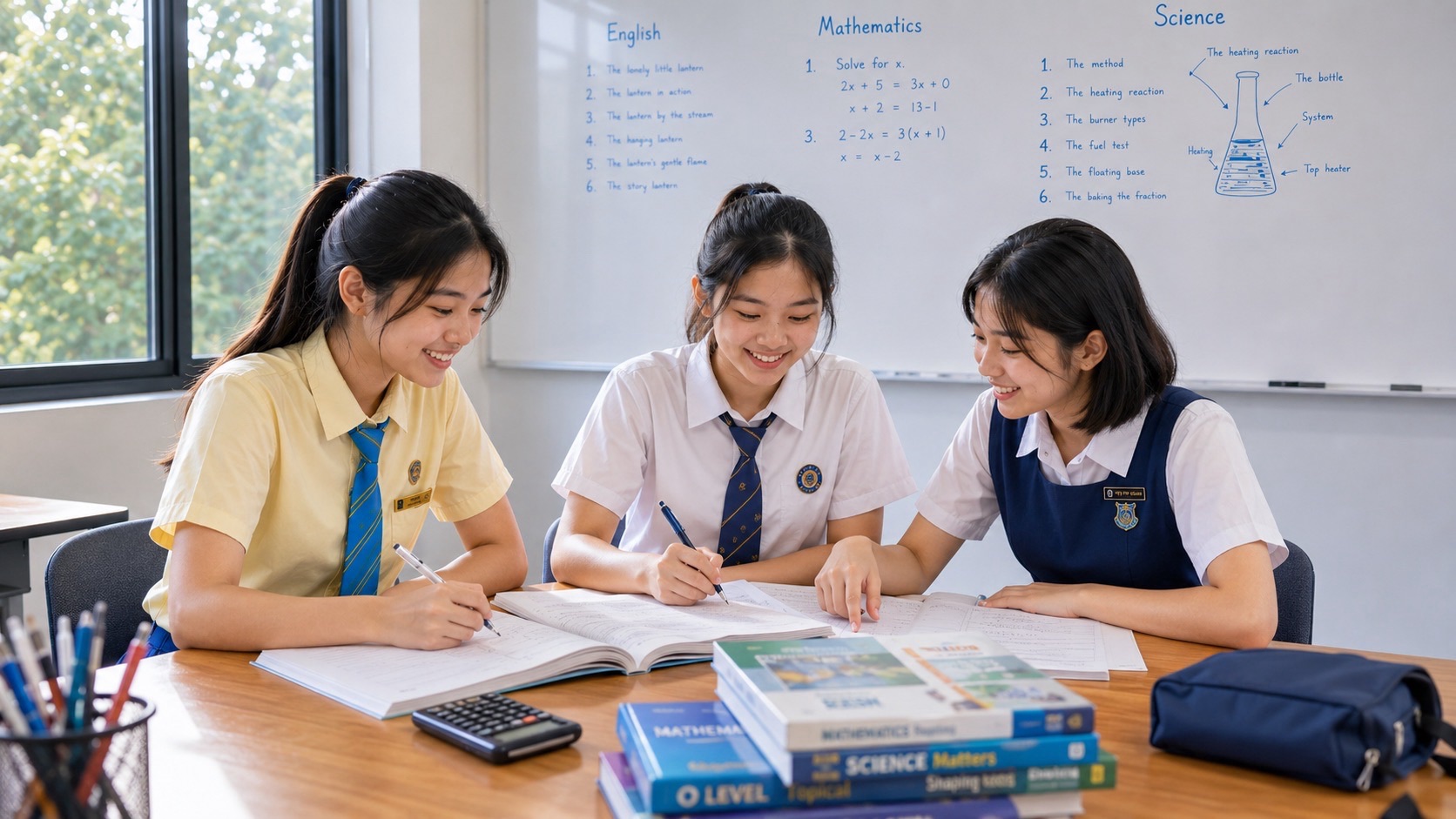
Tutors for Queenstown families should provide continuity in a school life that changes quickly.
A student moves from one topic to another, one teacher to another, one assessment cycle to another and eventually from Primary school into Secondary school. The work changes. The language changes. The expectations rise. Yet the learner carries the same mind, the same habits and the same unresolved weaknesses forward.
That is why good tutoring is not simply a weekly delivery of worksheets.
It is a continuity system.
A good tutor remembers what was difficult last month, notices what is becoming easier this month and knows which earlier skill is still affecting the student’s current work.
At eduKateSG, we use 3-pax small-group tutorials to keep that continuity visible. Lessons are 1.5 hours weekly, with close observation, targeted explanation, deliberate practice, error review and gradual release toward independent work.
We support Primary and Secondary students in English and Mathematics, Primary Science, and Additional Mathematics where the student is ready.
The purpose is not to make a student permanently dependent on tuition.
The purpose is to help the student carry stronger methods from one school demand to the next.
See eduKateSG small-group tuition programmes
Arrange a parent–student consultation
Chat with eduKateSG on WhatsApp
The Hidden Value of Continuity
A school result is a snapshot.
A tutor should be reading the film.
One test may show a student scoring well because the topic was familiar. Another may show a sharp decline because the question demanded transfer. A composition may look stronger because the topic was comfortable, while the next piece exposes weak paragraph control. A Mathematics paper may appear careless, but several earlier scripts may reveal the same sign error or the same difficulty with translating words into equations.
Continuity allows the tutor to distinguish an isolated bad day from a repeated learning pattern.
That is important because repeated patterns deserve intervention. Isolated errors often do not.
A useful tutor keeps asking:
- What has changed since the last assessment?
- Which mistake is repeating?
- Which improvement is now stable?
- What can the student do without help that previously required prompting?
- Which older topic is interfering with the current one?
- Is the student forgetting, misunderstanding or simply rushing?
- Is school pace the problem, or is the underlying foundation too weak?
- Does the student need repair, stabilisation or extension next?
The answers build a learning history.
That history helps tuition remain coherent even when school topics move quickly.
Why Queenstown Families Should Look Beyond a Tutor’s Subject Label
Parents naturally begin with the subject.
English tutor. Mathematics tutor. Science tutor. Additional Mathematics tutor.
The label matters, but it is only the beginning.
Two tutors can know the same syllabus and produce very different learning environments.
One may explain well but fail to notice that the student cannot retrieve the method later. Another may set demanding work but never identify the earlier gap that makes the work feel impossible. A third may correct every mistake but do so quickly enough that the student never learns to self-correct.
The more useful questions are about teaching behaviour.
Can the tutor diagnose? Can the tutor pace? Can the tutor distinguish explanation from practice? Can the tutor reduce help over time? Can the tutor see when confidence is low because competence is low, and repair the competence instead of merely offering reassurance?
A strong tutor is not only a subject expert.
A strong tutor is an observer of learning.
What We Observe Before We Add More Work
A student can look weak for many reasons.
The first task is to determine which reason is active.
When the issue is knowledge
The student may simply not know the required concept, rule, vocabulary or fact.
This needs clear instruction and retrieval.
When the issue is structure
The student may know individual pieces but fail to connect them.
This is common in multi-step Mathematics, comprehension inference and Science explanation.
When the issue is language
A student may understand an idea but misread the question, choose an imprecise word or fail to express the reasoning clearly enough for the examiner.
When the issue is memory
The student may perform well immediately after teaching but lose access to the method days later.
That requires spaced retrieval rather than more same-day repetition.
When the issue is execution
The student may know the content but lose marks through timing, layout, skipped steps, incomplete checking or panic when the first approach fails.
Different causes require different lessons.
This is why diagnosis comes before volume.
Why 3-Pax Tutoring Works for Precision
A group of three gives the tutor enough room to notice individual patterns without removing the useful presence of peers.
Students benefit from hearing another explanation and seeing another method. They also learn that difficulty is not private or shameful. Another student may ask the question they were hesitant to ask.
At the same time, three students are few enough for the tutor to inspect work directly.
That matters because learning problems often appear in the middle of a solution.
The final answer may be wrong because the student misread the question, selected the wrong formula, copied a number incorrectly, skipped a logical step or performed the final arithmetic badly.
Only one of those is a conceptual problem.
If every wrong answer receives the same correction, the teaching becomes blunt.
A 3-pax class allows
- frequent individual questioning;
- close checking of written work;
- fast interruption of repeated errors;
- clearer adjustment of pace;
- more opportunities to explain thinking aloud;
- guided peer comparison without crowding;
- targeted extension when one student is ready; and
- targeted repair when another student needs to return to a foundation.
The class is small so the teaching can stay specific.
Primary Years: Build the Floor Before the Ceiling
Primary students need knowledge, but they also need a way of working.
The earlier years are where many later habits begin: whether the student checks, whether they can explain, whether they read questions carefully, whether they recover after a mistake and whether they expect learning to make sense.
Primary English
We work across vocabulary, grammar, comprehension, cloze, oral communication and composition.
The central objective is control over meaning.
A student should become better at understanding what a question is really asking, choosing relevant evidence, building a sentence accurately and developing ideas rather than decorating them.
Primary Mathematics
We protect number fluency, fractions, ratio, percentage, geometry, measurement, data and problem solving.
The tutor watches not only whether the student can finish a question, but whether the method is durable enough to survive a slightly different version.
Primary Science
Science requires concepts, but it also requires relationships.
Students need to understand systems, cycles, interactions, energy and diversity, then use those ideas to interpret evidence and explain outcomes.
Keywords matter only when they are attached to correct reasoning.
PSLE preparation
Near PSLE, the task changes again.
The student must retrieve knowledge quickly, recognise question types without being told the chapter, manage time and sustain accuracy across a complete paper.
Preparation therefore moves from learning isolated topics to coordinating many skills at once.
Secondary Years: More Subjects, More Abstraction, More Transfer
Secondary school increases both breadth and abstraction.
Students encounter subject-specific language, symbolic Mathematics, longer written responses and assessments that require stronger judgement about what method to use.
Under Full Subject-Based Banding, students may take subjects at G1, G2 and G3 levels. From the 2027 graduating cohort, the Singapore-Cambridge Secondary Education Certificate reflects the subjects and subject levels taken.
The tutor therefore needs to understand the actual level being studied rather than treating all Secondary students as one group.
Secondary English
The work increasingly depends on interpretation, evidence selection, summary control, writing structure, vocabulary and oral clarity.
A student who could rely on surface comprehension in Primary school may now need to infer tone, purpose, relationship and implication.
Secondary Mathematics
Mathematics becomes more symbolic and cumulative.
Weakness with fractions, negative numbers or basic algebra can appear again inside equations, graphs, trigonometry and later topics.
The tutor must know when the current topic is genuinely new and when it is exposing an old weakness.
Additional Mathematics
A-Math rewards symbolic fluency.
Students need reliable algebra, accurate manipulation, strong retrieval and enough patience to hold several steps in view.
Teaching ahead can help, but only when the runway is stable.
The eduKateSG Tutoring Sequence
1. Find the first unstable point
We look for the earliest step that stops being dependable.
A Secondary algebra problem may actually fail because of fraction control. A composition may fail because the student cannot generate a specific supporting detail. A Science response may fail because the student confuses observation with explanation.
2. Make the idea visible
We slow the work down enough for the student to see the structure.
This may involve a diagram, a worked comparison, a sentence frame, a number line or a simpler version of the same reasoning.
3. Practise inside a clear boundary
We keep the task focused before adding complexity.
Once the student can control the core idea, we vary the surface details.
4. Retrieve later
Learning is tested again after time has passed.
Recognition during the original lesson is not enough.
5. Mix topics
Interleaving forces the student to decide what method is needed instead of copying the method demonstrated immediately before.
6. Remove support
Prompts are gradually reduced.
The lesson is succeeding when the student can continue without the tutor carrying the thinking.
A 90-Minute Tutorial Has a Rhythm
A stable lesson rhythm helps the tutor gather evidence while the student learns.
Opening retrieval
A short review reveals what survived from earlier lessons.
Instruction
The day’s concept is explained with attention to meaning, not only procedure.
Guided practice
The student works while the tutor can still interrupt a misconception early.
Independent practice
The student then attempts selected work with less assistance.
Mixed application
Earlier topics are reintroduced so the student must recognise the correct method.
Error classification
Mistakes are sorted into useful categories: concept, reading, recall, language, arithmetic, notation, organisation or time pressure.
Continuation
Home practice reinforces the lesson with enough repetition to consolidate without creating meaningless volume.
The Three Pathways: Repair, Stabilise, Extend
Repair
A student has fallen behind or is carrying an earlier gap into current work.
The priority is to stop drift and rebuild from the first unstable point.
Stabilise
A student can perform the work but not consistently.
The priority is dependable retrieval, accuracy and execution.
Extend
A student is secure and needs greater challenge.
The priority is deeper transfer, more unfamiliar work, stronger explanation and better independent judgement.
These pathways are not labels for children.
They describe the next teaching job.
How Parents Can Tell Whether Tutoring Is Working
A grade is one signal.
There are others.
Parents may notice that the student:
- begins work more readily;
- needs fewer reminders to start;
- asks questions that are more specific;
- can explain why an answer is wrong;
- keeps cleaner working;
- uses notes less often for routine tasks;
- remembers older material more reliably;
- handles unfamiliar questions with less avoidance;
- recovers after an error instead of shutting down; or
- shows more stable results across several assessments.
These signals matter because they describe capability, not only one performance event.
A strong tutor should help parents see these changes without creating artificial promises.
The Parent’s Role Is Important—but Different
Parents do not need to reproduce the tuition lesson at home.
The home can do something more valuable.
Protect the conditions that make learning possible.
- consistent attendance;
- reasonable sleep;
- a workable study routine;
- honest sharing of school feedback;
- access to the right materials;
- enough time for focused practice; and
- a calm expectation that corrections are part of learning.
When the parent, tutor and student each perform a different role, the system becomes clearer.
When a Queenstown Family May Need a Tutor
Tutoring may be useful when the student:
- repeatedly cannot restart a method at home;
- shows the same mistake across several assessments;
- works hard but produces little improvement;
- has a sudden transition problem after moving to a new level;
- depends heavily on model answers;
- loses marks through weak execution despite understanding the topic;
- is anxious because too many gaps have accumulated;
- has stable foundations but needs disciplined extension; or
- needs a calmer learning environment with closer feedback.
The right time to intervene is not always after a major failure.
A smaller early correction is often more efficient than a large later repair.
From Queenstown to Sixth Avenue
eduKateSG’s Bukit Timah teaching location is at 8 Fourth Avenue, Singapore 268674, near Sixth Avenue MRT on the Downtown Line.
Queenstown is served by the East–West Line. A rail route to Sixth Avenue can run from Queenstown to Buona Vista, transfer to the Circle Line for Botanic Gardens, then transfer to the Downtown Line for Sixth Avenue.
For some students, this journey creates a useful change of setting.
The school day ends. The student enters a smaller learning environment with one defined purpose. The lesson becomes a separate block for diagnosis, practice and correction.
Location: eduKateSG, 8 Fourth Avenue, Singapore 268674
Nearest MRT: Sixth Avenue MRT, Downtown Line
Attendance: By appointment
Class Details
Format: 3-pax small-group tutorials
Duration: 1.5 hours weekly
Levels: Primary and Secondary
Subjects: English, Mathematics, Primary Science and Additional Mathematics for suitable Secondary students
Lessons may include:
- diagnostic questions;
- concept teaching;
- guided practice;
- independent application;
- retrieval practice;
- mixed-topic work;
- error review;
- assessment preparation; and
- focused continuation work.
What to Bring to a Consultation
A useful consultation begins with evidence.
- recent test papers;
- marked homework;
- teacher comments;
- current topic lists or schedules;
- examples of unfinished work;
- the student’s notes;
- questions the student repeatedly avoids; and
- a short account of what homework looks like at home.
We use these materials to decide whether the next job is repair, stabilisation or extension.
Frequently Asked Questions
Do you support students from Queenstown?
Yes. Students from Queenstown can attend our small-group teaching location near Sixth Avenue MRT, subject to a suitable class placement.
Is small-group tuition suitable if my child is quiet?
A 3-pax environment can help because the student has more opportunities to answer and fewer places to disappear. The tutor can also observe whether silence comes from uncertainty, processing time or reluctance to speak.
Will you reteach the entire syllabus if there are gaps?
Usually no. We return to the foundations that are actively affecting present work, repair them and reconnect them to the current topic.
Do you teach ahead of school?
Yes, when the student is ready. Pre-teaching is used to create familiarity and reduce surprise, not to race through chapters.
How do you stop a student from becoming dependent on tuition?
Support is gradually reduced. Students move from explanation to guided practice to independent application, with later retrieval used to check whether the learning survived.
What if my child is already scoring well?
Then the teaching job changes. Extension should deepen reasoning, improve transfer, introduce unfamiliar structures and strengthen independent performance rather than simply add more routine questions.
How quickly can marks improve?
There is no responsible fixed promise. Improvement depends on the size of the gap, attendance, practice, school demands and the time available before assessments.
Can students join mid-year?
Yes, subject to fit. We first look at the student’s current work so that class pace and support needs are reasonably compatible.
Does every student need tuition?
No. Tuition is useful when it solves a real learning problem or provides purposeful extension. A student who is progressing independently may not need additional support.
Tutors for Queenstown Families
A good tutor gives the student something more valuable than another completed worksheet.
The tutor gives continuity.
The student learns what to carry forward.
A method survives the test.
A correction survives the week.
A concept becomes usable in a new question.
A student who once waited for the next hint begins to know what to do next.
That is the direction of good tutoring.
For students who need repair, we rebuild.
For students who need consistency, we stabilise.
For students who are ready, we extend.
The aim is a learner who can continue moving even when the tutor is no longer in the room.
Arrange a Parent–Student Consultation
Speak with us about your child’s level, current results, learning patterns and upcoming assessments.
eduKateSG
8 Fourth Avenue
Singapore 268674
Near Sixth Avenue MRT
3-pax small-group tuition
By appointment
Properly taught kids shine a bright light into the future.