
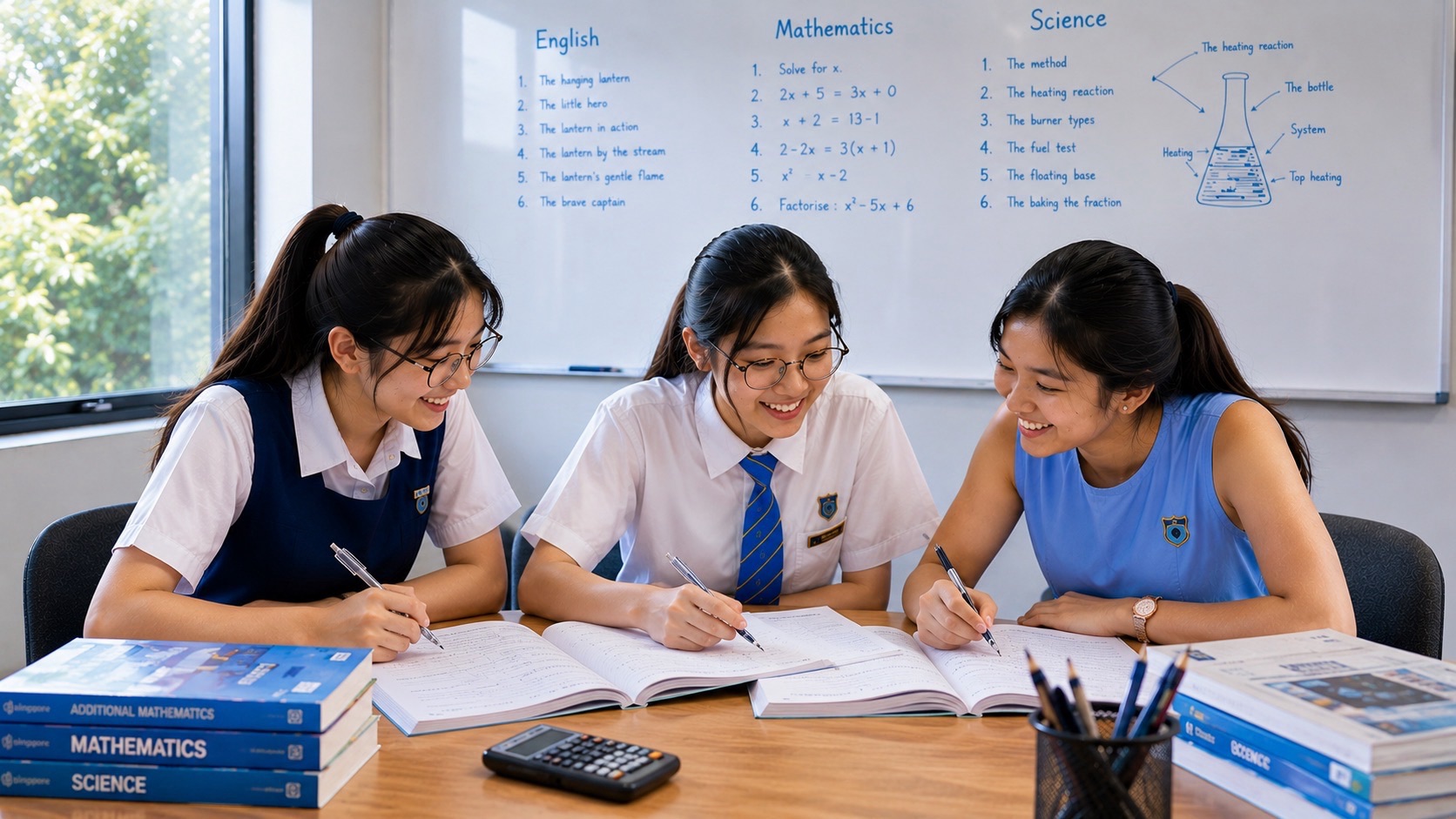
Tutors for Thomson families should help students build a strong academic runway.
Many difficult upper-level topics are not difficult only because they are new.
They are difficult because they assume earlier skills are already automatic.
At eduKateSG, our 3-pax small-group tutorials protect those foundations while still moving students forward. Lessons are 1.5 hours weekly and combine diagnosis, clear teaching, guided practice, retrieval, interleaving and independent application.
We support Primary and Secondary students in English and Mathematics, Primary Science, and Additional Mathematics for suitable upper-secondary students.
The objective is not simply to reach the next chapter.
It is to arrive there ready.
See eduKateSG small-group tuition programmes
Future Difficulty Is Often Built Earlier
A student may encounter difficulty in Secondary Mathematics that began with unstable fractions in Primary school.
A Secondary English student may struggle with inference because vocabulary depth and evidence selection were never secure.
An upper-primary Science student may memorise facts but still fail application because cause-and-effect reasoning was never made explicit.
The tutor should look upstream.
What earlier capability is the current topic assuming?
The Academic Runway
A runway is useful only when it gives enough space to accelerate before take-off.
Learning works similarly.
Students need enough foundation before advanced work can become productive.
- vocabulary before subtle inference;
- number fluency before algebraic load;
- clear scientific concepts before application;
- basic algebra before Additional Mathematics;
- retrieval before timed performance;
- accuracy before speed.
Teaching ahead is useful only when the runway is stable.
Why 3-Pax Tutorials Help Build Foundations
A group of three allows the tutor to check prerequisites closely without turning the whole lesson into remediation.
One student may need repair, another stabilisation and another extension.
The class is small enough for those pathways to coexist.
Primary English
Primary English foundations include vocabulary, grammar, comprehension, oral communication and writing.
Students need enough language control that later reading and writing demands do not consume all available attention.
Primary Mathematics
Number sense, fractions, ratio, percentage, geometry and multi-step problem solving form the runway for later Mathematics.
We build understanding first, then fluency, then transfer.
Primary Science
Science foundations include accurate concepts, careful observation, variable awareness and cause-and-effect explanation.
These help students handle unfamiliar experiments rather than depend on memorised answer patterns.
Secondary English and Mathematics
Secondary school increases abstraction.
Students need stronger inference, writing control and evidence selection in English, while Mathematics requires increasingly reliable algebra, graphs, geometry and multi-step symbolic reasoning.
The stronger the runway, the more calmly students can meet this change.
The eduKateSG Build Sequence
1. Check prerequisites
Identify what the new topic assumes.
2. Repair missing foundations
Return only as far as necessary.
3. Teach the current idea
Make the new structure clear.
4. Practise
Build accurate execution.
5. Retrieve
Check whether the learning survives after delay.
6. Mix
Interleave with older topics.
7. Extend
Increase difficulty only when the structure is secure.
What Progress Looks Like
- new topics require less rescue;
- older skills remain available;
- students recognise connections between topics;
- homework becomes more efficient;
- working becomes clearer;
- assessment preparation becomes less frantic; and
- confidence follows real competence.
When a Thomson Family May Need Tutoring
- new topics repeatedly expose old gaps;
- the student needs constant reteaching;
- school pace is moving faster than the foundation can support;
- the student is accurate only on familiar question forms;
- the student is preparing for a major transition; or
- the student is already secure and needs purposeful extension.
From Thomson to Sixth Avenue
eduKateSG’s Bukit Timah teaching location is at 8 Fourth Avenue, Singapore 268674, near Sixth Avenue MRT.
Families from Thomson can plan a regular route into Bukit Timah and use the journey as a predictable transition into focused learning.
Class Details for Thomson Families
Format: 3-pax small-group tutorials
Duration: 1.5 hours weekly
Levels: Primary and Secondary
Subjects: English, Mathematics, Primary Science and Additional Mathematics for suitable Secondary students
Teaching features include diagnosis, retrieval, guided practice, mixed application, error analysis, assessment alignment and progressive release toward independent work.
Frequently Asked Questions
Do you support students from Thomson?
Yes. Students from Thomson can attend our small-group teaching location near Sixth Avenue MRT, subject to a suitable class placement.
Do you teach ahead of school?
Yes, when foundations are ready. Pre-teaching should make later school learning easier rather than simply accelerate syllabus coverage.
Can a struggling student join a 3-pax class?
Yes, when the class fit is appropriate and the tutor can preserve enough individual attention for repair.
What if my child is already strong?
Then extension should increase depth, transfer, explanation and independent judgement rather than only add more routine work.
How do you handle repeated careless mistakes?
We break careless into specific error types such as reading, recall, arithmetic, notation, copying, language, organisation and time pressure, then teach the relevant correction.
How quickly will results improve?
There is no responsible fixed timeline. Progress depends on the starting point, attendance, practice, school demands and assessment timing.
Does every student need tuition?
No. Tuition is useful when it solves a real learning problem or provides purposeful extension.
Tutors for Thomson Families
Good tutoring should make learning clearer, more durable and more independent.
For students who need repair, we rebuild.
For students who need consistency, we stabilise.
For students who are ready, we extend.
The long-term objective is a learner who can carry stronger methods into school, homework and examinations without needing constant rescue.
Arrange a Parent–Student Consultation
Speak with us about your child’s level, current results, learning patterns and upcoming assessments.
eduKateSG
8 Fourth Avenue
Singapore 268674
Near Sixth Avenue MRT
3-pax small-group tuition
By appointment
Properly taught kids shine a bright light into the future.