
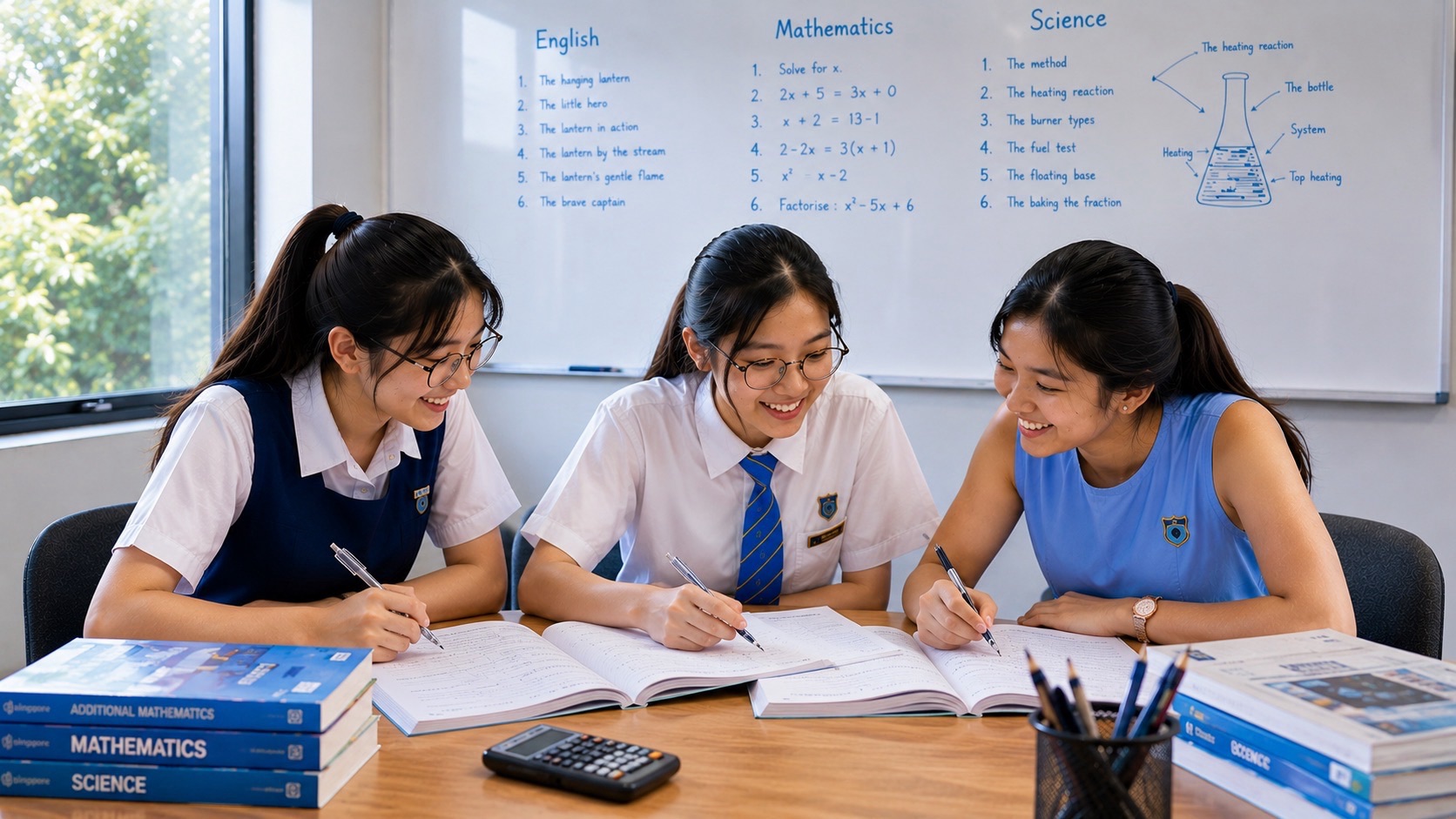
Tutors for Woodlands families should help students build enough independence that distance, school pace and changing assessment demands do not constantly reset learning.
Woodlands students often manage full school days, CCAs, travel and family routines across a large northern town. In that environment, tuition has to do more than occupy another weekly slot.
It should simplify learning.
A good tutor helps the student know what to do first, what to practise, what to retrieve and what to leave for later.
At eduKateSG, our 3-pax small-group tutorials use diagnosis, clear explanation, guided practice, retrieval, interleaving, error review and gradual release toward independent performance.
Lessons are 1.5 hours weekly. We support Primary and Secondary students in English and Mathematics, Primary Science, and Additional Mathematics for suitable upper-secondary students.
The objective is not a student who can only perform when the tutor is present.
The objective is a student who carries stronger learning habits back into school and home.
See eduKateSG small-group tuition programmes
Arrange a parent–student consultation
Chat with eduKateSG on WhatsApp
The Real Goal Is Learning That Travels
A student may perform well inside tuition and still struggle alone.
That usually means too much of the thinking remains with the tutor.
The tutor explains. The tutor chooses the method. The tutor notices the error. The tutor decides what comes next.
The student follows.
This can create smooth lessons without creating independence.
Good tutoring gradually transfers those decisions back to the learner.
The student should learn to identify the task, choose an approach, notice when a method is failing and decide what kind of correction is needed.
That is what allows learning to travel beyond the tuition room.
Why Woodlands Students Need a Clear Learning Sequence
When a student has many subjects and responsibilities, uncertainty creates wasted time.
A child may sit at a desk for an hour without knowing which problem deserves attention first.
A good tutor reduces this ambiguity.
The lesson creates a sequence:
- identify the present bottleneck;
- repair the prerequisite if needed;
- teach the current concept clearly;
- practise with support;
- retrieve without notes;
- mix with older learning;
- review the error pattern; and
- leave with one clear next step.
A clear sequence reduces the amount of energy spent deciding what to do.
What We Diagnose
English
We separate vocabulary, grammar, reading accuracy, inference, evidence selection, oral organisation, sentence control and composition development.
Mathematics
We inspect number fluency, fractions, signs, algebra, diagram reading, formula choice, sequencing, working presentation and checking.
Science
We look at concept knowledge, application, variables, data interpretation, cause-and-effect reasoning and scientific language.
Learning behaviour
We also notice whether the student can begin independently, retrieve older work, persist through uncertainty and correct mistakes without immediately asking for rescue.
These behaviours become increasingly important as school demands rise.
Why 3-Pax Tutorials Support Independence
Three students give the tutor enough visibility to watch individual reasoning while preserving peer energy.
The tutor can ask one student to explain, another to compare methods and a third to attempt independently.
Support can be adjusted without turning the lesson into passive one-to-one instruction.
- frequent individual questioning;
- close checking of work;
- rapid correction of misconceptions;
- peer explanation;
- adjustable pacing;
- targeted repair;
- targeted extension; and
- progressive reduction of prompts.
The class is small so the tutor can see when independence is actually increasing.
Primary English: Build Language That Can Be Used Alone
Primary English becomes stronger when the student can apply vocabulary, grammar, comprehension and writing skills without waiting for a model answer.
We train students to identify what a question requires, locate evidence, construct accurate sentences and develop ideas with sufficient detail.
Oral explanation is useful because it reveals whether the student understands the idea before writing begins.
The aim is language control, not decorative memorisation.
Primary Mathematics: Teach Students to Start
A common Mathematics problem is not that students know nothing.
It is that they do not know how to begin.
We teach students to identify the known information, the relationship being tested and a sensible representation.
Once a starting structure exists, multi-step problem solving becomes more manageable.
Over time, prompts are removed so the student generates that first step independently.
Primary Science: Build the Reasoning Chain
Science answers improve when students can move from observation to explanation.
We teach students to identify what changed, which concept is relevant, how the concept explains the outcome and what evidence supports the response.
Keywords become useful after the relationship is secure.
Secondary Tutoring: Independence Matters More Each Year
Secondary school increases subject load, abstraction and the number of decisions students must make without immediate adult support.
Secondary English
Students need to interpret longer texts, select evidence, summarise accurately, organise writing and speak with greater precision.
Secondary Mathematics
Algebra, equations, graphs, geometry, trigonometry and statistics require stable methods and clear working.
Additional Mathematics
A-Math requires enough algebraic fluency that the student can monitor several symbolic steps without losing control.
The eduKateSG Independence Loop
1. Model
The tutor demonstrates the concept clearly.
2. Guide
The student attempts the method with support.
3. Prompt lightly
The tutor reduces assistance.
4. Retrieve
The student reconstructs the idea later.
5. Mix
The skill appears among other possible methods.
6. Transfer
The surface of the problem changes.
7. Release
The student performs without the tutor carrying the decision-making.
Independence is not expected instantly.
It is built deliberately.
What Happens in a 90-Minute Lesson
- short retrieval from previous lessons;
- diagnosis of the current target;
- clear concept instruction;
- guided practice;
- independent application;
- mixed-topic questions;
- error review; and
- focused continuation work.
The balance changes according to the student’s readiness.
Repair, Stabilise and Extend
Repair
An earlier weakness is preventing independent work.
We rebuild the prerequisite.
Stabilise
The student can perform the method but not consistently.
We strengthen retrieval, accuracy and checking.
Extend
The student is ready for greater unfamiliarity and deeper reasoning.
Each pathway should move the student toward stronger self-direction.
What Progress Looks Like
- the student begins work with fewer prompts;
- older methods are retrieved more reliably;
- mistakes are identified earlier;
- the student can explain why a method fits;
- working becomes clearer;
- homework requires less rescue;
- unfamiliar questions cause less avoidance; and
- assessment results become more stable.
These are signs that the learner is carrying more of the process.
When a Woodlands Family May Need Tutoring
- the student depends heavily on adults to start work;
- school pace has exposed an earlier gap;
- the same mistake appears repeatedly;
- old topics disappear when new ones arrive;
- homework takes too long because the student cannot choose a method;
- the student needs a smaller environment with faster feedback; or
- the student is secure and ready for deeper extension.
The strongest tutoring gradually reduces dependence rather than increasing it.
From Woodlands to Sixth Avenue
eduKateSG’s Bukit Timah teaching location is at 8 Fourth Avenue, Singapore 268674, near Sixth Avenue MRT on the Downtown Line.
Woodlands is served by the North–South and Thomson–East Coast Lines. Students can use the Thomson–East Coast Line toward Stevens, transfer to the Downtown Line and continue to Sixth Avenue.
For families willing to make the journey, the travel can create a clear boundary between the school day and a focused tutorial block.
Location: eduKateSG, 8 Fourth Avenue, Singapore 268674
Nearest MRT: Sixth Avenue MRT, Downtown Line
Attendance: By appointment
Class Details
Format: 3-pax small-group tutorials
Duration: 1.5 hours weekly
Levels: Primary and Secondary
Subjects: English, Mathematics, Primary Science and Additional Mathematics for suitable Secondary students
Teaching features include diagnosis, retrieval, interleaving, transfer, error analysis, guided practice, independent application and assessment alignment.
Frequently Asked Questions
Do you support students from Woodlands?
Yes. Students from Woodlands can attend our small-group teaching location near Sixth Avenue MRT, subject to a suitable class placement.
Can tuition make my child more independent?
That is one of the central aims. Support is gradually reduced as the student learns to identify, attempt and correct work with less prompting.
Do you teach ahead?
Yes, when foundations are stable. Pre-teaching should improve later school learning rather than simply increase speed.
Can a struggling student join a 3-pax class?
Yes, when class fit is appropriate and the tutor can protect enough individual attention for repair.
What if my child is already strong?
Then extension should increase transfer, depth and independent judgement.
How quickly will grades improve?
There is no fixed responsible timeline. Progress depends on the starting point, attendance, practice and assessment timing.
Does every student need tuition?
No. Tuition is useful when it solves a real learning problem or provides purposeful extension.
Tutors for Woodlands Families
Good tutoring should make the student increasingly portable.
The learning should survive the journey home.
The method should survive the weekend.
The correction should survive the next worksheet.
For students who need repair, we rebuild.
For students who need consistency, we stabilise.
For students who are ready, we extend.
The objective is a learner who can carry more of the learning process alone.
Arrange a Parent–Student Consultation
Speak with us about your child’s level, current results, learning patterns and upcoming assessments.
eduKateSG
8 Fourth Avenue
Singapore 268674
Near Sixth Avenue MRT
3-pax small-group tuition
By appointment
Properly taught kids shine a bright light into the future.