
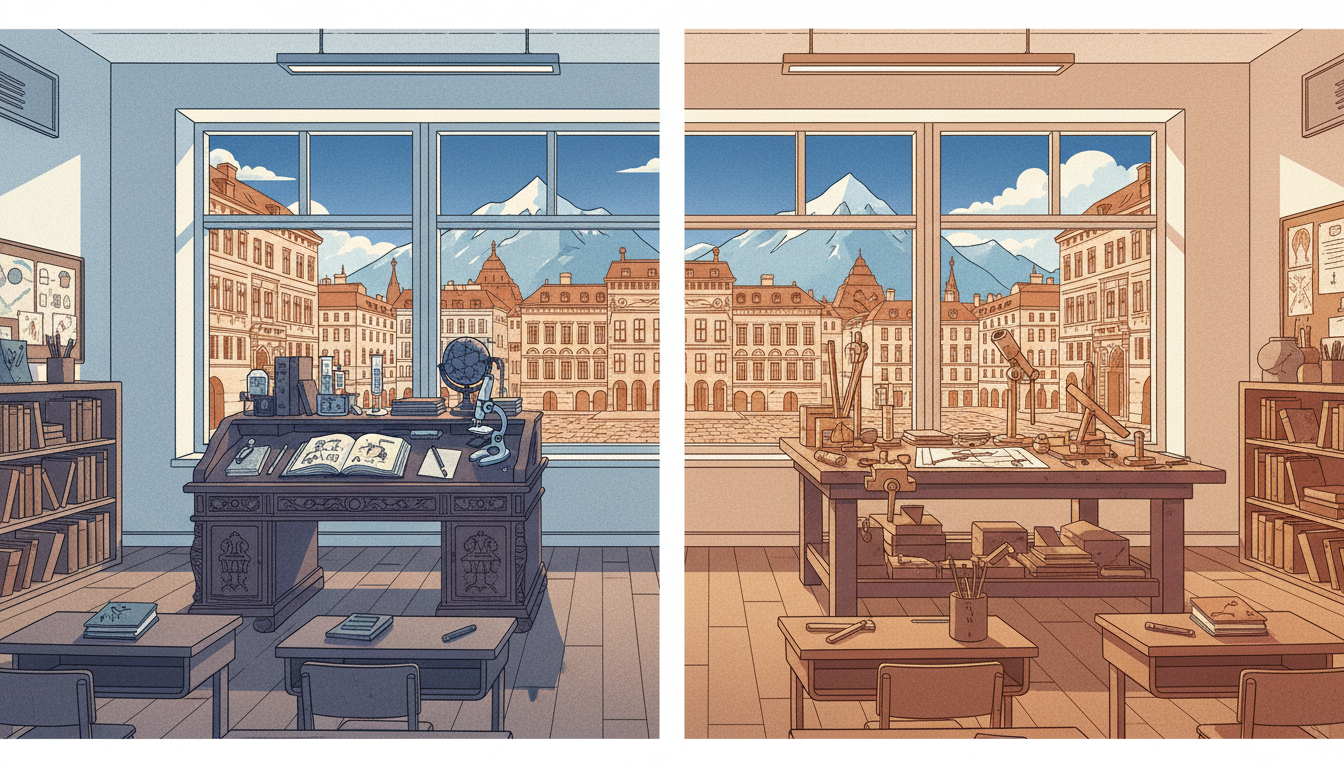
Austria’s education system is organised around four years of Volksschule (primary school), four years of lower secondary study, then different academic and vocational routes. All children permanently resident in Austria are generally subject to nine years of compulsory schooling, beginning on the relevant 1 September after their sixth birthday. This nine-year schooling obligation must not be confused with the separate AusBildung bis 18 requirement: young people are ordinarily required to continue in recognised education or training until eighteen, or until they complete an accepted qualification earlier under the legal rules.
The defining choice comes after the fourth year of primary school, at about age ten. Pupils can continue at a Mittelschule or an AHS-Unterstufe, the lower section of an academic secondary school. Later options include the academic AHS-Oberstufe and its Matura, a five-year berufsbildende höhere Schule (BHS) offering both a Reifeprüfung and Diploma, intermediate vocational schools (BMS), or apprenticeships with part-time vocational school. Austria is therefore not accurately described as one nine-year comprehensive school followed by a single high-school examination.
This guide explains Austrian primary, lower and upper secondary education, Mittelschule, AHS, BHS, BMS, Polytechnische Schule, Lehre, Matura and Berufsreifeprüfung, plus language support, university entry, pathways and 2026 examination facts. It uses Austria’s official school obligation explanation updated 16 July 2026, the government’s education and training requirement and the OeAD education-system map.
Austria education system at a glance
| What the reader needs | Quick answer |
|---|---|
| Primary stage | Volksschule, school years 1–4, roughly ages 6–10. |
| Lower secondary stage | Mittelschule (MS) or AHS-Unterstufe, school years 5–8, roughly ages 10–14. |
| Mandatory school attendance | Nine school years, normally until approximately age 15. |
| Education/training after Year 9 | AusBildung bis 18 requires recognised education or training for most relevant young residents until eighteen or accepted completion. |
| Ninth school year | Can occur at Polytechnische Schule, upper AHS, BMS, BHS or another accepted arrangement. |
| Academic upper secondary | AHS-Oberstufe, usually four years (school years 9–12), ending with the Reifeprüfung/Matura. |
| Higher vocational upper secondary | BHS, normally five years after lower secondary (years 9–13), ending in Reife- und Diplomprüfung. |
| Intermediate vocational school | BMS, programmes of different lengths, with a focus on occupational learning. |
| Apprenticeship route | Lehre with training company and Berufsschule, followed by an apprenticeship qualification; additional routes can lead to Matura. |
| University entry | Often through Matura, BHS qualification, Berufsreifeprüfung, relevant entrance routes or recognised alternatives. |
| Where to verify | Austrian government, OeAD education map and the actual receiving institution. |
This is a pathway map, not a ranking. The correct course for one pupil depends on learning strengths, the desired qualification, language readiness, work interests and institutional requirements. Every path should be judged by what it teaches and what its certificate permits next.
The two clocks: nine years of school versus education until eighteen
The biggest source of confusion is the assumption that nine years of compulsory school means Austrian young people can simply stop learning at approximately fifteen. They cannot generally treat that as the end of educational obligations. Austria operates a second requirement known as AusBildung bis 18, meaning education or training until age eighteen under the applicable framework.
The first obligation, allgemeine Schulpflicht, begins on the first relevant 1 September after a child reaches six and lasts nine school years. It includes children permanently resident in the country regardless of citizenship. During those nine years the legally recognised route may be a public school, recognised private school or another permitted arrangement subject to notifications and equivalence rules.
The second obligation concerns adolescents who have completed compulsory school attendance. They must pursue recognised education, vocational training or another qualifying programme until age eighteen unless they meet an earlier recognised completion condition. The government explanation last updated 1 January 2026 describes the goal as helping young people continue their education and make meaningful transitions.
This difference matters when a family considers an apprenticeship. A pupil can leave a full-time general school route and still meet the broader educational requirement through recognised training. It does not mean an apprenticeship is unsupervised work without classroom learning.
A guide that says “education is compulsory until age fifteen” without mentioning the age-eighteen training obligation is incomplete for 2026 readers.
The starting age and the school-entry decision
Children generally enter Austrian Volksschule at age six. The official government’s school rules use the 1 September cutoff, so a child’s birthday near that date can affect the year of mandatory entry. The OeAD primary-school guide describes school readiness, enrolment procedures and the option of a preparatory school year when appropriate.
For a parent, this is not simply a numerical age conversion. Austrian school administration considers whether a child is ready to follow the first-year programme without undue strain. A pupil may have strong conversational language but need support following formal instructions or working in a group. Another might show mathematical curiosity yet find classroom routines unfamiliar.
Early admission and readiness-related decisions have specific rules. A family relocating to Austria should contact the regional education authority and receiving school rather than apply a foreign cutoff. The responsible Bildungsdirektion can clarify school assignment and documents.
A child’s readiness is best understood holistically: language, play, attention, early literacy, number concepts and emotional development. A preschool-aged child does not need to master complex worksheets to prove their worth.
When a family uses German at school but another language at home, teachers should ask what the child can already explain before concluding that unfamiliar German terminology signals poor understanding.
Kindergarten and preschool: what early education is for
Austria has early childhood provision before the start of primary education. Kindergarten is a developmental environment in which children practise language, cooperation, creativity, movement and an ability to persist with unfamiliar problems. Some legal participation requirements apply before formal school entry, and families should consult the federal and provincial rules for the relevant age.
The label Vorschule also needs precision. It can refer to a pre-school year within the primary-school framework for a child who has reached compulsory school age but is not yet considered ready for regular Year 1. It is not a universal requirement that every pupil must spend five years in a separate preschool ladder before Volksschule.
For a family entering Austria from abroad, a child may have attended formal early education with a different national name. Schools need to know what the child can do, not only translate the former institution’s title. Collect previous attendance evidence where available and discuss language needs directly.
At home, adults can support development through stories, counting everyday objects, drawing, sorting and respectful conversations. If a child cannot follow a German instruction but succeeds in another language, the teacher can use meaningful examples to build school vocabulary.
Early education should cultivate curiosity and independence. A system guide should never turn it into a competition over the most advanced-looking preschool worksheet.
Volksschule: primary education in four years
Volksschule consists of school years 1–4, normally from about six to ten years of age. It develops literacy, mathematics, scientific and social understanding and habits required for further schooling. The official Austrian system chart and OeAD primary guide place this stage before the choice between Mittelschule and academic lower secondary.
The early years teach children to read and write with understanding, not only recognise printed words. In mathematics, pupils progress from number meaning and operations into reasoning with fractions, measurement, patterns and problem solving. A child who calculates correctly but cannot explain the problem needs a different response from one who has not mastered the operation.
A teacher can diagnose literacy by asking whether the child understands a paragraph, locates evidence and gives a short written response. For mathematics, one familiar problem and one slightly altered version reveal whether a method transfers.
The critical transition happens near the end of Year 4. Families receive educational guidance on progression and must understand the entry rules and available schools. A child’s result should be read together with interests, support needs and actual ability to meet the next curriculum’s expectations.
The family’s goal is not to rush toward the earliest selective label. It is to preserve strong foundations and access to a genuinely suitable next educational stage.
At age ten: Mittelschule or AHS-Unterstufe?
Austria’s lower secondary stage usually covers school years 5–8. Pupils may attend a Mittelschule, commonly described as a school providing broad lower-secondary education, or an AHS-Unterstufe, the lower cycle of an academic secondary school. This is an early structural choice compared with countries where most children remain in one undifferentiated programme until age fifteen or sixteen.
A Mittelschule is not simply “the school for pupils who cannot do academics.” The official OeAD Mittelschule guide describes individualisation, internal differentiation, academic learning and career guidance. Pupils can progress to senior academic or vocational schools when the specified performance and admission conditions are met.
An AHS-Unterstufe is the first four years of a longer academic secondary route, with Gymnasium and other types differing in emphasis. Access after primary school has subject performance and other official conditions. These need to be checked against current rules, not guessed from a foreign examination score.
Why does the choice matter? Language, Mathematics and other subjects may use different performance expectations or pacing. A pupil who is strong in mathematical reasoning but needs time for academic German should be assessed thoughtfully. A child who enjoys practical learning can still require demanding study and future academic options.
A path should be evaluated through what the student learns, recognised progression and support, not an assumption that early placement reveals lifelong potential.
What do Standard and Standard AHS mean in Mittelschule?
Austria’s Mittelschule has particular performance-assessment terminology. The official Mittelschule description distinguishes the levels Standard and Standard AHS in German, Mathematics and modern foreign language from the sixth school stage onwards, with grading rules in each level.
That matters when an admissions officer reads a transcript. A numerical school grade without its performance level may not convey the full expectation. The term “Standard AHS” refers to a higher level aligned with AHS lower-stage goals, not a separate national high-school diploma.
The official system provides additional differentiated performance descriptions, and parents and teachers discuss strengths and growth. These are intended to help learners understand progress and future routes. They should not be replaced by an internet table that maps all numbers one-to-one to a foreign exam grade.
A pupil who receives a lower mark may still have particular strengths. Inspect the actual Mathematics working, reading comprehension and explanatory writing to understand the cause. The next intervention depends on whether the learner misunderstood a concept, struggled with wording or made an accuracy error.
For upper-school entry, check how grades and performance levels are interpreted under current progression rules. The receiving institution’s requirements are more important than a generic claim that any mark above a certain number guarantees admission.
AHS: what is an academic secondary school?
Allgemein bildende höhere Schule (AHS) is an academic secondary-school route typically divided into a four-year Unterstufe and a four-year Oberstufe. A full conventional AHS path after Volksschule therefore spans school years 5–12, culminating in the Reifeprüfung, widely called the Matura.
Some AHS types emphasise languages and humanities; others place greater emphasis on mathematics, science or economics. The official AHS upper-cycle guide also describes special routes and schools with particular programmes. Not every type offers identical electives or specialised admission.
The AHS upper cycle prepares pupils for advanced academic learning, mature written reasoning and the Matura. That qualification can support entry into recognised higher education subject to particular programme conditions.
Families should understand that four years of AHS-Unterstufe do not themselves constitute the Matura. The certificate arrives only after the requirements of the upper cycle and examinations have been satisfied. Calling every Gymnasium pupil a Matura graduate confuses attendance with completed qualification.
Subject choices should follow goals and evidence: a student interested in scientific work needs conceptual Mathematics and lab reasoning; a language-minded learner benefits from close reading and argument. A respected school label is not a substitute for a correct learning plan.
The ninth compulsory school year
After school year eight, a student has not normally completed the nine-year school attendance obligation. The ninth year can be fulfilled in several settings. The official Austrian government summary names Polytechnische Schule, the AHS upper level, and vocational middle or higher schools among accepted routes.
The Polytechnische Schule is usually a one-year preparatory school that helps adolescents consider professional education and the transition into vocational learning. It is not identical to a five-year BHS, a university foundation programme or a general high-school completion certificate.
A pupil who enters AHS-Oberstufe or BHS immediately after lower secondary is also fulfilling the ninth school year, but in a different programme. So a rigid ladder that makes every Austrian teenager attend Polytechnische Schule is incorrect.
For families, the decision at fourteen needs two related checklists: the legal school attendance requirement and the recognition or future opportunity attached to the chosen programme. The short-term question is how to meet year-nine requirements; the longer-term question is which qualification the pathway will actually award.
If a student has difficulty with German-language instructions or foundational Mathematics, support should be planned before the transition rather than after a failed application.
BHS: five-year higher vocational secondary school
A berufsbildende höhere Schule (BHS) combines advanced general education with specialised vocational knowledge. The official Austrian government BHS page says the conventional programme runs five years and culminates in a Reife- und Diplomprüfung.
This qualification has two important components. The Reifeprüfung provides general higher-education eligibility, while the Diplomprüfung verifies professional specialisation and may carry additional recognised vocational entitlements under relevant law. A BHS graduate therefore has a different documented combination from someone who has taken an ordinary AHS Matura alone.
Examples include higher technical institutions (HTL) and commercial academies (HAK) as well as other vocational fields. A programme may ask for significant mathematics, engineering, business, applied science, languages or management competence depending on its specialisation.
The five-year length should not be mistaken for a university degree. BHS belongs to the school and vocational framework, even though its professional education may be demanding and some parts can be recognised by higher-education providers under applicable conditions.
A prospective student should inspect real subjects, practical training, assessment methods, exact diploma title, qualifications and post-school options. A route is useful when it matches the learner’s aims and preserves legitimate progression.
A worked BHS-style technical reasoning task
Consider an invented teaching problem for a student exploring applied engineering. A workshop needs a rectangular metal panel measuring 1.2 m by 0.8 m. It buys sheet metal by area at €25 per square metre, before any waste allowance. What is the theoretical material cost?
Area = 1.2 × 0.8 = 0.96 m². Multiply by unit price: 0.96 × €25 = €24. The student should record units and understand why the area is below one square metre. In a real workshop the final procurement cost may also depend on cutting waste, sheet sizes and labour, which the simplified model excludes.
A student who multiplies 1.2 + 0.8 may not understand area. Another who finds 0.96 but labels it “metres” has a unit misconception. A third who reports €24 as a full job quotation has overlooked the stated limitations.
These are distinct errors. Strong vocational mathematics connects concepts, practical meaning and safe interpretation. A teacher should first identify what the learner understood before increasing the difficulty.
This task is an original educational illustration, not a mandatory Austrian BHS Diploma examination question. For real certification, use the school’s current authorised programme.
BMS: intermediate vocational schools
Berufsbildende mittlere Schulen (BMS) provide vocational or professional education at the intermediate school level. Their duration and scope vary, including shorter programmes and multi-year specialist courses. They should not be described as universally five-year schools or assumed to award the same Reife- und Diplomprüfung as a BHS.
For families, BMS is an important reminder that the word vocational covers several qualification types. Some programmes develop occupational competencies while also providing opportunities for later continuation through bridge or additional examinations. Those routes depend on the exact award and current admission rules.
A learner who enjoys practical technical work may thrive in a programme with laboratories, workshop practice or applied business tasks. The relevant question is which competencies are assessed and which progression or occupational recognition the qualification gives.
The choice should also preserve foundational literacy and numeracy. A student in hospitality or care needs strong communication; a technical worker needs measurement, accuracy and safety. Vocational learning does not remove academic reasoning from the curriculum; it applies reasoning in a different context.
Parents should compare the official programme title, duration, awarding institution, practical content and later rights, not just promotional claims about employability.
Lehre: the apprenticeship route
An Austrian Lehre is an apprenticeship combining training in an approved workplace with educational instruction at a Berufsschule, or part-time vocational school. It is a substantial education route, not simply a teenager doing a job without recognised coursework.
The programme typically includes learning an occupation’s tools, technical knowledge, communication, work processes and safety requirements. It ends with an apprenticeship qualification after required training and examination. The exact duration depends on the recognised occupation and arrangement.
A pupil considering apprenticeship should examine the training company, the occupational standard, who supervises learning, practical conditions, travel, remuneration, school attendance and recognised completion. The legitimacy of a training agreement matters more than a promise of rapid employment.
After the apprenticeship, a learner may enter employment or continue through additional recognised training. Austria also offers Lehre mit Matura, which connects vocational preparation to a higher education entrance qualification under specific rules.
For a student who learns best through applied tasks, this can be a strong path. The choice is not between “intelligence” and “manual work”; it is between educational environments and credentials with different purposes.
Lehre mit Matura and the Berufsreifeprüfung
The Berufsreifeprüfung (BRP), often called Berufsmatura or Lehre mit Matura, offers people with specified vocational qualifications a route to general higher-education eligibility. The official government explanation lists four examination components: German, Mathematics, a modern foreign language and a vocational or specialised subject area.
Apprentices may prepare for and complete some exam components during training. The full qualification has eligibility and age requirements: the government notes it can be completed no earlier than nineteen under the specified apprenticeship-linked programme. This matters because advertisements promising an immediate full Matura at sixteen can mislead.
The BRP provides general access eligibility for higher education, subject to any additional admission conditions for individual programmes. It is distinct from a Studienberechtigungsprüfung, which can provide eligibility for a particular study field rather than unrestricted general access.
This distinction is a valuable example of second-chance and bridge pathways. A person who began vocational training does not have to assume that university study is permanently closed. But they must complete the correct recognised requirements.
An admissions enquiry should name the qualification precisely: BRP, AHS Matura, BHS Reife- und Diplomprüfung and an apprenticeship certificate are not interchangeable titles.
Zentralmatura in the 2026 examination year
Austria’s partly standardised competence-based school-leaving exams are commonly called Zentralmatura. The official 2025–2026 main-session timetable gives 5 May 2026 for German and 11 May 2026 for Mathematics or Applied Mathematics, among other specific dates.
These are historical dates for the 2026 main session, not instructions for 2027. The same official page distinguishes the standardised Reifeprüfung at AHS and the Reife- und Diplomprüfung at BHS, reflecting their different educational purposes.
A high-stakes examination is more than a schedule. Students should know the correct subject specification, written and oral or school-related assessment components, requirements for successful completion and permitted aids for their actual school type. The meaning of the qualification comes from the full process, not one paper.
A student preparing for German may need reading analysis, extended writing and argument. Mathematics may require accurate methods, mathematical modelling and interpretation. BHS programmes can add professional specialisation and diploma-related requirements. Do not practise an AHS Mathematics paper and assume it covers every BHS assessment objective.
The best preparation is based on the current school’s real syllabus and official assessment guidance, with attention to the first conceptual or written-expression difficulty shown in student work.
An original Matura mathematics example
Consider a fictional student asked to model the total cost of hiring equipment with a fixed setup fee of €60 and a variable charge of €18 per hour. Write the cost equation and find the total for seven hours.
Let h be the number of hours. Total cost is C(h) = 60 + 18h. At seven hours, C(7) = 60 + 126 = €186. If the available budget is €240, solve 60 + 18h ≤ 240, so 18h ≤ 180 and h ≤ 10 hours.
A pupil might incorrectly write C(h) = 60h + 18, confusing fixed and variable costs. Another could solve the inequality mechanically but forget to interpret ten as a maximum duration, subject to the simplified model. These errors require different feedback.
A strong explanation connects algebra, the meaning of the units and the assumption of a linear hourly rate. It should also recognise that real hire conditions may include part-hour charges or additional fees not included in this teaching model.
This is an original practice problem, not an official 2026 Zentralmatura question. Its purpose is to show what mathematical understanding looks like beyond a memorised procedure.
How schools assess learning before the Matura
Not every important education outcome in Austria is decided by the final Matura. Primary and secondary schooling involve ongoing classroom assessment, subject grades and progression rules. Mittelschule also uses differentiated performance standards, while vocational programmes can contain practical assessments.
A student may receive an average mark but be very strong in one part of Mathematics and weak in another. The most useful response is to inspect the actual working and classify the error. Does the learner understand what the question requests? Can they choose a valid procedure? Do they use accurate units? Can they explain their conclusion?
Formative assessment matters because teachers can correct problems while there is time to improve. A final grade describes a result; a diagnostic explanation helps determine the next lesson. A robust school system needs both functions.
For an international transfer, include a copy of the relevant report and information about the school type and performance level. An Austrian numerical mark should not automatically be equated with the same number on a foreign grading scale.
Parents should use the school teacher’s current advice and official progression rules rather than making a decision from a single percentage or an outdated internet table.
German-language learning and minority-language provision
German is central to schooling in Austria and academic proficiency matters increasingly as a student moves into longer texts and technical subjects. But a child’s ability to discuss a concept in another language should not be ignored when assessing academic readiness.
A family arriving with a child who already understands fractions might need to teach the German words for numerator, denominator, estimate and compare. That is a different intervention from reteaching all arithmetic. Likewise, a student with strong spoken German may need help writing an analytical essay.
Austria also has recognised linguistic-minority school provisions, including arrangements associated with Slovene, Croatian and Hungarian communities in relevant areas. The details are governed by law and programme, not a claim that every school teaches through the same mixture of languages.
For school admission, ask what language support and educational assessment are available. For subject tuition, teach vocabulary through meaningful problems and written explanations rather than isolated translation drills.
A student’s language history is part of educational planning. It does not determine intelligence or place a permanent ceiling on progress.
University and higher-education choices
Austria’s higher-education landscape includes universities, universities of applied sciences (Fachhochschulen) and university colleges of teacher education (Pädagogische Hochschulen), among other legally recognised providers. These routes have different programme objectives and admission rules.
Matura or an eligible alternative such as BRP may provide general university entrance eligibility, but certain subjects or programmes can have additional selection processes, language prerequisites or capacity limits. A document that qualifies a person to apply is not the same as an unconditional admission offer.
A student considering engineering, medicine, teaching or business should check the precise programme, qualification, accreditation, practical placements and language expectations. Professional recognition is a separate issue for regulated occupations. A degree title alone is not automatic permission to practise everywhere.
Applicants coming from abroad may need official recognition of school-leaving certificates, evidence of language proficiency and documents in a specified form. The admissions office rather than a tuition agent sets these conditions.
A vocational graduate can have genuine routes into higher education. The system should be understood as multiple recognised pathways with distinct prerequisites, not one academically privileged ladder and many dead ends.
Equity and early selection
Austria’s structural choice at around age ten raises important educational questions. Some pupils demonstrate academic readiness early; others develop later, move countries, learn German as an additional language or face changing family circumstances. The school system’s progression routes and transfer rules therefore matter.
An early decision should not be presented as an irreversible label on a child’s intellect. Students can move between certain programmes when they meet the requirements, and routes such as BHS and Berufsreifeprüfung offer recognised further possibilities.
A useful parental question is whether the chosen environment will provide appropriate teaching and a feasible next transition. A student in Mittelschule may aim toward BHS or AHS later; a student in AHS may discover a stronger interest in vocational technical education. Accurate programme advice is better than social stereotyping.
Regional school availability, support for disability-related needs and language development can influence choices. A family should ask about accessibility, the school commute and actual teaching rather than choose by reputation alone.
Education systems should be evaluated through what learners can achieve and the opportunities made available, not a ranking of children’s supposed worth at ten years old.
Case study: a Year 4 pupil choosing the next school
Imagine a fictional ten-year-old who enjoys science and Mathematics but struggles when reading a long German text. The family is considering Mittelschule and AHS-Unterstufe. An unhelpful adviser might say that one result from Year 4 settles the entire child’s future.
A better process gathers the official primary school report, asks the teacher about relevant AHS admission rules and examines samples of independent work. Can the pupil solve the numerical tasks? Do difficulties appear mainly in academic German? Can the student sustain the pace and reading demands of the proposed programme?
The family should then visit or contact the actual schools and discuss support, curriculum, commute and future progression. If a bridging need is identified, plan specific language and reading practice rather than assign every possible worksheet.
The receiving school and applicable rules determine eligibility. A tutor can support learning but cannot rewrite the official admission criteria.
This fictional case illustrates a fit-and-recognition decision, not a universal recommendation that every pupil should enter the same type of Austrian lower secondary school.
Case study: apprenticeship to university
A fictional student completes a recognised apprenticeship in a technical field, develops strong applied skills and later becomes interested in an engineering degree. They assume that not having an AHS Matura means university can never be possible.
The family should examine Berufsreifeprüfung eligibility and the receiving institution’s rules. The BRP contains German, Mathematics, a modern foreign language and a professional examination component. Preparation can be pursued through recognised programmes, including the apprenticeship-linked route.
Academic readiness is a separate question. A student may be excellent at practical measurements yet need to deepen algebra, scientific writing or the higher education programme’s mathematical content. Targeted bridging can address those skills.
Successful completion of the qualification provides a route to higher education eligibility, but some degree courses may still have additional selection conditions. A responsible adviser explains both the opportunity and the remaining requirements.
This is why vocational preparation should not be treated as intellectual failure. Pathways can develop over time when learners retain independence and keep improving.
Four weeks to strengthen an Austrian learner’s next transition
- Week 1 — check the correct curriculum and actual performance. Identify whether the pupil is at Volksschule, Mittelschule, AHS, BHS, BMS or an apprenticeship-related school. Inspect real work before prescribing support.
- Week 2 — repair the earliest unstable concept. If the problem is German reading, teach academic language; if it is algebra, teach the mathematical principle; if it is technical reasoning, use a safe applied example.
- Week 3 — vary the context. Introduce new wording, numbers and diagrams; connect subject ideas to realistic school or professional tasks.
- Week 4 — demonstrate independence. Set a fresh problem without prompts and check whether the learner can explain the solution and identify limitations.
This is an educational method, not an official four-week Matura curriculum. Use the relevant 2026 or later syllabus to decide examinable content. A timetable cannot compensate for a missing foundational concept.
Record observable outcomes: “can explain a linear relationship independently,” “can summarise a German textbook paragraph with evidence,” or “can measure and calculate material area with correct units.” Such outcomes are more meaningful than a promise of an instantly higher grade.
The purpose of targeted support is to strengthen the student, not create permanent dependence on tutoring.
Ten mistakes in guides to Austrian education
Mistake one: saying compulsory education ends entirely after Year 9. The separate AusBildung bis 18 participation requirement matters.
Mistake two: calling Mittelschule and AHS-Unterstufe identical. They are distinct lower-secondary institutional routes with their own requirements.
Mistake three: assuming every pupil enters Polytechnische Schule. Year nine can be spent in several permitted school types.
Mistake four: calling every Gymnasium pupil a Matura holder. Matura follows successful upper-cycle requirements.
Mistake five: claiming BHS takes four years. The conventional BHS route is five years and combines a Reifeprüfung with a Diploma examination.
Mistake six: equating every vocational certificate with BHS. BMS, apprenticeships and BHS have distinct aims and awards.
Mistake seven: treating Berufsmatura as automatic on completing an apprenticeship. BRP has separate exam, eligibility and age conditions.
Mistake eight: reusing May 2026 Matura dates for future years. Annual examination schedules must be checked.
Mistake nine: ignoring Mittelschule’s Standard and Standard AHS performance levels. A numerical grade without context can mislead.
Mistake ten: assuming academic pathways cannot follow vocational training. Recognised bridging and alternative examinations can preserve further options.
Frequently asked questions about Austria’s education system
How many years is primary school?
Volksschule usually lasts four school years, beginning at around six, before progression into Mittelschule or an AHS lower stage.
When does compulsory school start?
It generally starts on the relevant 1 September after the child’s sixth birthday, according to the official age-cutoff rule. The exact date is important for children born near September.
Is school compulsory for nine years or until eighteen?
Both statements refer to different legal duties. General compulsory school attendance lasts nine years; a separate duty to pursue education or training generally applies to relevant young people until eighteen or specified completion.
What is Mittelschule?
It is a four-year lower-secondary institution after Volksschule, with differentiated teaching, career guidance and progression to later routes. It should not automatically be described as a school with no further academic options.
What is AHS-Unterstufe?
The lower four years of an academic secondary school, normally school years 5–8. Completion can lead into AHS-Oberstufe or other recognised secondary routes subject to entry requirements.
What is a Gymnasium?
An academic secondary school within the AHS family, typically with lower and upper cycles. Its exact programme may differ from other academic types such as Realgymnasium.
What happens in the ninth school year?
The learner may attend Polytechnische Schule or begin an accepted upper secondary academic or vocational school, among other legally permitted routes.
What is Polytechnische Schule?
A generally one-year pre-vocational school that helps students with occupational orientation and preparation. It is not a university and not a mandatory stop for every pupil.
What is BHS?
A higher vocational secondary school lasting usually five years, with a combined Reife- und Diplomprüfung giving an important academic and professional qualification.
What is BMS?
An intermediate vocational school. Its programmes vary in duration, type and recognised qualification. Do not assume BMS always awards the same qualification as a five-year BHS.
What is Lehre?
An apprenticeship combining practical training at a company and education at a Berufsschule. Its duration and final assessment depend on the occupation.
What is the Austrian Matura?
A school-leaving examination or qualification used for higher education eligibility. The Zentralmatura includes standardised competence-based components, but school type and full requirements matter.
Does BHS have a Matura?
BHS graduates can complete a combined Reife- und Diplomprüfung, providing higher-education eligibility and recognised professional specialisation.
When were the 2026 main Matura papers?
Austria’s official schedule lists German on 5 May 2026 and Mathematics or Applied Mathematics on 11 May 2026, among other subject dates. These belong to the 2026 session.
Is a vocational apprenticeship a dead end for university?
No. Recognised alternatives such as Berufsreifeprüfung can provide higher-education entrance eligibility, subject to their examination and admission rules.
What is the difference between BRP and Studienberechtigungsprüfung?
BRP offers a general higher-education entrance route for eligible vocational graduates, while a Studienberechtigungsprüfung can provide a subject- or study-specific route under defined conditions.
Is German compulsory in school?
German is central to mainstream school instruction, but minority-language and other specific provisions exist. The exact school’s language arrangements and support must be checked.
Can an overseas child transfer to Austria?
Potentially, under the receiving authority’s enrolment and recognition rules. Bring the transcript, school history and language information; the school decides placement, not an online grade conversion table.
Does Matura guarantee a specific university place?
No. It can establish general eligibility, but particular programmes may have admissions, subject or language conditions.
What should a family do before choosing AHS or Mittelschule?
Review the official primary grades and guidance, the child’s actual learning strengths, language readiness, school options and progression opportunities. No single social label should determine the decision.
What a reader should do next
Parents near school entry should confirm the six-year birthday cutoff and readiness arrangements. Parents of a Year 4 child should review realistic Mittelschule and AHS choices. Teenagers approaching the ninth school year should understand AusBildung bis 18 and compare the recognised qualification they hope to obtain. An aspiring university student should separate Matura/BRP eligibility from the receiving programme’s admission rules.
Visit the eduKate Education Hub for general learning methods. The existing Education | Austria article serves as a related education resource; the Austria Mathematics tutor choice guide focuses on subject support. This article’s distinct job is to explain the Austrian national education pathway.
Continue the 195-country education system series
The preceding article is Australia. Next are Azerbaijan and Bahamas. Unlike Austria, these systems use different middle-school completion and senior qualification frameworks, so readers should compare actual documents rather than convert names by appearance.
Authoritative sources and verification
- Government of Austria — compulsory school education, updated July 2026.
- Government of Austria — education and training until eighteen, updated January 2026.
- OeAD — Austrian education-system map.
- OeAD — Volksschule entry and progression.
- OeAD — Mittelschule.
- Government of Austria — Mittelschule assessment levels.
- OeAD — AHS academic upper cycle.
- Government of Austria — BHS five-year vocational education.
- Government of Austria — 2026 Zentralmatura timetable.
- Government of Austria — Lehre mit Matura and BRP.
- OeAD — Berufsreifeprüfung educational bridge.
Editorial verification: 17 October 2026. Nine-year compulsory school and education-until-eighteen rules are distinguished; the May examination dates apply only to the 2026 main session. Worked examples and families are fictional educational illustrations, not official examination tasks.