

Barbados’s education system moves from early-childhood and primary education to secondary school, then to sixth-form, college, technical training, apprenticeship or university pathways. The main regional secondary award is the Caribbean Secondary Education Certificate (CSEC); advanced study can lead to the Caribbean Advanced Proficiency Examination (CAPE). Both belong to the Caribbean Examinations Council (CXC), which is the examining organisation, not the name of one qualification. In October 2026, the most important update concerns secondary-school placement: BSSEE remains in use for specified cohorts while a new model is introduced gradually. The Ministry’s August 2026 cohort-specific statement is more useful than earlier headlines suggesting an immediate end to Common Entrance.
Reviewed: 17 October 2026. This guide distinguishes the current school structure from announced changes and institution-specific admission rules. Ages are typical unless a legal rule or dated intake requirement is explicitly stated.

Barbados education system at a glance
| Question | Quick answer |
|---|---|
| Compulsory school age | The Education Act, Cap. 41 defines it as 5–16; specific school-leaving protections also apply. |
| Typical secondary entry | Around age 11, after primary education; individual circumstances and approved arrangements can differ. |
| What is BSSEE? | Barbados Secondary Schools’ Entrance Examination, commonly called Common Entrance or 11-plus; a school-placement examination. |
| Did BSSEE continue in 2026? | Yes. The Ministry scheduled the 2026 examination for 5 May; later cohort-specific guidance retains it during transition. |
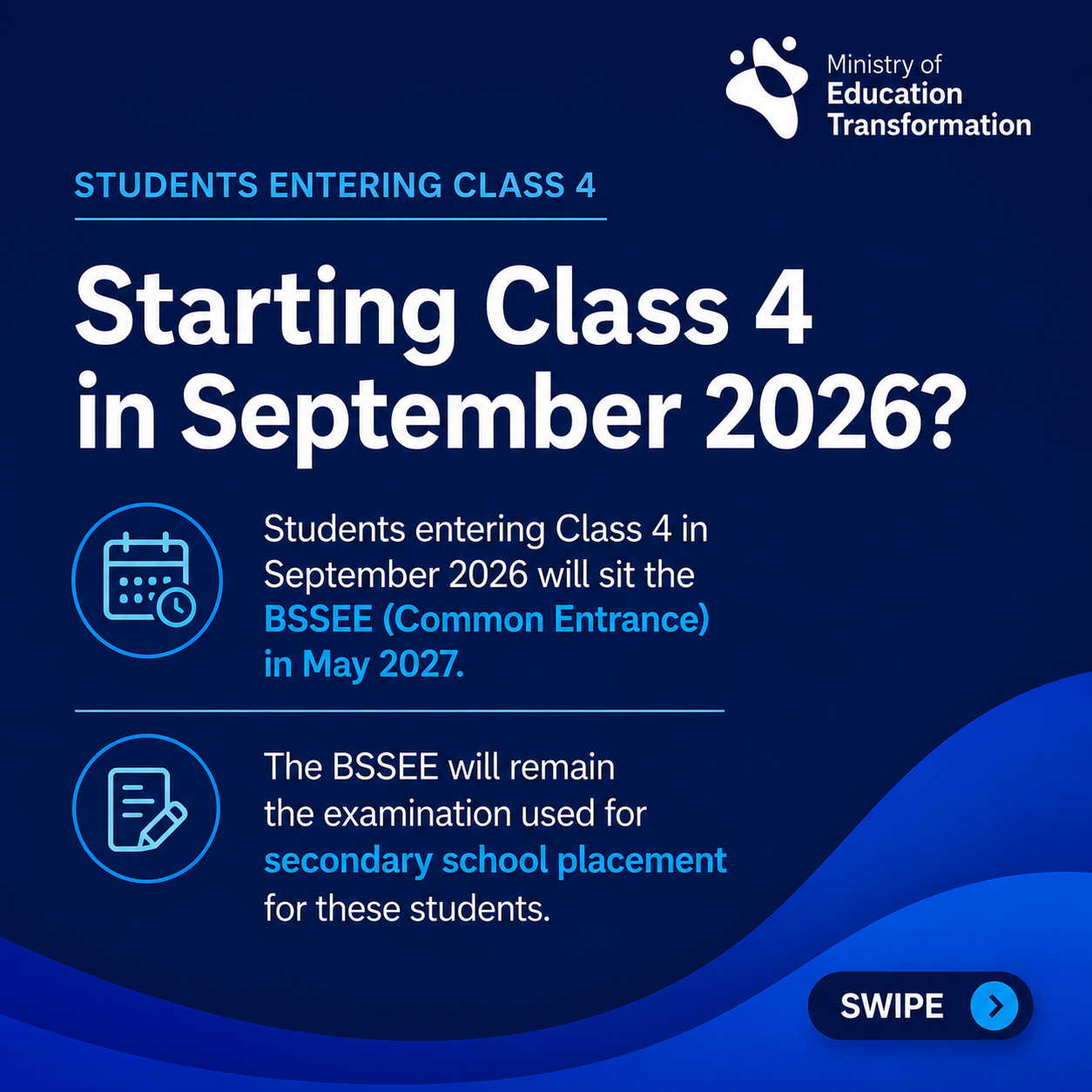
| September 2026 Class 4 | The Ministry says these pupils will sit BSSEE in May 2027. |
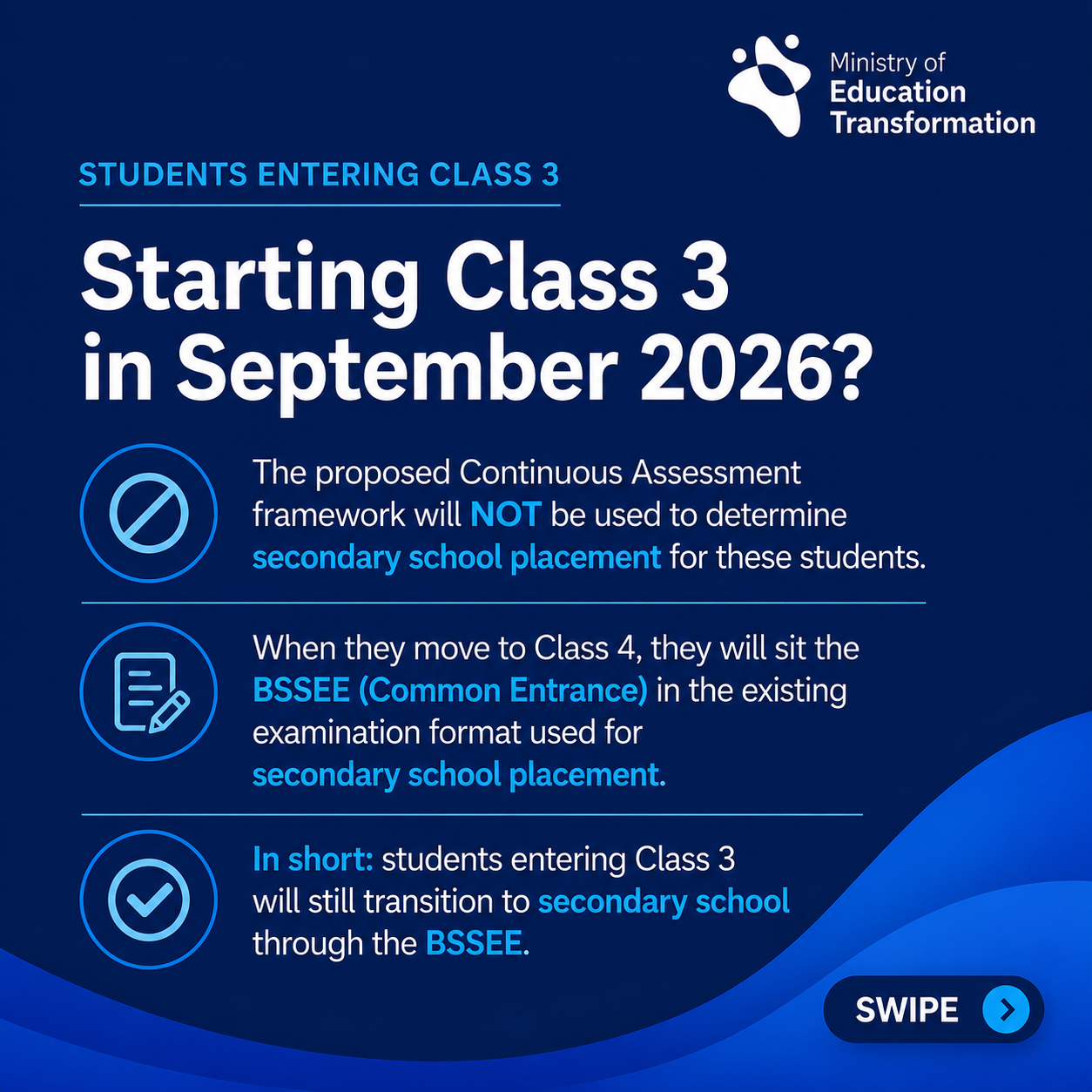
| September 2026 Class 3 | These pupils also retain the existing BSSEE when they reach Class 4; continuous assessment will not determine their placement. |
| First proposed new-model cohort | Pupils entering Class 2 in September 2026, with secondary transition proposed for 2029/30 after three years of preparation. |
| CSEC and CAPE | CSEC is the Caribbean Secondary Education Certificate; CAPE is the Caribbean Advanced Proficiency Examination. |
| Technical and further-study options | SJPI, Barbados Community College, BVTB apprenticeships and skills programmes, UWI Cave Hill and other verified providers. |
| Foreign secondary qualifications | Since 23 June 2026, the receiving tertiary provider handles their evaluation for admission; BAC discontinued this service. |
Choose your reading route
Start with the question closest to your family’s situation. Each chapter links back here, so you can use this guide without reading it from beginning to end.
Understand the system
- The school ladder and the meaning of each transition
- Compulsory education and what “free” actually covers
- Early-childhood and primary education in 2026
- BSSEE and the phased placement changes: the cohort matters
Compare qualifications and pathways
- Secondary education and CSEC
- Sixth form, CAPE and advanced academic study
- CVQ, SJPI and apprenticeships
- Barbados Community College and university admission
Plan the next step
1. The school ladder and the meaning of each transition
The system is easiest to understand as three different transitions. The first is from primary to secondary school. The second is from secondary education into advanced academic or technical study. The third is from a completed qualification into a particular university, training programme or occupation. A result that answers one transition does not automatically answer the others.
The Ministry’s school-system overview places the usual primary-to-secondary transition around eleven and secondary study across roughly ages eleven to eighteen. CSEC is commonly taken around sixteen, while students continuing in advanced study may take CAPE around eighteen. These are typical ages, not a guarantee that every learner follows an identical timetable or that every school offers sixth form.
For a family arriving from another system, school labels require care. Barbados’s current transition guidance uses primary Class 2, Class 3 and Class 4 to identify particular cohorts. Do not translate those names mechanically into another country’s grade numbers. Ask the school to identify the child’s stage by age, completed curriculum, learning record and intended examination year.
The Ministry of Education Transformation is the main policy and administrative starting point. CXC explains regional examinations. Individual colleges and universities decide admissions. Keeping these responsibilities separate helps families avoid asking an examining body to promise a school place or assuming that a school recommendation guarantees a university offer.
2. Compulsory education and what “free” actually covers
The Education Act, Cap. 41 defines compulsory school age as five to sixteen. Section 41 requires suitable full-time education through school attendance or another arrangement satisfactory to the Minister. Section 41A also protects at least five years of secondary education and addresses the position of pupils entering secondary school after twelve. The simple age range should therefore not be read as permission to end any pupil’s education on an arbitrary birthday.
The Ministry’s public-school overview states that public primary schools do not charge school fees and notes a book fee at secondary level because textbooks are subsidised. Private schools charge fees. A family’s real education budget can still include uniform, transport, supplies, activities, examinations or other institution-specific charges. Request a current written list rather than interpreting “free education” as zero household expenditure.
For tertiary study, check tuition, compulsory fees and other charges separately. The UWI Cave Hill registration information directs students to programme-level financial information. Sponsorship or national support can depend on nationality, programme and other conditions; it should not be assumed to cover every applicant, every degree or every expense.
The practical task is to compare the complete route. An inexpensive course with daily transport costs or an additional prerequisite year may cost more than its headline fee suggests. Conversely, a fee-paying route is not automatically a better educational fit. Ask what the student will learn, which award follows, what support is available and what the next institution accepts.
3. Early-childhood and primary education in 2026
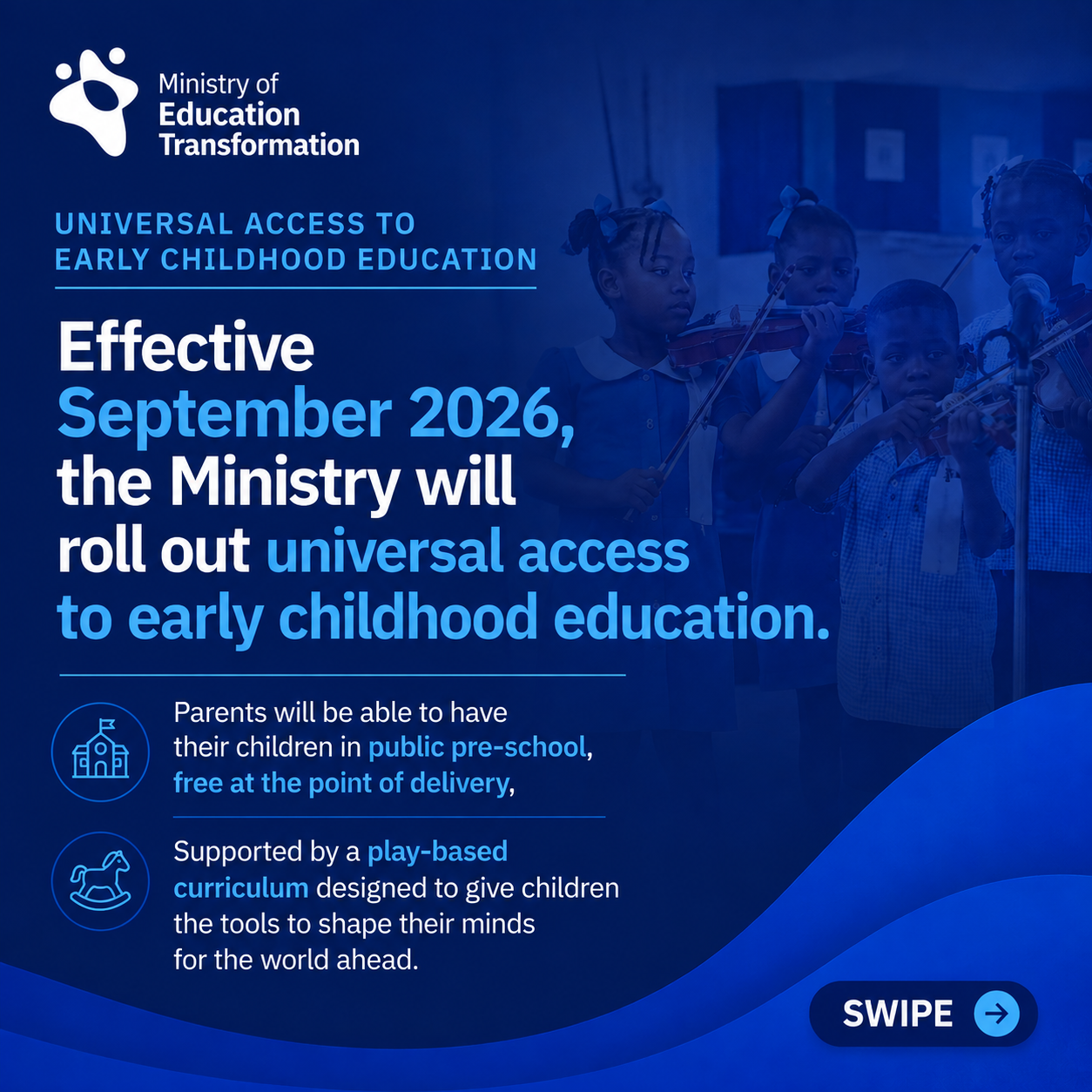
The Ministry’s August 2026 early-childhood announcement sets out a rollout of universal access to public preschool from September 2026, free at the point of delivery and supported by a play-based curriculum. This is an important expansion commitment. It should be distinguished from proof that every preferred school has an immediate place. Parents still need to confirm age eligibility, registration, available capacity and the arrangements serving their community.
Older general summaries describe nursery admission from three-and-a-half and primary provision beginning around four. Those descriptions and the statutory compulsory age of five answer different questions. For a three- or four-year-old in the 2026–27 school year, use the actual registration instructions rather than forcing every child into an older age chart.
Primary learning should develop confident reading, writing, number understanding, curiosity and the ability to work with others. A useful school conversation goes beyond a score: Can the child explain a text? Choose a mathematical method? Follow instructions? Ask for help? Which difficulties has the teacher noticed, and what happens next?
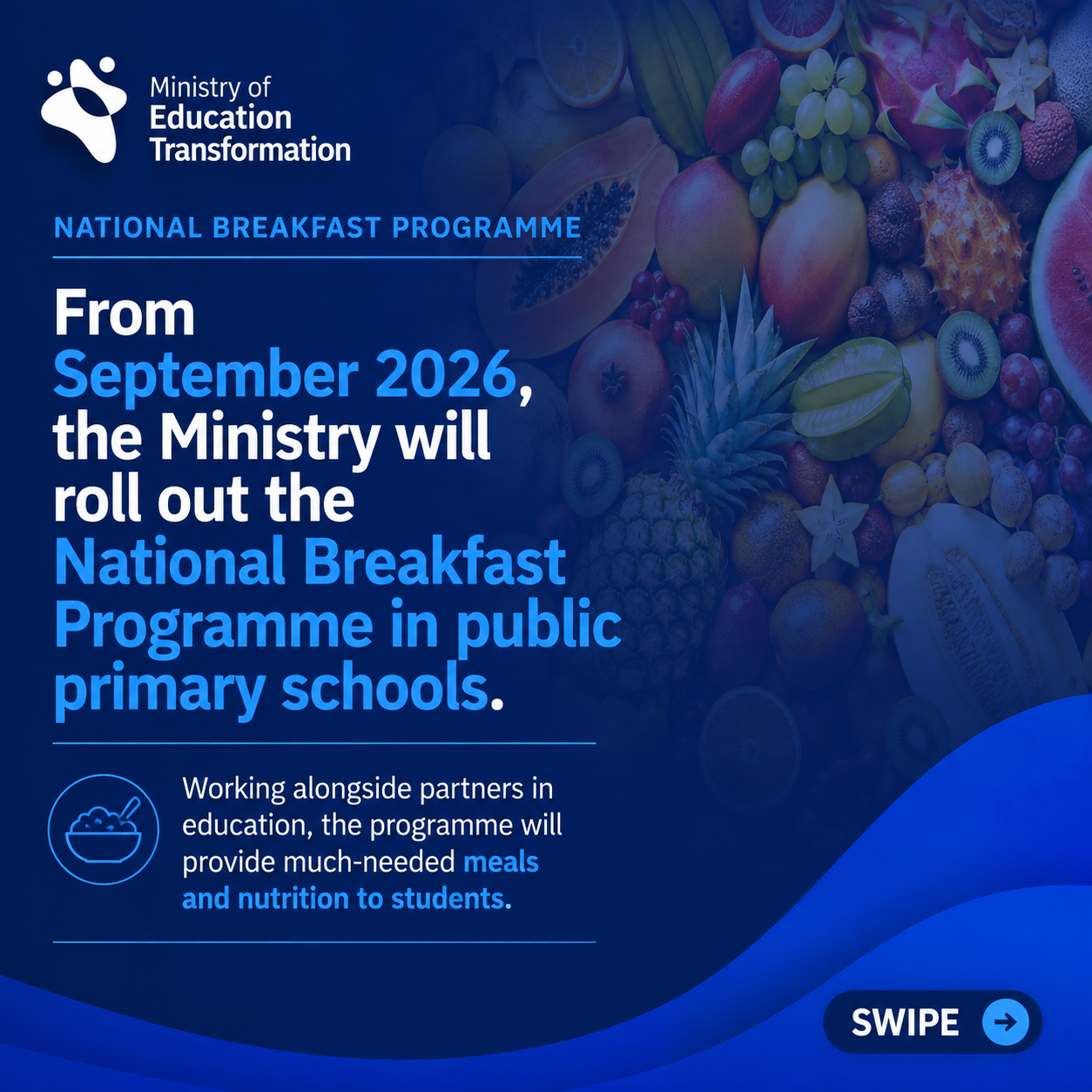
The same August package announced a National Breakfast Programme rollout in public primary schools from September 2026. Families should ask their own school how the programme operates, rather than assuming that the national announcement fixes every local serving time or access arrangement. Readiness to learn includes regular attendance, nutrition, a manageable journey and support for additional needs as well as classroom teaching.
4. BSSEE and the phased placement changes: the cohort matters
The Barbados Secondary Schools’ Entrance Examination is commonly called BSSEE, Common Entrance or the 11-plus. It concerns the transition into secondary school. It is not CSEC, which belongs to the later secondary stage. The Ministry’s 2026 examination notice scheduled BSSEE for 5 May 2026 and described requests for early sitting, deferral and special consideration.
The later official guidance is specific. Pupils entering Class 4 in September 2026 will sit BSSEE in May 2027 for secondary placement. Pupils entering Class 3 in September 2026 will also sit the existing BSSEE when they reach Class 4. The proposed continuous-assessment framework will not determine secondary placement for that Class 3 cohort.
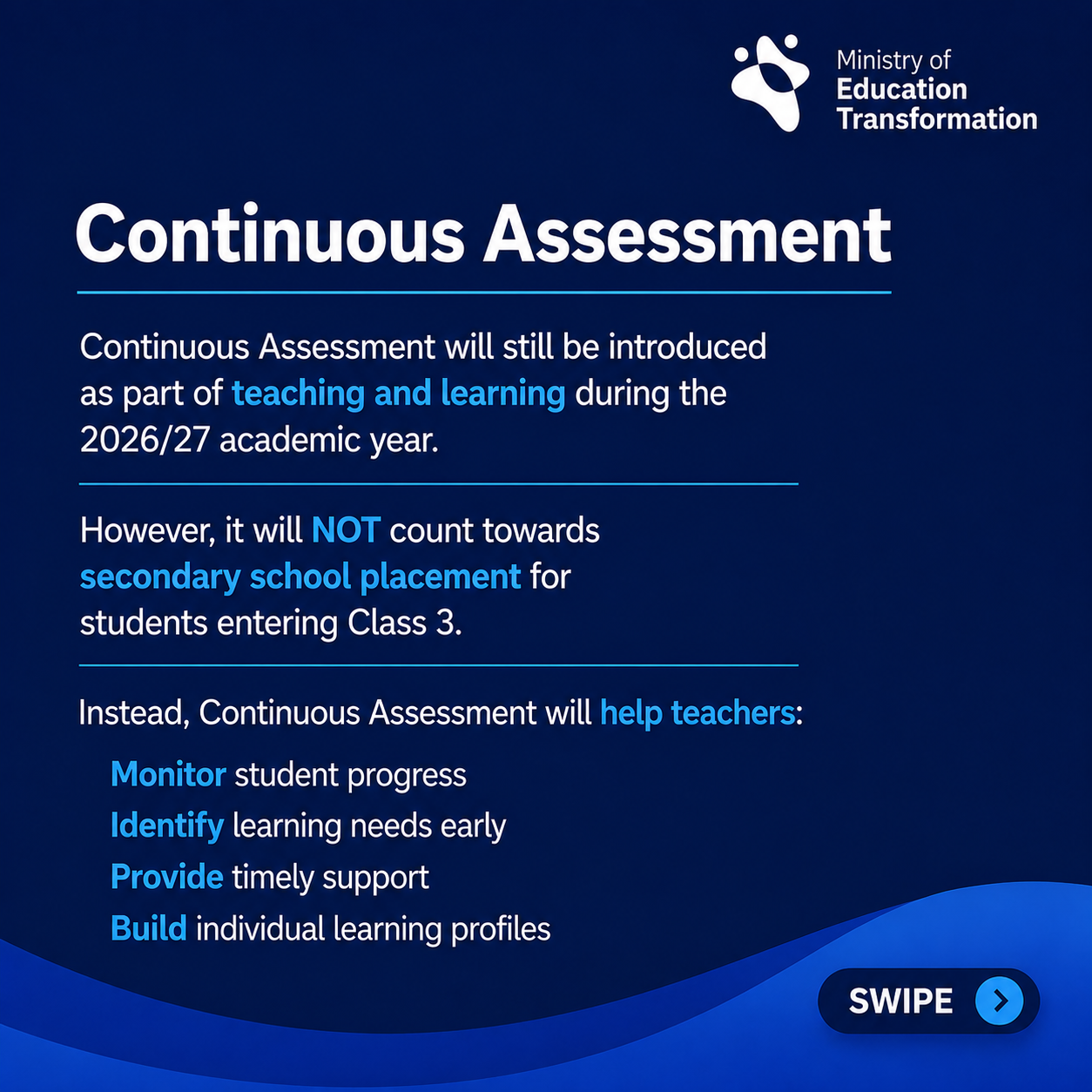
This does not mean continuous assessment has been abandoned. The Ministry’s assessment explanation says it will be introduced as part of teaching and learning during 2026–27 to monitor progress, identify needs, provide support and build learning profiles. Using assessment to improve teaching is different from using it to allocate secondary-school places.
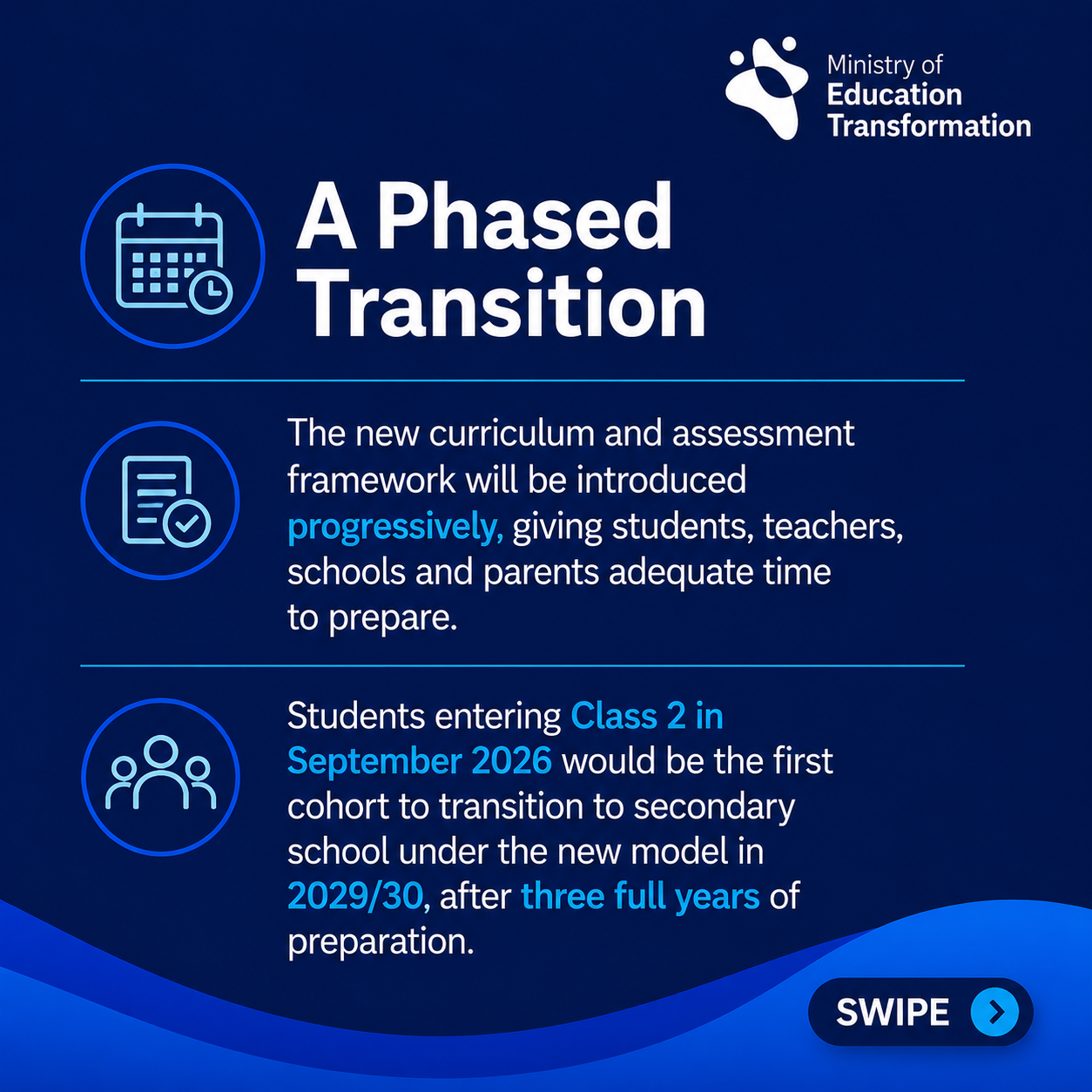
The phased-transition announcement identifies pupils entering Class 2 in September 2026 as the proposed first cohort to transition under the new model in 2029/30, following three full years of preparation. The wording is prospective: this is a planned timetable, not an examination already taken or a completed allocation system.
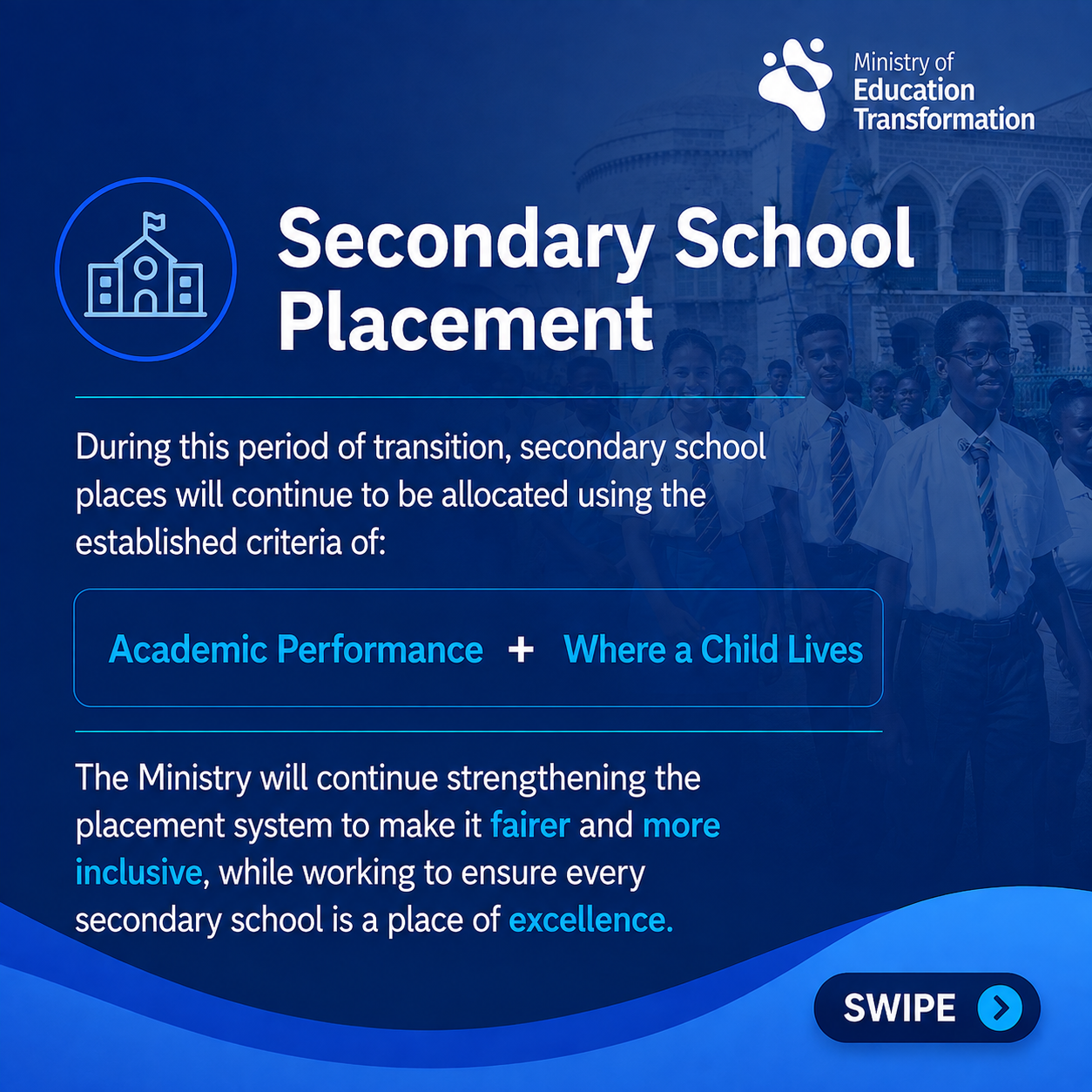
During transition, the Ministry’s placement summary says allocation continues to use established criteria involving academic performance and where the child lives. Families should obtain the current placement guide and school instructions for their own cohort. Earlier reports about a 2028 replacement should not override this later, more specific August 2026 guidance.
A parent’s immediate question should be: “Which class was my child entering in September 2026, and which placement instructions apply?” That single check prevents the costly mistake of preparing for a pathway intended for a younger cohort.
5. Secondary education and CSEC
CSEC means Caribbean Secondary Education Certificate. The Caribbean Examinations Council’s CSEC page is the authoritative source for the name, examination framework and subject information. Some summaries expand the initials incorrectly. “CXC exams” is common conversational shorthand, but an application should identify the actual qualification and subjects.
At secondary school, students need to develop both broad learning and a workable subject package for the next stage. Ask which subjects the school offers, when options are chosen, what practical or coursework requirements apply and whether timetable combinations restrict choices. A desired university route can be affected by missing mathematics, science or language prerequisites even when the student performs well overall.
CSEC produces subject-level evidence. A student should retain the statement of results and final certificate and check name, date and subject details. The next institution may specify particular grades and subjects rather than simply a number of passes. For example, a programme requiring English and mathematics is not satisfied by an equal number of unrelated subjects.
Preparation should include the current syllabus, examination format and any school-based assessment requirements that apply to the subject and candidate category. School candidates and independent candidates may have different administrative arrangements. Ask the school’s examination officer or the local registrar rather than assuming that a practice paper found online contains all the current requirements.
If results do not meet a preferred route, identify the precise shortfall. A resit, a different eligible course or a foundation pathway may be possible, but each has its own rules. The goal is to build a credible next step, not to pretend that any collection of passes opens every door.
6. Sixth form, CAPE and advanced academic study
CAPE means Caribbean Advanced Proficiency Examination. CXC describes it as advanced certification for students who have completed at least five years of secondary education and wish to continue studying. CAPE is organised through units; its official qualification page distinguishes certificates showing completed units from broader awards such as the CAPE diploma. A single unit, a full two-unit subject and a diploma should not be confused.
Sixth form is one route into this stage. Entry is not automatic because a learner has finished secondary school. Check the institution’s CSEC requirements, available subjects, timetable and any conditions for continuing from one year to the next. The appropriate combination depends on both the student’s strengths and plausible destinations.
For university planning, work backwards from an actual programme. The UWI Cave Hill Faculty of Culture, Creative and Performing Arts handbook for 2025–26 illustrates the combination of university matriculation, advanced qualifications, English-language requirements and programme-specific conditions. It includes routes involving two two-unit CAPE subjects or an acceptable associate degree, alongside other requirements. This is an example from a dated faculty handbook, not a universal admission promise for every UWI course.
A practical subject discussion includes workload. Several individually appealing subjects can create a demanding combination of reading, laboratory work, projects and deadlines. Ask how assessment is distributed through the year and what academic support exists. A manageable package that meets the destination’s requirements is more useful than an overloaded one selected mainly for prestige.
7. CVQ, SJPI and apprenticeships
Technical and vocational study includes different types of awards and learning arrangements. The Caribbean Vocational Qualification (CVQ) is competency-based: candidates demonstrate occupational standards rather than simply attend a course. CXC explains that a full award requires the prescribed units; a statement can record achievement when the complete award requirements have not been met. Ask exactly which qualification, level and units a programme delivers.
The Samuel Jackman Prescod Institute of Technology (SJPI) provides a major technical route. Its 2026 entry requirements state that applicants must be at least sixteen by 31 August 2026. It also requires an entrance examination from applicants who do not possess CSEC mathematics or English at application, with programme prerequisites to be checked separately. Those dates belong to that intake and should not be reused as a later deadline.
The Barbados Vocational Training Board (BVTB) offers skills training, apprenticeships and other formats. Its admissions policy describes apprenticeship entry from sixteen with prior formal education and an employer-training relationship. Some skills courses have higher age requirements. The student guidance distinguishes introductory skills training from more sustained apprenticeship learning and explains possible progression.
When choosing a technical route, inspect workshop access, supervised practice, safety training, assessment, workplace experience and the award’s status. Ask whether the student must find an employer or whether assistance is available. A short course, an apprenticeship, a CVQ and a college diploma are not interchangeable simply because they concern the same trade. Progression and employment depend on the actual competence and qualification acquired.
8. Barbados Community College and university admission
Barbados Community College (BCC) offers a range of academic and vocational programmes. Its general entry guidance specifies at least four CSEC General Proficiency passes at Grades I–III or equivalent, including English Language, while making clear that other required subjects depend on the area of study. Meeting the general minimum does not guarantee selection into a particular programme.
The January 2026 programme entry-requirements document shows why that second check matters. Several economics-related associate-degree combinations require mathematics as well as English. Other programmes have different subject packages. Check the named course rather than transferring one department’s rule to the whole college.
Admission can also require evidence beyond examination results. BCC’s Associate Degree in Visual Arts page asks prospective students for a portfolio of specified projects as well as the academic entry requirements. For a student considering art and design, portfolio preparation is therefore part of the pathway, not an optional decoration after the application.
For university study, verify the programme, awarding institution, admissions route and any professional recognition needed later. An associate degree can provide a route toward further study where accepted, but credit transfer and entry year must be agreed by the receiving institution. Do not assume that two years at one provider automatically remove two years from a different degree.
The Barbados Accreditation Council provides information about registered and accredited providers. Registration, accreditation, admission eligibility and professional licensing are different questions. Check the relevant status and validity, and ask a professional regulator where the intended occupation has separate requirements.
9. Additional needs, access arrangements and home education
The Ministry’s Student Support Services guidance describes referral routes for children needing specialist support. For a child already enrolled, a referral can be made through the principal or parent/legal guardian, supported by a student profile, work samples, professional reports and information about interventions already tried. A family should begin early enough for assessment and planning, rather than waiting until an examination is imminent.
The BSSEE 2026 forms page distinguishes early-sitting requests, deferral, special requests and information for pupils born outside Barbados. The dated examination notice also lists accommodations such as readers, scribes, enlarged print and extra time among requests received. A request is not the same as approval, and a classroom arrangement should not be assumed automatically to apply in an external examination.
Ask who coordinates support, what evidence is needed, which deadlines apply and how a decision is communicated. Agree how the child will participate in normal learning while applications are being considered. It is helpful to bring examples of the specific barrier, such as reading a paper, writing under timed conditions or accessing a classroom, alongside professional advice where available.
Home education is a regulated route. The Ministry’s home-schooling process asks for an application, curriculum, tutor information and timetable, followed by review. Successful permission is renewed annually and attendance officers may verify arrangements. A family should not assume that buying an online course or using a recognised foreign syllabus by itself completes the local approval process.
10. Understand the reform programme without overstating it
Barbados’s Every Child education-transformation initiative presents a programme aimed at fairness, inclusion, relevance and modernisation. Its scope includes student achievement, teacher support, school environments and administration. This is broader than replacing one examination, and progress should be assessed through the specific measures actually introduced.
The Skills for the Future II programme describes work on curriculum areas such as computer science, fintech, climate change and the blue and green economy, together with inclusive education, infrastructure and management systems. These are programme objectives and components. They do not mean that every school already offers every new subject with identical resources.
The Ministry’s August 2026 new Education Act update says development and review work continues. That is not evidence that a replacement Act has already been enacted and commenced. Families seeking a legal or administrative decision should use the current applicable law and Ministry instructions, not infer new rights or duties from a reform slide.
The same discipline applies to school names, grade labels, placement models and curriculum changes: distinguish a proposal, an announced rollout, an operational instruction and a completed implementation. For a child, the actionable question is what changes in their classroom, assessment or application this year. Keep the dated notice and ask the school to explain the concrete effect.
11. Four practical pathway examples
A child entering Class 3 in September 2026. The August guidance retains the existing BSSEE for this cohort when it reaches Class 4. Parents can support continuous classroom learning without assuming those assessments now decide placement. Ask the school for the cohort’s preparation plan and the current placement guide, and revisit future notices if the Ministry changes the arrangements.
A sixteen-year-old interested in engineering technology. Compare available SJPI courses with an appropriate BCC or advanced-school route. Check mathematics and English requirements, practical facilities, the exact award and further-study options. If considering BVTB apprenticeship, establish the employer arrangement and training structure. The best route depends on the student’s interests and verified progression, not a blanket preference for one institution type.
A creative student considering visual arts. Use BCC’s programme page to check both the examination requirements and portfolio tasks. Plan time to develop original work, obtain feedback and meet submission instructions. If the longer-term goal is a degree, ask the intended university what it accepts and whether credit transfer is available; do not infer that from the associate-degree title alone.
A family returning with overseas secondary certificates. For admission to a tertiary provider, approach that provider’s admissions office directly. The official August 2026 BAC notice says the Council discontinued secondary-level qualification evaluations effective 23 June 2026; the receiving institution now evaluates them for admission. Bring complete results, subject descriptions where requested and any certified translations the institution requires. This change concerns secondary qualification evaluation and should not be mistaken for the end of BAC’s wider tertiary quality-assurance role.
12. Frequently asked questions
Has Barbados abolished Common Entrance?
Not for every current cohort. The latest official August 2026 guidance retains BSSEE for pupils entering Class 4 and Class 3 in September 2026, while proposing the new model first for the Class 2 cohort’s 2029/30 transition.
Does continuous assessment decide placement for September 2026 Class 3?
The Ministry says it does not. It is introduced to support teaching and learning, while that cohort continues toward the existing BSSEE. Keep learning assessment and placement assessment separate.
Are BSSEE, CSEC and CAPE the same examination?
No. BSSEE concerns entry to secondary school. CSEC is a secondary qualification. CAPE is advanced study after the main secondary stage. CXC is the regional examining organisation behind CSEC and CAPE.
Is sixth form compulsory?
The statutory compulsory age range is five to sixteen, with additional school-leaving protections in the Act. Sixth form is one further-study route, alongside college and technical options. Admission and suitability depend on the institution and learner.
Can four CSEC passes get a student into BCC?
Four qualifying passes including English meet the published general baseline, but a particular course may require additional subjects, a portfolio or other conditions. Check the course and intake, not just the institution’s general FAQ.
Can a learner without CSEC mathematics or English apply to SJPI?
The published 2026 requirements provide for an entrance examination in that situation. Programme prerequisites and selection still apply, and future applicants need the rules for their own intake.
Is all education free?
Public primary school fees, secondary book arrangements, private-school fees and tertiary finance are different matters. Even where tuition is publicly supported, families should budget for other costs and confirm eligibility.
Who evaluates a foreign secondary qualification for college admission?
From 23 June 2026, the chosen tertiary institution handles that admission evaluation following BAC’s service change. Ask its admissions office what documentation it needs.
What should a parent do first?
Identify the child’s cohort, current qualification and next transition. Then obtain the dated Ministry, CXC or institution instruction that applies. That is the safest way to navigate a system that is changing gradually.
Official sources and verification notes
Use the dated source that matches the learner’s cohort, examination year and programme. A policy announcement, an examination certificate and an admission offer answer different questions. Links below were checked for this October 2026 guide.
- Education Act, Cap. 41 — Compulsory age and attendance framework; see sections 2, 41 and 41A.
- Ministry of Education Transformation — Administrative responsibilities and associated institutions.
- Ministry, school-system overview — Typical stages and public/private cost distinction; CXC sources used to correct qualification names.
- Ministry, August 2026 ministerial statement — Overview of the current reform package.
- Ministry, September 2026 early-childhood rollout infographic — Universal-access announcement, play-based learning and free-at-delivery wording; local capacity still requires confirmation.
- Ministry, National Breakfast Programme infographic — Announced September 2026 public-primary rollout.
- Government Information Service, BSSEE 2026 notice — 5 May 2026 examination and special-request categories.
- Ministry, September 2026 Class 4 guidance — BSSEE in May 2027.
- Ministry, September 2026 Class 3 guidance — Existing BSSEE retained when this cohort reaches Class 4.
- Ministry, continuous-assessment guidance — Learning-support role; not placement for the Class 3 cohort.
- Ministry, secondary-placement guidance — Established performance and residence criteria during transition.
- Ministry, phased-transition guidance — Class 2 cohort proposed for 2029/30 new-model transition.
- CXC, Caribbean Secondary Education Certificate — Correct qualification name and examination framework.
- CXC, Caribbean Advanced Proficiency Examination — Advanced qualification and unit/award distinctions.
- CXC, Caribbean Vocational Qualification — Competency-based awards and prescribed-unit requirements.
- SJPI, entry requirements and prerequisites — Published 2026 age rule and mathematics/English entrance-exam arrangements.
- BVTB, admissions and registration policy — Skills and apprenticeship entry conditions.
- BVTB, student guidance — Training formats and progression considerations.
- BCC, general admission FAQ — Four qualifying CSEC passes including English; course-specific conditions.
- BCC, entry requirements revised January 2026 — Programme-level subject requirements.
- BCC, Associate Degree in Visual Arts — Academic and portfolio requirements.
- UWI Cave Hill, 2025–26 creative-arts faculty handbook — Illustration of matriculation and programme-specific entry requirements; not a current universal threshold.
- UWI Cave Hill, registration — Programme-level tuition, compulsory fees and other charges.
- Barbados Accreditation Council — Provider registration/accreditation information.
- GIS/BAC, secondary-qualification evaluation change, 12 August 2026 — Service discontinued effective 23 June 2026; receiving tertiary institutions evaluate for admission.
- Ministry, Student Support Services — Referral process and supporting documentation; no unverified contact details reproduced.
- Ministry, BSSEE 2026 forms — Early-sitter, deferral, special-request and overseas-born-pupil forms.
- Ministry, home-schooling process — Permission, supporting material, annual renewal and verification.
- Every Child, Skills for the Future II — Programme objectives and components, not blanket school-level implementation.
- Every Child education-transformation hub — Overall reform aims.
- Ministry, new Education Act infographic — Development/review status in August 2026, not enactment.
Continue exploring education systems
This guide belongs to eduKate’s planned 195-country education-system series. Read the Bahamas education-system guide for a different school and qualification structure, or use the Education Hub to explore broader learning and school-choice questions. Compare each country’s actual curriculum and qualification requirements rather than treating similarly named grades or certificates as identical.