
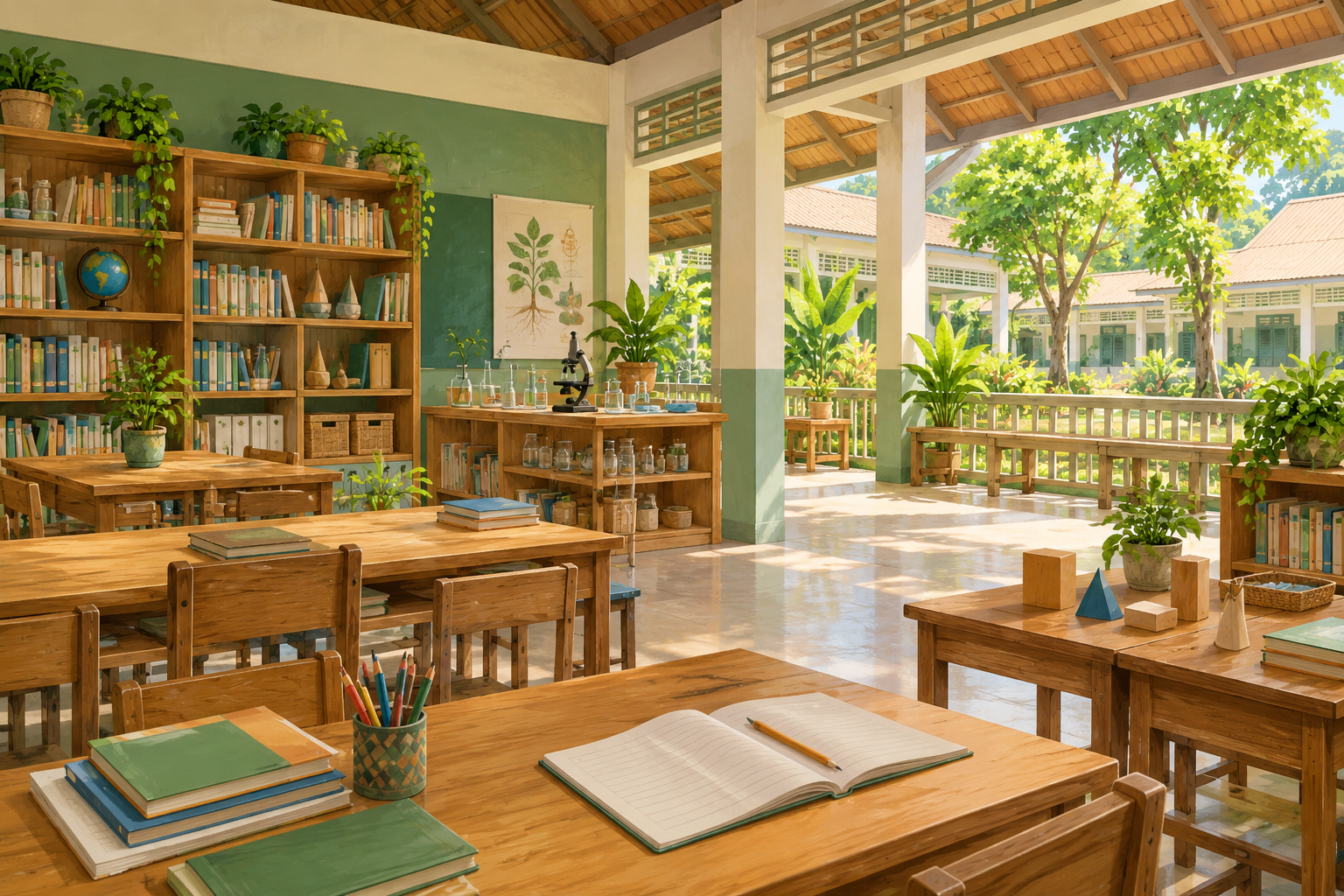
Cambodia’s general education route has six primary years, three lower-secondary years and three upper-secondary years. The major decisions come at the Grade 6 transition, completion of Grade 9 basic education, and the Grade 12 Bac II examination. Technical training, flexible equivalency programmes and university provide different next steps, each with its own entry conditions.
Reviewed: 17 October 2026. This guide distinguishes the national framework, verified 2026 examination information and reforms still being implemented. Typical ages assume uninterrupted progression. A policy target, a school’s actual provision and an individual admission decision are different kinds of evidence.

Cambodia education system at a glance
| Question | Quick answer |
|---|---|
| School ladder | Primary Grades 1–6 → lower secondary Grades 7–9 → upper secondary Grades 10–12. |
| Normal entry | Around age six; Education Law Article 32 specifies six years or at least 70 months at the school-year start. |
| Typical ages | Primary 6–11; lower secondary 12–14; upper secondary 15–17. |
| Basic education | The first nine years; the constitutional minimum-schooling commitment and free basic-education entitlement cover this stage. |
| Main school authority | Ministry of Education, Youth and Sport (MoEYS), with local education structures and school leadership. |
| Language | Khmer is the national public-school language; targeted Indigenous-language bridging and other curricula require school-specific checks. |
| School-leaving examination | Grade 12 upper-secondary examination, commonly called the Baccalaureate or Bac II. |
| Technical pathways | MoEYS general and technical high schools and MLVT technical/vocational institutions are distinct routes. |
| Return to learning | BEEP offers recognised Grade 9 equivalency linked to further skills training. |
| Higher education | Programme-specific admission, scholarships and recognition must be checked separately. |
Choose your reading route
Start with the stage or decision you need. Each chapter links back here and onward to the next chapter.
Understand access and classroom learning
- The six-three-three ladder makes the main transitions visible
- Nine years is the basic commitment; entry rules deserve precise reading
- School administration, technical training and higher education have different responsibilities
- Preschool access and quality depend on the actual setting
- Khmer literacy and multilingual support need separate attention
- Primary progress means understanding the reading and mathematics beneath the grade
Navigate examinations and qualifications
- The Grade 6 to Grade 7 move needs an attendance plan as well as a school place
- Grade 9 completion is a qualification point and a choice point
- Bac II is the Grade 12 school-leaving examination
- TVET has several entry levels and more than one supervising route
- BEEP can reopen a Grade 9 route for an out-of-school learner
- University admission is institution-specific, including within public higher education
Make a workable family plan
1. The six-three-three ladder makes the main transitions visible
Cambodia’s 2007 Education Law, Article 17, places Grades 1–6 in primary education, Grades 7–9 in lower secondary and Grades 10–12 in upper secondary. It defines basic education as the first nine grades. Preschool comes before this numbered route; higher education and technical training have their own admission requirements.
The usual age map is approximately six to eleven for primary, twelve to fourteen for lower secondary and fifteen to seventeen for upper secondary. A learner who entered late, repeated a grade or had schooling interrupted will not necessarily fit those ages. Use the transcript and completed learning rather than age alone when arranging a transfer.
Each transition changes more than the school label. Grade 7 can bring a different campus, longer journey and more subject teachers. After Grade 9, the learner needs to understand the next general or technical route. Grade 12 completion produces another decision about a recognised qualification, a university application or skills training.
A Singapore family should therefore compare actual programmes rather than equate Cambodian Grade 6 with every aspect of Singapore Primary 6. The curriculum, teaching language, assessments and next-school arrangements differ. A receiving school needs evidence of what the student can read, calculate, explain and manage independently.
Back to reading routes · Next: Nine years is the basic commitment; entry rules deserve precise reading
2. Nine years is the basic commitment; entry rules deserve precise reading
Article 68 of the Constitution provides for free primary and secondary education in public schools and at least nine years of schooling. This is commonly described as the nine-year compulsory basic phase. Education Law Article 31 expresses a citizen’s right to at least nine years of quality public education without charge. Neither statement means that every child currently completes the stage.
The entry rule also has a useful detail. Article 32 specifies age six, or at least seventy months, at the beginning of the school year. Families should confirm the current enrolment procedure, age calculation and required documents with the receiving school. A fixed calendar-year birthday cutoff used in another country may not apply.
Free public schooling does not mean a household has no education-related expenditure. A family may still need transport, uniforms, stationery, food, connectivity and a workable arrangement for the child’s time. Ask which charges are official, which services are optional and what support is available.
If a child has missed schooling, the first question should be how to restore access and establish the right learning level. A legal entitlement and a practical placement need to meet in the same plan. Do not assume that being older than the typical class makes the child ineligible for every recognised route.
Back to reading routes · Next: School administration, technical training and higher education have different responsibilities
3. School administration, technical training and higher education have different responsibilities
MoEYS is the main authority for general schooling. Provincial, district and local school structures handle implementation and practical decisions. The Ministry of Labour and Vocational Training (MLVT) has a major role in technical and vocational education. Universities and institutes have programme-specific admissions, while the Accreditation Committee of Cambodia is a key higher-education quality-assurance body.
This division explains why one answer rarely settles an entire family move. A school can explain a child’s placement, timetable and records. A training institute can explain the entry conditions for its own certificate. A university can assess whether the applicant qualifies for a particular degree. The Accreditation Committee of Cambodia is the appropriate starting point for checking higher-education accreditation questions.
For an enquiry, include the current grade, completed subjects, teaching language, previous qualification and intended destination. Ask which office decides the point you need resolved. A broad question such as “Is this diploma accepted?” is incomplete until the purpose is clear: school transfer, university admission, credit transfer or professional practice.
Keep copies of written replies. Where two offices appear to give different answers, identify whether they are addressing the same decision and the same intake. A general eligibility statement and a competitive admissions result can both be correct without promising the same outcome.
4. Preschool access and quality depend on the actual setting
Early childhood provision includes state, community and private settings, alongside support for learning at home. The ministry’s strategic plan uses ages three to five as its preschool planning group. UNICEF’s Cambodia education programme includes community preschools among the approaches used to extend early learning, especially for children facing access barriers.
For a family, the useful questions are concrete. How many days does the setting operate? What language does the adult use with the child? What happens during play, stories and meals? Is there safe water and a suitable toilet? How are children supervised at arrival and collection? A label such as kindergarten tells less than a clear account of the daily routine.
Readiness for Grade 1 includes understanding instructions, communicating needs, sharing space with other children and developing early language and number ideas. It should not be reduced to how many worksheets a preschool completes. Ask how staff notice a child who is quiet, confused or unable to participate.
A child who speaks an Indigenous language at home may need a deliberate bridge into Khmer. A child returning from an English-speaking school may need a different bridge. Both benefit from adults identifying what the child understands already and building from that knowledge, rather than assuming silence means lack of ability.
5. Khmer literacy and multilingual support need separate attention
Khmer is the principal language of national public-school learning. Spoken confidence, reading Khmer script and writing a subject explanation are different skills. A returning child may converse comfortably with relatives yet find a science passage difficult; a child learning Khmer as an additional language may understand a mathematical idea before understanding the wording of its question.
Targeted multilingual education provides an important alternative starting point for some Indigenous children. UNICEF’s 2019 evaluation describes a model beginning in an Indigenous language and bridging towards Khmer and the national curriculum by Grade 4. It documents provision in selected languages and locations. That historical evaluation is not proof that the same programme is currently available in every village or school.
Ask the school which languages are used for explanation, reading, writing and assessment, and how any transition is supported. Do not assume that a bilingual school uses the same language balance for mathematics as it does for social studies, or that an English lesson makes the whole programme English-medium.
A useful home activity is to let the learner explain a familiar process in the language they know best, then build the Khmer terms and sentence patterns needed for school. If the concept is already understood, language work should help express it. If the concept is not understood, extra vocabulary alone will not solve the difficulty.
Back to reading routes · Next: Primary progress means understanding the reading and mathematics beneath the grade
6. Primary progress means understanding the reading and mathematics beneath the grade
Primary education lays the foundation for every later subject. Cambodia’s early-grade learning work emphasises Khmer reading and mathematics, including teacher support and structured learning materials. A 2025 UNESCO account describes continuing expansion across the early grades; its rollout goals should be distinguished from confirmation of provision in an individual classroom.
There is also more recent outcome evidence. MoEYS and UNICEF’s December 2025 release on SEA-PLM reports improvement between the 2019 and 2024 Grade 5 assessments while noting persistent inequality. These are assessment-year comparisons, not a live score for every school in 2026.
For a child, begin with actual work. Can they read a short text and explain its meaning? Can they compare quantities and show why a calculation makes sense? Can they use information from a simple table? A copied page can look complete while revealing little about independent understanding.
Consider a problem about buying rice at a market. Ask the learner to identify the quantities, explain the operation and check whether the answer is plausible. If they can solve it orally but cannot read the question, literacy is part of the barrier. If they read confidently but choose the wrong operation, the mathematical relationship needs attention.
Before Grade 7, ask for a short picture of strengths and gaps in Khmer and mathematics, not only a final average. That information makes support more focused and gives the next school something useful to work with.
Back to reading routes · Next: The Grade 6 to Grade 7 move needs an attendance plan as well as a school place
7. The Grade 6 to Grade 7 move needs an attendance plan as well as a school place
Lower secondary contains Grades 7–9. This is a particularly important retention stage: the MoEYS–UNICEF campaigns launched in October 2025 explicitly addressed persistent lower-secondary dropout. The issue is not simply whether a student is academically able to continue; the route must also be reachable and sustainable.
Before the transition, establish the receiving school, daily journey, timetable, required materials and adult contact for absences. If the family’s work is seasonal or involves migration, discuss how records and learning will continue before the move occurs. A child can be registered yet miss enough lessons to become increasingly detached from school.
Lower secondary also requires more independent organisation. Help the learner keep one list of assignments and identify the subject teacher to approach when confused. Ask about access to textbooks and any support for gaps carried from primary school.
Watch patterns rather than waiting for a crisis: repeated lateness, missing materials, unfinished work or avoidance of one subject. These signals can have different causes, including transport, bullying, language difficulty or a learning gap. A useful school conversation identifies the cause and agrees a specific response, then checks whether it worked.
8. Grade 9 completion is a qualification point and a choice point
Grade 9 completes the basic-education stage. The ministry’s Education Strategic Plan 2024–2028, second edition records the transfer of Grade 9 examination responsibility to the sub-national level. Families should not assume that its administration is identical to the centrally organised Grade 12 Bac II examination.
Ask the school for the current completion and examination requirements, registration procedure and certificate arrangements. Confirm what happens if the learner has been absent, transferred recently or has outstanding assessment. A general national-system description cannot settle an individual candidate’s status.
After Grade 9, compare general upper secondary, an eligible general-and-technical high-school programme and relevant vocational study. The useful comparison is the qualification at the end, the entry requirements and the next destination that accepts it.
A learner interested in electrical work might benefit from a technical route with substantial supervised practice. Another learner may prefer general upper secondary while exploring engineering later. Neither decision should be made from the word technical alone. Obtain the actual curriculum, workshop time, assessment and progression conditions.
If the learner is unsure, preserve options by identifying prerequisites shared by several routes. A clear plan for the next two or three years is more useful than pressure to choose an entire career at fourteen.
9. Bac II is the Grade 12 school-leaving examination
The upper-secondary examination is commonly called the Baccalaureate or Bac II. A government news report relaying MoEYS’s announcement confirms that the 2026 written examination took place on 10–11 August, with science and social-science streams. Those dates are a completed 2026 event; they are not a timetable for the next cohort.
The stream matters because it shapes the subject preparation and examination package. Ask the school for the precise current subjects, weighting, registration and permitted materials. Do not build a revision plan from an old online list whose year and stream are unclear.
Preparation should connect three things: the taught curriculum, the learner’s actual weaknesses and timed examination practice. For a physics problem, examine whether the difficulty is choosing a principle, interpreting a diagram, rearranging an equation or explaining a result. Repeating whole papers without reviewing these distinctions can consume time without repairing the problem.
Passing Bac II is an important qualification outcome, but university selection is a separate process. A programme may require particular results, an entrance test, language evidence or a competitive application. An overall pass does not automatically secure a place in medicine, engineering or another selective course.
If the result is unsuccessful, discuss the next officially available examination route and eligible alternatives. The September 2026 government response encouraged unsuccessful candidates to prepare again and consider skills-training opportunities. It does not establish an immediate universal supplementary sitting or unrestricted entry to every higher-education programme.
10. TVET has several entry levels and more than one supervising route
Cambodia’s technical and vocational education is broader than a single alternative to university. MoEYS general and technical high schools and MLVT training institutions serve different programmes and stages. Short skills training, technical certificates, higher diplomas and degree-level technical study should be identified by their actual award and entry conditions.
The Cambodia Skills Development Roadmap 2023–2035 sets a long-term policy direction. A roadmap establishes priorities; it does not guarantee that every listed specialism is already offered nearby. Check the institution’s current intake, equipment, teaching staff and assessment arrangements.
The targeted initiative commonly called TVET 1.5M is active rather than merely a proposal. An August 2026 government report describes participation by disadvantaged young people. The programme name is a target population, not proof that 1.5 million learners have graduated. Eligibility, financial support and available courses need individual confirmation.
For automotive, construction or hospitality training, ask what a learner must demonstrate to pass. How much work is supervised in a workshop or workplace? Who provides protective equipment? Is a placement guaranteed, competitive or arranged by the student? Which employer or institution recognises the award?
A practical programme should still develop reading, mathematics, communication and safe working habits. Those capabilities help a graduate adapt when equipment or work processes change. Avoid promises that a short course alone guarantees employment or automatic access to a higher qualification.
11. BEEP can reopen a Grade 9 route for an out-of-school learner
The Basic Education Equivalency Programme, or BEEP, is a joint MoEYS, MLVT and UNESCO initiative. It provides flexible learning for young people who left lower secondary before completion. UNESCO’s programme explanation describes free online-based learning with supported centres and a recognised certificate equivalent to Grade 9 linked to further skills training.
This is a specific bridge. It should not be advertised as an automatic Grade 12 certificate, a shortcut into any university or proof that every regular-school transfer will be accepted. Ask the intended receiving institution how it uses the BEEP certificate. UNESCO-UNEVOC’s 2026 programme profile confirms the continuing flexible-learning model.
For a working young person, check the nearest active centre, access to a device and internet, facilitator availability, required subjects and final assessment. A flexible timetable still needs protected study time. Agree how work responsibilities will fit around learning, rather than assuming online delivery requires little effort.
Start with the desired next step. If the learner wants a particular technical certificate, verify that programme’s entry requirements and how BEEP fits them. Then plan the basic-equivalency work backwards from that goal. The strongest second-chance route is one whose next door is known to be open before the learner invests months of effort.
Back to reading routes · Next: University admission is institution-specific, including within public higher education
12. University admission is institution-specific, including within public higher education
Cambodia has public and private universities and institutes offering different fields and awards. Bachelor’s study commonly follows upper-secondary completion, but admission requirements, duration and fees vary. The Royal University of Phnom Penh (RUPP) programme directory illustrates the range; it should be read alongside the relevant department’s current admission notice.
A concrete current example is RUPP’s 2026/2027 social-work admission information, which describes a four-year Bachelor of Arts in Social Work and an entrance examination for the fee-based first-year programme. It would therefore be wrong to tell every Bac II holder that all RUPP degree places are automatic or free.
Postgraduate study builds on a first degree rather than directly on Bac II. For example, RUPP’s Master of Science in Climate Change describes two years of full-time study or its part-time equivalent. Applicants need a recognised bachelor’s degree or equivalent and an entrance examination; non-science entrants also face a bridging requirement. These examples give a concrete four-year undergraduate and two-year postgraduate sequence, while the field, entry conditions and actual duration remain programme-specific. A doctorate is a further research qualification, with its own selection and supervision requirements.
Technical institutions also distinguish programmes. The Institute of Technology of Cambodia’s 2025/2026 academic planning document described document-based technician selection and a separate engineering entrance examination focused on mathematics, physics-chemistry and logic. This is a dated example of the distinction, not a replacement for the current intake notice.
Compare admission, scholarship selection and registration separately. Ask whether a scholarship covers tuition only, whether it is renewable and what academic conditions apply. A public institution can have both scholarship and fee-paying places.
International applicants should confirm qualification equivalence, teaching language, documents and fee category directly. Likewise, a Cambodian student applying abroad needs the destination institution’s assessment. A familiar English programme title does not create automatic equivalence across countries.
13. A framework level and accreditation answer different questions
The Cambodian Qualifications Framework provides a way to locate awards by level. MLVT’s 2021 General Information of TVET Institutes, available in an unofficial English translation hosted by the International Labour Organization, describes eight levels, including higher diploma or associate-level awards at Level 5, bachelor’s at Level 6, master’s at Level 7 and doctorate at Level 8. Use this as framework orientation, with current institutional confirmation for a particular qualification.
A level is not a promise of credit transfer. Two programmes can sit at a similar level while having different subject content, practical hours and progression rights. Ask the receiving institution how much prior learning it will accept and which remaining requirements must be completed.
Accreditation is another check. Confirm the institution’s status through the Accreditation Committee of Cambodia and ask about the exact programme, campus and award. A recruitment agent’s assurance, international-sounding name or partnership logo is insufficient evidence.
Professional practice may involve additional requirements beyond academic admission or graduation. For a regulated occupation, identify the relevant professional authority before committing to a course. An academically recognised award and permission to practise are not interchangeable.
Retain the curriculum, transcript, award certificate and current recognition information. These records help when moving between institutions or countries and are more useful than a screenshot of a marketing claim.
Back to reading routes · Next: Model schools and full-day learning are implementation programmes, not a universal timetable
14. Model schools and full-day learning are implementation programmes, not a universal timetable
The Education Strategic Plan 2024–2028, in its February 2025 second edition, promotes school management, model-school standards, New Generation Schools, digital education and expansion of full-day learning. It includes selection and support for schools able to implement these approaches. The existence of that plan does not mean every Cambodian public school already operates the same full-day model.
Ask a prospective school about actual hours, teachers, subjects, facilities and the conditions attached to any additional programme. If a contribution or fee is requested, ask what it funds, whether it is required or voluntary and what happens for a family unable to pay. National policy language cannot substitute for a transparent school-level explanation.
Digital learning needs the same distinction. MoEYS’s Sala Digital provides educational resources, but a resource library does not ensure that every pupil has a device, connectivity or teacher feedback. Check the grade, subject, author and date of a resource before using it as an examination guide.
The useful question is what has changed for this learner: more supported reading, better feedback, reliable laboratory access, a longer supervised day or an accessible lesson. A reform becomes educationally valuable through those observable improvements. Treat targets, pilot activity, confirmed local delivery and evaluated results as separate claims.
15. Costs, disability and disrupted schooling need a continuity plan
A workable education route includes the journey, meals, materials, safety and time needed to attend. For a learner moving from a rural area to an urban secondary school or university, accommodation and daily transport can matter as much as the nominal fee. Compare a complete annual budget and identify which support has actually been awarded.
Inclusive provision also needs practical detail. UNICEF’s June 2026 reporting from Battambang describes mainstream and specialised support working together for children with disabilities. It demonstrates a real model, not identical provision at every school. Ask what materials, communication support, physical access and teacher expertise are available locally.
Where schooling has been interrupted, preserve records and ask about temporary placement, learning recovery and examination arrangements. A UN assessment published in April 2026 documents education disruption associated with the border conflict. Historical closure figures should not be treated as the current status of a particular school; obtain local confirmation before planning a return.
For any disruption, prioritise safety and a stable learning routine. Identify a named school contact, the materials to use, how work will be reviewed and what evidence is needed when the student returns. A digital lesson can support continuity, but it cannot by itself resolve placement, safeguarding or certification.
16. Three family decisions, worked through
A Grade 6 pupil faces a longer journey to Grade 7
Confirm the receiving school and test the ordinary travel plan before the transition. Check cost, rainy-day alternatives, arrival time and safe return. Ask the primary teacher for a brief Khmer-and-mathematics learning summary. During the first weeks, review attendance and assignments together. The goal is to catch a practical barrier before it becomes a learning gap and then a reason to leave school.
A teenager left Grade 8 and wants technical training
Identify the desired course first. Ask the institution which school-completion evidence it accepts, then discuss BEEP or another recognised route with the appropriate centre. Confirm subjects, assessment, device access and study time around work. Do not promise that any online certificate will satisfy entry. The route works when both the equivalency provider and the receiving programme explain the same progression.
A Bac II candidate is choosing between engineering and another degree
Compare the actual entry tests, subject prerequisites, programme length and full cost. Use the engineering institution’s current notice rather than assuming the Bac II pass is sufficient. Consider the learner’s mathematics and science preparation, but also ask about teaching language and support. If a scholarship is needed, keep a funded alternative until the award is confirmed. Prestige alone cannot make an unaffordable or academically mismatched first year workable.
17. Frequently asked questions
Is Cambodia’s school system six-three-three?
Yes. General education has Grades 1–6, 7–9 and 10–12. The first nine grades form basic education.
Is the compulsory stage nine years or twelve?
The constitutional minimum and basic-education commitment are nine years. Do not confuse the full twelve-year school ladder with twelve compulsory years, or the legal commitment with universal completion in practice.
Must a child already be exactly six on the first school day?
The Education Law includes an age-six rule and the alternative wording of at least seventy months at the school-year start. Ask the receiving school how the current enrolment process applies to the child.
Are Grade 9 and Bac II administered in the same way?
No. Grade 9 responsibility has been transferred to the sub-national level. Bac II is the upper-secondary national examination; use the appropriate current instructions for each.
Does passing Bac II guarantee a university place?
No. The university or programme may apply additional selection, subject, language or entrance-test requirements. Funding is a separate decision.
Does BEEP replace upper secondary school?
BEEP provides a basic-education equivalency route linked to Grade 9 and further skills training. It does not automatically confer Grade 12 completion or admission to every degree.
Are all public schools now full-day or New Generation Schools?
No. These reforms involve specific implementation and school-selection arrangements. Ask what the particular school is delivering now.
Official sources and scope
Sources prioritise Cambodian legislation, government agencies, universities and the UN organisations implementing or evaluating the named programmes. The Education Law link is an unofficial English translation. The ministry’s Education Strategic Plan is the February 2025 second edition hosted by an education-sector partner. Older framework and evaluation documents are explicitly dated; they do not establish current availability at every institution. Examples below are illustrative.
- Education Law, 2007: unofficial English translation — Articles 17, 31 and 32 cover the ladder, basic entitlement and school-entry age.
- Constitution of the Kingdom of Cambodia — Article 68: public-school education and the nine-year minimum.
- MoEYS Education Strategic Plan 2024–2028, second edition — February 2025 ministry document hosted by NGO Education Partnership; Grade 9 administration and implementation plans.
- UNICEF Cambodia: education programme — Early learning, inclusion and approaches supporting disadvantaged learners.
- UNICEF: multilingual-education evaluation — 2019 evaluation of the Indigenous-language bridging model; dated scope is important.
- UNESCO: early-grade learning expansion — 2025 account of Khmer reading and mathematics work and progressive rollout.
- MoEYS–UNICEF: SEA-PLM findings — December 2025 report comparing 2019 and 2024 Grade 5 outcomes.
- MoEYS–UNICEF: school-retention campaigns — October 2025 action addressing lower-secondary dropout and early learning.
- AKP: completion of the 2026 Bac II examination — Government report relaying MoEYS; 10–11 August 2026 and science/social-science streams.
- AKP: response to 2026 Bac II results — September 2026 advice to successful and unsuccessful candidates; no automatic supplementary examination promise.
- Cambodia Skills Development Roadmap 2023–2035 — National skills policy document hosted by ASEAN; roadmap versus delivery distinction.
- AKP: August 2026 TVET programme update — Evidence of active targeted skills training; the 1.5M label is not a graduate count.
- MoEYS: BEEP portal — Official basic-equivalency programme and learning-centre entry point.
- UNESCO: BEEP programme explanation — Recognised Grade 9-equivalent certificate and specified onward skills routes.
- UNESCO-UNEVOC: BEEP, 2026 profile — Continuing flexible-learning approach for out-of-school youth.
- Royal University of Phnom Penh: programme directory — Institutional programme range; individual admission notices still required.
- RUPP: Department of Social Work — Four-year bachelor’s programme and 2026/2027 fee-based first-year entrance examination example.
- RUPP: Master of Science in Climate Change — Two-year full-time equivalent, bachelor’s entry, examination and bridging example.
- ITC: 2025/2026 general and pedagogical document — Dated distinction between technician selection and engineering entrance examination.
- MLVT: General Information of TVET Institutes, 2021 — Unofficial English translation hosted by ILO; qualifications-level table, not current admission rules.
- Accreditation Committee of Cambodia — Official higher-education accreditation authority.
- MoEYS: Sala Digital — Educational resources; verify grade, author and publication date.
- UNICEF: inclusive learning in Battambang, June 2026 — Example of mainstream and specialised support, not universal local availability.
- United Nations: border-conflict socioeconomic impact assessment — April 2026 documentation of disruption; current school status needs local verification.
Continue exploring education
Use the eduKateSG Education Hub to connect this country guide with wider questions about learning, school transitions and family support. Compare actual programme requirements and qualifications before translating a school year or award into another education system.
This guide belongs to eduKate’s planned 195-country education-system series. Compare the Bhutan education-system guide for a different school and qualification structure, or browse the country guides in the Education Hub.