
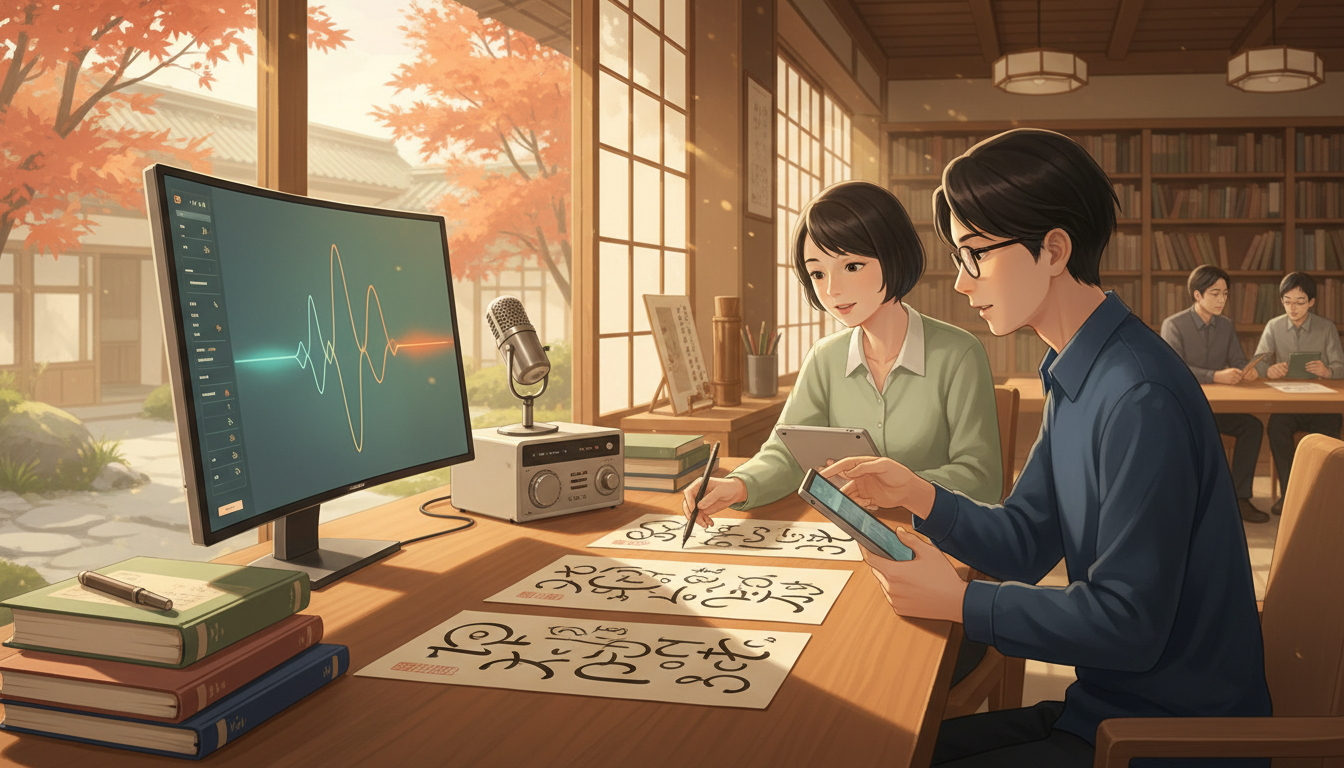
Need useful Japanese phrases for Japan? Start with こんにちは (konnichiwa, hello), ありがとうございます (arigatō gozaimasu, thank you), すみません (sumimasen, excuse me), いくらですか (ikura desu ka, how much?) and トイレはどこですか (toire wa doko desu ka, where is the toilet?). These help you communicate immediately.
This guide teaches 50 essential Japanese words and phrases with the original Japanese script, romanisation, English meanings and situations in which you can use them. You can use the list in everyday life, conversations, workplaces, shops, neighbourhoods and restaurants; it is not only a list for tourists.
Start with eight phrases, rehearse a short conversation, and come back for the next group. Romanisation is only a bridge to pronunciation: Japanese has distinctions you must hear, and real signs use Japanese writing. For a medical issue or a serious food allergy, use precise written translation and professional assistance rather than an approximate phrase.
Quick answer: eight phrases to learn first
- Hello — こんにちは — konnichiwa
- Thank you — ありがとうございます — arigatō gozaimasu
- Excuse me — すみません — sumimasen
- This, please — これをください — kore o kudasai
- How much? — いくらですか — ikura desu ka
- Where? — どこですか — doko desu ka
- I don’t understand — わかりません — wakarimasen
- Help me — 助けてください — tasukete kudasai
Find what you need: 50 useful phrases · Real conversations · Common mistakes · Seven-day practice plan · FAQs.
The language behind the phrases
Three writing systems: Japanese commonly mixes kanji, hiragana and katakana. You do not need to master every character today. Begin with recurring signs such as 駅 (station), 入口 (entrance), 出口 (exit) and トイレ (restroom). Read them as visual signals in everyday surroundings.
Start politely: Forms with desu and masu make useful beginner sentences. Sumimasen is a versatile expression for attracting attention and acknowledging a small inconvenience, but its meaning changes with the interaction.
Listen for long vowels: In this guide, ō indicates a long vowel. Romanisation styles vary, and spelling alone does not teach rhythm. Say the phrase after listening to a native speaker, then check whether you can use it naturally in a question.
The 50 words and phrases by real-life situation
Read each phrase, notice its use, cover the English meaning and try recalling it without looking. Grouping vocabulary by situation makes it easier to find the words later. If you are short of time, begin with greetings, questions and help.
Greetings and courtesy — 1–10
| # | Original writing | Say it (approx.) | English meaning | Real use |
|---|---|---|---|---|
| 1 | こんにちは | konnichiwa | Hello / good afternoon | Start a daytime conversation |
| 2 | おはようございます | ohayō gozaimasu | Good morning | Morning greeting |
| 3 | こんばんは | konbanwa | Good evening | Evening greeting |
| 4 | ありがとうございます | arigatō gozaimasu | Thank you | After help |
| 5 | すみません | sumimasen | Excuse me / sorry | Get attention |
| 6 | ごめんなさい | gomen nasai | I’m sorry | Apologise directly |
| 7 | はい | hai | Yes / acknowledgement | Reply to a question |
| 8 | いいえ | iie | No | Decline or disagree |
| 9 | お願いします | onegaishimasu | Please / I request | Complete a request |
| 10 | またね | mata ne | See you later (casual) | Say goodbye to a friend |
The first ten expressions open and close an interaction. Practise saying them to an imaginary colleague, neighbour or shopkeeper.
Asking questions and understanding — 11–20
| # | Original writing | Say it (approx.) | English meaning | Real use |
|---|---|---|---|---|
| 11 | 英語を話せますか | eigo o hanasemasu ka | Can you speak English? | Ask about a shared language |
| 12 | 日本語が少しわかります | nihongo ga sukoshi wakarimasu | I understand a little Japanese | Set expectations |
| 13 | わかりません | wakarimasen | I do not understand | Signal confusion |
| 14 | もう一度お願いします | mō ichido onegaishimasu | Once more, please | Ask for repetition |
| 15 | ゆっくり話してください | yukkuri hanashite kudasai | Please speak slowly | Ask for a slower reply |
| 16 | これは何ですか | kore wa nan desu ka | What is this? | Identify an item |
| 17 | どこですか | doko desu ka | Where is it? | Ask for a location |
| 18 | どうやって行きますか | dō yatte ikimasu ka | How do I get there? | Ask about a route |
| 19 | 大丈夫です | daijōbu desu | It is okay / I’m fine | Respond according to context |
| 20 | ちょっと待ってください | chotto matte kudasai | Please wait a moment | Pause an interaction |
If you cannot understand someone, ask for repetition or slower speech instead of guessing. That skill is useful in nearly every language.
Food, cafés and shopping — 21–30
| # | Original writing | Say it (approx.) | English meaning | Real use |
|---|---|---|---|---|
| 21 | メニュー | menyū | Menu | Find the menu |
| 22 | 水 | mizu | Water | Request a drink |
| 23 | お茶 | ocha | Tea | Ask for tea |
| 24 | ご飯 | gohan | Rice / meal | Talk about a meal |
| 25 | おすすめ | osusume | Recommendation | Ask what’s recommended |
| 26 | これをください | kore o kudasai | This, please | Point to an item |
| 27 | いくらですか | ikura desu ka | How much is it? | Ask a price |
| 28 | お会計お願いします | okaikei onegaishimasu | The bill, please | Finish a meal |
| 29 | おいしいです | oishii desu | It is delicious | Comment on food |
| 30 | アレルギーがあります | arerugī ga arimasu | I have an allergy | Then specify the ingredient |
For shopping and food, pointing to a word can help, but ingredient restrictions and health matters need careful, explicit confirmation.
Station signs and directions — 31–40
| # | Original writing | Say it (approx.) | English meaning | Real use |
|---|---|---|---|---|
| 31 | 駅 | eki | Railway station | Find a station |
| 32 | 電車 | densha | Train | Talk about trains |
| 33 | 地下鉄 | chikatetsu | Subway | Find urban rail |
| 34 | 切符 | kippu | Ticket | Buy a ticket |
| 35 | 改札 | kaisatsu | Ticket gate | Find fare gates |
| 36 | 出口 | deguchi | Exit | Read direction signs |
| 37 | 入口 | iriguchi | Entrance | Read building signs |
| 38 | 乗り換え | norikae | Transfer / change trains | Make a connection |
| 39 | 右 | migi | Right | Follow directions |
| 40 | 左 | hidari | Left | Follow directions |
Read sign vocabulary as well as spoken vocabulary. Being able to recognise an entrance or exit solves a real problem even when you cannot form a complete sentence.
Daily life and assistance — 41–50
| # | Original writing | Say it (approx.) | English meaning | Real use |
|---|---|---|---|---|
| 41 | 病院 | byōin | Hospital | Find medical services |
| 42 | 薬局 | yakkyoku | Pharmacy | Find medicines |
| 43 | トイレ | toire | Toilet / restroom | Ask for facilities |
| 44 | 助けてください | tasukete kudasai | Please help me | Request help |
| 45 | カードで払えますか | kādo de haraemasu ka | Can I pay by card? | Ask about payment |
| 46 | 現金 | genkin | Cash | Understand cash payment |
| 47 | 予約 | yoyaku | Reservation | Talk about a booking |
| 48 | 開いていますか | aite imasu ka | Is it open? | Check whether open |
| 49 | 閉まっています | shimatte imasu | It is closed | Understand opening information |
| 50 | 写真を撮ってもいいですか | shashin o totte mo ii desu ka | May I take a photograph? | Ask permission |
Keep this group available as a written reference. It can be important when you need help rather than simply making conversation.
Real conversations: put vocabulary to work
A word is easier to remember when it has a job. Each scene below shows an opening, the request and the next useful step. Actual responses and levels of formality will vary.
At a café
- すみません。メニューをお願いします。 — Sumimasen. Menyū o onegaishimasu. — Excuse me. The menu, please.
- これをください。 — Kore o kudasai. — This, please.
- お会計お願いします。 — Okaikei onegaishimasu. — The bill, please.
Learn how a request is assembled. The words for an item come before o onegaishimasu or o kudasai. There is no perfect one-word swap for every English ‘please’.
At a train station
- すみません。駅はどこですか。 — Sumimasen. Eki wa doko desu ka. — Excuse me, where is the station?
- 右です。 — Migi desu. — To the right.
- ありがとうございます。 — Arigatō gozaimasu. — Thank you.
If you cannot understand the full answer, ask the person to indicate the direction. Read the destination and line name on signs before travelling; do not assume every operator or ticket works identically.
When you need someone to repeat
- 日本語が少しわかります。 — Nihongo ga sukoshi wakarimasu. — I understand a little Japanese.
- ゆっくり話してください。 — Yukkuri hanashite kudasai. — Please speak slowly.
- もう一度お願いします。 — Mō ichido onegaishimasu. — One more time, please.
These are conversation-repair phrases. They can be more valuable than advanced nouns because they keep the conversation moving when you are unsure.
Five common mistakes to avoid
- Do not assume that sayonara is the best goodbye every time. It can sound formal or final; mata ne is casual and best used with friends.
- Do not translate every English ‘please’ as the same Japanese word. Learn the request pattern with the phrase.
- Do not ignore vowel length and native pronunciation. Written romanisation is a starting point, not an audio lesson.
- Do not confuse the words for entrance (入口) and exit (出口). These two signs save time repeatedly.
- Do not treat an allergy phrase as proof that an ingredient or cross-contact is absent. Confirm details carefully.
A seven-day learning and memory plan
Practise for ten to fifteen minutes a day. Do not merely reread the list: close the page, recall the expression, check the original and then put it into a sentence. The aim is usable recall, not collecting highlighted words.
- Day 1: Speak the eight quick-start phrases without looking at the translations.
- Day 2: Practise starting and ending three different conversations politely.
- Day 3: Use the food and shopping phrases in an imagined order.
- Day 4: Find and recognise the words for station, entrance, exit and directions.
- Day 5: Practise asking for help, repetition and slower speech.
- Day 6: Write five original mini-dialogues using words from two groups at once.
- Day 7: Recall all 50 meanings and phrases; review the ones you missed tomorrow.
How to tell whether the vocabulary is really helping
Ask yourself a practical question: could you greet someone, explain that you did not understand, ask where a place is, recognise a sign and thank the person who helped you? Those five abilities are a stronger test than reciting words in numerical order. Next, try changing the scene from a café to a shop or from a station to an office. Reusing a phrase in a new setting is evidence of learning.
Frequently asked questions
How do you say hello in Japanese?
こんにちは (konnichiwa) is a common daytime greeting. おはようございます is for morning and こんばんは for evening.
How do you say thank you in Japan?
ありがとうございます (arigatō gozaimasu) is a widely useful polite thank-you.
What does sumimasen mean?
すみません (sumimasen) can mean excuse me or a mild apology; the context matters.
How do you ask where the toilet is in Japanese?
トイレはどこですか (toire wa doko desu ka?) means ‘Where is the toilet?’
Should I learn Japanese writing?
Yes. Start with hiragana and the signs you meet most often. Romanisation becomes less useful as you progress.
Are these phrases only for visiting Tokyo?
No. These are common standard Japanese expressions. Regional speech and social situations still vary.
How can I remember phrases without a vocabulary app?
Cover the translations, retrieve them aloud, use them in a short scene and review the following day.
Continue reading and learning
To understand the country more broadly, open the country overview. To build language knowledge beyond a phrasebook, use the separate learning guide. You can also compare how everyday expressions work across other countries in this series.
- Everything About Japan
- How to Learn Japanese Quickly and Correctly
- Vocabulary for South Korea
- Vocabulary for France
- Vocabulary for Thailand
Sources and editorial accuracy
Primary language-learning and official tourism sources informed this guide. Transliteration conventions and usage vary. Always use current native-speaker audio to check pronunciation; for food allergies, medical care or emergencies, obtain dependable written interpretation and suitable assistance.
- Japan National Tourism Organization: Japanese language
- Japan Society for the Promotion of Science: Useful Japanese Expressions
Reviewed: November 2026. This is an educational language guide, not live travel advice or professional interpretation.