
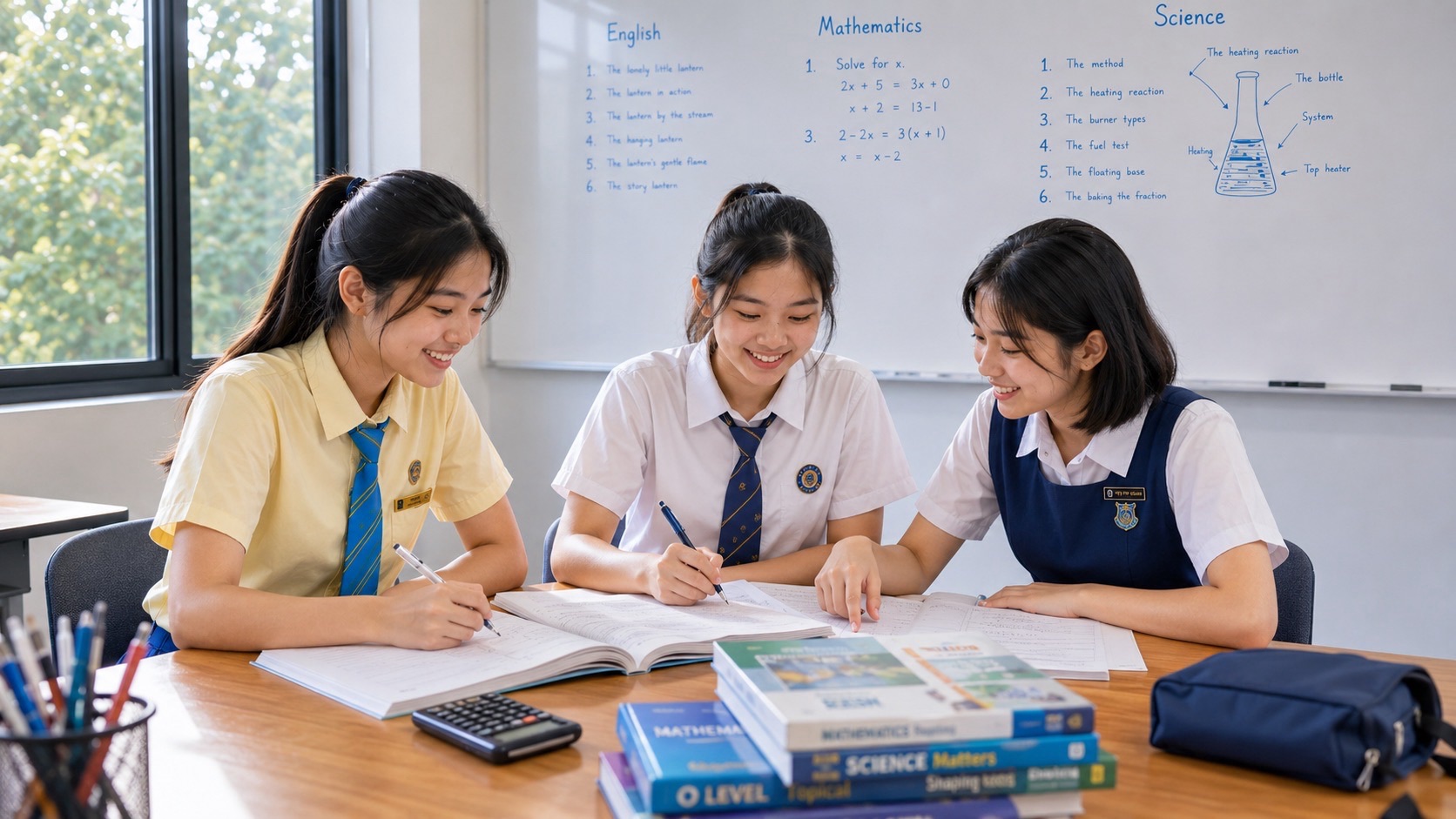
A beautifully drawn straight line can conceal a remarkable learning gap. A Bishan student has plotted every point correctly, ruled the line neatly and labelled both axes. Then the tutor asks, “If x increases by one, what happens to y?” The child knows how to draw the result but not yet how to read it. That gap is a gift to a careful teacher: the next lesson has a precise purpose.
What happens in IGCSE Bishan Mathematics tuition at the Secondary 2 stage? The most useful lessons connect linear graphs, gradients, simultaneous equations, proportion, coordinate geometry and mathematical word problems while developing readiness for the student’s actual Cambridge IGCSE Core or Extended pathway. Families searching for IGCSE Maths tuition Bishan, Secondary 2 Mathematics tuition Singapore, linear graphs revision, simultaneous equations tutor and Core vs Extended IGCSE Maths should look for explanations that cross from words to equations to tables to graphs.
Did you know? Cambridge IGCSE Mathematics 0580 does not dictate that linear graphs must be taught in a Singapore Secondary 2 year. This is the second stage in a practical Bishan family timeline, not a mandated syllabus calendar. International schools may use Year 8 or Year 9, and the qualification may be 0580, 0980, 0607 or another preparatory course. Check the child’s school scheme, course code and eventual examination year before assuming which topics are required this term.
What should improve first? The student’s ability to explain relationships
A graph has several mathematical jobs. It represents quantities, reveals how they change and can show where two statements are simultaneously true. When a tutor teaches these jobs as connected ideas, the learner becomes better at selecting methods in unseen word problems. Without those links, the child may produce attractive plots yet struggle with interpretation questions.
The first diagnostic can be surprisingly brief: show one line and ask the child to explain its gradient, intercept and one point on it. Then give the same relationship as a sentence and ask for an equation. The first place the explanation breaks reveals the next teaching step.
A linear equation tells us a starting amount and a change
Consider y = 3x − 2. At x = 0, y = −2. At x = 1, y = 1. At x = 2, y = 4. The resulting line has gradient 3 and y-intercept −2. Its y-value rises by three for every one-unit increase in x, regardless of where the student begins.
Ask whether the point (4, 10) belongs to the line. Yes: 3 × 4 − 2 = 10. Does (4, 11) belong? No. Substitution is an independent check. The learner need not rely on the tutor to say whether the plotted point is correct.
Now change the relationship to y = −2x + 7. Its negative gradient means it falls as x increases. A child drawing an upward-sloping line may have lost the minus sign, reversed axes or misunderstood the table. These mistakes are different; an effective tutorial does not simply respond to all three by handing out more identical plots.
A fictional Bishan choice: where do two plans cost the same?
Imagine two invented study-library membership plans. Plan A costs $6 to register and $4 a month; Plan B costs $18 to register and $2 a month. These are teaching numbers, not prices charged by a real Bishan business. Let m be the number of months. Then A = 6 + 4m and B = 18 + 2m.
For equal cost, solve 6 + 4m = 18 + 2m. Subtract 2m and six to obtain 2m = 12, hence m = 6. Both plans then cost $30. Their two cost graphs meet at (6, 30). The coordinate is not merely a point: it is the break-even time and cost.
Which plan is cheaper after eight months? Plan A costs $38 and Plan B costs $34, so B is cheaper. At three months A costs $18, while B costs $24, so A is cheaper. The choice flips because Plan A starts cheaper but grows faster. This is what interpreting gradients and intercepts means.
Try a changed question. If Plan B increases its registration fee to $22, when will the plans meet? The equality becomes 6 + 4m = 22 + 2m, so m = 8. A learner who understands the original situation should predict that the break-even time moves later before calculating. This is reasonableness checking built into modelling.
Simultaneous equations: one answer that meets two constraints
Suppose 2x + y = 16 and x − y = 2. Adding the equations eliminates y: 3x = 18, so x = 6. Substitute into the second equation to get y = 4. The solution is (6, 4). Check: 2(6) + 4 = 16 and 6 − 4 = 2.
The graphical meaning is that the lines described by those two equations intersect at (6, 4). If a pupil can eliminate variables perfectly but cannot explain why both equations must be satisfied, their knowledge is procedurally useful but conceptually fragile. The tutor should link the algebraic operation to the meeting point.
A word problem reveals another challenge. Two adult tickets and three child tickets cost $39; three adult tickets and two child tickets cost $46. Let a and c denote their prices. The equations are 2a + 3c = 39 and 3a + 2c = 46. Solve to get a = $12 and c = $5. Both statements check: 24 + 15 = 39 and 36 + 10 = 46.
A child can fail this problem while knowing elimination well. The difficult part may be setting up the two equations from language, or keeping the quantities consistent. Diagnosis must locate the first incorrect step rather than assume “simultaneous equations” is the sole missing skill.
Gradient is a ratio, not a decorative number beside a line
For the points (−1, 8) and (3, 0), the vertical change is −8 while the horizontal change is 4, so gradient = −2. The minus sign agrees with the graph descending as x increases. This alignment between picture and arithmetic is an immediate self-check.
Suppose a student calculates a positive two. Ask them to write the horizontal change carefully: 3 − (−1) = 4. A directed-number problem from the foundation stage may be hiding inside the graph topic. Repair the number operation, then repeat a changed gradient question.
The expression “change in y divided by change in x” also gives gradient an everyday interpretation. A simplified model might describe a quantity decreasing by two units each hour. Real-world variation is rarely perfectly linear, but an explicit mathematical model lets pupils reason about an assumed constant rate.
Why direct proportion is different from an ordinary rising line
Compare y = 4x with y = 4x + 5. The gradients are the same, but only the first passes through the origin and is directly proportional to x. For x = 2, the first gives eight and the second thirteen. Double x to four: the first doubles to sixteen, while the second reaches twenty-one, not twenty-six.
A fixed charge explains the difference. If an item costs $4 each with no fee, the cost is directly proportional to quantity. Add a $5 joining fee and the cost remains linear but is not directly proportional. A child who can explain this distinction is reading the meaning of an intercept instead of merely spotting two similar graphs.
Inverse proportion is different again. A simplified model such as t = 24/w, in which w represents equally productive workers and t represents time for a fixed workload, gives t = 12 for w = 2 and t = 6 for w = 4. Doubling workers halves time under the idealised assumptions. The graph is not a straight line. Recognising the structure matters more than memorising another isolated formula.
Coordinate geometry: position, midpoint and distance
Take points A = (−3, 5) and B = (7, −1). Their midpoint is (2, 2), since the x-values average to two and the y-values to two. Draw the segment to check that the midpoint lies halfway between the endpoints rather than simply applying a formula.
The horizontal distance between A and B is ten units; the vertical difference has magnitude six. The straight-line separation is √(10² + 6²) = √136 = 2√34 units. An exact form may be appropriate where required. A student who can identify the right triangle created by the coordinate differences understands the distance formula more deeply.
The actual school syllabus determines when these coordinate methods are introduced. Their role here is to show the conceptual route from directed numbers to graphs to geometric reasoning, not to force an identical timetable on every international-school learner.
Transformations: translate the diagram into a movement
Take a point (−2, 3). A translation five units right and four units down sends it to (3, −1). Reflect the original point in the y-axis and it becomes (2, 3). These tasks are straightforward when the pupil keeps horizontal and vertical directions separate.
Ask the student to reverse the translation as a check: from (3, −1), move five left and four up to recover (−2, 3). The skill is a translation among a verbal instruction, an ordered pair and a drawing. That same crosswalk is valuable throughout algebra and graphs.
Probability and statistics still need the earliest number foundations
A bag holds four red, three blue and one green counter. Assuming all are equally likely to be selected, the probability of blue on one draw is 3/8. If two blue counters are selected without replacement, the probability is (3/8)(2/7) = 3/28. The second fraction changes because one blue counter has been removed. Understanding the condition is part of solving the problem.
For scores 2, 3, 3, 4 and 18, the mean is 6 and the median is 3. Both calculations are correct, but the high score of eighteen raises the mean. A question asking which value better represents a typical score requires the pupil to interpret the data rather than merely recall a formula.
These examples bring earlier fractions into probability and number sense into statistical interpretation. A purposeful tuition programme makes such connections visible so a child can choose methods when the question does not announce the chapter.
Core and Extended are examination routes, not early labels
Cambridge IGCSE Mathematics 0580 has Core and Extended tiers. Under the 2025–2027 syllabus, Core uses Papers 1 and 3 and Extended uses Papers 2 and 4, with a non-calculator paper at each tier. The 2028–2030 syllabus and related updates should be checked for those examination years.
That does not mean a school must decide Core or Extended during an official Singapore Secondary 2 year. Entry decisions follow the school’s programme and evidence. What tuition can do is strengthen algebra, graph interpretation, method selection and transfer to unfamiliar questions. Those are useful capabilities regardless of whether tier selection has already occurred.
Also, Extended 0580 is not the separate Cambridge IGCSE Additional Mathematics 0606 qualification. Similar-sounding terms should never determine which workbook or examination paper a learner receives.
How premium three-pupil teaching can respond to different errors
- Learner A: plots graphs accurately but cannot explain gradient; the next task is a rate-of-change explanation.
- Learner B: understands gradient but loses negatives when subtracting coordinates; revisit signed arithmetic.
- Learner C: understands both and needs an unfamiliar cost-comparison problem with two equations.
The immutable eduKateSG three-pax tutorial reference explains the underlying teaching logic: observe work closely, diagnose a specific gap, explain it and retest independence. A group limited to three creates the opportunity for precise feedback. Its educational value appears only when that opportunity is used well.
A four-week continuity plan
- Week 1: identify the first unsupported step in a graph or equation task taken from actual school work.
- Week 2: teach one relation through a sentence, equation, table and graph.
- Week 3: introduce changed contexts that require the learner to choose the route independently.
- Week 4: retest with different numbers after a delay and compare the student’s working, not just marks.
This is an illustrative routine rather than a fixed Cambridge teaching timetable. If the pupil already has school tests and CCA, reduce the load. The aim is to strengthen learning synchrony with school and preserve enough attention to do the work properly.
A good Bishan tuition choice includes practical fit
This guide is for families living around Bishan and nearby estates. It does not claim that eduKateSG operates a separate Cambridge IGCSE Mathematics classroom inside Bishan. The established premium three-pax teaching reference is near Sixth Avenue MRT in Bukit Timah. Confirm actual syllabus coverage, class location, lesson times and current availability before choosing a long journey.
Bring the real school Mathematics course, intended examination year and a recently marked script. Ask what the student should be able to explain unaided after a few lessons. An answer about a capability is more useful than a promise of marks without a diagnosis.
Frequently asked questions
Does every Secondary 2 pupil need to choose Core or Extended now?
No. Cambridge specifies the tiers, while schools organise teaching and entry decisions. Check when the child’s school makes those choices and what evidence it uses.
Why can a learner draw a line but not write its equation?
The child may have a representation gap: the diagram is understood procedurally but gradient and intercept are not connected to algebra. Teach the relationship through words, tables and coordinates.
Can Singapore Secondary Mathematics practice be used for IGCSE?
Some topics overlap, but the courses are not identical. Use the pupil’s actual school syllabus first and borrow only questions that target relevant skills.
How will a parent know tuition is working?
Look for independent changed-question solutions, accurate explanations, fewer recurring errors and delayed recall. A later assessment score can supplement those measures.
The complete Bishan IGCSE Mathematics learning sequence
- Secondary 1: Fractions, Ratio and Pre-IGCSE Algebra
- Secondary 2: Linear Graphs, Simultaneous Equations and Core vs Extended
- Secondary 3: Quadratic Graphs, Trigonometry and Extended Maths
- Secondary 4: Cambridge 0580 Past Papers and Non-Calculator Skills
Official curriculum and related eduKate reading
Use the official Cambridge 0580 Mathematics subject page for the current syllabus and updates. Explore IGCSE Mathematics tuition in Singapore, the Bishan parent and education guide, and the Ang Mo Kio IGCSE Secondary 2 companion.
Ask for a diagnosis before deciding on the next lesson
Bring the learner’s syllabus code, marked graph questions and a realistic weekly routine. Ask which relationship needs repair, how the tutor will explain it and when the student will demonstrate progress without hints. Contact eduKate Singapore or enquire about Secondary 2 IGCSE Mathematics for Bishan. Confirm syllabus fit, venue and availability before enrolment. Less noise. More structure. Better results.