
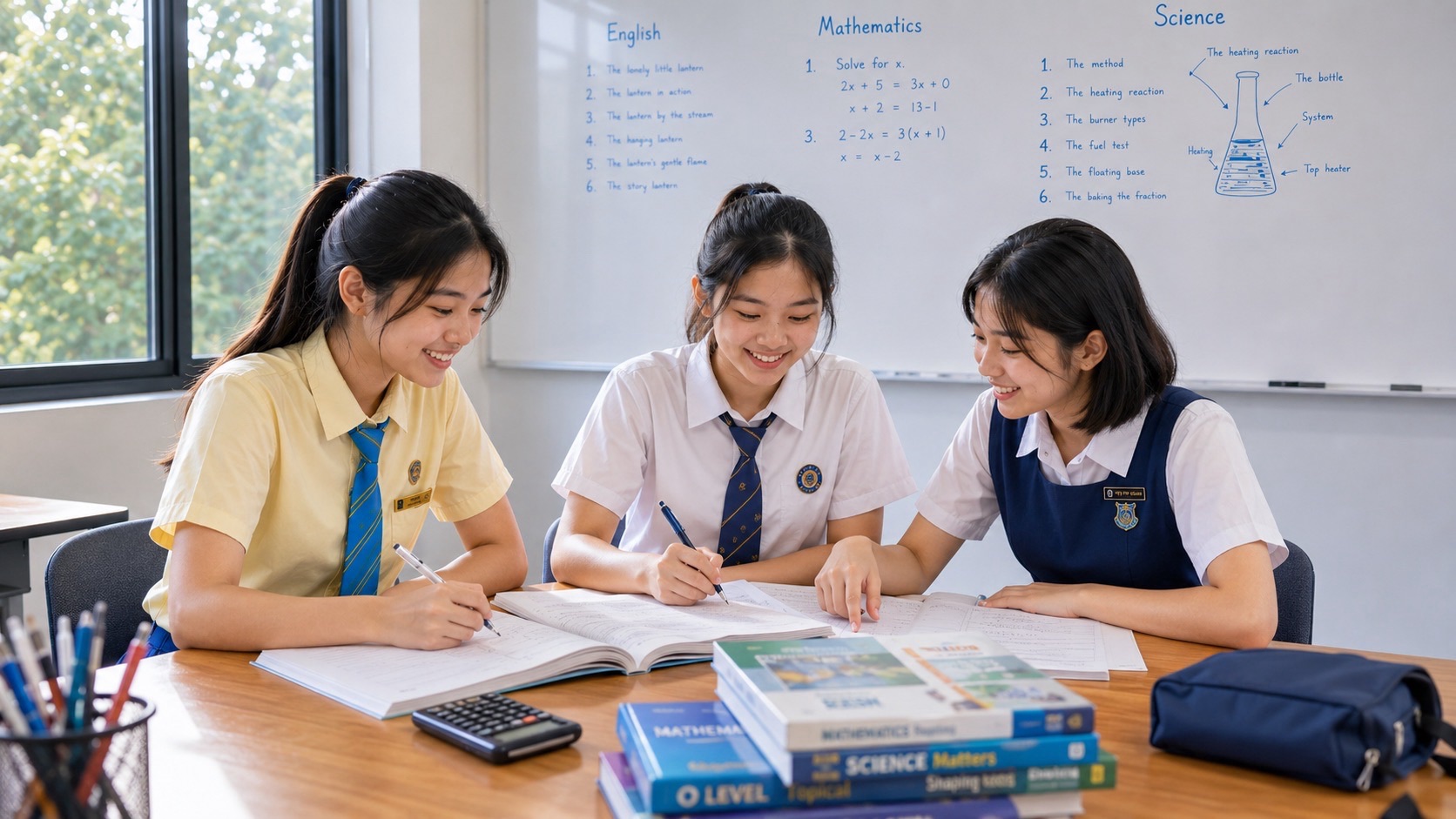
A student has drawn a lovely straight line. The axes are labelled, the ruler work is neat, and every coordinate appears to be in the right place. Then the question asks what the gradient means. Suddenly the task is not about drawing at all. It is about making sense of a relationship. The difference between these two abilities is one of the most useful things a Secondary 2 Mathematics lesson can uncover.
What happens in IGCSE Bukit Batok Mathematics tuition at Secondary 2 level? A thoughtful tutor joins linear graphs, coordinate geometry, gradients, simultaneous equations, ratio and practical modelling, with difficulty matched to the student’s actual international-school syllabus. Parents searching for IGCSE Maths tuition Bukit Batok, Secondary 2 Maths tuition Singapore, linear graph revision, simultaneous equations help or IGCSE Core vs Extended Mathematics should expect clear explanations, individually diagnosed errors and unfamiliar problems solved without prompts.
Did you know? Cambridge IGCSE Mathematics 0580 does not specify a compulsory Singapore Secondary 2 year for linear graphs. This is the second article in a family-friendly four-stage progression rather than an official Cambridge timetable. An international-school learner may encounter these skills in Year 8, Year 9 or a different course structure. Confirm whether the actual syllabus is 0580, 0980, 0607 or a preparatory programme, and use the school’s current scheme of work.
The real lesson: a line connects four ways of thinking
Take y = −2x + 11. From the equation alone, the y-intercept is eleven and the gradient is negative two. Each time x increases by one unit, y falls by two. For x = 0, 1, 2 and 3, the y-values are 11, 9, 7 and 5. These form a table that can be plotted as a straight line.
Ask whether the point (4, 3) lies on the graph. It does, because −2 × 4 + 11 = 3. The point (4, 5) does not. A child who can test a point is beginning to treat an equation as a relationship, not merely a set of instructions.
Now reverse the task. A line starts at y = −3 when x = zero and rises by four for each unit of x. Its equation is y = 4x − 3. Draw it, then describe it in words, construct a table and identify its gradient and intercept. The student should travel freely among all four representations.
When the line in the drawing disagrees with the gradient’s sign, the pupil has a useful checking opportunity. Did the child reverse coordinates? Was a negative sign omitted? Was the scale applied inconsistently? A tutor should diagnose the first wrong interpretation rather than merely redraw the correct answer.
A fictional Bukit Batok choice: two plans and a break-even point
Imagine two made-up resource subscriptions. Plan A costs a $9 initial fee and $2 for each month, while Plan B costs $3 initially and $3 each month. These are invented amounts, not actual prices of a business. After m months, their models are A = 9 + 2m and B = 3 + 3m.
The prices are equal when 9 + 2m = 3 + 3m. Thus m = 6. The common cost is $21. On the graph the two lines meet at (6, 21); in a table their outputs match in the sixth-month row; in words, six months is the break-even point.
Which plan costs less after ten months? Plan A costs $29; Plan B costs $33. A is cheaper after the intersection because its monthly rate is smaller. What about two months? A costs $13 and B costs $9, so B is cheaper while its lower starting fee dominates. The interpretation matters as much as the algebra.
A thoughtful follow-up changes one number. If Plan B’s starting fee becomes $1, will the equality occur sooner or later? Later, because B begins even cheaper but rises faster. Solving 9 + 2m = 1 + 3m gives m = 8. Making a prediction before calculating builds an independent reasonableness check.
Simultaneous equations: two conditions agreeing
Suppose 3a + 2b = 34 and 2a + 3b = 31. To eliminate b, multiply the first equation by three and the second by two. This gives 9a + 6b = 102 and 4a + 6b = 62. Subtract them: 5a = 40, so a = 8. Substitute back to find b = 5.
The pair (8, 5) satisfies both: 3(8) + 2(5) = 34, and 2(8) + 3(5) = 31. On a graph, it would be the intersection of the lines. A tutor should explain why the answer contains two numbers: two different quantities must simultaneously satisfy two relationships.
Put the equations into a story. Suppose three adult tickets and two child tickets total $34, while two adult tickets and three child tickets total $31. The same algebra now identifies adult tickets costing $8 and child tickets costing $5. These are invented prices. A pupil who understands the structure can move from words to equations and back.
A common difficulty is not elimination at all. The student may assign coefficients to the wrong items while reading the story. That is a translation error. Another pupil may set up the system correctly but calculate the difference of two equations incorrectly. The first needs modelling help; the second needs more reliable execution.
Gradient is a ratio of changes
Find the gradient between (−2, 8) and (3, −2). The vertical change is −10 and the horizontal change is 5, so the gradient is −2. It is a downward-sloping relationship, which a sketch should confirm.
A student who gets +2 may have subtracted x-coordinates in one direction but y-coordinates in the other. The tutor should ask the pupil to state which point is the starting point and keep that choice consistent.
A fractional slope is an especially useful bridge to earlier number learning. A gradient of 3/5 means a five-unit increase in x corresponds to a three-unit increase in y. A strong student recognises that a gradient is a ratio of two changes, not merely a fraction written beside a line.
Direct proportion is not the same as any straight line
Compare y = 4x with y = 4x + 7. The gradients are identical, but only y = 4x expresses direct proportion because it passes through the origin. The second equation contains a fixed starting amount; the ratio y/x does not remain constant as x changes.
A fictional service charging four dollars per unit without a setup fee is directly proportional to the number of units purchased. Add a seven-dollar setup charge and it is still linear, but it is no longer directly proportional. Understanding the y-intercept gives the pupil a reason, rather than an arbitrary label.
For inverse proportion, consider the deliberately simplified model t = 30/w, where w is the number of equally productive workers and t is the time for a fixed task. Two workers correspond to fifteen units of time and five workers to six. The relationship is not a straight line. Its assumptions must be made explicit if the pupil uses a real-world interpretation.
Coordinate geometry: midpoint, distance and checking
Take the points (−2, 4) and (4, −4). Their midpoint is (1, 0), found by averaging each coordinate. A student should sketch the segment and see why that point is halfway between the endpoints.
The horizontal separation is six units and the vertical separation is eight. Pythagoras gives the straight-line distance √(6² + 8²) = 10 units. Recognising a 6–8–10 triangle is helpful, but the more important understanding is that the distance formula comes from a right triangle drawn between the coordinates.
The precise timetable for midpoint and distance methods varies by school. They are included as connected concepts here, not as a claim that every international-school Secondary 2 student must already have learnt all coordinate geometry.
Transformations: make movement and notation agree
The point (−3, 2) is translated six units right and five units down. It becomes (3, −3). Reflect the original point in the y-axis and it becomes (3, 2). A pupil who can reverse the translation has another independent method of checking.
These tasks train accurate reading of ordered pairs. The x-coordinate names horizontal location; the y-coordinate names vertical location. Confusing them creates mistakes in graph plotting, transformations and later vector work.
Probability and data: the early fraction foundation returns
A bag holds four red, three blue and one yellow counter. Each has equal chance of selection. The probability of drawing two reds without replacement is (4/8)(3/7) = 3/14. The second probability changes because one red counter was removed.
For data 2, 5, 5, 6 and 17, the mean is 7 and the median is 5. The high value 17 raises the mean above most observations. Explaining when the median better represents a typical observation is a skill in interpreting data, not just using arithmetic.
These topics show that fractions, ratios and reading precision never disappeared after the Secondary 1 Bukit Batok foundation article. They now support longer problems and unfamiliar contexts.
Core vs Extended: preserve readiness without inventing a universal school timetable
Cambridge IGCSE Mathematics 0580 has Core and Extended assessment tiers. The 2025–2027 syllabus and 2028–2030 syllabus specify the actual content and examinations for those years. Core candidates take Papers 1 and 3; Extended candidates take Papers 2 and 4. Both tiers have a non-calculator paper.
A child’s school controls how it teaches and decides examination entry. A tutor can strengthen algebra, gradients, graph interpretation, accuracy and transfer, but should not use one bad test to assign a permanent tier label.
Also note that 0580 Extended is not Cambridge IGCSE Additional Mathematics 0606. These are different qualifications. The exact course code must be checked before choosing worksheets.
A premium three-pupil lesson can respond to three different errors
- Student A: draws graphs accurately but cannot explain what gradient means; next practise verbal rate-of-change descriptions.
- Student B: understands gradient but miscalculates signed coordinates; next repair subtraction with negatives.
- Student C: handles the graphs and signs but cannot translate a new ticket story; next develop simultaneous-equation modelling.
The immutable eduKateSG small-group Mathematics reference describes premium three-pax teaching that permits close observation and individual feedback. The small group is valuable when each pupil receives a distinct next task that responds to their actual working.
A four-week graph-and-equation learning cycle
- Week one: diagnose the earliest unsupported step in school graph and equation work.
- Week two: express one linear relationship as a sentence, table, equation and graph.
- Week three: solve a changed context with no chapter hint, then justify the method.
- Week four: retest independently after a delay and compare reasoning and errors.
This is a flexible teaching model rather than an official Cambridge calendar. School assessment dates, CCAs and rest must be considered. A successful lesson increases the pupil’s independent method selection, not merely the number of pages completed.
Bukit Batok families: course fit, distance and energy
This article is for families living in Bukit Batok and nearby western Singapore neighbourhoods. It does not claim that eduKateSG operates a dedicated IGCSE Mathematics centre physically inside Bukit Batok. The established premium three-student reference is near Sixth Avenue MRT in Bukit Timah. Ask directly about syllabus expertise, lesson venue, vacancies and travel practicality.
Bring the pupil’s actual school scheme of work, a recent marked script and expected exam year. A tutor should be able to say which connection needs repair and how the child will show independent improvement.
Frequently asked questions
Does every Secondary 2 student choose Core or Extended?
No. Cambridge defines the examination tiers while schools organise teaching and entry decisions. There is no universal Singapore Secondary 2 tier-decision date.
Why can my child plot graphs but not explain them?
The missing connection may be between visual slope, gradient and the story described by the equation. Practise moving between all three forms.
Can Singapore Mathematics exercises support Cambridge IGCSE?
Some prerequisites overlap, but the syllabuses are not interchangeable. Use the actual international-school course as the authority and supplement only the relevant skills.
How should parents measure progress?
Look for fresh questions solved without hints, accurate interpretations, fewer repeated mistakes and recall after a delay.
The full Bukit Batok IGCSE Mathematics series
- Secondary 1: Fractions, Number Sense and Algebra
- Secondary 2: Linear Graphs, Equations and Core vs Extended
- Secondary 3: Quadratic Graphs, Trigonometry and Extended Maths
- Secondary 4: Cambridge 0580 Past Papers and Non-Calculator Revision
Curriculum and eduKateSG supporting links
Use the Cambridge Mathematics 0580 official syllabus page for the candidate’s examination year. Continue to IGCSE Mathematics tuition in Singapore, the Bukit Batok tuition and education guide, and the Clementi Secondary 2 IGCSE companion.
Start with the right diagnosis
Ask what the child presently understands about equations and graphs, which connection fails and how a fresh question will test the repair. Contact eduKate Singapore or enquire about Bukit Batok Secondary 2 IGCSE Mathematics. Confirm actual syllabus, class venue and availability before enrolment. Less noise. More structure. Better results.