
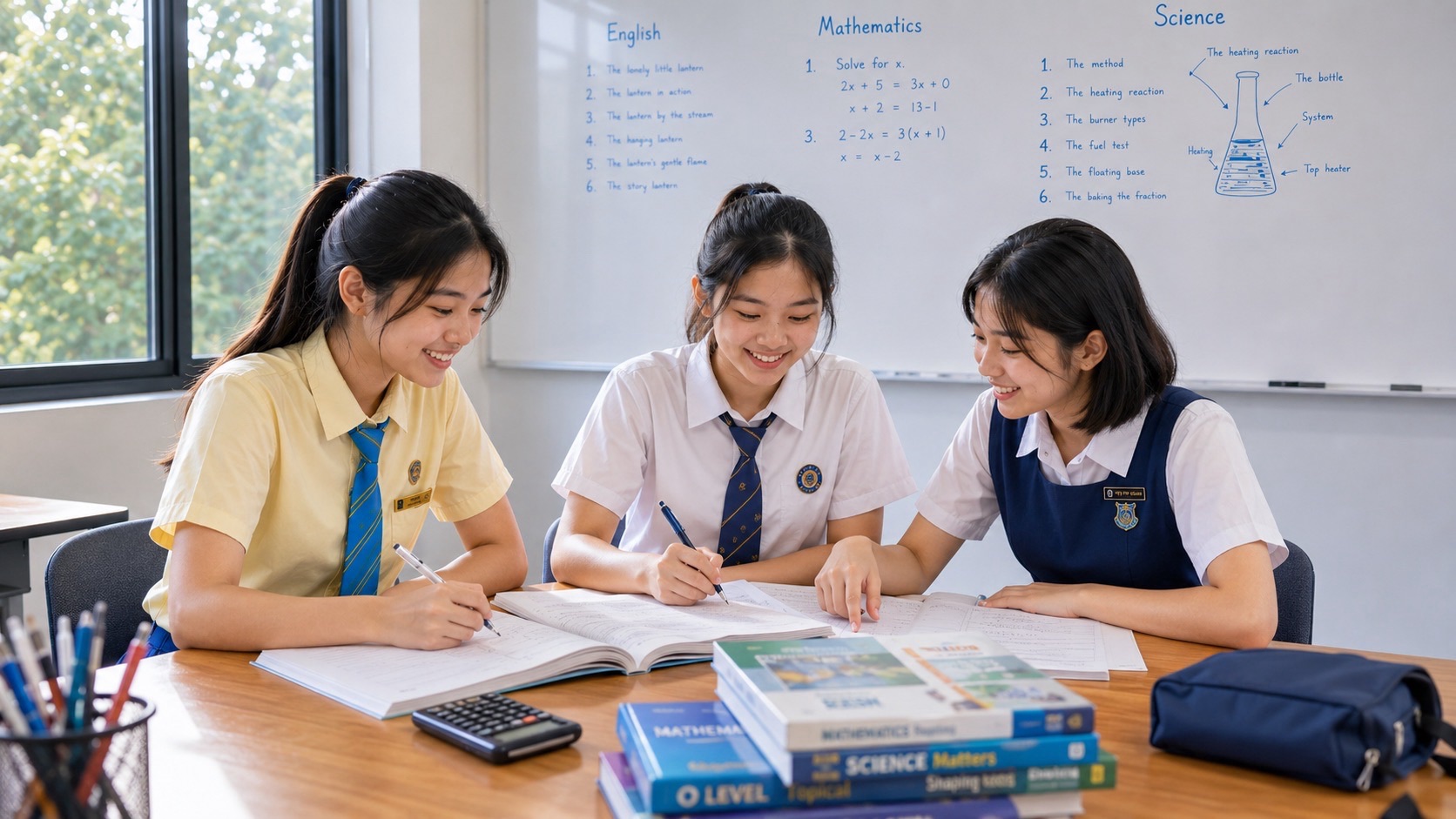
A straight line can be a surprisingly generous teacher. It tells us where a relationship begins, how quickly something changes and when two different choices become equal. Yet a pupil can draw one perfectly and still be unable to explain what it means. That gap between making the picture and understanding the story is one of the most valuable things Mathematics tuition can discover.
What happens in IGCSE Serangoon Mathematics tuition at Secondary 2? The tutor connects linear graphs, equations, gradients, coordinates, simultaneous equations and proportion, using the student’s actual international-school course as the immediate guide. Parents searching for IGCSE Maths tuition Serangoon, Secondary 2 Mathematics tuition, IGCSE linear graphs revision, simultaneous equations tuition or Core and Extended IGCSE Maths should look for explanations that connect words, tables, graphs and algebra—not just accurate plotting or high worksheet counts.
Did you know? Cambridge IGCSE Mathematics 0580 does not assign a fixed list of topics to Singapore Secondary 2. This article is the second step in a four-part educational planning route for Serangoon families, not an official Cambridge timetable. A learner in an international school’s Year 8, Year 9 or another programme may encounter these skills at a different time. The precise syllabus code, school plan and eventual examination year remain authoritative.
The answer parents often need within the first lesson
Ask the pupil to draw a line from a simple equation, then explain how the y-value changes when the x-value increases. If they can draw but cannot explain, teach gradient as change. If they understand gradient but lose negative signs, revisit signed-number operations. If the student can explain both, ask them to form an equation from an unfamiliar story. Those three outcomes reveal three different routes for tuition.
A grade may report that a child lost marks in graphs, but it does not reveal which of these routes is needed. That is why diagnosis before a new pile of worksheets is valuable.
An equation is a compact description of a relationship
Consider y = 4x − 1. When x is zero, y = −1. When x is one, y = 3. When x is two, y = 7. These points lie on a straight line with gradient 4 and y-intercept −1. Every one-unit increase in x raises y by four. The equation encodes both the starting value and the rate of change.
Ask the student to build the table, sketch the line and then tell the same story aloud. Next remove the table: could they still predict y when x = five? Yes, y = 19. Could they test whether (3, 11) lies on the line? Yes, because 4 × 3 − 1 = 11. Could they explain why (3, 10) is not on it? Also yes. The goal is an independent mathematical language, not a neat ruler alone.
Reverse the situation. A graph crosses the y-axis at five and goes down two units whenever x rises by one. Its equation is y = −2x + 5. If the pupil writes y = 2x + 5 instead, ask whether the line rises or falls. The contradiction between the picture and the proposed equation should help reveal the sign mistake.
A price comparison that can become a graph, an equation or a decision
Imagine two fictional after-school activity plans, with no connection to any real Serangoon provider. Plan A costs a joining fee of $5 and $3 per session; Plan B costs $13 to join and $1 per session. After n sessions their modelled costs are A = 5 + 3n and B = 13 + n.
The costs are equal when 5 + 3n = 13 + n. Hence 2n = 8 and n = 4. Each plan costs $17 after four sessions. Plot their lines and the point (4, 17) is their intersection. Before four sessions Plan A is cheaper; after four sessions Plan B becomes cheaper.
Now increase Plan B’s joining fee to $17. Will it catch up earlier or later? Later: it begins at a higher cost while its per-session advantage stays unchanged. The new equality gives n = 6. Making a prediction before calculating helps the student recognise whether the algebraic answer makes practical sense.
One example has now connected reading, algebra, an intersection and a comparative decision. It is useful because examination questions regularly require more than one of these steps without announcing their chapter labels.
Simultaneous equations are two statements that must both be true
Solve 2x + y = 17 and x − y = 1. Adding the two equations gives 3x = 18, so x = 6. From x − y = 1, y = 5. The solution is (6, 5). Check both conditions: 2(6) + 5 = 17, and 6 − 5 = 1.
The graph interpretation is that two lines meet at (6, 5). The algebra is a way to find the exact place of agreement. A pupil who can perform elimination mechanically but cannot explain the coordinate has a missing connection worth teaching.
In a word problem, two cinema tickets and three drinks might cost $27, while three cinema tickets and two drinks cost $33. With ticket price t and drink price d, the equations are 2t + 3d = 27 and 3t + 2d = 33. Eliminating gives t = 9 and d = 3; both totals check. These are invented prices. Their function is to show how reading and symbolic translation lead into the same simultaneous-equations method.
Gradient: watch the signs and the direction together
Take the points (−2, 7) and (4, −5). The change in y is −12 and the change in x is 6. Therefore the gradient is −2. The negative result agrees with a line that descends as x increases. Ask the pupil to predict that sign before doing any subtraction.
A student who instead obtains +2 may have reversed one of the subtraction orders but not the other. A tutor should inspect the original working and explain that both changes must be measured consistently, in the same direction from one point to the other.
Here an older skill reappears: 4 − (−2) = 6. A pupil’s graph problem may actually be a directed-number difficulty inherited from earlier work. Repair the arithmetic briefly, then return to the gradient, keeping the new application connected to the old concept.
Direct and inverse proportion: similar language, different models
The equations y = 3x and y = 3x + 4 describe lines with the same gradient. Only the first expresses direct proportion because it passes through the origin. The second contains a fixed starting amount, so the ratio y/x is not constant.
This matters when modelling costs. Buying identical items with no entry fee may have cost directly proportional to quantity. A subscription with a fixed joining fee has a linear cost but not direct proportion. Being able to explain the difference is more useful than simply labelling both lines “straight”.
A simplified inverse-proportion model such as t = 24/w might relate hours t to the number of equally productive workers w for a fixed task. If w doubles from two to four, t falls from twelve to six. Real teams are more complicated, and the assumptions should be explained. In Mathematics the important recognition is that this relationship is not linear.
Coordinates and geometry: drawing should justify the formula
The midpoint of points (−4, 8) and (6, −2) is (1, 3), found by averaging x-values and y-values separately. A sketch helps a learner test that (1, 3) truly lies halfway in both horizontal and vertical directions.
The horizontal separation of the endpoints is ten units and the vertical separation is also ten. By Pythagoras, the direct distance is 10√2 units. The exact answer is useful in its own right, and the diagram gives the student a way to anticipate the order of magnitude.
A transformation offers a further check. Translating (−1, 3) by four units right and five units down gives (3, −2). The student can reverse the movement to confirm it. Correct coordinate work combines the meaning of ordered pairs with negative-number arithmetic.
Probability and data: the earlier fraction concept is still here
A bag contains four yellow counters, three green counters and one blue counter, each equally likely to be drawn. The probability of green in one draw is 3/8. If two draws are made without replacement, the probability of two greens is (3/8)(2/7) = 3/28. The second fraction changes because one counter has been removed. Understanding “without replacement” is part of Mathematics reading.
For scores 3, 3, 4, 5 and 20, the mean is 7 and median is 4. The outlying score of 20 raises the mean. A mathematical explanation should discuss which measure is appropriate to the question rather than only calculate both. This develops data interpretation alongside number fluency.
The important distinction between Core and Extended IGCSE Mathematics
Cambridge 0580 provides Core and Extended examination routes. Under the 2025–2027 syllabus, Core candidates take Papers 1 and 3 and Extended candidates take Papers 2 and 4. The first paper at each tier is non-calculator. The 2028–2030 syllabus and updates should be used for examinations in those later years.
This does not mean every Secondary 2 student must choose a tier now. Schools organise teaching and entry decisions. A tutor can supply evidence about readiness: does the learner use algebra accurately, interpret graphs, select a method in a new story and check their work? A Core or Extended decision should be made in consultation with the school, not inferred from a single disappointing test.
The name also matters. Cambridge IGCSE Additional Mathematics 0606 is a separate qualification from Extended Mathematics 0580. Parents should not accidentally select an Additional Mathematics workbook when the student is preparing for 0580 Extended.
The three-pupil lesson: teach one concept and diagnose three different needs
- Pupil A: graphs lines neatly but cannot explain slope; practise reading rates of change.
- Pupil B: understands slope but loses negatives; repair directed-number operations.
- Pupil C: understands both and needs a fresh two-plan comparison or simultaneous-equations model.
The immutable eduKateSG small-group tutorial reference describes a premium three-pax teaching format. Its educational logic is close observation, clear explanations and differentiated next tasks. The class is valuable when the tutor actually uses that feedback loop; the small headcount by itself does not guarantee progress.
A four-week continuity plan
- Week 1: find the earliest broken connection from an actual school exercise or diagnostic graph.
- Week 2: express the same relation as words, a table, a graph and an equation.
- Week 3: apply the method in a fresh story without telling the learner the chapter in advance.
- Week 4: retest the skill after a delay and record what can now be completed independently.
This routine is illustrative and can be shortened or extended around school examinations, CCA and home energy. Learning has become stronger when the pupil needs fewer hints, not simply when another set of worksheets is complete.
Serangoon families: the actual class should fit the child and the journey
This is an information guide for students living in Serangoon, including those comparing different commuting routes. It does not assert that eduKateSG has a separate IGCSE Mathematics centre physically inside Serangoon. The established three-pax reference location is near Sixth Avenue MRT, Bukit Timah. Confirm the exact course taught, current venue, timetable and vacancies before making arrangements.
Bring the school’s Mathematics course, a recent marked script and an honest picture of the child’s weekly workload. A suitable programme should strengthen mathematical capability without making the family’s routine impossible to sustain.
Frequently asked questions
When does a learner select Core or Extended?
The school’s teaching and examination-entry arrangements determine this. Cambridge provides the tiers, not a universal Singapore Secondary 2 selection date.
Why can my child draw a line but cannot explain it?
That usually suggests a representation gap. Teach how gradient and intercept describe a relationship, then practise translating the graph back into words and an equation.
Can local Secondary 2 Mathematics materials support IGCSE?
They may be useful for specific overlapping prerequisites, but the actual school course and Cambridge syllabus remain the authority. Similar skills do not make the full curricula interchangeable.
How can parents measure progress?
Use changed-question solutions without hints, clearer written reasons, fewer repeat errors and recall after a delay, alongside actual school performance.
The complete Serangoon IGCSE Mathematics learning progression
- Secondary 1 — Fractions, Algebra and Pre-IGCSE Foundations
- Secondary 2 — Linear Graphs, Equations and Core/Extended Readiness
- Secondary 3 — Quadratics, Trigonometry and Extended Maths
- Secondary 4 — Past Papers and Non-Calculator Exam Skills
Official Cambridge and wider eduKate resources
Use the Cambridge 0580 syllabus hub for the appropriate examination year. Read IGCSE Mathematics Tuition in Singapore, the Serangoon education and tuition guide and the Hougang Secondary 2 IGCSE companion.
Choose a starting-point consultation
Ask which graph or equation relationship needs repair first, how it will be explained and what a fresh independent solution will show. Contact eduKate Singapore or enquire about Secondary 2 IGCSE Mathematics for Serangoon. Confirm syllabus, venue and class availability directly. Less noise. More structure. Better results.