
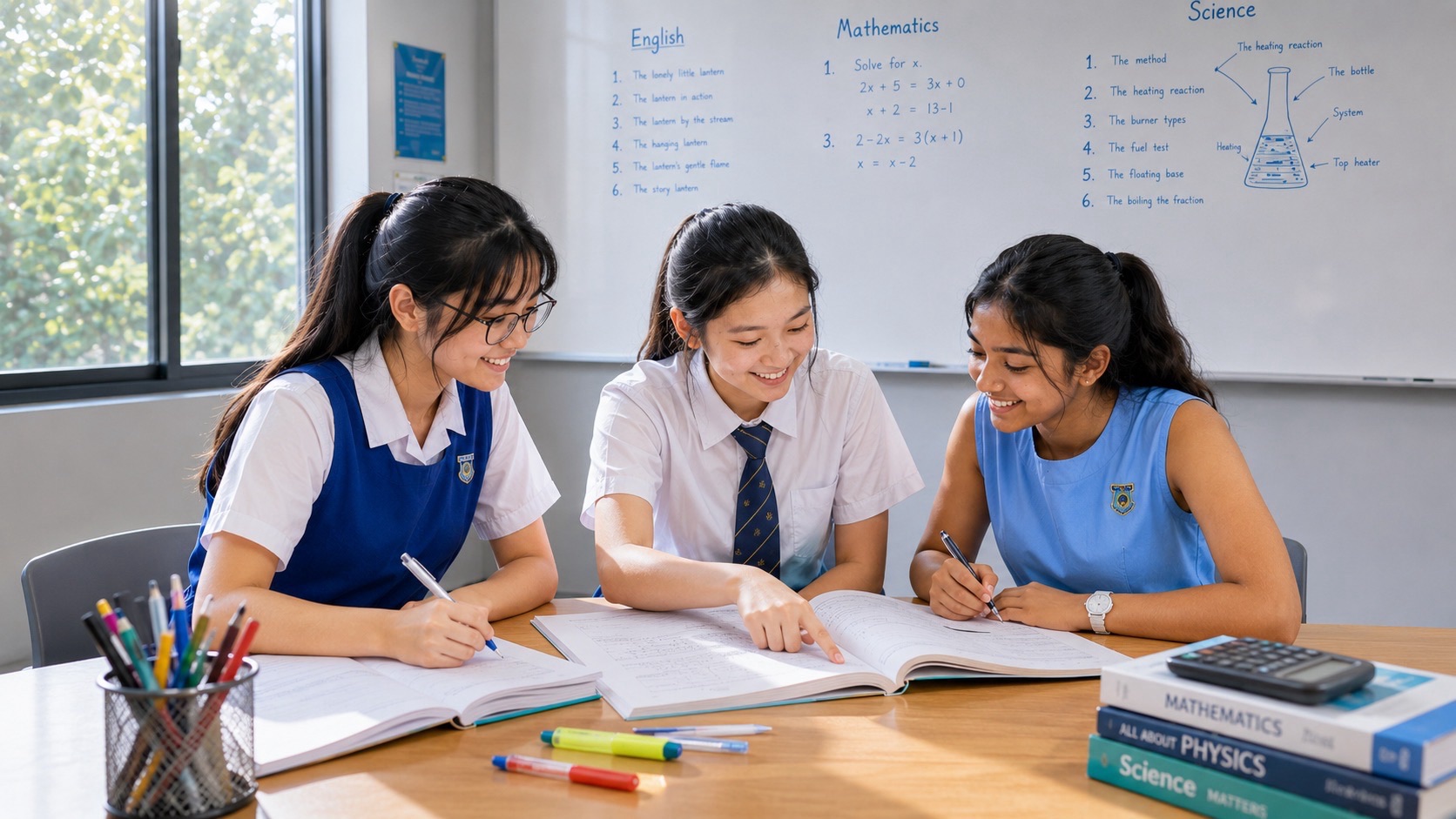
“Why did the teacher say my English answer is irrelevant? I wrote so much.” That question captures a common Secondary 2 frustration. The student may understand the passage and express an interesting idea, yet respond to the wrong part of the task. The missing skill is not always vocabulary or effort. It can be a precise judgement about which information belongs in an answer.
Secondary 2 Bukit Panjang English tuition should strengthen comprehension inference, relevant-point selection, summary writing where the school requires it, paragraph reasoning and grammar editing. After Secondary 1’s transition, the second year is about more dependable reading decisions and clear expression. Students learn to choose the evidence the question needs and leave out material that merely sounds impressive.
For families living around Bukit Panjang Central, Senja, Fajar, Bangkit, Petir and Cashew, this guide explains how a three-student lesson can develop those skills without consuming every family evening. The referenced eduKateSG tutorial model is near Sixth Avenue MRT at 8 Fourth Avenue, not a classroom within Bukit Panjang. A good programme should be chosen for teaching fit, not just because its title mentions the learner’s estate.
The Secondary 2 English Skill Map
- Comprehension inference: form text-grounded interpretations, compare possible meanings and reject unsupported guesses.
- Writer’s effect: explain how significant wording, contrast or narrative structure influences understanding.
- Summary writing: identify what the question requests, select distinct relevant points and paraphrase accurately when formal summary is assessed.
- Vocabulary in context: distinguish shades of meaning, tone and degrees of certainty.
- Paragraph writing: develop a claim with a mechanism and credible example rather than repeat the topic.
- Grammar and editing: reduce repeated sentence-boundary, tense, agreement and pronoun-reference errors.
- Assessment: practise accuracy first, then use controlled timing and targeted error review to build consistency.
Did You Know? Understanding and Answering Are Different Skills
A child may tell a parent the passage’s entire story correctly while still missing marks on three questions. This can happen because school comprehension is not only a test of memory. A response has to identify the exact information requested and express it in a form that reveals reasoning.
We separate four stages. Text access is understanding the words and sentence structures. Interpretation is deciding what an action or word implies. Selection is choosing which clue or idea answers the question. Expression is putting the point into accurate, sufficiently specific English.
If access is weak, we unpack vocabulary and syntax. If interpretation is weak, we compare alternative readings. If selection is weak, we teach question-scope marking. If expression is weak, we practise concise sentence construction. These are not four interchangeable worksheets.
Consider a passage about a student who helps organise an event, then withdraws from the final photograph. One learner can interpret the social discomfort but cannot word it clearly. Another chooses a sentence about the event’s decorations instead of the student’s withdrawal. The same marks may hide two different teaching needs.
The purpose of diagnosis is to identify the failed operation rather than reduce a child to the label “weak in English”. A strong tutor can explain why a particular task is appearing in the lesson today.
Inference: The Text Decides Which Interpretation Is Defensible
Imagine this original passage: “Shanice read the invitation twice, placed it on her desk and returned to it after dinner. By bedtime she had still not replied.” The actions may suggest uncertainty about whether to accept. They do not establish that she dislikes the sender, fears the event or is trying to offend anyone.
A weak answer might state, “She read the invitation again.” This reports a clue without explaining meaning. Another weak answer might invent a quarrel with the organisers. Neither provides a defensible response to a question asking what her actions suggest.
We teach claim → clue → connection. The student states a cautious inference, identifies the relevant action and explains how the clue supports the reading. The answer may be short, but its meaning should be complete.
We sometimes provide a later sentence that changes the context. Suppose the reader learns that Shanice is waiting to check her family’s plans. The original hesitation now has a clearer explanation. Students see how a good interpretation should respond to additional evidence rather than become rigid.
This is useful preparation for more advanced critical reading. Learners become comfortable revising a conclusion when the text warrants it—a habit of intellectual accuracy.
Three Common Inference Mistakes
- Copying a clue: writing what the character did without explaining what the action indicates.
- Inventing a motive: adding reasons or relationships not established by the passage.
- Over-answering: listing several contradictory or vague emotions because the student hopes one will be correct.
In the tutorial, children compare three possible answers and justify the most relevant one. They learn to recognise when one precise, supported inference is better than multiple unsupported guesses.
A final unfamiliar question tests transfer. Knowing which model answer the teacher prefers is less important than being able to choose and explain evidence independently on a new passage.
Writer’s Effect: Meaning Comes From the Particular Words
Secondary 2 learners increasingly benefit from analysing why an author selected a particular image, sequence or contrast. A technique name such as “personification” is useful only if it helps explain meaning.
Original passage: “The shutters closed one after another. Soon the street seemed to breathe more slowly, as if the day’s noise had finally exhausted it.” The personification contributes to a sense of winding down and quiet. An answer that says simply “The writer uses personification to make the passage interesting” gives very little interpretation.
A stronger answer explains how the street is presented as a living thing becoming tired, reinforcing the atmosphere of the day ending. The exact words support that effect.
Another example: “The notice described the delay as brief. Residents began counting missed appointments rather than minutes.” The contrast makes the word “brief” seem inadequate in light of real consequences. A strong answer explains the mismatch, not just the existence of contrast.
We teach language choice → implication → effect. Students highlight significant words, infer what they suggest and explain how the reader’s understanding changes. Practising with short texts makes the operation clear before longer passages introduce distractions.
The same skill supports composition. A student who understands the effect of wording can begin choosing descriptions and sentence rhythms more deliberately.
Summary Writing: Choose the Points Before You Shorten Them
Where formal summary is part of a Secondary 2 learner’s school programme, the first step is deciding what belongs. A passage may discuss the causes of a problem, the actions taken, the effects of those actions and a personal story. If the question requests actions, the personal story may not be relevant.
Consider an original passage about a community reading activity in a fictional Bukit Panjang setting. Volunteers create small age-based groups, provide large-print materials for some visitors, make signs clearer and offer short storytelling sessions. If the question asks how organisers helped readers participate, these practical adaptations are relevant. A detailed history of the event may not be.
Our method is scope → candidate points → remove repetition → paraphrase → verify. The student identifies what the task asks before replacing words or drafting full sentences. Otherwise they may waste time compressing material that the answer should exclude.
A concise summary must still preserve meaning. Saying merely “The volunteers helped people” is too vague when the question requires concrete methods. Equally, copying every example may produce unnecessary length and repetition.
Formal tasks and word limits can vary by school and subject level. The tutor should match current schoolwork, while the broader skill of accurate information selection remains valuable everywhere.
Worked Summary: More Accurate, Not Just Shorter
Original: “After heavy rain made an outdoor programme unsafe, the organisers moved activities into a covered hall, placed direction signs at the old entrance and informed registered families.”
Too vague: “They changed the programme because of rain.”
More useful: “Organisers shifted activities indoors, updated directions and informed families when rain made the outdoor site unsafe.”
The revised answer retains meaningful actions. But if the question asks only how participants were informed, the response should mention the communication rather than all the measures. One passage can support different summaries under different question scopes.
We use that contrast in a lesson: students answer two summary questions from the same source and explain why their selected points differ. The activity teaches relevance, not rote substitution.
Paraphrasing Without Changing What the Writer Said
Some students paraphrase by replacing every noun and verb with a synonym. The result may sound awkward and subtly distort the source. “May improve” is not “guarantees improvement”; “some learners” is not “all learners”. A small word can change the strength of an entire claim.
We teach meaning reconstruction. First, explain the original sentence in ordinary language. Then look away and write a concise version. Finally, compare the versions for cause, degree, condition, time and certainty.
For example: “Providing regular reading opportunities may help reluctant readers become more familiar with different genres.” An inaccurate paraphrase is “Regular reading makes every reluctant child enjoy all genres.” The revised sentence asserts a much stronger and unsupported outcome.
We ask students to pay attention to words like may, can, unless, although and only. These small elements often carry the sentence’s logic. They deserve as much care as the prominent vocabulary.
The skill supports more than formal summaries. It teaches responsible reading and careful representation of another person’s ideas.
Vocabulary in Context: The Neighbouring Words Matter
A word such as “reserved” can refer to a seat, an item kept aside or a quiet personality. Students need to inspect the grammatical role and the surrounding text, not simply recite the first dictionary definition they remember.
We use three checks: part of speech, local clues and substitution. Does the new word preserve the meaning and tone? Is the replacement too strong? Does it fit naturally in the sentence?
Compare “cautious”, “reluctant”, “hostile” and “fearful”. These describe different attitudes and degrees. A learner who selects carefully in comprehension is also better equipped to write accurate arguments and compositions.
Short retrieval tasks after a delay help vocabulary remain available. A word that appears correctly in a new passage and original sentence has become more useful than one the student can recognise only in the first worksheet.
We also practise collocations such as “raise a concern”, “meet a requirement” and “draw a conclusion”. Clear English is partly knowing how words naturally work together.
Discursive Paragraphs: What Does the Point Actually Explain?
A student might write, “Community events are very beneficial because they are useful and important.” The claim is enthusiastic, but the reader does not know how the benefit is produced. The missing element is mechanism: the explanation of how or why.
A stronger paragraph could say: “Participating in a community project can give students an opportunity to practise responsibility outside normal classroom routines. When a group must allocate tasks, communicate changes and finish within a limited time, members learn to consider how their decisions affect other people.” Now the relationship is visible.
We teach claim, mechanism, example and implication. The claim states a specific point, the mechanism explains it, the example illustrates it and the implication connects it to the prompt. This is a thinking scaffold, not a requirement to label those parts in the finished essay.
In a three-student class, each learner writes on the same general theme but chooses different examples. The tutor asks which example genuinely supports its corresponding claim. A colourful anecdote is not automatically evidence for a point.
Students then repeat the reasoning process with a new topic. The transfer, not the model paragraph, demonstrates understanding.
Developing a Fair Counterargument
Suppose a student argues that school clubs should be compulsory. A fair concern is that students have different family responsibilities, accessibility needs and schedules. A serious response might propose flexible activities or differentiated expectations rather than dismiss every objection.
We ask students to state the other side in a way its supporters would recognise. “They just dislike learning” is not a meaningful counterargument. Intellectual fairness strengthens writing and prepares students for later oral discussion and Secondary 3 argumentative essays.
At Secondary 2, one well-developed argument paragraph and a sensible counterpoint may be a better learning unit than a premature complete final-year essay.
Editing: Stop Making the Same Mistake in Different Sentences
Repeated grammar errors often receive the label “careless”. That label is not a teaching strategy. We ask which pattern is actually recurring: subject–verb agreement, tense shifts, comma splices, dependent clauses, vague pronouns or word forms.
Consider: “One of the students were absent.” The subject head is “one”, so standard agreement calls for “was absent”. A student who chooses based on the nearby plural noun needs to locate the grammatical subject more carefully.
Another example: “The instructions were confusing, the group asked for clarification.” A comma alone joins two independent clauses incorrectly. “Because the instructions were confusing, the group asked for clarification” repairs the sentence and explains the causal relationship.
The learner does not simply copy the correction. They explain the rule, generate fresh examples and revisit the pattern in later writing. A good error log shows whether the student can now self-correct without a tutor circling the sentence.
The practical benefit is an efficient assessment check. Instead of reading every line anxiously, students know which two or three patterns deserve particular attention.
Sample Ninety-Minute Three-Student Tutorial
- Minutes 0–10: retrieve a vocabulary distinction and one personal grammar rule.
- Minutes 10–25: classify a recent schoolwork error into text access, reasoning, selection or expression.
- Minutes 25–45: model an inference answer, summary filter or paragraph structure.
- Minutes 45–65: students practise independently, discuss alternative evidence choices and receive individual feedback.
- Minutes 65–80: complete an unfamiliar transfer task with an appropriate time boundary.
- Minutes 80–90: update the error log and assign one manageable continuation task.
The sample changes with school assessments and the group’s needs. One learner may require more comprehension work; another may need stronger writing structure. Three-pax tuition only adds value when each learner’s thinking remains visible.
The class-size teaching principles follow eduKateSG’s immutable reference article, while the methods described here address English rather than Mathematics.
Six Weeks to Strengthen Secondary 2 English
Week 1: Name the Main Bottlenecks
Bring a marked comprehension paper and extended writing sample. Identify the recurring weakness in access, inference, selection, expression, grammar or time. Choose two targets and record a short independent baseline.
Week 2: Practise Evidence-Based Inference
Use short unseen passages with multiple plausible meanings. Students explain the strongest clue, reject unsupported guesses and answer a fresh passage without hints.
Week 3: Select and Compress Accurate Points
Work with summary-style questions that request different categories. Choose relevant material, combine repeats and paraphrase without changing logical force. A new question about the same text shows why scope matters.
Week 4: Develop a Meaningful Paragraph
Write a specific claim, explain how it works, provide a credible example and recognise one fair counterpoint. Compare with a weak paragraph that repeats its opinion.
Week 5: Add Realistic Time Control
Combine a short reading task, a paragraph and a targeted editing check. Introduce timing only after the basic method is accurate. Identify whether errors emerge from weak knowledge or rushed execution.
Week 6: Test What Transfers
Use unfamiliar tasks and compare with Week 1. Are inferences now supported? Are summary points more relevant? Does writing develop instead of repeat? Are recurring grammar mistakes less frequent? Set the next cycle from these observations.
Secondary 2 and the Upper-Secondary Pathway
Secondary 2 is also a time when school guidance about later subjects becomes important. The student’s actual school arrangements, interests and achievement determine subject options. English tuition cannot guarantee a particular subject placement.
However, careful language supports other learning. A Science explanation relies on accurate causal relationships, Humanities questions need evidence-based interpretation and Mathematics problems sometimes hinge on words such as “at least” or “remaining”. These skills are not substitutes for subject knowledge, but they reduce avoidable misunderstanding.
A good English tutor should be precise about the contribution. Stronger reading and explanation can help a learner communicate across school, while a missing Science concept still needs Science teaching.
The Bukit Panjang education and tuition guide provides wider context. This article stays focused on the English methods the student can carry into Secondary 3.
A Sustainable Home Routine for Bukit Panjang Families
A family using the Bukit Panjang LRT, Downtown Line or local buses already needs to manage time carefully. An effective English habit can begin with three short tasks a week: one inference explanation, one personal grammar review and one summary or paragraph exercise appropriate to current school work.
Parents can ask “Which clue supports that?” in comprehension, “What did the question exclude?” in summary and “How does your example prove the point?” in writing. These are productive questions because they keep the reasoning with the child.
Reading for enjoyment should continue. Fiction, informative articles and books chosen for interest can develop vocabulary and perspectives without every page becoming a graded activity.
A personal error log with brief dates and outcomes can show change. “Included irrelevant details in summary” is fixable. “Bad at English” is not. Diagnosis should make the next task clear rather than make the child anxious.
G1, G2 and G3 English: Calibrate Difficulty
Students may take English at G1, G2 or G3 under Full Subject-Based Banding, according to school arrangements. The core reasoning methods apply across levels, but texts, writing requirements, scaffolding and assessments should suit the actual learner.
From 2027, the Singapore-Cambridge Secondary Education Certificate continues the corresponding examination standards at the respective levels. Families can consult MOE’s official SEC explanation and SEAB’s SEC information for the national system.
Secondary 2 tuition should first build competence in the student’s current school programme. Later examination material can provide context, but excessive full-paper drilling may miss the prerequisite that actually needs repair.
From Bukit Panjang to the Tuition Location
The referenced eduKateSG teaching site is 8 Fourth Avenue, Singapore 268674, near Sixth Avenue MRT, not a classroom in Bukit Panjang. The Downtown Line connects Bukit Panjang and Cashew stations with Sixth Avenue. Families living nearer Senja, Fajar, Bangkit or Petir may need a feeder journey before reaching the line.
The complete weekly time includes class, travel, meals, CCA and independent schoolwork. A ninety-minute tutorial is useful only if the learner can arrive with enough attention and still have space for the rest of life.
For programme details, read Secondary 2 English Tuition | Bukit Panjang, Tuition in Bukit Panjang and the English Learning Hub. Parents can begin with a parent–student consultation based on marked work and current class arrangements.
Frequently Asked Questions: Secondary 2 Bukit Panjang English Tuition
Why does my child read correctly but answer vaguely?
Understanding words is only one step. Selection of relevant evidence and clear written explanation can be separate weaknesses. A diagnostic should identify the stage that fails.
Does every Secondary 2 English student need summary writing practice?
Assessment formats differ across schools and G-levels. Formal summary exercises should match current requirements, while the skill of selecting and compressing relevant meaning remains useful.
Why might a long comprehension answer be weaker?
It may contain repeated or irrelevant points, or unsupported guesses. A concise supported interpretation often communicates more precisely than a long speculative response.
Can vocabulary learning help with inference?
Yes. Understanding word connotation and degree can make the student more sensitive to a narrator’s attitude or character’s feelings, provided the response remains grounded in the text.
How are repeated grammar mistakes repaired?
By identifying the pattern, explaining the rule, practising it on new sentences and testing it after a delay. Copying a correction once is not enough.
Does an argumentative paragraph have to contain many examples?
Not necessarily. One carefully selected example that supports a clear mechanism can be stronger than several decorative anecdotes.
Is small-group tuition appropriate for quieter children?
It can be if the tutor provides preparation time and individual feedback. Three students should mean everyone works and explains, not that one confident learner supplies all the answers.
Should a Secondary 2 child begin full Secondary 4 English papers?
Only selectively as an orientation tool. Current-year skill mastery is usually a better priority than prematurely completing many final-year papers.
Is the teaching venue in Bukit Panjang?
The referenced programme teaches near Sixth Avenue MRT at Fourth Avenue. Families from Bukit Panjang travel to that location rather than a branch inside the town.
Continue the Bukit Panjang English Learning Timeline
The Secondary 1 Bukit Panjang English article introduced evidence-based reading, coherent narrative and grammar foundations. Secondary 2 strengthens inference, summary and paragraph reasoning. Secondary 3 develops situational writing, argument and writer’s effects, while Secondary 4 consolidates the skills under the correct examination conditions.
An effective second year ends with a learner who can say what a question needs, choose the relevant information and explain it. That is a more valuable achievement than merely finishing more English worksheets.