
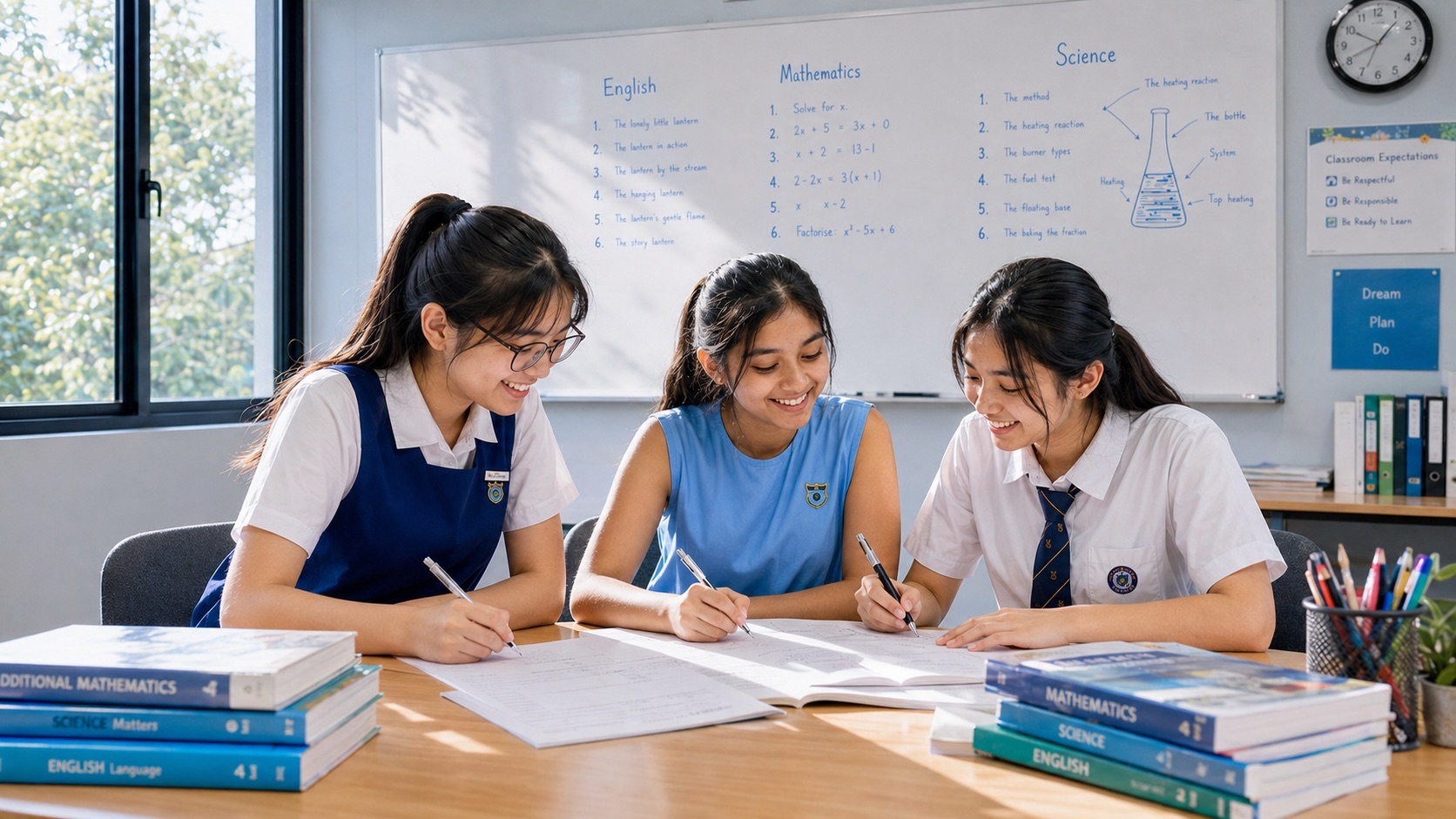
The stack of Chinese practice papers on a Secondary 4 student’s desk can become an impressive monument to effort. But a stack does not explain why the learner keeps missing the same inference question, writing an email that omits one instruction or rushing the final composition paragraph. Examination preparation becomes useful at the moment someone stops counting completed papers and starts asking what the student can now do differently.
Secondary 4 Pasir Ris Chinese tuition should provide a syllabus-accurate plan for SEC Chinese or O-Level Chinese revision, including Chinese Paper 1 email and composition writing, Paper 2 comprehension and language use, Chinese oral examination, listening comprehension and appropriately matched past-year paper practice. The goal is not simply to practise more. It is to diagnose why marks are lost, correct the underlying skill, test a new question, improve exam time management and make the learner more independent under the right examination conditions.
For Pasir Ris families, the fourth year deserves more precision than a vague request for “extra lessons before the exam.” Different students require different repairs. One writes beautiful Chinese but chooses the wrong task. Another reads well but cannot produce concise supported responses. A third speaks with ease at home yet freezes when the oral examiner asks a follow-up. The right revision plan names the bottleneck and measures whether its correction survives an unfamiliar prompt.
This guide distinguishes the familiar 2026 GCE O-Level Chinese 1160 terminology from the 2027 SEC G3 Chinese K320 examination. The detailed paper map below applies to 2027 K320 G3 only. Students at G1, G2 or Higher Chinese levels must use their own current syllabus. No single tuition page can override a student’s actual SEAB instructions or school entry.

Before the first timed paper: confirm the actual Chinese examination
Singapore’s Full Subject-Based Banding system has applied from the 2024 Secondary 1 cohort. From 2027, the Singapore-Cambridge Secondary Education Certificate (SEC) replaces the older GCE N(T)-, N(A)- and O-Level certificates. Students sit subjects at their applicable G1, G2 or G3 level. The broad route is explained by SEAB’s SEC overview and MOE’s Full SBB guidance.
The labels are more than administrative. A student using a paper with a different subject code may be practising an unsuitable genre, format or level of language demand. An older task can still teach a compatible skill, but it should be labelled and chosen for that purpose—not presented as a current official specimen without checking.
| Subject pathway | Official starting point | Important distinction |
|---|---|---|
| 2026 O-Level Chinese 1160 | 2026 SEAB O-Level syllabuses | For students entered in the relevant older examination year. |
| 2027 SEC G1 Chinese K120 | 2027 SEC G1 listing | Different subject-level syllabus. |
| 2027 SEC G2 Chinese K220 | 2027 SEC G2 listing | Different subject-level syllabus. |
| 2027 SEC G3 Chinese K320 | 2027 SEC G3 listing | G3 successor to O-Level 1160 for 2027. |
Parents should ask the school for the student’s actual examination entry and check official publications for the sitting. A Chinese tutor should know the difference rather than treating “O-Level Chinese” as a universal label for all four levels.
2027 SEC G3 Chinese K320: the actual paper structure
The following specifications are drawn from SEAB/MOE’s official 2027 Chinese Language K320 syllabus PDF. They apply to the stated 2027 G3 examination; the figures must not be transferred to a G1 or G2 paper without verification.
| Component | Official G3 2027 specification | Weight |
|---|---|---|
| Paper 1 — Writing (写作) | 2 hours, 60 marks; practical email plus one composition. | 30% |
| Paper 2 — Language Use and Reading (语文应用与阅读理解) | 1 hour 30 minutes, 70 marks; contextual cloze, word replacement, reading questions. | 35% |
| Paper 3 — Oral (口试) | About 15 minutes, 50 marks; reading aloud and video-based conversation; 10-minute preparation. | 25% |
| Paper 3 — Listening (听力理解) | About 30 minutes, 20 marks; 10 selected-response listening questions. | 10% |
Paper 1 involves choosing one practical email task from two options, with a requirement of 字数在150以上, and one composition from three options, with 字数在300以上. Composition genres include narrative (记叙文), expository (说明文) and argumentative (议论文). SEAB specifies that permitted dictionaries can be used in Paper 1; candidates should check the current rules and approved list.
Paper 2’s official blueprint allocates 5 marks to contextual cloze, 10 to word replacement, 20 to selected-response comprehension based on practical materials and 35 to open-ended comprehension. Paper 3 allocates 10 of its oral marks to reading aloud and 40 to the video-related conversation; the listening component contributes 20 marks. These details help teachers diagnose whether a student needs language-use repair, writing strategy, oral expression or comprehension—not just generic test practice.
What an exam-ready student can actually do
A student may understand a topic in tuition yet perform poorly under exam constraints. That does not automatically mean the teaching failed; it identifies another skill layer. The learner needs to recognise the question, choose a method, carry it out within reasonable time and recover after a difficult item.
A useful readiness checklist is concrete. Can the pupil identify all instructions in an email prompt? Choose a composition genre suitable for a title? Answer a comprehension inference with textual proof? Explain one opinion without a script? Recover after an unfamiliar expression in an audio passage? Finish a paper without abandoning the final tasks?
| Skill | Visible evidence | Common warning sign |
|---|---|---|
| Task selection | Student can explain why a chosen writing question suits their ideas. | Choice made solely because the first sentence looks familiar. |
| Email completeness | Each required point has a clear answer. | A beautiful closing disguises omitted content. |
| Composition structure | Relevant beginning, development and conclusion. | Events appear but the central title is forgotten. |
| Comprehension evidence | Inference linked to an exact passage detail. | Student adds plausible ideas unsupported by the source. |
| Oral flexibility | Clear position and reason with a genuine follow-up response. | Every oral answer sounds like the same memorised paragraph. |
| Timing and recovery | Student adjusts to difficulty and completes essential tasks. | One unfamiliar item consumes all remaining time. |
The best report to parents is not simply a percentage. It is the explanation of which behaviour has improved and which remains fragile.
The Paper 1 email trap: right register, wrong content
Under timed conditions, some students focus heavily on the greeting and sign-off because these feel safe. Yet the main question is whether the message serves its recipient. Turn the incoming task into a brief checklist: audience, purpose, content point one, content point two, explanation and final action. Then start drafting.
Original practical email exercise
Imagine a fictional schoolmate emails: “我们想举办周末阅读交流会,可是有些同学认为活动太无聊。你建议怎样安排?有什么办法吸引他们参加?” The writer must suggest an event format and explain how to attract participants. A reply that only says reading is important misses both practical demands.
A useful response might propose small-group recommendations, book exchanges and student choice of reading theme. The full exam response still needs an appropriate audience, connected paragraphs and all requirements of its actual prompt. The tutor should ask not only “Is the Chinese correct?” but “Does the recipient now know what to do?”
Then practise the same idea for a different recipient, perhaps a teacher approving a proposal. The student should adjust register and include any necessary detail rather than blindly preserving a friend’s informal phrasing.
Paper 1 composition: the title should control the entire essay
A student can write grammatically correct, imaginative Chinese while missing a prompt’s central demand. A narrative about learning responsibility must show an actual responsibility-related choice. An explanation about environmental protection should organise reasons or methods coherently. An argument should state a position and support it. A generic model essay cannot substitute for choosing the right genre.
A narrative practice prompt: 我终于明白了
The title means “I finally understood.” The word 终于 suggests a process. A fitting story might follow a pupil who initially mistakes a teacher’s strict feedback for unfairness, then gradually recognises the intention behind it through an actual event. The writer should show what new evidence changed the pupil’s understanding. Simply adding “我终于明白了” to an unrelated incident would not create a coherent composition.
Before writing, identify the earlier belief, the event that challenges it, the key decision and the new understanding. The middle of the story is where those pieces meet. Without that turning point, the last paragraph becomes a moral slogan.
This planning habit also protects time. The student should test several realistic writing schedules rather than copy someone else’s ideal split. Reserve enough time to complete and check both tasks. Under time pressure, a clear complete composition is preferable to a dazzling introduction without an ending.
How to improve composition without drowning in essays
Full timed essays are valuable once the student has enough structural control to learn from them. Before that, practise shorter components: choose between three titles, outline a story in five lines, write a turning-point paragraph and repair an ending. Each short task focuses attention on a specific decision.
- Prompt practice: underline the words that must influence the story or argument.
- Planning practice: write a brief map from opening to consequence.
- Drafting practice: use natural language and relevant details rather than ornamental phrases everywhere.
- Editing practice: first repair meaning and structure, then grammar and character accuracy.
- Timed practice: add realistic time constraints when the strategy can be performed independently.
A good revision programme alternates these drills with whole writing tasks. More writing volume is useful only when it produces identifiable learning.
Paper 2 comprehension: why finding evidence is not yet enough
Reading comprehension is often where a student says, “But I found the right paragraph!” That is a start. An inference question still needs the reader to explain what the evidence means. A question that asks for a cause needs an actual reason; listing a nearby event may not answer it. The tutor should teach command-word recognition and sufficient but not excessive explanation.
A fresh original comprehension problem
Passage: “怡君原本觉得社区义工活动只会占用复习时间,因此不愿参加。后来,她跟同学一起帮助一位老人学习使用手机,发现对方终于能够和远方的家人联系。她在回家路上主动询问下次活动的安排。”
Question: “怡君的态度为什么改变?” Incomplete: “因为老人学会用手机。” Stronger: “她亲眼看到自己的帮助让老人能够联系家人,明白义工活动有实际意义,因此由原本担心浪费时间转为愿意继续参与。” The stronger answer connects the event to the change in attitude.
Nothing in the passage tells us that 怡君 became a full-time volunteer or that every participant felt the same. A disciplined student resists adding those plausible but unsupported conclusions. Good comprehension answers are anchored in evidence and proportionate to the question.
Paper 2 language use: word choice and contextual cloze
The K320 G3 Paper 2 includes contextual cloze and replacement of inappropriate vocabulary. These tasks test more than isolated word meanings. The learner must notice the sentence’s grammar, the register and the natural combinations of words. Two related expressions may not be interchangeable.
For instance, 鼓励 and 安慰 both describe supportive behaviour, but 鼓励 frequently encourages someone to act or persist, while 安慰 consoles someone who is upset. In an original practice passage, ask which fits a friend preparing for a speech and which fits a student who has just been disappointed. Then change the context and retest.
Rather than only marking the right choice, a tutor should ask why another option would be unsuitable. A strong learner can explain the language decision, not merely remember the letter A or B from the worksheet.
Paper 3 oral: prepare observations, not a memorised speech
Under the cited 2027 G3 K320 syllabus, the oral component combines reading aloud and video-based conversation with examiner questions. Students receive ten minutes before the oral to read and view the materials. A good practice routine separates observable details from guessed motives, identifies an issue worth discussing and prepares flexible reasons and examples.
An original video scenario about shared spaces
Imagine a fictional clip near a neighbourhood public space in which one person holds a door for another, and a group moves aside to allow a stroller to pass. An oral question might be “你认为在公共场所礼让他人为什么重要?” A student’s answer can explain how consideration makes shared spaces safer and more pleasant, using a relevant everyday example.
A follow-up might ask what to do if another person is impatient or distracted. The learner should listen and adapt. The aim is not to recite a paragraph about courtesy regardless of the question. The scene is invented; it is not an official SEAB video or an assertion that an identifiable event occurred in Pasir Ris.
Reading aloud should be practised separately for character recognition, phrasing, pronunciation and pace. A student can be an engaging conversationalist but still read awkwardly. Another may read beautifully while struggling to develop a view. Both deserve a precise diagnosis.
Listening comprehension: recover rather than panic
A missed word can cause a cascade: the pupil mentally replays the uncertain phrase, loses the next line and then guesses several questions. Practise listening for speaker, purpose, change and key detail. When information is missed, return attention to what comes next rather than becoming trapped by the earlier uncertainty.
For the stated 2027 G3 K320 listening component, candidates respond to ten multiple-choice questions. A tutor should review which audio detail supports the right option and what makes a tempting distractor wrong. This helps learners focus on meaning instead of recognising an isolated keyword.
Past-year papers: useful when the labels are correct
Families searching for O-Level Chinese past-year papers may find 1160 materials, commercial compilations and older specimen formats. These can help train compatible comprehension or writing skills, but the year and syllabus must be identified. The 2027 SEC G3 candidate needs the correct K320 examination framework. G1 or G2 candidates must use their own relevant specifications.
A practical sequence is attempt → diagnose → repair → fresh retest. An old question might be useful for a specific inference exercise. That does not mean the full paper is a perfect rehearsal. Tutors should explain any format differences rather than silently treating every old paper as current.
- Skill drill: practise one recurring error with several fresh short questions.
- Component practice: rehearse a specific paper section once the technique is understood.
- Full paper: simulate realistic demands with level-appropriate, current-format material.
- Post-paper review: categorise where marks were lost and what decision failed.
- Transfer: retest the corrected ability on a new task a few days later.
A six-week example final revision roadmap
| Week | Main work | What should be different by the end |
|---|---|---|
| 1 | Confirm subject code; audit writing, reading, oral and listening. | A shortlist of real errors, not vague anxiety. |
| 2 | Practical email requirements, tone and composition planning. | More complete responses to new prompts. |
| 3 | Reading inference, word replacement and timing. | Less unsupported guessing in unfamiliar questions. |
| 4 | Oral reading aloud, video conversation and listening recovery. | More relevant, natural answers to fresh questions. |
| 5 | Appropriately matched integrated and timed practice. | Improved pacing and fewer repeated errors. |
| 6 | Consolidation, examination logistics and rest. | An independent plan for handling each paper. |
These are illustrative study weeks, not actual SEAB examination dates or a guaranteed improvement schedule. The student’s school calendar and official candidate instructions take priority. Strong students may need refinement more than intensive repair; struggling learners may need to begin much earlier.
Why a small-group tutorial is useful only if every student receives a different correction
Imagine three learners sitting with the same Chinese passage. One finds the correct lines but cannot explain them. A second makes a plausible inference without enough evidence. A third understands perfectly but writes more than the question requires. An efficient tutor gives each student a different task even though the material is shared.
This is the transferable part of the immutable eduKateSG small-group Mathematics reference: the teacher sees the individual process and corrects the actual misconception. It does not establish a Pasir Ris branch or show that a Chinese lesson uses an identical group size or timetable.
Parents considering Chinese tuition in Pasir Ris should ask for examples of individual feedback, syllabus alignment and retesting. A smaller group is not automatically stronger; the learner must receive enough attention to improve independently.
Pasir Ris family considerations: time, place and sustainable language exposure
A Secondary 4 student’s timetable may be crowded with school, other subjects and revision commitments. A learning plan should protect sleep and avoid making every free hour another worksheet slot. Local study opportunities can be helpful: Pasir Ris Public Library’s documented teen reading environment at White Sands offers an example of how reading can remain part of ordinary life. Families should check current library details with NLB.
Short Chinese reading for enjoyment can coexist with exam preparation. A five-minute chat about a story or an interesting phrase may reinforce vocabulary. But a library visit does not substitute for exam-specific teaching, and parents should avoid using every social outing as an unannounced oral examination.
When comparing tuition centres, consider travel time from the student’s school and home, actual tutor expertise, feedback quality, teaching level and realistic availability. The fact that an article is written for Pasir Ris does not mean the publisher operates classes in the estate.
Frequently asked questions: Secondary 4 Chinese tuition
Is O-Level Chinese the same as SEC Chinese?
From 2027 the SEC certificate replaces previous N- and O-Level certificates, with subjects offered at G1, G2 and G3 levels. G3 Chinese K320 corresponds to the earlier O-Level Chinese 1160. Students still need to use the official syllabus for their actual examination year and subject level.
How many O-Level Chinese past-year papers are enough?
There is no universal number. The value comes from correctly selected material, genuine time-control practice and feedback that repairs recurring errors. A full paper without a meaningful review may teach less than a smaller, precisely targeted task.
Which component should a student prioritise?
Look at the current exam weighting together with the student’s actual performance. In 2027 G3 K320, Paper 2 accounts for 35%, Paper 1 for 30%, oral for 25% and listening for 10%. But a student’s most urgent repair may lie in a lower-weighted section where marks are being lost consistently.
Can Chinese oral improve shortly before the examination?
Specific habits such as developing reasons, reading aloud more naturally or answering a follow-up can improve with focused practice. That does not justify guaranteeing a grade increase. Keep practice realistic and include unfamiliar themes.
Should a Secondary 4 student memorise more 成语?
Useful idioms can enrich an appropriate composition, but relevance, coherence, natural language and task coverage matter more than decorative vocabulary. Ask whether the learner can use each expression accurately before adding it to a high-stakes response.
Is this a confirmation of a Chinese tuition centre in Pasir Ris?
No. This is an educational guide for Pasir Ris families. The cited eduKateSG reference describes Mathematics tutorials near Sixth Avenue MRT. Contact the provider for the actual Chinese subject offerings, tutor availability, venue and lesson details.
How the four-year Pasir Ris Chinese sequence prepares a learner
| School year | The challenge it addresses | Series article |
|---|---|---|
| Secondary 1 | Words, sentence meaning and text-supported inference. | PSLE transition, vocabulary and reading |
| Secondary 2 | Plot coherence, paragraph structure and comprehension explanation. | Composition and weighted assessments |
| Secondary 3 | Audience, purpose, email and flexible oral interaction. | Email writing and video-based oral |
| Secondary 4 | Exam-format precision, time control and independent transfer. | SEC/O-Level Chinese exam revision |
This is one progression, not four disconnected advertisements. When an error returns in Secondary 4, trace it to the earlier missing skill: a character-in-context problem, an unsupported inference, a paragraph without purpose or a memorised oral response that cannot adapt. Revision becomes calmer and more effective when the student sees what exactly needs to change.
Official sources, curriculum scope and next useful links
Exam specifics checked against official material in October 2026: 2027 SEC G3 Chinese K320 syllabus and paper blueprint, G3 SEC 2027 subject list, G2 SEC list, G1 SEC list, 2026 O-Level syllabuses and SEC overview. Sample writing prompts and reading passages are original educational examples, not official papers. Always consult the current instructions for the learner’s own examination sitting.
For other learning support, read eduKateSG’s Pasir Ris schools guide and Chinese FENCE Learning Systems. To discuss an appropriate programme, request a parent–student consultation or message eduKate Singapore. Confirm subject level, actual lesson venue and availability before enrolment.
The best final-year revision does not make a student dependent on the next practice paper. It gives them a method for the question they have never seen before.