
The last Maths paper before the examination can be a strange sight. The student has revised every chapter, labelled every formula and completed several past-year papers. Yet one unfamiliar question about a journey, a graph and a budget seems to erase all that confidence. The problem is not necessarily missing knowledge. Often the learner has not yet practised turning a mixed real-world situation into a sequence of mathematical decisions. That is the skill a good final-year revision programme must protect.
Secondary 4 Yishun Mathematics tuition should organise O-Level E-Math past-year paper revision and the appropriate SEC G3 Mathematics exam preparation across Paper 1 and Paper 2, algebra, functions, graphs, geometry, trigonometry, statistics, probability and practical exam time management. A useful tutor begins with the actual examination year and subject code, diagnoses why marks are lost, corrects recurring mistakes and rehearses unfamiliar integrated questions. Here is what a complete revision programme should do—and which decisions matter most for Yishun parents choosing support.
Secondary 4 is the last part of a four-year storyline. Secondary 1 made numbers and algebra connect; Secondary 2 joined equations to graphs; Secondary 3 trained students to select routes through geometry and functions. This year brings everything together under time, accuracy and communication constraints. Simply doing more sums cannot replace the ability to recognise which topics belong in a particular question.
Exam distinction first: the 2026 GCE O-Level Mathematics code is 4052. For the 2027 Singapore–Cambridge Secondary Education Certificate, the equivalent G3 Mathematics subject code is K310. The exact timing and assessment blueprint below are from the 2027 SEC G3 K310 syllabus; G1 K110, G2 K210, Additional Mathematics K341 and earlier examination years must be checked separately.

Before practising: identify the correct examination and code
Singapore implemented Full Subject-Based Banding for the 2024 Secondary 1 cohort, and from 2027 students take the Singapore–Cambridge Secondary Education Certificate in place of the previous N- and O-Level qualifications. Mathematics is examined at the candidate’s subject level: G1 K110, G2 K210 or G3 K310 for the 2027 SEC.
The MOE Full SBB announcement explains the national transition. The SEAB 2026 O-Level list identifies Mathematics 4052, and the 2027 G3 SEC list identifies Mathematics K310. Tutors should label their papers by year, code and level before using them for timed simulations.
| Examination route | Mathematics code | Where to check |
|---|---|---|
| 2026 O-Level Mathematics | 4052 | SEAB 2026 O-Level subjects |
| 2027 SEC G1 Mathematics | K110 | SEAB 2027 G1 syllabuses |
| 2027 SEC G2 Mathematics | K210 | SEAB 2027 G2 syllabuses |
| 2027 SEC G3 Mathematics | K310 | SEAB 2027 G3 syllabuses |
A paper from another year may still provide useful compatible question practice. It is not automatically an identical exam rehearsal. A 2027 K310 candidate should use the current official scheme to rehearse timing and question formats, with older material used transparently for targeted skills.
The verified 2027 SEC G3 Mathematics K310 Paper 1 and Paper 2 structure
The official 2027 SEC G3 Mathematics K310 syllabus sets out two equally weighted written papers. The table is specific to this examination and should not be generalised to G1 or G2.
| 2027 G3 paper | Time | Questions and marks | Weight |
|---|---|---|---|
| Paper 1 | 2 hours 15 minutes | About 26 short-answer questions; all compulsory; 90 marks. | 50% |
| Paper 2 | 2 hours 15 minutes | 9–10 questions of varying length; all compulsory; final question centres on a real-world scenario; 90 marks. | 50% |
An approved calculator may be used in both Paper 1 and Paper 2 for K310. The document also says essential working must be shown; omission can cost marks. Relevant mathematical formulae are provided, but a formula sheet cannot decide which relationship the student needs. Geometrical instruments should be available for both papers.
The specified answer-accuracy convention is generally three significant figures for non-exact numerical answers and one decimal place for angles in degrees, unless the question requires a different accuracy. These details matter during timed revision. A correct calculation can still lose credit when a candidate rounds prematurely or ignores the required unit or instruction.
What Paper 1 is really testing: dependable decisions across short questions
Paper 1’s approximately 26 short questions can look approachable individually. The difficulty is sustaining accuracy across many different topics while shifting between them. A student may go from algebra to coordinates, ratio, geometry and statistics without the luxury of a worksheet heading announcing the method.
A useful revision routine should therefore include mixed sets. The child must recognise the task from its structure: Is this a linear equation, reverse percentage, gradient, probability or geometric condition? After selecting a method, they must carry out the working accurately and check whether the answer is reasonable.
Worked example: reverse percentage, not a routine discount
Suppose an item costs $80 after a 20% discount. The original price is not $80 + 20% of $80, because the discount percentage was taken from the original price, not the reduced price. Let the original price be x. Then 0.8x = 80, giving x = $100.
Check: 20% of $100 is $20, so the discounted price is $80. A child who instead adds $16 to $80 gets $96 and fails the check. This small example shows why memorised “add 20% back” shortcuts are fragile. Percentages describe a base quantity.
The numbers are fictional teaching values, not a retailer price in Yishun. The skill can be transferred to tax, percentage change or simple financial contexts where the base matters.
Paper 2: long questions and a real-world problem require route selection
The official 2027 G3 K310 syllabus makes the last Paper 2 question specifically about applying Mathematics to a real-world scenario. Such a task may integrate several concepts. The student must decide which information is relevant, represent quantities appropriately, make calculations and interpret the result in its context.
This is a reason to build modelling skill before the last few weeks. Simply doing a series of full papers may not teach a learner how to organise a long scenario. Good tuition works through a separate skill: read the purpose, identify the constraints, choose representations and explain the final decision.
An original journey problem, worked fully
Imagine a fictional student walking 4 km in 15 minutes at constant average speed. Converting fifteen minutes to hours gives 15/60 = 0.25 hours. Average speed is distance divided by time, so 4/0.25 = 16 km/h.
A student who writes 4/15 = 0.267 km/h has confused minutes with hours. The main error is not arithmetic; it is unit conversion. Ask for a reasonableness check: four kilometres in a quarter-hour means roughly sixteen kilometres in one hour if that average pace continued. The number now tells a coherent story.
Next, change the question. If the student travels for 30 minutes at the same average speed, the corresponding distance is 16 × 0.5 = 8 km. A pupil who can extend the model has learnt a relationship rather than just one answer. These figures are purely illustrative.
Graphs inside real-world questions: recognise what the axes mean
Imagine a cost model C = 5 + 2n, where C is dollars and n is the number of participants in a fictional activity. The coefficient 2 is the additional cost for each participant; 5 is the fixed amount before adding participants. The graph is a straight line with gradient 2 and vertical intercept 5.
If the budget is $25, solve 5 + 2n = 25 to get n = 10. The point (10, 25) lies on the cost graph. But the context also requires a non-negative whole number of participants. A value such as 10.5 may be mathematically possible on the continuous line but not a feasible count of people.
This shows how a complete solution differs from a calculation. The student interprets mathematical output under real-world constraints. Under examination conditions, such a final statement may be just as important as the arithmetic.
Algebra: the hidden engine of almost every E-Math paper
A student who loses marks on quadratic functions may actually have weak factorisation. One who struggles with geometry may be manipulating fractions incorrectly. A learner who cannot translate words into symbols may freeze before any advanced method is needed. The first step is locating the missing prerequisite, not assigning every possible topic.
A short quadratic worked example
Solve x² − 5x + 6 = 0. Factorise as (x − 2)(x − 3) = 0. Hence x = 2 or x = 3. Check both values in the original expression. On the related graph y = x² − 5x + 6, the two answers are its x-intercepts.
Now change the problem to x² + x − 6 = 0. Factorise (x + 3)(x − 2) = 0, so x = −3 or x = 2. The negative root is legitimate. A pupil who instinctively discards negative values has carried an earlier number-sense misunderstanding into upper-secondary algebra.
A tutor should deliberately connect roots, factors and the x-axis. The student should be able to explain the same idea symbolically and visually, then adapt it when the coefficients change.
Geometry and trigonometry: diagram-first reasoning
Many marks disappear when a student chooses a theorem before checking its conditions. In a right triangle, Pythagoras relates the three side lengths; trigonometric ratios relate sides to a reference angle. In circle geometry, theorems depend on the configuration of chords, tangents and arcs.
Imagine a right triangle with perpendicular sides 5 cm and 12 cm. The hypotenuse is √(5² + 12²) = 13 cm. This is a Pythagoras problem because the right angle and two legs are known. If the question instead supplies an angle and one side, an appropriate trigonometric ratio may be the natural route.
In geometry proofs, have the student state Given → Theorem → Conclusion. A numerical result without justification can be incomplete when the task asks for reasoning. When a diagram looks familiar but the exact condition is absent, a student must resist using the theorem mechanically.
Statistics, probability and the habit of reading information precisely
The official G3 syllabus includes statistical representations, data interpretation and probability. These questions can look less algebraic, but they demand careful reading of labels, scales and definitions. A simple percentage bar chart becomes unreliable when the learner misreads the vertical axis.
For an original probability example, imagine a bag with five red counters and seven blue counters, all otherwise equally likely to be selected. The probability of selecting a red counter in a single draw is 5/12. The probability of blue is 7/12, and the two sum to 1. That sum is a useful reasonableness check.
A tutor should not automatically assume every probability situation has equally likely outcomes. Students need to know when a sample space is uniform and what is being counted. This develops the same habit as graph work: define the representation before using it.
Significant figures and premature rounding
Suppose a question requires three significant figures. Rounding an intermediate value too early can push the final answer outside acceptable accuracy. Where possible, retain more digits in working or use the calculator’s stored precision, then round the final result as instructed.
The 2027 K310 syllabus states the general precision convention and notes situations where answers must be shown to a higher accuracy before rounding. Students should practise reading that instruction rather than treating “three significant figures” as a universal rule regardless of question wording.
Units matter too. An answer of 16 may mean kilometres per hour, square centimetres or dollars depending on the problem. Write and check the unit. It takes little time and helps show the interpretation is correct.
A revision ledger that distinguishes seven kinds of lost marks
| Error category | What you may see | What tuition should actually repair |
|---|---|---|
| Missing concept | Student does not know which relationship applies. | Teach the idea with a small example and an explanation. |
| Broken prerequisite | Advanced step fails because fractions, algebra or signed numbers are weak. | Return briefly to the missing foundation, then resume. |
| Wrong route | Student knows multiple methods but chooses an unsuitable one. | Classify the task and compare possible approaches. |
| Translation | Words, diagrams and variables are not connected. | Label quantities, units, constraints and equations. |
| Execution | Correct method, wrong calculation or copied number. | Use checks, clear working and deliberate accuracy. |
| Calibration | Rounding, units or reasonableness neglected. | Compare answer with context and prescribed precision. |
| Regulation under time | Student spends too long on one question or freezes. | Practise time allocation, stopping decisions and recovery. |
Two candidates with the same total mark may have very different profiles across this table. A student who repeatedly fails to start word problems needs route and translation work. One who understands every question but loses small marks may need working, accuracy and time control. A generic promise of “more practice” conceals the distinction.
A practical timing strategy for 2027 K310
Each of the two G3 K310 papers runs for 135 minutes and carries 90 marks. Dividing 135 by 90 gives an average of 1.5 minutes per mark, but this is only a rough planning reference. Some short items require little time; longer Paper 2 questions and checking need more. A rigid minute-per-mark rule can be as unhelpful as no timing plan at all.
A student should practise recognising when a question is not progressing. Mark it clearly, protect the time needed for other compulsory questions and return when possible. This is not an invitation to abandon difficult work. It is a strategy for preventing one blank start from damaging an entire paper.
Full-paper rehearsals should include brief post-test notes: Where was time lost? Which question could have been started with a diagram or equation? Which simple marks were omitted in the rush? Those observations help the next practice become more targeted.
What should happen in a Secondary 4 Yishun Maths small-group lesson?
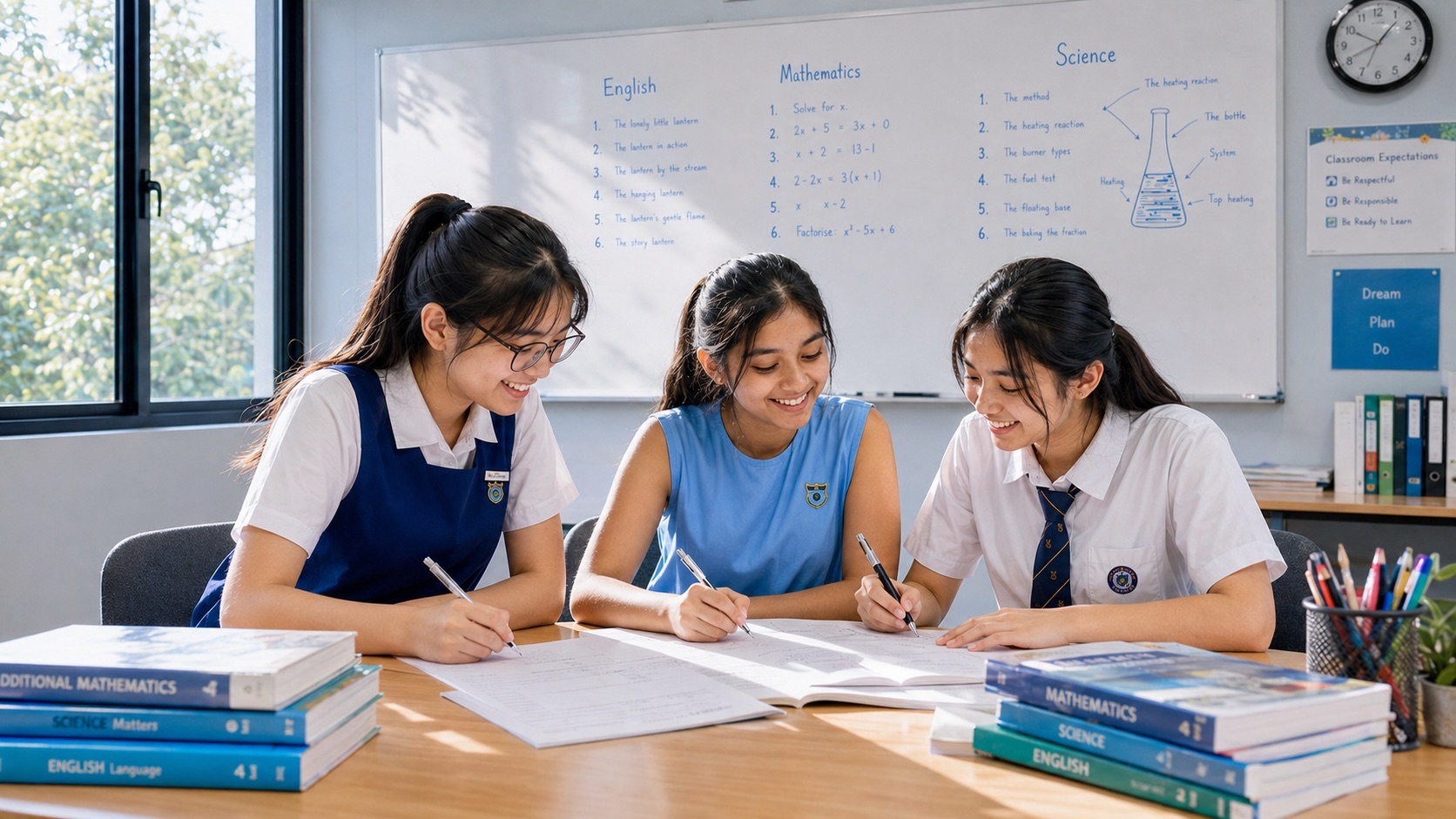
The immutable eduKateSG Clementi Mathematics tutor reference describes a three-student small-group model with close teaching attention near Sixth Avenue MRT. For an imagined Secondary 4 revision session, one student might need to repair algebraic fractions; another, geometric reasons; and the third, the interpretation of a real-world graph.
A good tutor gives each learner an independent task, identifies the first failing step, shows one targeted correction and retests with an unfamiliar variation. Discussion can broaden strategies, but each pupil must be able to execute the chosen route without watching a stronger classmate.
This teaching scenario does not certify a live Yishun class, its price, tutor or timetable. Actual programme availability and physical location must be verified directly; the published reference describes another venue.
An illustrative ten-week exam revision pathway
| Weeks | Priority | Evidence of improvement |
|---|---|---|
| 1–2 | Confirm code and subject level; diagnose each strand. | A ranked error ledger and realistic study plan. |
| 3–4 | Repair algebra, graph reading and familiar recurring errors. | New mixed questions solved with fewer prompts. |
| 5–6 | Geometry, trigonometry, data and probability. | Correct method selection plus units and reasons. |
| 7–8 | Integrated real-world scenarios and Paper 2 planning. | A complete mathematical model with interpreted results. |
| 9 | Timed paper practice aligned with the actual exam. | Stronger pacing and fewer repeated errors. |
| 10 | Consolidation, correction, approved materials and adequate rest. | Student explains a reliable strategy for each paper. |
This is a flexible educational example, not a national timetable or a guarantee of a target grade. Students with significant foundational gaps may need longer. A strong candidate may gain more from precise refinement and calm full-paper rehearsal than from taking on many unfamiliar advanced exercises.
Yishun family logistics: travel, rest and sensible support
Secondary 4 Mathematics revision competes with multiple school subjects and commitments. Before adding tuition, ask whether the commute and lesson time are sustainable. A carefully structured revision session may be more useful than extra hours that leave the learner exhausted.
Yishun Public Library’s NLB factsheet documents a local reading and digital-learning resource in the Northpoint area. Families may explore appropriate mathematics and study resources there, subject to current collection and opening information. Do not assume the library operates any eduKateSG tuition programme.
- Ask what type of question went wrong, not just how many marks were lost.
- Request one fresh retest of a correction a few days later.
- Keep track of actual paper codes rather than assuming older question formats are identical.
- Encourage estimation, units and checking before final submission.
- Preserve sleep and recovery so the pupil can think clearly under timed conditions.
Choosing Secondary 4 Mathematics tuition near Yishun
Look for a tutor who can show a concrete error classification, explain the real assessment format and differentiate G1, G2 and G3 Mathematics. Ask whether timed practice is reviewed for reasoning and method choice, not just marked with a score.
- Does the tutor use the student’s actual 2026 O-Level or 2027 SEC Mathematics syllabus?
- Can the teacher show how an unfamiliar Paper 2 real-world question is broken into steps?
- Are word-problem translation and algebraic prerequisites diagnosed separately?
- Does the programme teach accurate working and checking, including significant figures?
- Is the advertised small-group format genuinely individual in its feedback?
- Have the current venue, schedule, fees, subjects and places been directly confirmed?
A locality-focused Yishun article is not evidence of a physical eduKateSG Yishun Mathematics branch. The unchanged small-group reference concerns an identified programme near Sixth Avenue MRT; families should confirm the actual teaching arrangement before travel or enrolment.
Frequently asked questions about Sec 4 Yishun E-Math tuition
What is the difference between O-Level E-Math and 2027 SEC G3 Mathematics?
The qualification changes to SEC from 2027; 2027 G3 Mathematics uses code K310, while 2026 O-Level Mathematics uses 4052. Use the actual year’s official paper scheme when planning practice. Do not generalise G3 requirements to G1 or G2.
Is the 2027 SEC G3 Mathematics Paper 1 non-calculator?
No. The official K310 syllabus permits an approved calculator in both Paper 1 and Paper 2. Students must still show essential working. Always follow SEAB’s current approved calculator list and examination instructions.
How many O-Level E-Math past-year papers should my child finish?
There is no universally correct number. Start with diagnosis, work on repeated errors, then rehearse relevant timed sections and full papers. Quality of correction and independent transfer matter as much as practice volume.
Does Paper 2 really include a real-world scenario?
Yes. The official 2027 SEC G3 K310 syllabus says the last Paper 2 question specifically focuses on applying Mathematics to a real-world situation. The rest of the paper also assesses mathematical problem-solving and reasoning, but the last question has that particular design emphasis.
Is A-Math preparation included in ordinary E-Math tuition?
The subjects overlap in foundational algebra but have distinct syllabuses. In 2027 G3, Mathematics is K310 and Additional Mathematics is K341. Families should confirm whether a tutor teaches one or both, and which the learner actually studies.
Can a student improve examination timing without mastering every topic first?
Some time-management habits can improve early, but speed alone is fragile without understanding. A sensible approach repairs high-impact knowledge gaps while gradually rehearsing realistic conditions. The student should learn when to stop, check and return to a difficult question.
Complete Yishun Secondary Mathematics timeline
| Year | What is being built | Follow the article |
|---|---|---|
| Secondary 1 | Reliable algebra, signed numbers and equation thinking. | PSLE-to-algebra bridge and first WA |
| Secondary 2 | Graphs and simultaneous constraints across representations. | Linear graphs and simultaneous equations |
| Secondary 3 | Routes through quadratic functions, trigonometry and geometry. | Quadratic graphs and upper-secondary E-Math |
| Secondary 4 | Reliable, independent mathematical decisions across two exam papers. | O-Level E-Math and 2027 SEC revision |
When the four years are treated as a continuous learning journey, a recurring mistake has a history. A failed function question may stem from a missing linear graph connection; a trigonometry error may reveal weak triangle labelling; a long word problem may simply need better representation. The most valuable tuition repairs the link rather than covering it with extra paper.
Official sources and next useful route
Verified reference material: 2027 SEC G3 Mathematics K310 syllabus and assessment scheme, G3 2027 official subject list, G2 2027, G1 2027, 2026 O-Level Mathematics listing and MOE Full Subject-Based Banding announcement. The original worked examples, tutoring routines and imagined real-world situations here are educational guidance, not copied SEAB paper questions.
See eduKateSG’s Yishun schools guide and the immutable small-group Mathematics reference. For a learner-specific discussion, arrange a parent–student consultation or WhatsApp eduKate Singapore. Confirm subject level, current tutor, lesson venue, travel and availability directly.
The strongest exam preparation does not teach a student to recognise the paper they have already seen. It teaches them to begin intelligently when the next paper is unfamiliar.