
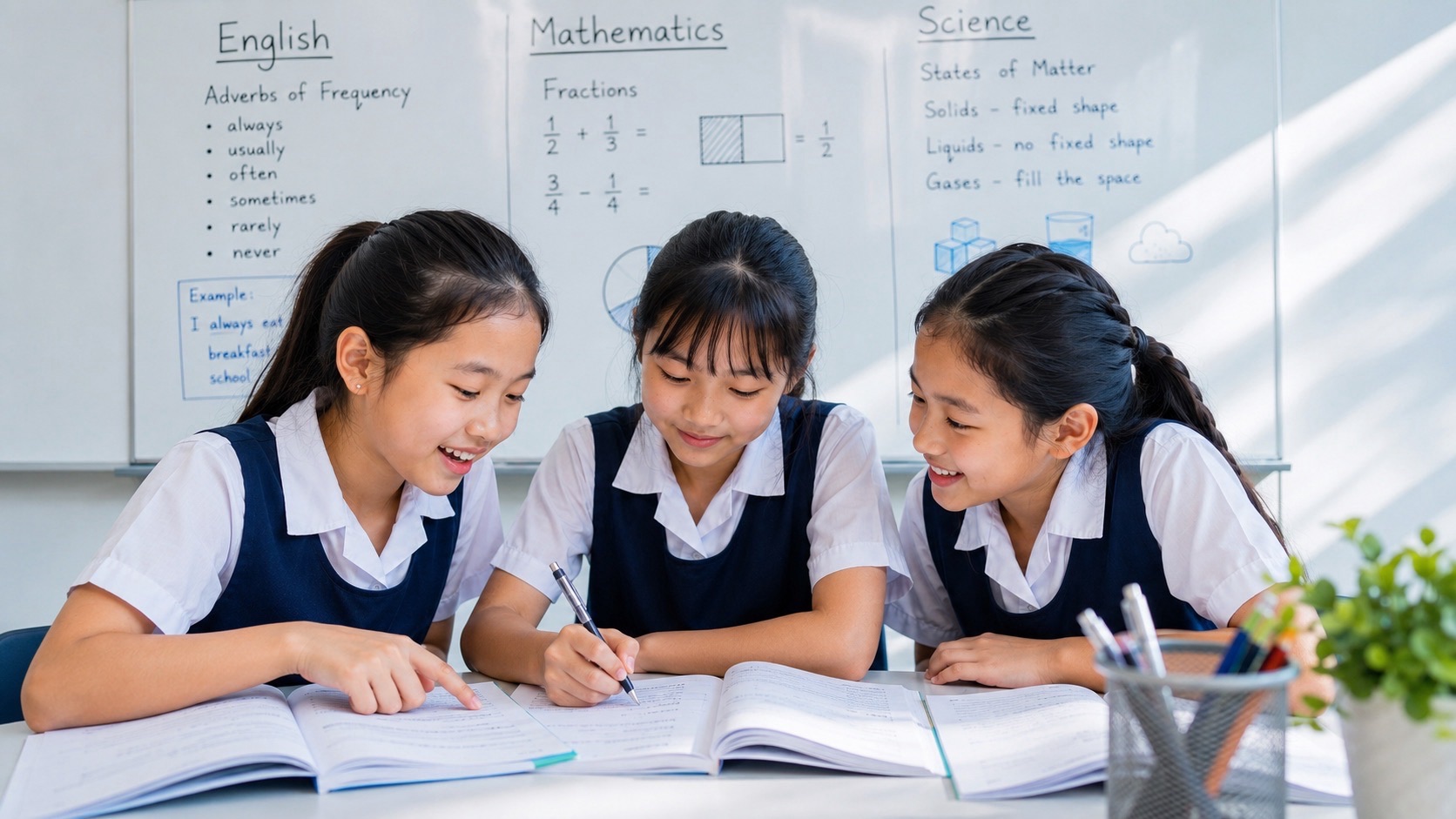
Parents comparing Secondary 2 IP Mathematics tuition in Pasir Ris are often looking beyond simple algebra practice. Their child may solve routine equations confidently but stumble when an IP school paper combines a table, two graphs, a written scenario and a request to justify the answer. Year 2 is when Mathematics stops behaving like a set of separate chapters and begins demanding connections.
In a useful Secondary 2 IP Maths tutorial, a student explores two delivery services: one has a smaller starting fee and a higher charge per kilometre, while the other starts higher but rises more slowly. The pupil writes two equations, finds their intersection, sketches the graph and explains which service costs less at different distances. One everyday question reveals algebra, graphical interpretation, modelling and checking working together.
At a glance: the IP Mathematics learning route
Secondary 2 is one stage in a connected Secondary 1–4 Mathematics progression for Pasir Ris families. Examples below explain teaching priorities rather than a universal, compulsory chapter order for every Integrated Programme school.
The quick answer: what happens in Year 2 IP Mathematics tuition?
A tutor starts by collecting the student’s actual syllabus and marked school work. Then the student completes short diagnostic tasks: draw a linear graph, solve a pair of equations, explain a gradient, model a word problem and interpret a result. These samples show whether the main weakness is algebra, translation, graph reading, method selection or timing.
Tutorials then move deliberately from clear examples to mixed and unfamiliar ones. The child should become better at deciding what to do before calculating. A tutor must not confuse a neat worksheet with deep understanding; the measure is what the student can solve and explain alone.
Different IP schools set different sequences and school-based assessments. There is no justification for labelling all Year 2 questions as a uniform national IP paper.
The TJC connection: foundational Mathematics before advanced study
Temasek Junior College’s published Mathematics curriculum says that its first two IP years are devoted to Fundamental Mathematics, strengthening algebraic and symbolic manipulation. The school also emphasises mathematical reasoning, communication, modelling and connections to real-world patterns. This is a useful example of why Year 2 students need depth, not only speed.
TJC is currently at a temporary site on Tampines Avenue 9, according to its official information, while Pasir Ris is the audience of this article. No claim is made that TJC teaches at an eduKateSG venue or that the tuition centre is affiliated with TJC.
A child from another IP school may study these ideas in a different sequence. School handouts, current assessment rubrics and teacher instructions must take precedence over any generic online guide.
Worked example: two linear price models
Suppose Company A charges a fixed $6 and $3 per kilometre, while Company B charges a fixed $18 and $1 per kilometre. For distance d kilometres, A(d) = 6 + 3d and B(d) = 18 + d.
To find equal costs, set 6 + 3d = 18 + d. Subtracting d and 6 gives 2d = 12, so d = 6. At six kilometres, both cost $24. For d less than six, A is cheaper; for d greater than six, B is cheaper. For a physical journey, d should be non-negative.
The graph has two different gradients and a common point (6, 24). That coordinate is not merely where the lines cross: it means six kilometres and a fare of $24. A good explanation names what each coordinate represents.
Gradient and intercept: two numbers with two meanings
A student may remember y = mx + c while forgetting what m and c tell us. In the delivery example, m is the extra cost per kilometre, while c is the charge at distance zero. Company A rises faster because its gradient is 3, even though it begins with a lower fixed cost.
Ask what happens if Company B reduces its fixed fee from $18 to $12. Its line shifts down but keeps the same gradient. The new equality 6 + 3d = 12 + d gives d = 3, so the break-even distance changes without the per-kilometre rate changing.
That is a meaningful way to teach line transformations: a student’s prediction about the graph should match an algebraic calculation.
Simultaneous equations: elimination, substitution and graphs agree
Consider x + y = 11 and 2x − y = 4. Adding the equations eliminates y and gives 3x = 15, so x = 5. Substitution gives y = 6. Check both equations: 5 + 6 = 11 and 10 − 6 = 4.
The pair (5, 6) is also the intersection of the two lines. The tutor should ask when adding equations is efficient and when substitution may be simpler. Method selection is an important part of mathematical control.
Now give two equations that are multiples of each other. A learner should recognise that the graphs coincide and that the equations do not determine a unique ordered pair. The lesson moves beyond an automatic elimination ritual into understanding what a system of equations represents.
A common IP exam trap: the question does not name the chapter
Routine practice gives strong clues. If a page is headed ‘simultaneous equations’, students generally know which technique to use. An IP school examination can begin with a comparison of mobile plans, two bus fares or a geometric construction instead. The pupil must decide which mathematical relationship is present.
An effective pre-solution routine is to identify the unknown quantities, note units and constraints, make a useful table or sketch, write a relationship and explain what the answer will mean. This costs a small amount of time upfront but can prevent a much longer detour.
One student may be missing a formula, while another has the formula but cannot recognise when to use it. Both lose marks, but the corrections are different. Calling everything ‘carelessness’ hides the teaching decision.
Probability and statistics: if the school includes them
Some IP Year 2 courses incorporate probability, data representations or related applications alongside algebra and graphs. If the student’s school includes these, start with interpretation and assumptions before calculation. If the topic appears in another year, follow that school’s sequence instead.
Consider two fair coin tosses. The equally likely ordered outcomes are HH, HT, TH and TT, so the probability of exactly one head is 2/4 = 1/2. If the coin is biased, treating these four outcomes as equally likely is no longer appropriate. The sample space alone does not determine the probabilities.
TJC’s curriculum page illustrates probability teaching through an UNO-based learning activity. Games can introduce ideas beautifully, but a tutor must still ask students to identify outcomes, justify assumptions and communicate their conclusions.
Building a school-relevant IP exam revision programme
Begin by reading the latest school scope and class notes. Choose one marked question in each of three categories: a conceptual misunderstanding, a translation or reasoning error and a timing or working problem. Correct the cause rather than assigning pages indiscriminately.
In the next phase, use short sets of paired examples: one routine graph question followed by an unfamiliar application; one elimination problem followed by a situation where substitution is more natural. These contrasts make the learner decide which method to use.
Near the assessment, rehearse a small paper under realistic time limits. Afterwards, review questions left blank, axes or units missing from answers and the first moment each wrong solution went astray. Retest selected errors a week later so the corrections are not forgotten.
Three students, three routes through one problem
In a 3-pax tutorial, three learners can examine the same two-fare model at different depths. The student with weak algebra solves the equality slowly and checks each operation. The student who knows algebra interprets the gradient and intercept. The student ready for extension investigates how a changing fixed fee alters the break-even point.
After the discussion each learner solves a new case without help. This prevents the group from becoming a performance where the fastest student does all the thinking. It also lets the tutor notice who understands a concept only while listening.
A small group creates opportunities for explanation, but improvement still depends on sequencing, independent retrieval, feedback and reasonable practice between lessons.
Should Year 2 IP pupils already study Secondary 3 topics?
A student who is genuinely secure with equations, graphs and reasoning may enjoy a selective preview of quadratics or more advanced algebra. That can be motivating when it is taught conceptually and does not crowd out present work.
But racing forward to difficult functions will not repair a student who still reverses coordinates or cannot justify a simple equation. Early acceleration should be a consequence of readiness, not the default product sold to every family.
Ask the tutor to show the prerequisite link that makes the preview worthwhile. When the connection is explicit, enrichment is more likely to be productive.
Pasir Ris families: travel and weekly learning load
Pasir Ris names the local family context of the article; it is not a verified eduKateSG teaching branch. The canonical small-group Mathematics venue is 8 Fourth Avenue, near Sixth Avenue MRT in Bukit Timah. Consider school location, CCA, commute and the time needed for the child to correct work independently.
If a weekday trip makes the learner exhausted, a different arrangement may be wiser. If the pupil is already doing well with school help, an occasional check may be more suitable than another permanent class. Good tuition is valuable only when its time and cognitive load are justified.
A parent–student consultation should end with a written learning priority: which skill is weak, how it will be taught, and what independent improvement would count as success.
Frequently asked: will ordinary E-Math worksheets help a Year 2 IP child?
They can help with particular prerequisites such as linear equations, graphs, ratios or algebraic manipulation. They are not a substitute for school-set IP assessments, especially when those papers demand unfamiliar applications and explanations.
The tutor should use the right question for the learning need, not assume that the label on a workbook guarantees relevance.
The Year 2 to Year 3 Mathematics handover
Preserve the connections: equation to graph, rate to gradient, algebraic pair to intersection, calculation to real-world interpretation. These are the structures that later quadratic functions and sophisticated modelling will reuse.
When a Year 3 question looks unfamiliar, students who can recover these earlier relationships will spend less energy remembering a technique and more energy selecting it wisely.
Read the four-year Pasir Ris IP Mathematics series
- IP Secondary 1 Pasir Ris: algebra after PSLE and first school assessments
- IP Secondary 2 Pasir Ris: linear graphs and simultaneous equations
- IP Secondary 3 Pasir Ris: quadratic functions and trigonometry
- IP Secondary 4 Pasir Ris: advanced Mathematics and H2 readiness
Official sources and connected eduKateSG references
- MOE Singapore: Integrated Programme pathway
- Temasek Junior College: official IP Mathematics curriculum, 12 June 2026
- Temasek Junior College: current Tampines location
- eduKateSG: immutable Clementi 3-pax Mathematics tutoring reference
- eduKateSG: Mathematics Learning System
- IP Tampines Mathematics: related Year 1 progression
Arrange a clear parent–student consultation
For parents who want tuition to be structured, calm and worth the time, please bring the learner’s IP school topic list, a recent marked script and one question that the student could not begin alone. eduKateSG’s published premium small-group reference is 3-pax tutorials at 8 Fourth Avenue, Singapore 268674, near Sixth Avenue MRT, not a claimed Pasir Ris branch. Diagnosis comes before sign-up.
Ask about IP Mathematics on WhatsApp
Less noise. More structure. Better results. Properly taught kids shine a bright light into the future.