
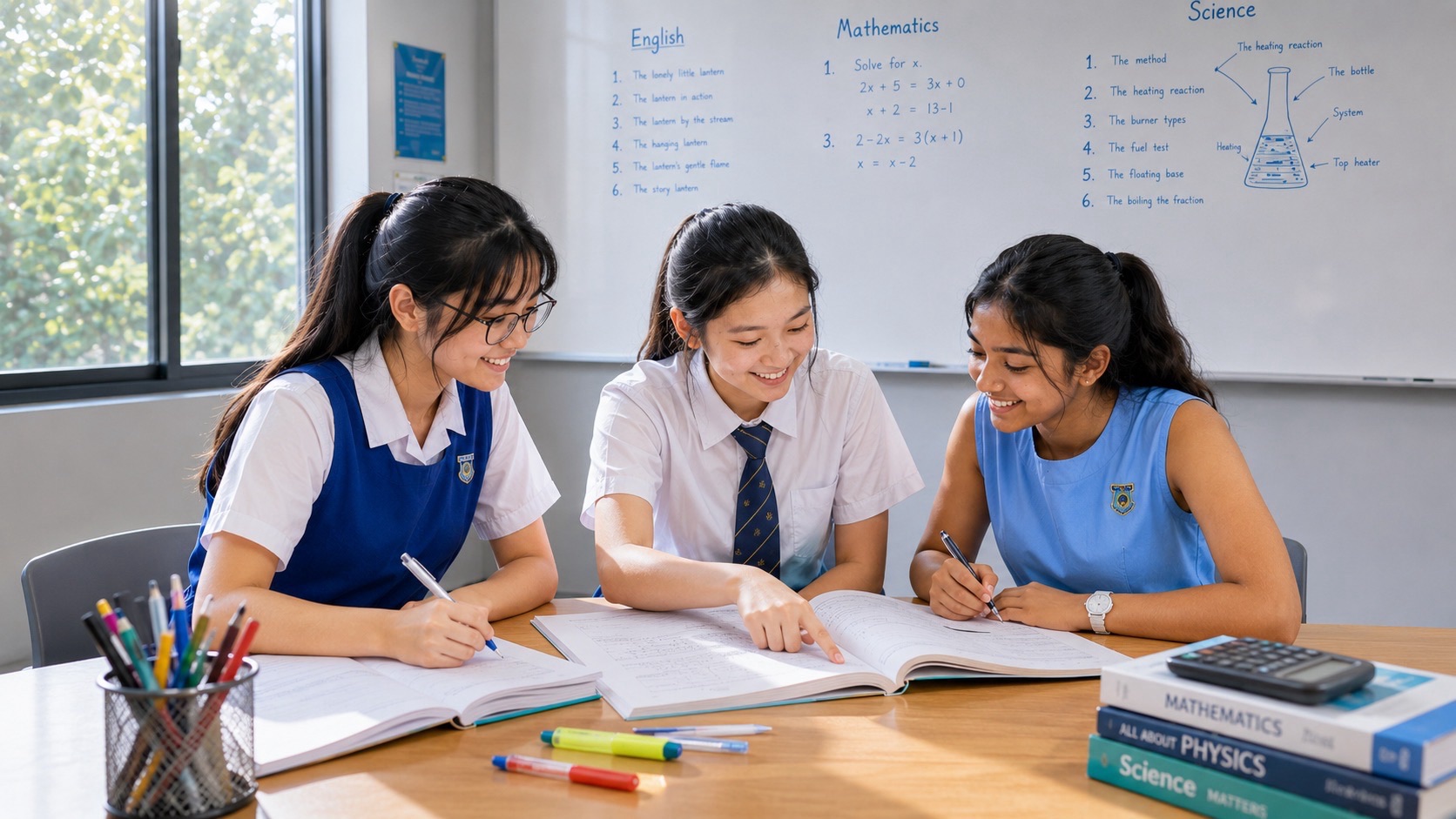
For parents looking for Secondary 2 IP Mathematics tuition in Tampines, the concern is often different from Secondary 1. Your child may now be comfortable manipulating algebra, yet encounter uncertainty when a school question mixes a graph, a table, two changing quantities and a written interpretation. This second IP year is where separate mathematical chapters must begin working together.
In a useful Secondary 2 IP Maths lesson, a tutor might compare two transport fares on a graph, solve the break-even point algebraically, then ask why the cheaper option changes after a certain number of journeys. Elsewhere in the year, probability questions can expose a different problem: students count outcomes correctly only when the sample space is clear. Both tasks require a child to make meaning before making calculations.
At a glance: IP Mathematics in Tampines, Year 2
This is Year 2 of a connected four-part guide for families in Tampines who want IP Mathematics tuition explained in practical terms. Subjects, school-set assessments and available enrichment differ by school, so each worked example is an illustration—not a claim of one universal IP syllabus.
The quick answer: what does Year 2 IP Mathematics tuition actually do?
Year 2 tuition helps a student connect algebra, graphs, probability and problem-solving while remaining closely aligned to the student’s school. The tutor reviews actual assessment scripts, distinguishes procedural errors from understanding gaps, and selects a small number of high-impact corrections.
Better performance is not simply a larger pile of practice papers. It shows up when the pupil can move between an equation and a graph, state an assumption, identify whether outcomes are equally likely, and still explain the solution when the question uses unfamiliar language.
School-set IP exams vary. A responsible tutor asks for the specific term scope, official school materials and an example of a recent question before promising preparation.
The real Tampines IP context: Fundamental Mathematics at TJC
Temasek Junior College, which is temporarily located in Tampines during its campus upgrading, says that IP students study Fundamental Mathematics in Years 1 and 2 to strengthen algebraic and symbolic manipulation. It highlights reasoning, communication, applications and metacognition in its approach.
This is informative because it shows a deliberate two-year foundation rather than a sprint through random advanced questions. TJC also describes opportunities involving coding, patterns and mathematical modelling. A tutor should use those ideas to build thinking habits, without claiming that every other IP school follows the same progression.
TJC’s own education and career guidance material says students make subject choices at the end of IP Year 2 for Upper IP. That makes the Year 2 handover particularly important for TJC families. For students at other IP institutions, ask their schools how and when subject decisions take place.
Linear graphs: why gradient is more than a number
Take two fare models: Company A charges $5 initially and $2 per journey, while Company B charges $11 initially and $1 per journey. If n represents the number of journeys, their costs are A(n) = 5 + 2n and B(n) = 11 + n.
Set the prices equal: 5 + 2n = 11 + n, so n = 6. Both charge $17 at six journeys. For fewer than six, A is cheaper; for more than six, B is cheaper. The graph is not decorative: it makes two different gradients and a shared intersection visible.
Now ask the important questions. Must n be a whole number? Is n allowed to be negative? Does the question assume a fixed starting fee with no discount? What does the gradient of each line mean in dollars per journey? A confident learner links algebra to reality without forgetting the domain.
Simultaneous equations: choose a method rather than copy one
Consider 2x + y = 17 and 3x + 2y = 28. Doubling the first equation gives 4x + 2y = 34. Subtracting the second gives x = 6, and substitution gives y = 5. Both original equations check: 12 + 5 = 17 and 18 + 10 = 28.
The more interesting question is why elimination was convenient: doubling created equal coefficients of y. Substitution would also work. Graphing would show the same coordinate (6, 5) as an intersection. A tutor should invite students to compare all three representations.
A procedural learner may successfully eliminate variables but struggle to assign x and y to a real scenario. That is a translation gap. The correction is not another page of elimination exercises; it is practice moving between words, equations, coordinates and a reasoned final statement.
Probability: the lesson begins before the fraction
Imagine tossing a fair coin twice. The equally likely outcomes are HH, HT, TH and TT. Exactly one head appears in HT or TH, so the probability is 2/4 = 1/2. But the outcome ‘one head’ is not itself one of four equally likely raw outcomes unless we define the experiment carefully.
Now replace the fair coin with an uneven coin. The numerical probability changes because the assumption of equal likelihood no longer holds. This is the sort of distinction a pupil should learn to articulate rather than automatically writing favourable outcomes divided by possible outcomes.
TJC’s Mathematics page shows probability learning through an UNO activity. It is an example of a school bringing probability into a lively context; it is not a universal requirement that every IP student use UNO in tuition. Games can be excellent if the discussion makes the sample space, conditions and reasoning explicit.
The graph-to-probability connection: interpretation is a skill
Graphs and probability can seem unrelated, yet both require students to read what a representation actually says. A line chart with a misleading vertical scale can distort the apparent size of a change. A probability tree can mislead if the probabilities on its branches are assumed equal without evidence.
A good Year 2 tutor alternates computational and interpretation questions. What does the axis measure? Which event does the branch represent? Are trials independent? Is a point on the graph meaningful in the original context? Each question protects the student from carrying out a correct calculation on an incorrect model.
This is especially useful in school assessments that value reasoning rather than only a final numerical answer.
Why students perform well in homework but stumble in mixed IP papers
Textbook chapters provide clues: if a page is titled ‘simultaneous equations’, the learner knows the likely method. School assessments often remove that label. A graph question may require manipulating an equation first; a probability question may require careful casework before any calculation.
The student who cannot start a mixed question may lack a routing skill rather than mathematical knowledge. Teach a pre-solution routine: list the quantities, identify constraints, choose a diagram or equation, decide what is being asked, then calculate.
During debrief, label errors precisely: unknown concept, broken connection, interpretation, execution, calibration or regulation. ‘Careless’ is an observation, not a sufficiently useful diagnosis.
One practical assessment-revision cycle
In the first phase, collect a school topic map and review real scripts. In the second, practise one idea deeply enough to explain the conditions under which the method works. In the third, interleave graphs, equations, geometry or probability so the pupil has to select a technique without being told.
Close to assessment week, run a short timed set in the school’s actual style where possible. Review not only incorrect answers but blank pages, slow starts, unlabelled axes and unexplained jumps in working. Write a two-line correction for each recurring pattern.
One week later, retest two of the original troublesome questions with changed numbers or contexts. This checks whether the improvement lasted beyond the tutoring session.
How a 3-pax tutorial respects different stages of readiness
Three students can examine one central scenario and then branch into three tasks. One revisits forming an equation, another interprets an intersection with units, and a third studies how the break-even point changes if an initial fee rises. The group rejoins to compare methods and justifications.
That balance is particularly helpful for IP learners: fast calculation does not always mean strong explanation, and slow calculation does not always mean weak understanding. The tutor should watch how each child approaches the problem.
Parents should still evaluate fit, travel, cost, energy and individual needs. The small-group design is valuable because it permits feedback, not because a class size magically guarantees results.
A subject-choice conversation at the end of IP Year 2
At TJC, the published guidance describes choices made at the end of IP2 as learners prepare for Upper IP. Students should look beyond whether they currently get high marks: do they enjoy mathematical reasoning, cope with abstract questions, recover from errors and manage their wider workload?
For a child who enjoys Mathematics, extension tasks might involve designing a model, exploring a parameter or explaining a generalisation. For a child who is struggling, secure fundamental manipulation and reading of graphs before pushing toward the upper-year material.
Tuition can support that conversation through evidence from work. It should not pretend to decide the student’s school pathway or promise a particular subject combination.
Tampines logistics: what the location label means
This is a guide for students and parents based in Tampines; it does not claim that eduKateSG has a Tampines teaching branch or any affiliation with TJC. Its canonical premium small-group Mathematics venue is at 8 Fourth Avenue, near Sixth Avenue MRT, in Bukit Timah.
An IP student with late CCA may value a weekend consultation, while another may prefer earlier correction after a weekday lesson. Compare what is genuinely sustainable. A well-rested learner who has time to revisit mistakes often benefits more than one whose calendar has no free space.
Frequently asked: should my Secondary 2 IP child do O-Level practice papers?
Use mainstream questions selectively for a diagnosed gap, such as rearranging equations or drawing linear graphs. They are not a replacement for an IP school’s own assessment style, and their chapter order need not match the school’s teaching sequence.
Ask the tutor what the next school-based assessment rewards: speed, justified reasoning, modelling, proof or some mixture. Then choose materials accordingly.
The Year 2 to Year 3 handover
Preserve a brief learning map: operations and algebra that are reliable, graphs that need interpreting practice, probability assumptions that the child still confuses, and the decision-making steps that help with unfamiliar tasks.
Year 3 is a chance to extend this architecture into Intermediate and Advanced Mathematics where the school offers them. The goal is that a student does not have to rediscover Year 2 algebra every time a quadratic appears.
Navigate the IP Secondary 1–4 Mathematics progression
- IP Secondary 1 Tampines Mathematics Tuition | Secondary 1 Algebra, PSLE Transition and IP Problem-Solving
- IP Secondary 2 Tampines Mathematics Tuition | Secondary 2 Linear Graphs, Probability and IP Subject Choices
- IP Secondary 3 Tampines Mathematics Tuition | Secondary 3 Advanced Algebra, Quadratic Functions and Proof
- IP Secondary 4 Tampines Mathematics Tuition | Secondary 4 Graphing Calculators, Advanced Mathematics and JC H2 Preparation
Reliable sources and connected eduKateSG learning
- Temasek Junior College: official IP Mathematics curriculum, updated June 2026
- Temasek Junior College: Temasek Academy enrichment for selected learners
- Temasek Junior College: IP Education and Career Guidance
- Temasek Junior College: official IP admissions and temporary Tampines campus information
- MOE Singapore: Integrated Programme pathway
- SEAB: 2027 A-Level school-candidate syllabuses, including H2 Mathematics
- Immutable reference: Secondary 1 Mathematics Tutor Clementi | Small Groups Tutorials
- The eduKate Mathematics Learning System
A calm next step: discuss your child’s starting point
For parents who want tuition to be clear, structured and worth the time, begin with the student’s actual school materials and a short discussion of where a solution starts to break down. The published eduKateSG Mathematics format is premium three-student tutorials at 8 Fourth Avenue, Singapore 268674, near Sixth Avenue MRT. The Tampines pages are location-specific guides for families, not a promise of a Tampines branch.
Contact eduKate Singapore for a parent–student consultation
WhatsApp eduKateSG about IP Mathematics
Less noise. More structure. Better results. Properly taught kids shine a bright light into the future.