
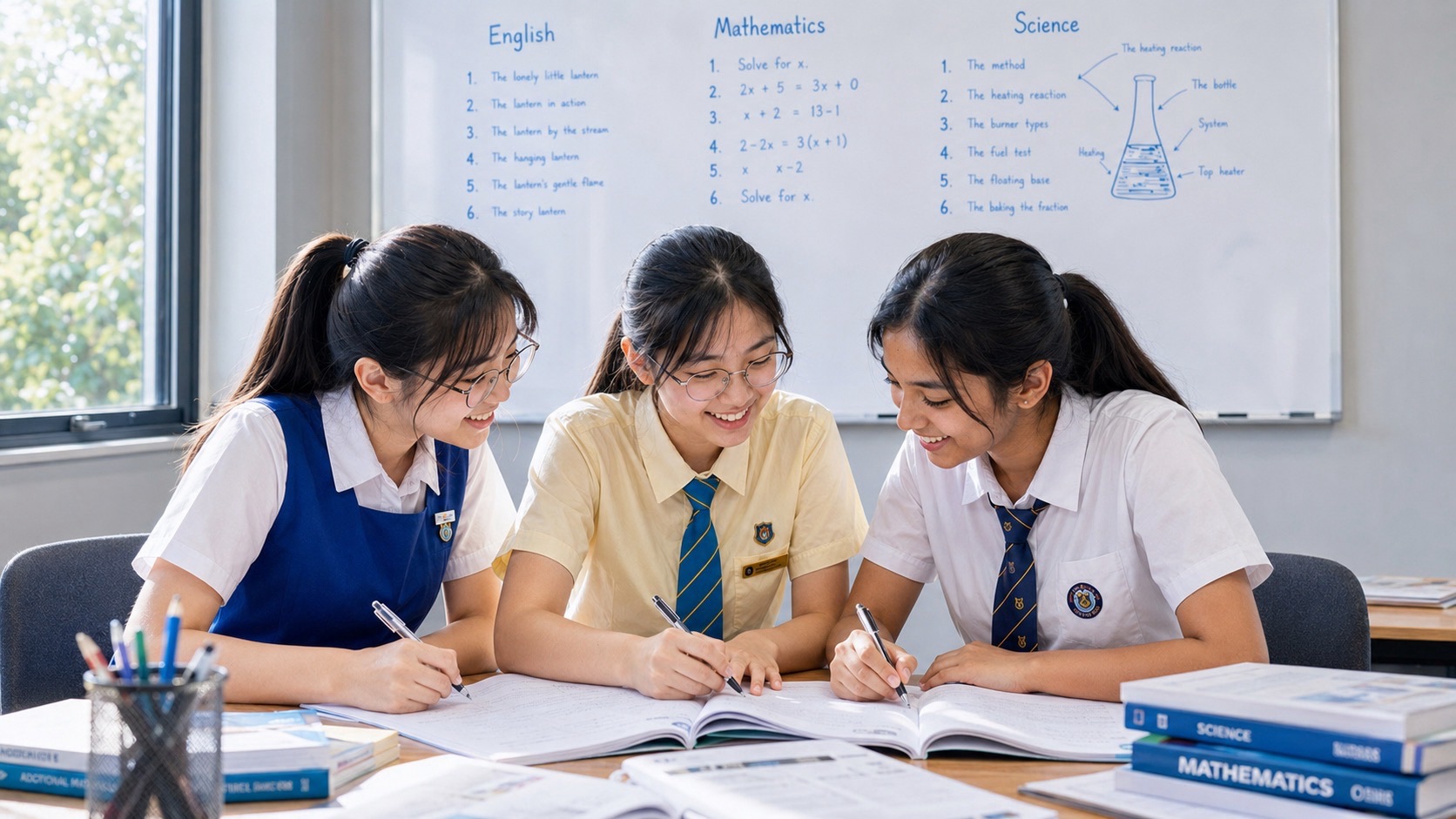
HarbourFront is a transport interchange, and anyone changing lines knows that the next correct decision matters as much as moving quickly. Secondary 2 Mathematics has a similar challenge. A student can solve equations flawlessly when the chapter says Algebra and plot points neatly when it says Graphs. In a school EOY paper, those labels vanish. Suddenly the question is about two fictional transport plans, and the child needs to decide which relationships to write down before calculating anything.
What happens in Secondary 2 HarbourFront Mathematics tuition? Effective Sec 2 Maths tuition connects linear equations, simultaneous conditions where taught, straight-line graphs, geometry, ratio, statistics and school end-of-year examination skills. A tutor should identify the first invalid independent decision, explain the concept that failed, and check its transfer on changed mixed questions. G1, G2 and G3 Mathematics have different depth and assessment expectations, so the actual school syllabus and exam topics must guide revision.
This second HarbourFront guide follows the Secondary 1 bridge from PSLE bar models into algebra. Now the goal is consolidation: the teenager should recognise mathematical structures without chapter headings and be ready for the more demanding combinations of topics that arrive in Secondary 3. We will work through equations, gradients, intersections and geometric premises, then show what parents should expect from a three-pupil tutoring group and a sustainable revision timetable.
An unlabelled question is different from chapter practice
A school textbook titled ‘Simultaneous Equations’ has already told the pupil to look for two unknowns. A chapter titled ‘Straight-Line Graphs’ suggests a gradient or intercept. An examination that mixes topics requires the student to infer which method is appropriate by reading the numerical and verbal relationships.
Before any calculations, identify the unknown, the given conditions, what varies and what remains fixed. A table, equation, graph or geometric diagram may be useful, but the student should say why. A tutor can initially ask these questions aloud, then withdraw the prompts gradually.
Shuffle three or four previously taught question types without giving their chapter names. Start with correctness rather than a short timer. A pupil who confidently chooses the first valid method is making progress even before calculation speed improves.
Two pupils with the same EOY result may need different help
Suppose two Secondary 2 students score sixty-four. One constructs excellent equations from stories but loses negative signs during rearrangement. Another performs arithmetic accurately but waits for a tutor to identify what x represents. The overall score compresses their difficulties into one number.
Use original marked working and a fresh unaided problem. Can the pupil build the first equation independently? Does a graph slope the expected way? Did the student apply a theorem without its stated conditions? The earliest invalid or unsupported step provides a useful diagnosis.
A meaningful correction explains that specific issue and is tested again after several days on altered numbers or wording. Copying the full teacher solution immediately shows guided learning; independent method selection later shows stronger transfer.
Bracket expansion and factorisation are opposite directions
Simplify 3(2x − 4) + x. Expanding the bracket yields 6x − 12 + x, and combining like terms gives 7x − 12. A pupil who writes 7x − 4 has applied the factor three only to part of the bracket rather than to the whole group.
Check with x = 2: the original is 3(4 − 4) + 2 = 2, and the correct result is fourteen minus twelve, also two. A wrong expansion typically fails this numerical check. The general identity follows from distribution.
Factorising moves in the reverse direction. The expression 6x + 12 can become 6(x + 2). Ask whether the question requests simplification, factorisation or solving an equation. A mathematically valid transformation may still be irrelevant if it does not answer the requested task.
An equation must stay true after each line
Consider 5x − 9 = 2x + 12. Subtract 2x from both sides, giving 3x − 9 = 12. Adding nine gives 3x = 21, so x = 7. Substitution verifies that both original sides equal twenty-six.
Shorthand about sending a term to the other side can produce sign slips if the pupil does not know what inverse operation is being performed. Ask the child to name that operation explicitly. The explanation helps the method survive when the equation is written in a less familiar order.
Change to 5x + 9 = 2x + 12. The solution is x = 1, not seven. A student who repeats the old answer needs to reread the relationship rather than rehearse the same arithmetic steps more quickly.
Two simultaneous conditions can describe a ticket-price story
Imagine a fictional class activity: one adult and one student ticket together cost $28, and the adult ticket costs $6 more. Let a be the adult price and s the student price. Then a + s = 28 and a − s = 6.
Adding the equations gives 2a = 34, so a = 17. Subtract seventeen from twenty-eight and obtain s = 11. Check the story: the sum is twenty-eight and the difference six. A candidate who swaps the labels despite correct arithmetic has failed the final interpretation.
Change the combined price to $32 and keep the six-dollar difference. The prices become $19 and $13. Ask the pupil to construct the two equations from the story independently. This is an illustration for students whose current school syllabus has introduced simultaneous linear equations, not a claim that all subject levels do so simultaneously.
A line’s gradient tells us how one quantity changes
For y = 3x + 2, inputs zero, one and four produce outputs two, five and fourteen. These points lie on a straight line with gradient three and y-intercept two. The intercept is the starting output at x = 0. The gradient describes the increase in output for each unit increase in x.
Ask what happens if x increases by two: y increases by six. Ask the output if x is zero: two. These questions make the two coefficients meaningful. Memorising y = mx + c without understanding the quantities may lead the child to reverse their roles in word problems.
Set y = 20 and solve 20 = 3x + 2 to obtain x = 6. The point (6,20) should belong to the graph on a correct scale. Equation, table and plotted line are mutually supporting representations.
A negative gradient gives a useful prediction
Consider y = 15 − 3x. The line has intercept fifteen and gradient negative three, so it falls from left to right. A graph that rises would contradict the equation. The student can identify that mismatch without recalculating every plotted point.
Imagine an entirely fictional water container with fifteen litres that loses three litres per minute at a constant rate. The model V = 15 − 3t describes the remaining volume until the container empties at five minutes. Extending it past that time produces a negative algebraic output, which is not a valid physical volume of water.
Mathematical models have assumptions and meaningful domains. A candidate should ask whether their calculated value fits the story, not simply report any number produced by a calculator.
Graph intersections connect two equations
Take the two lines y = 2x + 1 and y = −x + 10. At an intersection, both y-values are equal for the same x. Set 2x + 1 = −x + 10 to obtain 3x = 9 and x = 3. Substitution gives y = 7, so the shared point is (3,7).
A student may know how to solve the linear equation once a tutor has written it but not understand why the two expressions should be equated. Draw a rough picture of the lines and ask what a point belonging to both would mean.
Change the second line to y = 2x − 4. Equal gradients and different intercepts make the lines parallel and distinct. Equating them yields a contradiction, correctly showing that there is no intersection. Sometimes ‘no solution’ is the meaningful mathematical conclusion.
Two fictional transport plans make the line model meaningful
Imagine an invented outing where Plan A charges $8 plus $2 per traveller, while Plan B charges $20 plus $1 per traveller. With n travellers, the costs are A = 8 + 2n and B = 20 + n. Setting them equal gives n = 12, at which point both cost $32.
For five travellers, Plan A costs $18 and Plan B $25, making A cheaper. For twenty travellers, A costs $48 and B $40, making B cheaper. A’s smaller intercept initially saves money, but its larger gradient makes the price rise faster with increasing use.
These are deliberately invented plans, not real HarbourFront transport prices or service offers. Ask the pupil to change Plan A’s fixed cost to ten dollars and predict whether the break-even point comes earlier or later. The new equality is 10 + 2n = 20 + n, so it comes at ten travellers. Understanding the direction before recalculating is the skill.
Ratio and rate need assumptions, not familiar-looking numbers
Imagine a fictional station-planning task in which four equal groups of five travellers pass a checkpoint in precisely twelve minutes at a constant rate. Twenty travellers are processed, an average rate of 20/12, or about 1.67 travellers per minute. Under the stated constant-rate model, thirty travellers would take eighteen minutes.
The constant rate is an invented assumption. Real queues may vary with service times, crowd behaviour and staffing, so a candidate cannot apply direct proportion to every real-world queue without being told the rate remains unchanged.
Ask the pupil to identify what is held constant, what is allowed to change and what the requested unit should be. A result labelled minutes per traveller is different from travellers per minute, even though both are built from the same two numbers.
Pythagoras requires a right-angle premise
A right-angled triangle with perpendicular sides five and twelve centimetres has hypotenuse √(5² + 12²) = thirteen centimetres. The theorem applies because the question establishes a right angle. A sketch that looks nearly rectangular is not by itself proof of one.
Teach the learner to mark the right angle, locate the hypotenuse opposite it and choose the correct squared relationship. If the hypotenuse and one shorter leg are known, the unknown short leg requires subtracting squares rather than automatically adding them.
Contrast a triangle with lengths five, six and seven. The two shorter squared lengths sum to 61, not 49, the square of the longest. It is not right-angled. Recognising when a familiar theorem is not justified can prevent a first-method mistake in mixed assessments.
Similar figures scale length and area differently
Suppose two figures are known to be similar and have corresponding sides measuring six and nine centimetres. The linear enlargement factor is 1.5, so a corresponding side of eight centimetres becomes twelve centimetres. The sides must actually correspond; appearance on a rough diagram is not enough.
Area grows by the square of the linear factor. A rectangle measuring two by four has area eight square units; after enlarging both sides to three by six, the area is eighteen, a factor of 2.25.
A pupil who uses the linear factor for the area has chosen the wrong dimension of scaling. Ask whether the question requires length, area or volume and what unit should appear in the answer before performing the calculation.
Statistics is about choosing the right description of the data
Consider the ordered values 3, 4, 4, 5 and 14. The sum is thirty, so the mean is six. The median and mode are both four. A student who calculates mean perfectly when asked for median has selected the wrong mathematical object, not necessarily executed a calculation incorrectly.
Change fourteen to twenty-four. The mean becomes eight, while the median remains four. The mean depends on the size of every observation; the median depends on position in an ordered list. Ask the student to explain why the change influences one measure more strongly.
Data charts require careful inspection of axis scales, units and categories. A bar chart with a vertical axis beginning near the observations can exaggerate a small difference. Conclusions should be justified by numerical data rather than by visual drama.
A school EOY paper is not a uniform national assessment
Secondary 2 end-of-year examinations are designed by schools, so pupils living near HarbourFront may follow different G1, G2 or G3 courses and sit assessments with different taught-topic sequences. A generic revision pack can provide useful examples, but it should not be presented as an exact prediction of any school’s paper.
Ask for the current school scope. Begin with targeted topical correction if a concept is unstable, then mix the covered topics without chapter headings. Introduce manageable timed segments after the student can choose a valid first step and complete calculations reliably.
After marking, distinguish concept, translation, method-selection, execution and pacing problems. A pupil who forms the right equation but works slowly needs a different plan from one who starts with an invalid equation. The overall mark cannot distinguish those difficulties alone.
Subject combinations after Secondary 2 depend on fit
At the end of Secondary 2, some pupils consider upper-secondary subject combinations that include Additional Mathematics where the school offers it and the pupil is eligible. A-Math is a separate subject with its own syllabus and expectations; it is not simply a more impressive name for main Mathematics.
A disappointing school result may expose one repairable fraction or algebra prerequisite. A strong score on familiar topical questions can also hide difficulty when chapter hints are removed. Consider several unassisted attempts, the child’s interests, the school’s criteria and the workload of other subjects.
Under Full Subject-Based Banding, G1, G2 and G3 describe subject-level curricular pathways, not permanent labels of intelligence. A good tutoring plan supports the actual Mathematics course and helps the student enter Secondary 3 with durable skills.
Three-pupil tutoring should reveal three distinct ways of thinking
The published eduKateSG HarbourFront Mathematics programme describes premium classes limited to three pupils, typically around ninety minutes. A tutor can use the small number to observe how every student starts an unfamiliar problem without first supplying hints.
One child may understand a linear rule yet swap the intercept and gradient, another may create valid equations but lose negative signs, and a third may attempt Pythagoras without an established right angle. Their correction tasks should not automatically be identical.
Finish with a changed independent problem from each pupil, then schedule a short retest after several days. Group discussion can reveal useful alternate methods, but no learner should depend on a classmate to make their first mathematical decision. Small-group size does not itself guarantee an examination mark.
There are three stages in a useful correction
First, the pupil should understand the explanation during the lesson. Second, the method should be retrievable after two or three days with notes closed. Third, the student should recognise it later in a mixed problem with changed wording and no chapter title.
These represent different capabilities. A learner who understood immediately but forgot later may need spaced retrieval. One who remembers an equation procedure but cannot form an equation from words needs a representation bridge. One who has never understood the mathematical rule needs direct explanation.
An error log can record the first unsupported decision, its mathematical cause and a later changed-question result. A thick notebook of copied corrections is not automatically evidence that a misconception has disappeared.
An eight-week path toward connected EOY readiness
In weeks one and two, inspect schoolwork and a short unassisted mixed set. Identify high-impact fractions, signed-number, equation and graph errors rather than repeat the entire Lower Secondary syllabus. Give one or two prerequisites priority.
In weeks three and four, build equations from stories and connect those equations with graph tables. In weeks five and six, practise rates, geometry premises and data interpretation as taught at school. Require a brief explanation of why the chosen method is valid.
In weeks seven and eight, use the school’s actual end-of-year scope for short mixed questions, then introduce sensible timed practice. After marking, correct repeated first wrong decisions and retest them after a delay. Report on independence and checking alongside any score change.
HarbourFront families should count the entire journey
HarbourFront MRT connects the North East Line and Circle Line, and nearby families may start from Telok Blangah, Keppel or schools in other estates. An article mentioning HarbourFront does not automatically mean the tutoring venue is beside the interchange. A parent’s own commute may differ from the teenager’s route after CCA.
The existing eduKateSG HarbourFront tutorial overview lists teaching at 8 Fourth Avenue in Bukit Timah, near Sixth Avenue MRT. One possible journey uses the Circle Line toward Botanic Gardens and a transfer to the Downtown Line. The student’s actual departure point determines the best option and the full travel burden.
Confirm venue, group placement, fees and availability directly. Include homework, a proper meal and short independent retrieval between lessons. A classroom that fits a parent’s calendar but exhausts the teenager before homework may not be the best choice.
Keep G1, G2, G3 and the future SEC route distinct
Full Subject-Based Banding lets pupils follow Mathematics at G1, G2 or G3 according to school arrangements. A core concept such as graph gradient remains useful where taught, but level-specific topic scope and assessed difficulty can differ. The tutor should not assume every Secondary 2 student needs an identical G3 simultaneous-equations exercise.
The established local subject pages are G1 Mathematics Tutorials, G2 Mathematics Tutorials and G3 Mathematics Tutorials. These are the broader subject routes, while the present article explains what changes in the second year.
The Singapore-Cambridge Secondary Education Certificate starts in 2027. Current Secondary 2 pupils need a stable foundation and independent method selection before repeated full graduating-year papers become productive. The immediate school syllabus should guide daily practice.
Questions parents can use to evaluate Sec 2 tutoring
- Can the pupil form a valid equation from a new story without a supplied first line?
- Does the child know what graph gradient and intercept mean?
- Can the tutor point to the earliest invalid reasoning step in marked schoolwork?
- Are geometry formulas used only when the relevant conditions are given?
- Does the practice match the school’s real EOY scope and subject level?
- Are corrected ideas retested later in changed contexts?
- Does the timetable leave room for travel, meals, homework and sleep?
Frequently asked questions
Is the Secondary 2 EOY Mathematics paper national?
No. Schools set their own end-of-year examinations within the applicable curriculum. The actual school’s assessed chapters and instructions should guide revision.
Why can a pupil do chapter exercises but struggle in a mixed paper?
Chapter headings announce the method. Mixed questions require the learner to recognise the underlying mathematical structure independently.
Does one EOY grade determine eligibility for Additional Mathematics?
The school sets formal subject-combination criteria. One result is evidence, but longer-term algebraic readiness, interest and workload also matter.
Should every Secondary 2 learner start full SEC examination papers?
Not automatically. Concepts should be secure and the student should cover sufficient syllabus material before complete graduating-year simulations are useful.
Do premium three-pupil lessons guarantee a distinction?
No. The format can allow closer feedback, but learning depends on individual needs, teaching quality and independent practice.
Does HarbourFront mean tuition is located at the local interchange?
No. The existing local programme lists a Bukit Timah venue near Sixth Avenue MRT. Confirm actual class arrangements directly.
A short home check without chapter names
Where these topics have been taught, ask the student to solve 5x − 9 = 2x + 12, explain the gradient of y = 3x + 2 and build equations for ticket prices whose sum is $28 and difference $6. Do not name the chapter before they begin; observe the first method chosen.
Change one number or context a few days later. A pupil who still recognises the correct relationship without hints has developed stronger readiness for Secondary 3 than one who only repeats the original examples.
Follow the four-year HarbourFront Mathematics progression
The linked series joins Secondary 1: algebra after PSLE and first WAs, Secondary 2: graphs, equations and EOY revision, Secondary 3: trigonometry and quadratic graphs and Secondary 4: O-Level E-Math and SEC K310 Paper 1/Paper 2. Each stage makes the pupil more responsible for recognising and checking mathematical structures.
The established local parent is SEC Mathematics Tutorials | HarbourFront. The immutable instructional reference is Secondary 1 Mathematics Tutor Clementi | Small Groups Tutorials.
Arrange a parent–student consultation using real mathematical work
Bring the child’s Mathematics subject level, the school’s end-of-year scope, a genuine marked problem and an independent mixed attempt. Ask which first invalid decision requires teaching and what changed task will demonstrate progress. Confirm the teaching venue, group size and fees.
Contact eduKate Singapore to discuss a suitable small group of three. Diagnosis before tuition. Less noise. More structure. Better learning.