
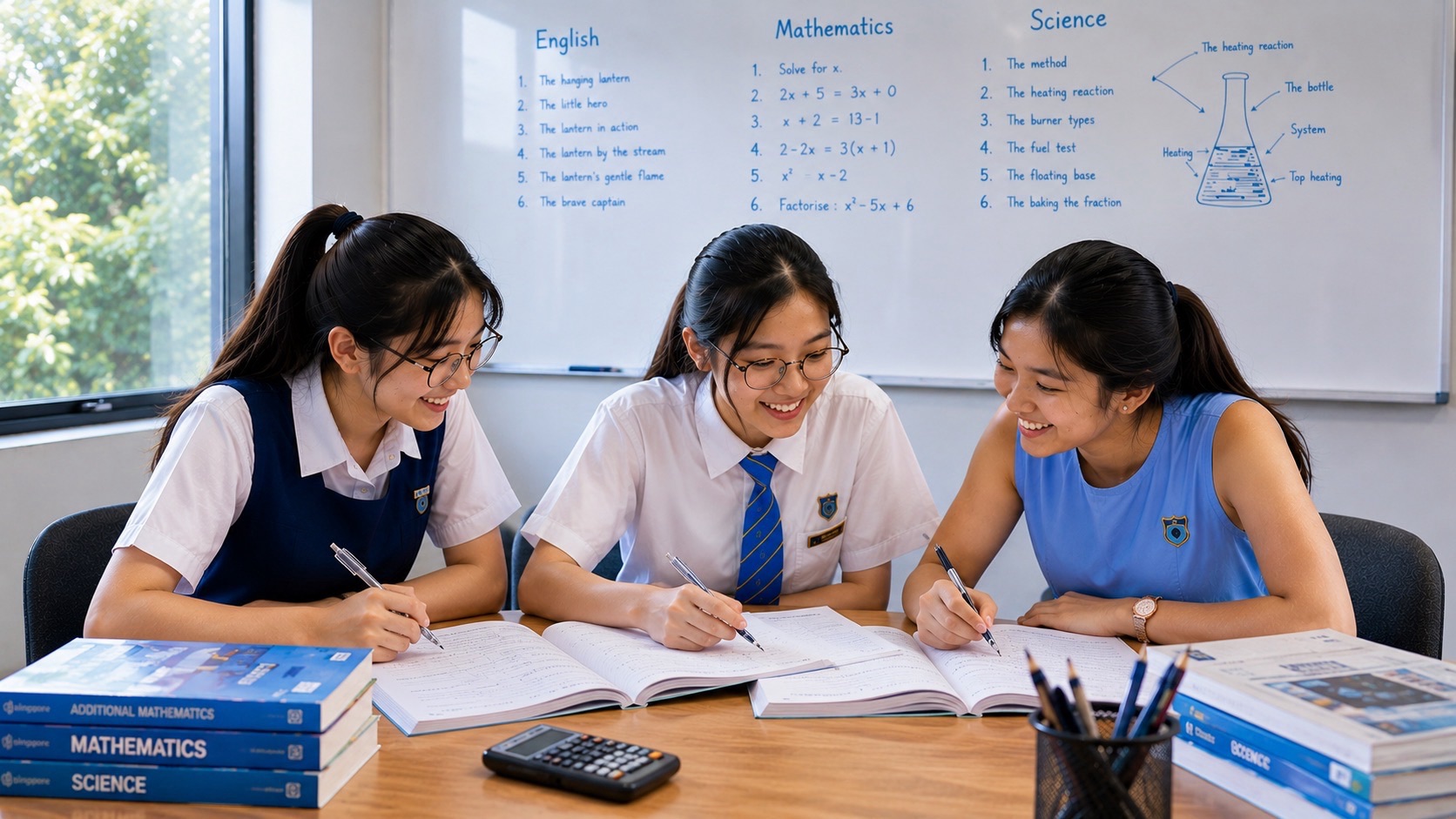
Secondary 3 Mathematics has a wonderfully inconvenient habit: it makes the chapters talk to one another. A student may know how to solve simultaneous equations and may know how to sketch a curve, but when both appear in the same problem, the first line becomes uncertain. Around Bishan, where busy school and CCA timetables can leave little spare attention, a teenager may mistake that hesitation for being unable to do Mathematics. Often the ability is there. The missing skill is recognising how the pieces connect.
What happens in Secondary 3 Bishan Mathematics tuition? In relevant G3 E-Math learning, Sec 3 Maths tuition should strengthen simultaneous equations, quadratic graphs, algebraic functions, coordinate reasoning and unfamiliar word-problem interpretation. A useful tutor teaches why two equations describe two conditions, how the roots of a quadratic connect to its x-intercepts, what a turning point means, and how to check whether an algebraic answer fits its context. The depth of work must follow the learner’s actual G1, G2 or G3 Mathematics syllabus, while Additional Mathematics remains a distinct subject.
This third article follows our Bishan Secondary 1–4 progression: new symbolic language in Secondary 1, connected algebra and graphs in Secondary 2, then richer method selection in upper secondary. The examples here reveal not just how a calculation works but where a correct-looking calculation can stop answering the original question. We finish with a teaching sequence, school-assessment guidance and parent questions that make close-feedback tuition meaningful.
The upper-secondary change: method selection becomes part of the subject
In a textbook chapter headed ‘Quadratic Functions’, students already know a curve will appear. In a mixed school paper, the problem may present a rectangle, a graph, two linked prices or a changing quantity without announcing which method applies. The learner must identify an unknown, translate conditions, select the right relationship and calculate. A student who remembers every formula yet cannot begin the modelling step still needs teaching.
One valuable tutor question is “What would you need to know before choosing a formula?” In an intersection problem, the important fact is that two relationships hold for the same x and y. In a quadratic graph task, the key might be whether the question asks for roots, an intercept or a turning point. The same expression may need different forms depending on the required result.
A confident learner should be able to pause, label the relevant quantities and say why the chosen mathematical route fits the conditions. This is not wasted examination time. It reduces wrong starts and can save much longer reworking when a guessed technique proves inappropriate.
A diagnostic that does not treat every wrong answer as ‘careless’
Bring recent schoolwork and one changed problem attempted without prompts. Ask the teenager to explain the first line and point to the first step they cannot justify. Did they misread what the variable represented? Did they factorise a quadratic incorrectly? Did they use a linear graph’s intercept as its gradient? Did they fail to check whether a negative length can exist? Each error belongs to a different instructional family.
Separate missing concepts, broken links between representations, method selection, execution and checking. If a pupil can factorise x² − 5x + 6 when the instruction says “factorise” but cannot recognise that a graph’s x-intercepts require y = 0, they need connection practice. If the connection is understood but signs are mishandled, they need procedural accuracy.
The tutor should make the next step observable. After a focused explanation, provide a changed equation, a curve with shifted intercepts or another contextual story. Retest it a few days later without showing the previous model. A correct changed attempt is better evidence than copying the marking scheme into a spotless correction book.
Worked lesson 1: simultaneous linear equations mean two truths at once
Suppose two purchases have a total cost of $18 and the first costs $4 more than the second. Let a and b represent their prices. The conditions are a + b = 18 and a − b = 4. Adding gives 2a = 22, so a = 11 and b = 7. These values are not simply two numbers obtained from an algorithm; they satisfy both statements in the original story.
Check them: eleven plus seven is eighteen and eleven minus seven is four. A pupil who swaps the prices might still list the correct numbers but answer the question incorrectly. A robust solution should define the variables clearly and interpret them in words at the end.
Now change the total to $24 and the difference to $6. The first price becomes $15 and the second $9. The learner should know how to translate the new statements without needing someone to announce that simultaneous equations are required. Where the school syllabus uses alternative strategies, ask when elimination or substitution would be more efficient.
Worked lesson 2: a graph intersection is also a simultaneous solution
Consider two straight lines, y = 2x + 1 and y = −x + 10. At their intersection both expressions for y must be equal. Set 2x + 1 = −x + 10, so 3x = 9 and x = 3. Substitution gives y = 7. Therefore the lines meet at (3, 7). This combines graph interpretation with the equation-solving skill developed earlier.
The important starting decision is not the arithmetic; it is recognising the shared point. A student who has mastered algebra but cannot form that equality may be struggling to translate a visual question into symbols. Draw rough lines, discuss the meaning of an intersection, then return to the equations.
Check (3,7) in both rules. The first gives 2(3) + 1 = 7; the second gives −3 + 10 = 7. Now consider y = 2x + 1 and y = 2x − 4. They have identical gradients but different intercepts, so they are parallel and have no intersection. Setting them equal leads to the contradiction 1 = −4. That contradiction carries information rather than indicating that the pupil must somehow invent an x-value.
Worked lesson 3: quadratic factorisation gives roots
For a G3 learner whose school has taught this topic, consider x² − 5x + 6 = 0. Factorising gives (x − 2)(x − 3) = 0. The roots are x = 2 and x = 3. Ask why each factor may be zero: if a product is zero, at least one factor must be zero. This conceptual sentence is more useful than memorising two numbers that multiply to six.
Check x = 2: four minus ten plus six is zero. Check x = 3: nine minus fifteen plus six is also zero. If a pupil chooses (x + 2)(x + 3), substitution quickly reveals the mistake. A small independent verification can save repeated sign errors across quadratic tasks.
Change the expression to x² + x − 6 = 0. It becomes (x + 3)(x − 2) = 0, with roots −3 and 2. A child who insists roots must both be positive is treating yesterday’s example as a rule. Algebra allows negative solutions; the question’s context, where one exists, determines whether those solutions are meaningful.
Worked lesson 4: roots and intercepts are the same relationship in two languages
The graph of y = x² − 5x + 6 crosses the x-axis when y = 0. Thus the x-intercepts correspond to the same solutions, x = 2 and x = 3. The intercepts as points are (2,0) and (3,0), while the roots are the x-values two and three. Teaching this distinction helps pupils avoid treating equations and graphs as unrelated exercises.
The curve opens upward because the coefficient of x² is positive. Its axis of symmetry is halfway between two and three, at x = 2.5. Substitution gives y = 6.25 − 12.5 + 6 = −0.25. The turning point is (2.5, −0.25), a minimum slightly below the x-axis. Each algebraic fact helps construct and check the sketch.
Now ask when y is positive. For this upward-opening parabola with two distinct real roots, it is positive for x less than two or x greater than three, and negative between the roots. That interpretation requires reading the graph’s sign and region, not simply reporting its roots. Use it only where such inequalities or graphical interpretations match the pupil’s current course.
Worked lesson 5: completed-square form reveals a turning point directly
Consider y = x² − 4x + 1. Rewriting gives y = (x − 2)² − 3. The squared quantity cannot be negative for real x, so its smallest possible value is zero, occurring when x = 2. Thus the minimum y-value is −3 and the turning point is (2, −3). This explanation shows why the algebraic form reveals the graph’s structure.
A pupil who can complete the square mechanically but cannot describe the minimum has learned a procedure without its meaning. Ask them to sketch the transformation from the basic y = x² shape: two units to the right and three units down. The sketch should agree with the symbolic expression.
Change the final constant so y = (x − 2)² + 3. Now the minimum is three and the graph never crosses the x-axis, because its value cannot be zero for a real x. This changed example challenges the assumption that every quadratic graph must have two real x-intercepts.
Worked lesson 6: a rectangle explains why negative roots may be rejected
A rectangular noticeboard is three centimetres longer than it is wide, and its area is forty square centimetres. Let the width be x; its length is x + 3. The area equation x(x + 3) = 40 becomes x² + 3x − 40 = 0. Factorising gives (x + 8)(x − 5) = 0, so x is −8 or 5.
Both values solve the algebraic equation, but −8 centimetres cannot represent the physical width of a noticeboard. Therefore the width is five centimetres and the length eight centimetres. The product five times eight confirms the area. The final contextual decision is just as mathematical as the factorisation.
Try changing the area to sixty square centimetres. Now x(x + 3) = 60, which does not have the same friendly integer solution as the first example. The learner should recognise that a valid solving method depends on the resulting equation rather than assume every story has been designed for easy factorisation. Match the solving techniques to what the school has taught.
Worked lesson 7: coordinate geometry adds another cross-check
Take the points A(1,2) and B(5,10). Their gradient is (10 − 2)/(5 − 1) = 8/4 = 2. The line through them is y − 2 = 2(x − 1), or y = 2x. Substitution of both points confirms the result. The gradient also describes a change of two units vertically for every one unit horizontally.
A common sign error occurs when a student reverses the subtraction direction for only the numerator or denominator. A rough sketch shows the line rising as x increases, so the gradient should be positive. A qualitative prediction helps check the arithmetic.
The midpoint is (3,6), found by averaging the corresponding coordinates. The distance is √((5 − 1)² + (10 − 2)²) = √80, or about 8.94 units. These are different questions applied to the same points. Reading whether the problem requests a slope, halfway point or length should precede selecting the formula.
Mixed-topic tests: the hidden skill is the first decision
A school paper may provide a straight-line rule and a quadratic curve, then ask about a shared point or a region on the graph. The pupil must decide which relationships need to hold simultaneously, then perform algebra. A tutor who announces the chapter before every practice gives away a critical part of the assessment.
Build independent practice with a brief planning pause. Ask what quantities are known, which conditions are present, what must be found and how a result could be checked. Then calculate. As the skill develops, the student should become quicker at recognising methods without being rushed through concepts.
Changed questions are especially informative. Shift the quadratic by a constant, exchange coefficients in the linear equation or change a rectangle’s area. Does the student adjust the approach, or continue copying the previously demonstrated steps? Transfer is what makes knowledge useful outside a single workbook page.
A ninety-minute three-student lesson should reveal thinking
The immutable eduKateSG reference describes premium small groups of up to three pupils, typically in weekly 1.5-hour lessons. A focused session can begin with two unassisted mixed questions. The tutor checks each student’s first method rather than merely recording right and wrong answers. One pupil may need factorisation repair while another needs to understand why two graphs intersect.
After a concept explanation, students compare related examples, then attempt one altered question independently. Peer discussion may introduce another valid route, but the quieter pupil still needs to complete their own working. The value of a small group depends on the tutor noticing specific errors and adjusting teaching.
The final task should demonstrate whether the student can identify the relationship without a hint. A polished guided solution is useful during teaching, but it is not the same evidence as an independent attempt. Families should ask for the latter when evaluating tuition.
An eight-week plan for upper-secondary mathematical connections
Weeks 1–2: repair the first failing prerequisite
Review recent schoolwork and a mixed independent set. Check whether signed numbers, expansion, equations and graph-reading errors are interfering with current material. Teach the smallest missing node or broken link, then return immediately to the upper-secondary question that exposed it.
Weeks 3–4: connect simultaneous solutions and graphs
Use suitable pairs of linear equations and coordinate questions. Ask why the intersection satisfies both conditions and how substitution checks the point. Present a second example that looks similar but has parallel lines, so the method’s limits become clear.
Weeks 5–6: develop quadratic representations
Move between an expression, its factors, roots, graph and turning point at the child’s appropriate subject level. Ask which form most directly reveals the requested feature. Include one unfamiliar contextual problem requiring an equation to be built from words.
Weeks 7–8: mixed reasoning and school-assessment control
Use the actual school’s assessed scope for short mixed questions. Remove topic headings, introduce modest timing where appropriate and track first wrong decisions. Retest the highest-impact misconceptions after several days. Progress is visible when the student can select and check the method without a tutor prompting each step.
Bishan families need a schedule that allows retrieval between lessons
A teenager living around Bishan North, Bishan town centre or the Marymount area may move between school, CCAs and family responsibilities on very different routes. A timetable filled edge-to-edge can leave no space for an unaided attempt, which is essential for finding out whether tuition has worked.
A sustainable pattern may include one close-feedback session, two brief algebra or graph retrieval windows and a separate correction review. Bring genuine wrong attempts rather than home-edited work. The tutor needs to see what the student actually chose without help.
This guide serves Bishan families and does not imply an eduKateSG classroom exists beside Bishan MRT. Confirm teaching location, course, fees, travel and availability directly before committing.
E-Math and Additional Mathematics are distinct tuition needs
A Secondary 3 pupil may be studying G3 Mathematics, often called E-Math, and may also be taking Additional Mathematics as a separate subject. The related algebra does not erase differences between syllabuses. The tutor should inspect the specific subject’s marked paper before choosing teaching material.
If a learner struggles to understand the x-intercepts on an E-Math graph, teaching an unrelated Additional Mathematics technique is not necessarily helpful. Similarly, a student with a particular A-Math weakness needs targeted A-Math practice rather than an E-Math paper chosen because it also contains algebra.
G1, G2 and G3 are curricular subject levels. A pupil’s learning plan must match the level actually taken at school, rather than using advanced examples to imply a higher-status programme. Mathematical clarity and independence remain valuable at every level.
The 2027 SEC changes the qualification, not the need to think
Students in Secondary 3 during 2026 are on the pathway to the first SEC examination in 2027. SEAB lists G3 Mathematics as K310 and Additional Mathematics separately as K341. This cohort-specific information matters when considering later examination papers, but present Secondary 3 lessons should still follow the school’s taught content.
The G3 Mathematics syllabus emphasises interpreting and solving problems, reasoning and communicating mathematical ideas. Those aims support teaching links between equations, graphs and context. Starting full graduating-year papers prematurely is not a substitute for completing the current syllabus and strengthening the prerequisites.
For authoritative documents, use SEAB’s 2027 G3 syllabus directory and the SEC overview.
Parent questions that reveal whether Sec 3 tutoring is useful
- Can my child explain what an intersection means before solving the equations?
- Does a pupil know why a quadratic root matches an x-intercept?
- Which algebraic form reveals the feature the school question asks for?
- Can the child reject a negative length without rejecting a valid algebraic root?
- Does the tutor distinguish G3 E-Math from Additional Mathematics?
- Will the student attempt a changed problem without hints after learning a method?
- Does tuition fit the actual syllabus, school assessment schedule and home-study time?
Frequently asked questions about Secondary 3 Bishan Mathematics
Are simultaneous equations and quadratic graphs the same topic?
They are related through representation and solving conditions, but each has its own ideas. A shared graph point can be found by solving equations simultaneously. A quadratic’s x-intercepts come from setting y to zero. Teaching the connection helps students recognise how different tools cooperate.
Do all G1, G2 and G3 pupils complete the same quadratic work?
No. Syllabus depth and topic selection differ. Examples of G3 quadratic functions in this guide are illustrations for pupils whose school course includes them, not a required schedule for every Secondary 3 learner.
Why can my child factorise when told to, but not start a graph question?
The student may not recognise that finding x-intercepts requires setting y = 0, or that a different algebraic form reveals the turning point. Practise changing between expressions and graphical meanings without announcing the method first.
Should Secondary 3 students begin full SEC timed papers?
Only when appropriate to curriculum coverage and the learner’s readiness. Current school lessons, mixed method selection and deliberate correction should generally come before large volumes of graduating-year papers.
Can a three-pupil group provide individual support?
It can, when the tutor examines each student’s first attempt and makes specific teaching decisions. Small groups create the opportunity for frequent attention but cannot guarantee progress by headcount alone.
Does a weak E-Math test mean the child cannot take A-Math?
The learner’s actual school programme, subject offerings and eligibility requirements govern A-Math. A single test should be interpreted alongside algebraic readiness, interests and school guidance rather than turned into a fixed judgement.
Does eduKateSG have a Bishan branch?
A town-specific article is not proof of a local classroom. Contact the provider to confirm current teaching location, class composition, fees and travel suitability.
A home check for connected mathematical thinking
Give three school-level-appropriate tasks: solve a + b = 18 and a − b = 4; find where y = 2x + 1 meets y = −x + 10; and identify the roots and turning point of y = x² − 5x + 6. Ask how each task differs and which mathematical relationship starts the solution.
Then change a coefficient and repeat later. A student who adapts without a model answer is becoming more independent. If the method fails, the exact first wrong choice supplies a useful next teaching objective rather than a vague claim that the whole subject is weak.
Follow the complete four-year Bishan Mathematics route
The route begins with Secondary 1: the after-PSLE algebra bridge, continues through Secondary 2: equations and straight-line graphs, develops into Secondary 3: simultaneous equations and quadratic graphs, and culminates in Secondary 4: O-Level E-Math Paper 1 and Paper 2 preparation. Each instalment tackles a distinct phase while preserving continuity: understand, connect, choose and check.
Read the immutable eduKateSG small-group Mathematics reference, Tuition | Bishan and Tutors and Tuition in Bishan for broader teaching and locality context.
Arrange a consultation around an authentic incorrect step
Bring the child’s Mathematics syllabus level, recent school questions, a marked script and the family’s real timetable. Ask where the tutor sees a broken connection and which independent problem would demonstrate repair. Confirm the teaching venue, availability and cost directly.
Contact eduKate Singapore or WhatsApp eduKateSG about Sec 3 Maths. Properly taught kids shine a bright light into the future.