
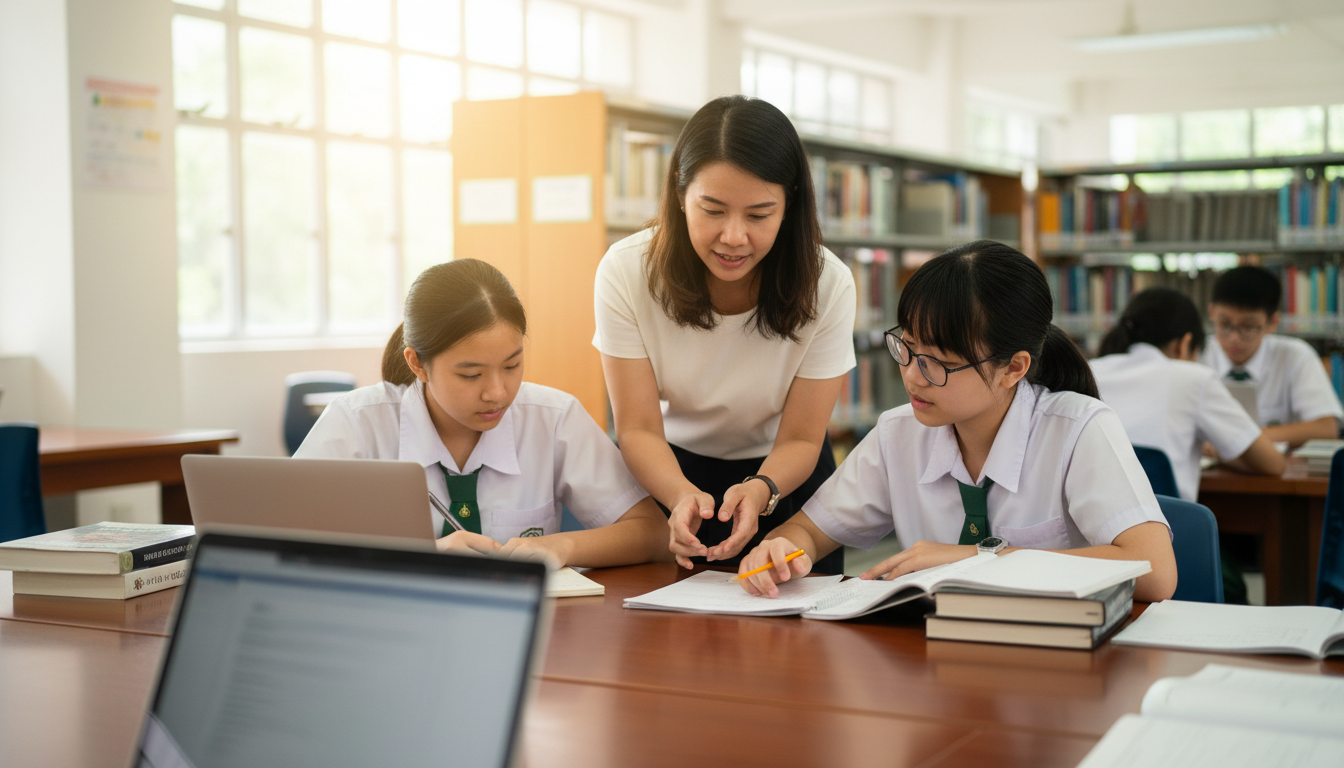
Academic integrity means learning, researching and presenting work honestly, with appropriate acknowledgement of other people’s ideas, sources and tools. It includes writing original answers, reporting genuine results, avoiding unauthorised help and following the specific rules of an assignment or examination. Using artificial intelligence or a private tutor does not automatically make work dishonest; misrepresenting their contributions or breaching a task’s conditions can. Singapore schools, SEAB assessments and universities apply requirements that must be checked for the particular course.
This parent and student guide explains plagiarism, collaboration versus collusion, citation, paraphrasing, AI-generated writing, research authenticity, examination rules and how to respond when a child submits work they cannot explain. It draws on Singapore education and NTU guidance without pretending one institution’s rules apply universally. The goal is responsible learning: students should receive help that develops their capability while teachers can still trust what each student demonstrates independently.
- Original work: the learner’s own thinking, explanation or authorised work product.
- Acknowledgement: give accurate credit to borrowed text, ideas, data, images and tools when required.
- Permitted assistance: check assignment-specific instructions before using a tutor, peer, translation service or AI.
- Verification: confirm sources and factual claims; AI output is not an automatically trustworthy citation.
- Fairness: academic procedures should support learning and investigate concerns proportionately rather than rely on guesses about authorship.
Find the answer you need
- What is academic integrity in plain English?
- Why academic integrity matters beyond marks
- What counts as plagiarism?
- Why replacing a few words is not enough
- How quoting differs from paraphrasing
- What is a citation?
- Which referencing style should students use?
- Collaboration versus collusion
- What is contract cheating?
- Can parents help with homework?
- Can private tutors help with assessed work?
- What is AI-assisted schoolwork?
- What Singapore’s 2026 AI-literacy plans emphasise
- NTU’s guidance: consult, document and verify
- Why an AI citation is not automatically a source
- How to disclose AI use when permitted
- What if AI was used only for brainstorming?
- What if AI is used for grammar correction?
- What if the student uses translation software?
- What counts as honest research?
- Research data and school projects
- Plagiarism in Primary school
- Academic integrity in Secondary English
- Academic integrity in Mathematics
- Academic integrity in Science
- Academic integrity in humanities and General Paper
- Research papers and project work
- Examination rules are stricter than ordinary homework
- Academic honesty and fair investigation of suspected misconduct
- Why AI detectors cannot settle every case
- Originality in an age of common facts
- Should every source be cited?
- How to create a simple source log
- How to check whether a source supports a claim
- Copyright and plagiarism are related but distinct
- Academic integrity and inclusion
- A fictional example: Alicia’s AI-written composition
- A fictional example: Ben’s overhelpful parent
- A fictional example: Mira’s careful use of AI
- Four-week plan for honest academic work
- Common integrity myths
- What education gains from honesty
- Frequently asked questions
- Sources and next reading
What is academic integrity in plain English?
A Secondary student writes an essay using information from a library article. They explain the argument in their own words and acknowledge the source. Another student copies a paragraph and changes a few synonyms without credit. A third pastes AI-generated text as though they wrote it independently in an assignment that prohibits such assistance. The differences concern authorship, honesty and the task’s rules.
Academic integrity protects the meaning of schoolwork. Teachers need to know what the learner can do, and students deserve fair evaluation of their own abilities. The objective is not to ban research, discussion or technology. It is to distinguish learning from misrepresentation and teach students how to use other people’s work responsibly.
Why academic integrity matters beyond marks
If an assessment result is based on someone else’s reasoning, the student may receive a grade without developing the intended skill. Later lessons can become harder because the foundation remains missing. A teacher may mistakenly assume the child can write independently when the essay was extensively rewritten by an adult.
Integrity also matters in scientific records, professional training and everyday decisions. A person who changes observations to fit an expected conclusion can harm the credibility of a project. Students should learn that honest uncertainty and a correctable error are better than presenting invented certainty. The educational goal is trustworthy evidence of learning.
What counts as plagiarism?
Plagiarism involves presenting another person’s ideas, wording or work as one’s own without appropriate acknowledgement. It can involve copying an entire answer, borrowing distinctive language without quotation, paraphrasing too closely, using uncredited figures or submitting material created by someone else.
Exact definitions and disciplinary consequences depend on the assessment and institution. Students should consult their school’s current policy instead of assuming that all permitted study resources may be copied into submissions. The simplest preventive habit is to record which ideas and facts came from which sources, write an original explanation and acknowledge borrowed material in the required format.
Why replacing a few words is not enough
A student may copy a source paragraph and substitute similar words, believing that the result is now original. The sentence structure, reasoning and information may still be closely derived from the source. Without proper acknowledgement, this can misrepresent whose intellectual work is being used.
Better paraphrasing starts with understanding. Read the material, close it, explain the idea accurately in language suited to the assignment and cite the origin when required. Reopen the source to check that the meaning has not changed. A good paraphrase is not a disguise for copied writing; it is an accountable restatement within the student’s own argument.
How quoting differs from paraphrasing
A quotation reproduces someone else’s words, usually with quotation marks and a reference. Paraphrasing communicates the underlying idea in new wording while still acknowledging its origin. The choice depends on the purpose: a literary analysis may need an exact phrase, while a Science explanation may be clearer when the concept is described independently.
Quoting too much can also hide the student’s contribution. An essay assembled largely from credited excerpts may technically acknowledge its sources yet fail to demonstrate the intended writing skill. Teachers should explain how evidence supports a learner’s argument, how much quotation is suitable and what independent reasoning must remain visible.
What is a citation?
A citation helps readers identify where information, ideas or text originated. It may include an author, title, publication date, page, web address or other details, depending on the required referencing style. A bibliography or reference list then gives fuller information about the materials used.
Students do not need to memorise every reference style at once. Teachers can provide an age-appropriate model and explain why each component matters. The important skill is traceability: a reader should be able to locate the underlying source and inspect whether it supports the claim. A fabricated citation undermines that purpose even if its formatting looks perfect.
Which referencing style should students use?
Styles such as APA, MLA and Chicago organise references differently. The correct choice depends on the school’s, course’s or publisher’s requirements. A Primary pupil may use a simple teacher-provided source record; an upper-secondary or university student may need a formal style and more detailed bibliographic information.
Do not assume a particular style applies to all Singapore schools or every examination component. Read the assignment instructions and use one consistent method. If a teacher has not specified a style, ask what level of attribution is appropriate. Reliable credit matters more than decorating a bibliography with information that has not been verified.
Collaboration versus collusion
Collaboration can be an authorised part of learning. Students may discuss ideas, compare methods and give feedback during groupwork. Collusion occurs when students improperly cooperate on work that must represent independent effort, such as exchanging answers in a restricted assessment.
The same conversation can be acceptable in one task and prohibited in another. A teacher may invite peer editing of a draft but require the final essay to be written independently. Students should understand what help is permitted, whether contributions must be declared and how group roles are evaluated. The existence of friends or a study group does not remove individual responsibility.
What is contract cheating?
Contract cheating generally involves another person or service producing academic work for a student to submit as their own. Payment is not essential to the underlying misrepresentation: a friend or relative may write the work without charging. The student’s submitted product then ceases to provide reliable evidence of their ability.
Parents may create a similar problem unintentionally by rewriting a child’s assignment until the result is no longer the student’s work. The alternative is to explain a concept, model a separate example and ask the learner to produce an independent response. An adult can support the process without taking over the authorship of an assessed product.
Can parents help with homework?
Parents can help children organise materials, read instructions, ask questions and find accurate explanations. They may model a separate Mathematics example or discuss which part of a comprehension question is confusing. Such support can be educationally valuable when the assignment allows it.
But parents should not routinely supply every final answer or rewrite the student’s composition. Doing so may conceal gaps and mislead teachers about progress. The family should clarify rules where necessary, especially for assessed coursework. A useful parent question is whether the child can complete a changed task after the support is withdrawn.
Can private tutors help with assessed work?
A tutor can teach prerequisite knowledge, explain difficult concepts, provide practice questions and give feedback consistent with the school’s rules. Students should still produce the work that the assessment is designed to measure. In some components, outside editing or direct writing assistance may be restricted or explicitly prohibited.
Before helping with coursework, check the specific instructions. A tutor should distinguish general subject teaching from preparing a submission that must be entirely independent. Keep records of guidance when required, avoid promising guaranteed marks and do not impersonate the learner. The right support strengthens capability without obscuring who actually did the assessed thinking.
What is AI-assisted schoolwork?
Generative AI can suggest explanations, draft text, summarise information, create questions or provide feedback. These tools may be useful for learning, but their outputs can also be wrong, biased or too fluent to reveal missing knowledge. A student must distinguish permitted assistance from outsourcing the task being assessed.
Some assignments allow particular AI uses with disclosure, while others restrict them. The task’s rules come first. A learner who asks AI for a hint, checks the explanation and solves a new question independently is doing something different from pasting an AI answer into a no-assistance assignment. The latter can misrepresent the student’s actual work.
What Singapore’s 2026 AI-literacy plans emphasise
MOE’s 2026 Committee of Supply announcements describe strengthening AI literacy in curriculum, co-curriculum and self-directed learning. Cyber Wellness lessons address validating generative-AI information and recognising deepfakes. This places responsible judgement and information checking at the centre of developing AI skills.
These announcements do not mean every student may use every AI tool during every assessment. School policies and component-specific instructions still govern authorship and permitted assistance. Parents should avoid treating national enthusiasm for digital literacy as blanket permission to delegate homework. The educational question remains what the student understands and can do.
NTU’s guidance: consult, document and verify
NTU Library’s responsible AI-use guidance advises students to consult instructors about course-specific expectations, document use where required and verify generated outputs. It also warns that plagiarism can still occur even when AI use has been acknowledged.
This is particularly useful because acknowledging a tool does not automatically make every use permissible. A course may still require original analysis or restrict submission of generated text. University guidance does not automatically determine rules for Primary or Secondary schoolwork, but the principles of clarity, truthful disclosure and independent responsibility are broadly valuable.
Why an AI citation is not automatically a source
An AI tool may produce a convincing reference with an author, year and journal that do not exist. It may also cite a real article that does not support the claimed conclusion. A citation generated by software is only a lead until the student locates the original material and checks its contents.
Teach learners to open the source, verify its author and date, read the relevant passage and judge whether it supports the claim. If the source cannot be found, do not place the reference into assessed work as though it were verified. Evidence quality cannot be outsourced to fluent text generation.
How to disclose AI use when permitted
Where use is permitted, students can follow the instructor’s requested declaration format. A useful record may identify the tool, what it was used for, and which parts of the final work remain the student’s own. NTU Library’s Document, Disclose and Cite guidance provides examples, while repeatedly emphasising course-specific rules.
Do not invent a universal disclosure rule for every Singapore examination. Some assessments prohibit outside tools entirely; others specify what must be acknowledged. The safest procedure is to read the instructions before use, keep accurate notes and ask the teacher when uncertain. A truthful declaration cannot retroactively authorise assistance that the rules prohibited.
What if AI was used only for brainstorming?
Brainstorming may be permitted in some tasks and restricted in others. Even when allowed, the learner must evaluate ideas and develop an original response. A list of AI-generated arguments can contain weak assumptions or irrelevant claims, so students should test each one against credible evidence and the actual assignment question.
Consider how much the final structure depends on external suggestions and whether disclosure is required. Do not assume that a tool’s contribution is invisible simply because its exact words were not copied. Academic integrity includes accurately representing the intellectual process, not only avoiding obvious pasted paragraphs.
What if AI is used for grammar correction?
Basic spelling and grammar tools have long supported writing, but generative systems can rewrite entire sentences, alter argument structure or invent content. The boundary between correction and substantive authorship depends on what the tool changed and what the assessment is measuring.
If the goal is independent composition, extensive rewriting can remove evidence of the student’s ability. A teacher may permit spellchecking while prohibiting generated paragraphs. Students can keep their original drafts and track edits when appropriate. The responsible question is whether the use fits the assignment instructions and preserves the intended demonstration of skill.
What if the student uses translation software?
Translation tools may help a multilingual learner understand unfamiliar instructions or check vocabulary where school policy allows. However, submitting a machine-translated essay as independent performance in the assessed language can misrepresent the learner’s competence.
Teachers should explain permitted uses and recognise genuine language-access needs. A useful learning approach might involve comparing a translation with original wording and then producing an independent sentence. If translation is prohibited during a particular assessment, students must follow that requirement. The goal is to support language learning without concealing what the child can do unaided.
What counts as honest research?
Honest research identifies a question, gathers suitable evidence, distinguishes fact from interpretation and reports limitations. Students should not invent survey responses, fabricate experimental measurements or silently remove observations because they conflict with expectations. A surprising result can be a valuable opportunity to improve the method.
An educator can demonstrate how to label a result as uncertain and describe why a sample is limited. In a Science investigation, the correct conclusion may be that the comparison was not fair enough to support a firm claim. Honest uncertainty is stronger scholarship than a flawless-looking table assembled from made-up numbers.
Research data and school projects
Students may collect measurements, photographs, survey answers or interview notes for a project. These materials need accurate handling, respect for privacy and appropriate consent where required. A child should not upload classmates’ personal details to an unapproved AI system or publish sensitive information simply to make the project more persuasive.
Teachers should define permissible collection and storage practices before the activity begins. Use fictional or anonymised examples when real data are unnecessary. A school project does not confer authority to conduct intrusive research. Integrity includes treating the people behind data responsibly as well as avoiding false numbers.
Plagiarism in Primary school
Younger children may copy text because they do not yet understand authorship or how to restate an idea. The educational response should be developmentally appropriate: teach what a source is, model how to say something in one’s own words and show simple ways to name the book or website used.
Not every inexperienced child needs a punitive response for a first misunderstanding. However, the adult should still correct the behaviour and explain why copying is not the same as demonstrating learning. A short original explanation after reading can help the teacher judge whether comprehension developed. Expectations should become more precise with age and assessment stakes.
Academic integrity in Secondary English
A student preparing a composition may read model essays for vocabulary and structure. The educational value comes from understanding why the model works and practising original writing. Copying a memorised paragraph into an unrelated prompt can weaken both relevance and authenticity.
Teachers can ask the learner to plan a new topic, select appropriate examples and explain each paragraph’s purpose. Feedback should target the child’s reasoning and language, not encourage copying ever more elaborate stock phrases. If a model is quoted or closely adapted, follow the assignment’s acknowledgement rules. The aim is transferable writing, not reproduction of somebody else’s polished sentences.
Academic integrity in Mathematics
Mathematics solutions can look similar because students use established methods. Integrity does not require inventing a new formula. It requires the learner to understand the steps and follow assessment conditions. During permitted collaborative study, pupils may compare approaches; during an independent test they must work according to the rules.
A teacher can ask students to explain why an operation preserves equality or whether units make sense. If a child copies an answer without understanding, the weakness becomes apparent in a changed question. Corrective teaching should focus on the missing mathematical concept as well as the importance of honest work.
Academic integrity in Science
A Science student should record what was actually observed, even when the experiment fails to match a prediction. Altering measurements to make the graph smooth is data fabrication. The teacher can help pupils identify uncontrolled variables, measurement error and appropriate limitations instead of rewarding only tidy results.
An honest laboratory report may state that the evidence is inconclusive. Students should learn how to reference scientific information and distinguish their own observations from facts taken from a textbook. The responsibility becomes more important as practical work becomes complex. Reliable scientific reasoning depends on transparent methods and genuine data.
Academic integrity in humanities and General Paper
History, Social Studies and General Paper often require selecting and evaluating external evidence. A good essay distinguishes the student’s argument from the facts or ideas cited in support. A source’s apparent authority does not make every claim accurate or relevant.
Students should check provenance, date, context and counterevidence. They can paraphrase appropriately and cite when required instead of inserting fabricated quotations or unattributed statistics. Original thought does not mean inventing historical facts. It means forming a reasoned conclusion from accountable information and recognising when evidence is incomplete.
Research papers and project work
Longer research tasks may allow some external consultation while restricting who can write the assessed text. Students should review component instructions before seeking editing, generative AI or outside assistance. A person who provides a useful explanation is not necessarily authorised to draft the learner’s final submission.
Keep a clear record of notes, sources and draft development where required. Teachers can inspect how the student refined the question, gathered evidence and revised the argument. This helps distinguish meaningful learning from a final product whose origins are uncertain. It also gives students a way to explain their own reasoning confidently.
Examination rules are stricter than ordinary homework
A practice exercise and a formal examination have different purposes. Students may use notes or ask for hints during ordinary study, while examination conditions may prohibit communication, devices, outside materials or unauthorised assistance. The applicable rules come from the examination authority and the specific assessment.
Parents should not generalise from one coursework policy to another exam. SEAB provides official examination information and rules for relevant national assessments. If an instruction is unclear, seek clarification before the examination. Integrity includes following the conditions under which the learner is being evaluated, not only acknowledging sources afterward.
Academic honesty and fair investigation of suspected misconduct
Schools should address credible concerns about authenticity, but a suspicion is not proof. An unusually polished essay might result from extensive legitimate practice, prohibited assistance or other circumstances. Teachers need to follow the relevant policy, collect appropriate evidence and give students a fair opportunity to explain their work.
Adults should avoid publicly accusing learners on the basis of writing style alone or assuming automated AI-detection scores establish authorship. Process records, drafts, conversations and task-specific evidence may be more informative. Fairness protects students and the integrity of the assessment. Parents should work through the school’s review process rather than spread claims about an individual child.
Why AI detectors cannot settle every case
Software claiming to classify text as AI-generated may produce incorrect results or perform differently across writing styles and groups. A detection score should not be treated as definitive proof that a student cheated. It also cannot establish whether a particular use of AI was permitted or properly disclosed.
Schools should consult policy and investigate relevant evidence proportionately. Teachers may ask about the research process and how a student developed an answer. The aim is a defensible judgement, not a technological shortcut that replaces procedural fairness. Students should retain drafts and understand their own work so they can discuss how it was produced.
Originality in an age of common facts
Many students will write similar factual descriptions of established concepts. Using the same correct mathematical definition does not inherently mean plagiarism. The concern arises when intellectual material is presented as independently generated despite being copied or when assessment rules are broken.
Teachers should explain what is expected for the particular task. A Science report may require a standard method and citation; an English composition may require original organisation and expression. Students benefit from knowing the boundary in advance. Overly vague warnings to ‘be completely original’ can confuse learners about whether they may use textbooks or discuss established knowledge.
Should every source be cited?
The answer depends on the assignment and the type of information. Common knowledge may not require citation under a particular style, while distinctive evidence, statistics, quotations and borrowed arguments normally do. Students should not invent a universal rule based on one project or a casual internet example.
Ask the teacher which sources and contributions need acknowledgement. A good source log helps the learner avoid losing the origin of material during drafting. It is better to record too much accurate information initially and select the relevant references later than discover that the final essay contains claims whose origins cannot be verified.
How to create a simple source log
A student can record the author or organisation, title, publication date, link, relevant page or passage and a note about how the material was used. For a book, add page numbers where appropriate. For web resources, check whether the material has been updated or moved.
Keep actual source details instead of asking a tool to invent missing metadata. A citation is a route back to evidence, not a decorative academic signal. The log also helps distinguish an idea encountered during research from the student’s analysis. Parents can model this process with a short school project without building a complex university citation database.
How to check whether a source supports a claim
A source may discuss a related topic while not supporting the precise assertion in an essay. For example, evidence that a particular teaching programme helped one group does not prove that every programme using the same label guarantees higher marks. Students should read enough context to determine the study population, comparison and outcome.
Teachers can ask learners to underline the source evidence and explain how it connects to their sentence. If the link is weak, revise the claim or find more suitable material. Critical citation is an intellectual skill: it demonstrates understanding rather than merely accumulating authoritative names in a bibliography.
Copyright and plagiarism are related but distinct
Copyright law addresses rights in protected works and particular uses; plagiarism concerns attribution and honest representation of intellectual contributions. A student may cite a work but still use too much copyrighted material in an impermissible way. Another may use a public-domain work without credit in a context where academic attribution is required.
Students should follow applicable school rules and seek suitable guidance for substantial quotations, images or distribution. A short citation does not automatically supply copyright permission. Conversely, publicly available text is not automatically free to present as one’s own. Education should make both distinctions clear without expecting children to become legal specialists overnight.
Academic integrity and inclusion
Students may need accessible materials, language assistance or other formal supports. Appropriate accommodations are not academic dishonesty when authorised. The challenge is to preserve the intended learning outcome while ensuring the student can participate and demonstrate understanding.
Schools should clarify allowed tools and support in advance. A learner using an approved screen reader may be independently performing the assessed reasoning, while another tool that writes the final answer could change what is being measured. Functional differences require careful policy and professional judgement, not stereotypes or automatic suspicion.
A fictional example: Alicia’s AI-written composition
Alicia asks a generative AI tool to write a complete essay for a school assignment that requires independent writing. The submitted result sounds fluent, but she cannot explain the chosen examples. Her teacher discusses the task rules and identifies the missing writing capability rather than assuming a polished text proves achievement.
Under appropriate school procedures, Alicia practises planning an argument and writing an original paragraph, with feedback on evidence and structure. The scenario is fictional; disciplinary processes and permitted AI use depend on the school. The key educational repair is restoring truthful evidence of the child’s own learning.
A fictional example: Ben’s overhelpful parent
Ben’s parent wants to help with a Science report and rewrites the entire explanation. The finished document is accurate but no longer demonstrates what Ben can explain. A teacher reviewing the work may assume the child understands controlled variables when he does not.
The family changes approach: the parent models a separate fair-test example, asks Ben to identify variables in his own task and lets him write the report. When the school requires an assistance declaration, they follow it. This fictional case illustrates the difference between supporting understanding and replacing authorship.
A fictional example: Mira’s careful use of AI
Mira is permitted to use an AI tool for brainstorming in a particular research task. She records the purpose of the assistance, checks proposed claims against actual sources and writes the analysis herself. One suggested citation turns out not to exist, so she removes it before drafting.
Her process shows independent responsibility, but it would not be automatically permitted under every assessment. She follows the task’s disclosure rules and preserves the evidence trail where required. The lesson is that AI can be used transparently when authorised, while the learner retains responsibility for accuracy and the meaning of the submitted work.
Four-week plan for honest academic work
Week 1 — Clarify the rules. Choose one assignment and read its conditions on collaboration, sources, tutoring and AI. Create a simple source log and identify which parts must be completed independently. Ask the teacher for clarification before using uncertain assistance.
Week 2 — Learn the relevant skill. Study accurate examples, practise paraphrasing or reasoning and distinguish source information from the student’s own ideas. Provide teaching or feedback without composing the assessed response on the learner’s behalf.
Week 3 — Draft and verify. Produce an original attempt, inspect factual sources and confirm that citations are real and relevant. If permitted AI was used, document it in the form the assignment requests. Check that private or sensitive information was not unnecessarily shared.
Week 4 — Review authorship and progress. Ask the student to explain key choices and complete a related small task independently. Compare with the starting position and identify a new skill to practise. This plan supports education; the actual assignment and examination rules remain authoritative.
Common integrity myths
Myth: every use of AI is cheating. Correction: permission varies by assessment. Myth: acknowledging AI makes all use acceptable. Correction: prohibited assistance may remain prohibited. Myth: changing a few words removes plagiarism. Correction: borrowed ideas and close paraphrases may still require credit.
Myth: a perfect citation proves the claim. Correction: inspect the actual source. Myth: parents helping means writing for the child. Correction: teach, guide and allow independent responses. Myth: AI detectors prove misconduct. Correction: allegations require appropriate evidence and fair process.
What education gains from honesty
Honest work helps teachers see what students know, so they can provide the right next explanation. It also helps learners practise judgement: finding evidence, recognising uncertainty and owning mistakes. An accurate imperfect draft can be more educationally valuable than a polished submission that conceals the student’s gaps.
Academic integrity is therefore not only a disciplinary rule. It protects the meaning of learning. Students should learn how to use resources responsibly, represent their own contribution truthfully and demonstrate new knowledge in changed tasks. Parents and teachers can support that goal without replacing the child’s thinking.
Frequently asked questions
What is academic integrity?
Honest learning and assessment, including original work, accurate sources, permissible collaboration and compliance with the task’s rules.
What is plagiarism?
Presenting someone else’s wording, ideas or work as one’s own without appropriate attribution, subject to the institution’s definitions.
Is using ChatGPT for homework cheating?
It depends on the task and school policy. Permitted hints or brainstorming differ from prohibited generated submissions.
Does citing AI make its use automatically acceptable?
No. A tool can be acknowledged yet still be prohibited for a particular assignment or used to replace work the learner must do.
Can a parent correct a child’s essay?
Parents can teach and provide permitted feedback, but extensive rewriting may conceal the student’s authorship or violate assessment rules.
Is paraphrasing without a reference acceptable?
Borrowed ideas generally still require acknowledgement where academic rules demand it, even when wording has changed.
Can students collaborate?
Where authorised, yes. Independent assessments may restrict sharing answers or outside assistance.
What if an AI tool invents a reference?
Do not use the citation as evidence; locate and verify the original source before citing it.
Are AI detection scores proof of cheating?
No. Schools should follow fair procedures and consider appropriate evidence about the student’s work and process.
How can students practise integrity?
Keep a source log, read assignment instructions, write an independent attempt, cite accurately and check any permitted assistance.
Sources and next reading
Authoritative practical guidance: Singapore MOE Committee of Supply 2026: AI Literacy and Cyber Wellness; NTU Library: Guidelines for Responsible AI Use; NTU Library: Document, Disclose and Cite AI Usage; NTU: Generative AI in Research; and SEAB official assessment information. Rules differ by examination, institution and assignment; these examples do not override a specific task’s instructions.
Related reading on eduKateSG: Education Hub, Academic Integrity in Singapore Schools, AI Literacy and Fact-Checking, Critical Thinking and Evidence and Self-Directed Learning.