
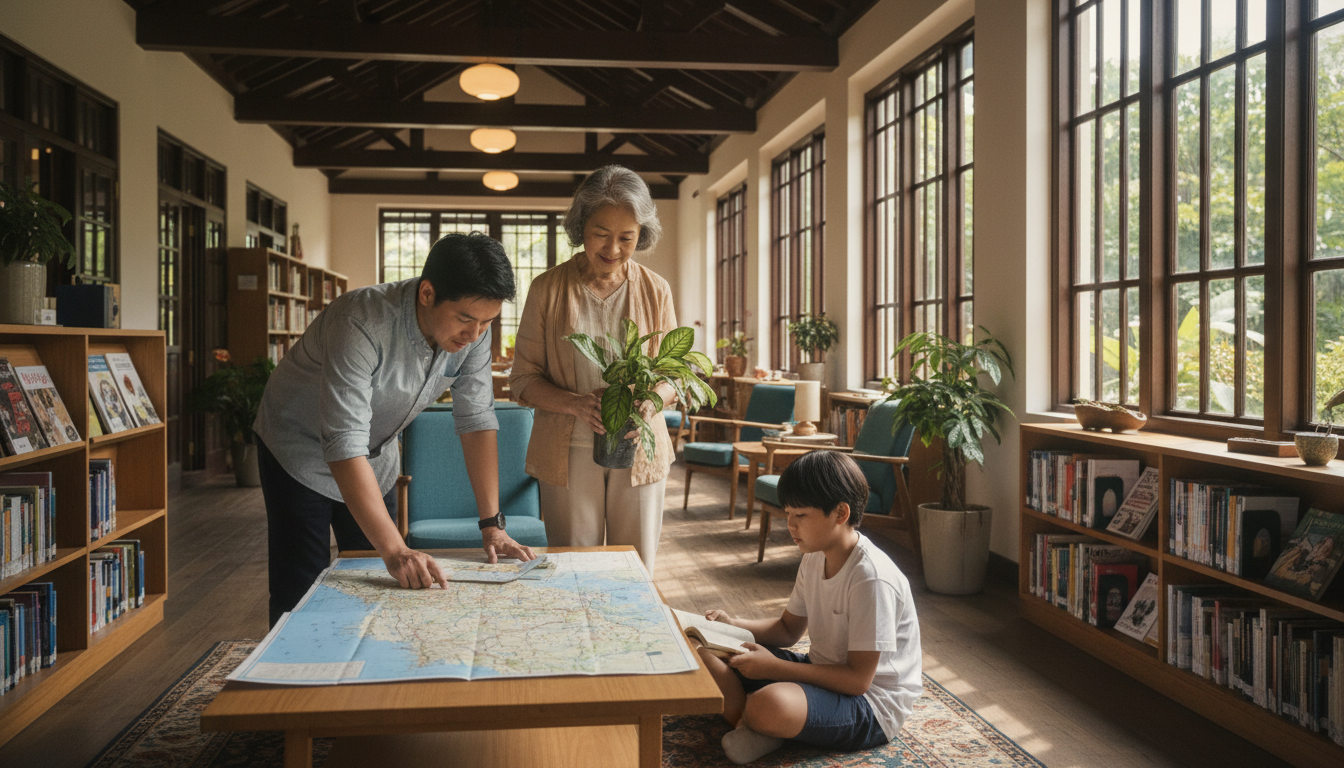
Education is the process of developing knowledge, skills, understanding, values and judgement across life. Schooling is the organised part of that process delivered through institutions, curricula, teachers and assessments. The two overlap, but they are not identical: school can provide essential foundations while people also learn at home, through community activity, work, independent reading and experience. Equally, being enrolled in school does not automatically mean every intended concept has been mastered.
Readers asking “What is the difference between education and schooling?” usually need a clear definition and a practical implication. This guide explains what schools are for, why learning extends beyond examinations, how school qualifications matter, what informal experience can and cannot replace, how Singapore pathways fit together, and what parents and adults can do next. It includes examples, common mistakes, a four-week capability plan and verified reading routes.
- Education: the wider growth of capabilities and understanding, through formal, non-formal and informal learning.
- Schooling: structured participation in an institutional education programme, typically with curriculum, teaching and progression rules.
- What matters: knowledge that can be explained, applied, corrected and transferred—not just attendance or certificates.
- Practical next step: identify the learner’s starting position, the desired outcome and the setting that can responsibly develop it.
Find the answer you need
- What is education, in plain English?
- What is schooling, in plain English?
- Education versus schooling: the central distinction
- Why do societies have schools?
- What is the purpose of education beyond examinations?
- Education is not the same as memorising information
- Education as capability transfer
- Formal, non-formal and informal education
- Education begins before a child goes to school
- What schools teach that life experience may not teach reliably
- What life experience teaches that school may not cover fully
- Schooling and social development
- Why attendance and marks are incomplete measures
- Credentials and real competence: both can matter
- Singapore’s primary-to-secondary education route
- Full Subject-Based Banding and the danger of labels
- ITE, polytechnic, JC and university: multiple kinds of formal learning
- Vocational education is not a lesser form of education
- Schooling, apprenticeships and supervised practice
- Lifelong learning: education continues after graduation
- Is online learning education or merely content consumption?
- How to test whether a child has learned a school concept
- How to turn daily life into useful learning without making home a classroom
- Education and critical thinking in a noisy information environment
- Equality of access and the reality of different starting positions
- What is the hidden curriculum of schooling?
- How school and family can cooperate without duplicating all the teaching
- Three fictional learners: schooling, experience and choice
- A four-week plan to connect school learning with real capability
- Why a meaningful educational decision begins with a question
- Common mistakes when comparing education and schooling
- A final test: what remains when the teacher is no longer present?
- Frequently asked questions
- Reliable sources and connected reading
What is education, in plain English?
Education changes what a person understands and can do. A child learns to read a bus timetable, recognise that a price comparison requires consistent units and explain why a story character acted as they did. An adult learns to understand a contract, improve a work process or distinguish reliable information from a rumour. Each involves capability becoming more precise through experience, explanation, practice and feedback.
The educational process is wider than receiving facts. Someone may know a rule but use it incorrectly when the circumstances change. Effective education develops an understanding of when and why a tool is useful. It can also cultivate judgement about fairness, consequences and uncertainty. The critical question is not merely whether information has been supplied; it is whether the learner can use it responsibly in a new situation.
What is schooling, in plain English?
Schooling is organised education provided through schools and related institutions. It commonly includes a curriculum, scheduled teaching, age or subject groups, assessment, qualifications and rules about participation or progression. Schooling allows a society to give many learners access to foundational knowledge that may be difficult to obtain reliably through chance experience alone.
Schools also create communities of learning. Students encounter peers, adults, disciplines and expectations beyond those in their immediate household. At the same time, a school is a real organisation with limited time and resources. It must plan subjects and make assessment decisions. Recognising that schooling is structured helps parents understand what schools can provide and why some learning must continue beyond a timetable.
Education versus schooling: the central distinction
A simple comparison is that schooling is one important route through education, while education is the wider process and outcome. A student who attends every lesson has participated in schooling; whether a specific concept is understood must be checked. A self-directed adult who studies a reliable manual and demonstrates a new skill is learning even without a classroom. Formal recognition, however, is a separate issue.
The difference should not be used to belittle either route. The phrase ‘school teaches nothing useful’ ignores the foundations, opportunities and qualifications formal institutions can provide. The phrase ‘only school counts as education’ ignores families, communities, apprenticeships and the ongoing work of learning after graduation. A sensible education ecosystem values both while being honest about their strengths and limits.
Why do societies have schools?
Schools help organise access to literacy, numeracy, science, history, language and other domains that a child may not encounter consistently at home. They also create shared standards, opportunities to interact with peers and recognised routes to subsequent study. Their public role includes helping learners participate in society, make informed decisions and develop capabilities that are not limited to an immediate occupation.
Schooling does not guarantee equal outcomes, and schools can differ considerably in resources and execution. But an organised system can make learning less dependent on the fortunes of one household. The practical question is how institutions can provide strong foundational teaching while recognising differences in student needs. Parents and policymakers should evaluate actual learning, access, wellbeing and progression rather than only counting enrolments.
What is the purpose of education beyond examinations?
Examinations can measure important knowledge and skills at defined moments, especially when the questions and marking are well designed. Yet everyday decisions also require understanding information, reasoning about uncertainty, communicating, cooperating and recognising when expert help is needed. These outcomes are part of the wider purpose of education even when a single examination cannot capture them all.
A child who learns percentage calculations may later interpret discounts, loan costs or statistical claims. A student who learns source analysis in History may become more careful about misinformation. A student who learns to support an English argument with evidence may communicate better in civic and working life. These transfers explain why education should aim for durable understanding rather than only short-term reproduction of model answers.
Education is not the same as memorising information
Memory matters. A person cannot reason confidently about a subject while forgetting every relevant fact. But isolated memorisation is not the whole educational journey. A student might remember the formula for area but use it on a quantity measured in the wrong units. Another might recite the definition of evidence yet rely on an unsupported anecdote in an essay. Knowledge must be organised and applied.
A good teacher builds accurate recall alongside explanation and practice in varied contexts. Ask the learner to describe the meaning of the fact, show a worked example and solve a related problem with changed details. The result reveals whether the student has moved from recognition to usable understanding. Education includes remembering, reasoning and transferring rather than declaring those activities rivals.
Education as capability transfer
A useful way to examine progress is to ask whether the learner can carry an idea from one context to another. A student who learns about ratios using coloured blocks should eventually recognise a ratio in recipes, scale drawings or speed. An adult who learns to use a spreadsheet formula should be able to adapt it to a different table rather than copy the original file forever.
Transfer is not automatic. If a task looks unfamiliar, the learner may fail to recognise the underlying relationship. Teachers can help by comparing examples, explaining why a method works and varying practice after foundations are secure. The eduKate capability-transfer overview develops this lens. The practical measure is independent performance with changed surface details, not the number of exercises completed.
Formal, non-formal and informal education
Formal education usually involves organised programmes within a recognised system, while non-formal education includes planned workshops and courses outside that pathway. Informal learning can occur through family experience, work, reading and everyday problem solving. UNESCO’s Recommendation on Adult Learning and Education recognises that these forms all contribute to learning across life.
These labels describe how learning is organised, not whether it is excellent or poor. A formal lesson can be taught badly; a well-designed community workshop may teach a useful skill efficiently. Informal experience can be valuable but may also reinforce mistakes without feedback. Families should choose based on the actual capability and any formal recognition needed. A certificate, a skill and permission to practise a regulated occupation are not interchangeable.
Education begins before a child goes to school
Children learn through responsive relationships, conversation, play, movement and daily routines before formal primary schooling begins. A toddler may learn sequences through preparing a snack, vocabulary through stories and quantity through matching objects. Adults help by naming ideas, modelling actions, setting safe boundaries and giving children appropriate opportunities to practise.
This does not mean every moment of childhood should be engineered to deliver an academic result. Rest, play and relationships have genuine importance. In Singapore, early childhood education uses age-appropriate frameworks rather than asking infants to perform like primary students. Families benefit from recognising what a child can do and what next step is manageable, while avoiding unnecessary pressure for premature examination-style preparation.
What schools teach that life experience may not teach reliably
Everyday experience may reveal some rules of arithmetic and cause and effect, but it cannot be counted on to supply systematic algebra, scientific methodology, historical context or advanced literacy. Schools deliberately sequence knowledge so learners encounter concepts they might otherwise miss. That matters for widening opportunity and preventing access to education from being determined solely by family circumstances.
Structured teaching also helps correct intuitive but mistaken beliefs. A child may believe heavier objects always fall faster or that the larger denominator indicates a larger fraction. Carefully chosen examples and explanations can show why those conclusions fail. Informal observations can start a question; expert teaching may be needed to build a reliable general explanation. Schooling contributes essential knowledge, not merely certificates.
What life experience teaches that school may not cover fully
Schools cannot anticipate every future job, family responsibility, new technology or local problem. An adult may learn how to coordinate a team, identify a misleading service contract or navigate an unfamiliar public process. These situations require applying prior foundations and sometimes acquiring new knowledge independently.
Life experience is not automatically accurate. A person may repeat an inefficient method for years and become highly confident in it. Informal learning needs feedback, comparison with reliable sources and willingness to revise. Education outside school works best when people preserve the habit of asking questions and checking outcomes. The goal is not to abandon institutional knowledge, but to use and extend it when new situations arise.
Schooling and social development
Schools give learners opportunities to work with classmates, understand different perspectives, navigate group responsibilities and seek support from adults. Social capabilities are not guaranteed simply by placing children together. Teachers need to model respectful communication and address exclusion, conflict and unfair roles in groupwork.
A student can receive excellent marks but still feel unable to participate in a group. Another may be socially confident yet struggle with academic foundations. Education should consider both learning and belonging without confusing them. A supportive school helps children reason, communicate and manage difficulty while recognising that their social experiences can differ from their exam performance.
Why attendance and marks are incomplete measures
Attendance tells us that a learner was present at a scheduled activity. Marks can tell us about performance on a defined assessment. Neither alone gives a full account of understanding, relationships, wellbeing or capability in unfamiliar situations. A student may score well by recognising familiar question formats but become confused when those formats change.
Good educators use multiple kinds of evidence: independent work, explanations, error patterns, discussions and suitably designed assessment. Parents can ask what the child can now do and how this compares with an earlier attempt. Results matter, but they should guide the next teaching decision rather than becoming an unchangeable description of the person.
Credentials and real competence: both can matter
Formal qualifications can govern admission to further study, employment requirements and professional licensing. They are important because receiving institutions need recognised evidence that defined standards were met. Skill demonstrations and work portfolios can provide additional information about what a person can currently do.
A learner with substantial informal experience may still need an accepted formal award for a specific pathway. Conversely, a person holding a qualification may require further practice to use a skill confidently at work. Parents and adult learners should ask what the next institution or employer actually requires, then consider capability and credential separately. Avoid assuming that an attractive course certificate is interchangeable with a recognised diploma.
Singapore’s primary-to-secondary education route
Singapore’s formal education system provides a structured route through primary and secondary schooling with defined curriculum and admission arrangements. Parents should use official MOE information for current compulsory education, subject levels and school posting requirements. These rules can change by cohort, so the year and examination matter.
Within this system, learning remains individual. Two children following the same syllabus may begin with different vocabulary, numeracy or confidence. Good support identifies the specific concept that is insecure rather than assuming that more worksheets will solve every problem. The system offers a structure; students still need responsive teaching and opportunities to practise in ways that deepen understanding.
Full Subject-Based Banding and the danger of labels
Singapore’s Full Subject-Based Banding arrangements allow students to study subjects at different levels under applicable rules. Posting groups and subject levels are administrative and educational arrangements, not complete descriptions of a student’s potential. Families should distinguish the current subject-level requirement from the child’s broader strengths and ambitions.
If a student struggles, the useful first question is whether the problem concerns prior knowledge, reading, practice, assessment technique or available support. Different causes call for different responses. Families should verify school-specific offerings and official progression rules, especially during the transition to new national assessment arrangements. A child’s education is more than a single category used to organise schooling.
ITE, polytechnic, JC and university: multiple kinds of formal learning
Post-secondary education in Singapore includes routes with different combinations of academic study, applied learning, workplace experience and qualification requirements. ITE, polytechnics, junior colleges and universities are not interchangeable products to be ranked along one simplistic ladder. Each serves different programmes, goals and entry arrangements.
Course choice should begin with the actual qualification and curriculum. What must the learner know? How is practical competence developed? What are the current entry requirements, total costs and routes for progression? Refer to official institutional sources and current admission information. A pathway can be valuable when it meets the learner’s goals and develops real capability, rather than because its name is regarded as socially prestigious.
Vocational education is not a lesser form of education
Technical and vocational programmes can require sophisticated reasoning, safe procedures, mathematical accuracy, communication and judgement. A student troubleshooting a transport system or maintaining a healthcare device must understand the relevant technical principles, not merely imitate hand movements. Applied training can be intellectually demanding and socially valuable.
Academic and vocational education often overlap. An engineering degree may include practical projects, while a technical qualification may include theory and general education. The better comparison is between actual courses: learning objectives, qualification recognition, workplace opportunities, progression, support and personal fit. Families should avoid treating a vocational route as proof that a learner lacks academic potential.
Schooling, apprenticeships and supervised practice
Some capabilities require carefully supervised performance. Reading a manual about electrical safety does not authorise someone to perform regulated work. A workplace mentor may help an apprentice connect classroom concepts with safe procedures, while recognised training and assessment may still be necessary.
Here the difference between education and schooling is especially clear. The person learns through a combination of structured teaching, observation, supervised practice and feedback. No single setting supplies everything. The value of the pathway comes from bringing knowledge and action together responsibly. Exact professional and licensing requirements should always be checked with the relevant authority rather than inferred from informal experience.
Lifelong learning: education continues after graduation
A person may graduate from university and later need to learn unfamiliar software, new workplace regulations or a different way of communicating. The end of a formal programme is not the end of education. UNESCO’s adult learning recommendation connects formal, non-formal and informal learning across adulthood.
A sustainable learning habit begins with one meaningful goal. A worker who needs to analyse data may start with a short course, practise with anonymised examples and seek feedback before considering a broader qualification. A parent may return to formal study after years of experience. The key is to identify the starting position, choose a credible route and check what can be applied independently afterwards.
Is online learning education or merely content consumption?
An online platform can offer structured teaching, independent exercises, feedback and assessment. It can also offer hours of video that a learner watches passively. The delivery medium does not settle the quality of education. What matters is the design and whether the learner can explain and use new knowledge.
Ask who provides guidance, how errors are corrected and what the certificate actually means. A person may enjoy a course yet remain unable to perform the skill without following the tutorial. This is why the online learning guide recommends active practice and independent evidence. Education is not measured by the length of a playlist.
How to test whether a child has learned a school concept
After a lesson, ask the child to explain one idea in ordinary language and demonstrate it with a fresh example. For a Mathematics concept, change the numbers or context. For English, use a different passage. For Science, ask what variable would matter in a related experiment. A correct explanation may show understanding that a familiar worksheet concealed.
The goal is not to interrogate children every evening. Choose a short, supportive check and listen for where the reasoning becomes uncertain. If the child cannot proceed, return to the first missing prerequisite and coordinate with the teacher where appropriate. This approach turns home support into a clearer diagnosis rather than an endless supply of extra questions.
How to turn daily life into useful learning without making home a classroom
Parents can connect school knowledge to safe ordinary activities. Comparing package sizes involves division and units. Reading a public notice requires vocabulary and interpretation. A family discussion about a news claim invites questions about sources and evidence. A walk can prompt observation of plants, materials, shadows or transport design.
These moments work best as conversation rather than compulsory exercises. Let the child notice, ask and explain. Supply an accurate word or correction when needed, then move on. Family life also needs rest, play and relationships that are not evaluated. The purpose is to help children see that school knowledge has meaning, not to turn every shared experience into a performance review.
Education and critical thinking in a noisy information environment
Modern learners encounter claims from advertisements, search results, social media, AI tools and peer conversations. Schooling can teach reading, mathematics and source analysis that help evaluate these claims, but adults must keep using those skills outside formal lessons.
Ask what was actually observed, who produced the information and whether the conclusion extends beyond the evidence. A large percentage without a denominator may mislead. A confident AI-generated quotation may be fabricated. A dramatic video may omit important context. Critical thinking is an educational habit that combines subject knowledge with careful judgement. It is useful precisely because life presents unfamiliar claims that were not listed on an examination syllabus.
Equality of access and the reality of different starting positions
A school system may offer the same general curriculum to many children while their starting positions differ. Some learners have a strong language foundation, quiet study space and reliable equipment. Others face barriers related to resources, accessibility, health or family circumstances. Equal treatment on paper does not always produce equal opportunity to participate and grow.
Education systems can respond through appropriate support, accessible materials, effective teaching and careful allocation of resources. The goal is not to guarantee identical results but to prevent avoidable barriers from determining who can learn. Parents should ask what support addresses a specific need rather than assuming that giving everyone the same worksheet is always the fairest approach.
What is the hidden curriculum of schooling?
Students learn from school routines as well as explicit subject lessons. They notice whether adults encourage honest questions, whether errors become opportunities for correction and how classmates are treated when they struggle. These repeated experiences can influence confidence, willingness to ask for help and views about learning.
A school that tells students to think critically but rewards only memorised slogans may communicate a contradictory message. A school that claims inclusion while routinely excluding a learner from meaningful group roles sends another. Families can ask how the school’s values appear in ordinary teaching, not only in brochures. Culture matters because students carry these expectations into work and community life.
How school and family can cooperate without duplicating all the teaching
Teachers have curriculum responsibilities, subject expertise and evidence from classrooms. Families know the child’s routines, concerns and experiences outside school. Good cooperation begins with a concrete learning question rather than an accusation. For example, ‘My child can calculate a fraction from a picture but cannot explain a new word problem’ identifies something useful to investigate.
Ask the teacher what skill is being targeted and which small form of practice would help. Parents should avoid automatically teaching a competing method when the student is already confused. A brief routine of retrieval, conversation or reading may be more valuable than a large amount of unsupervised extra work. The purpose is coherent support, not making the household another school.
Three fictional learners: schooling, experience and choice
Alicia, aged ten, learns percentages at school and then uses them to compare fictional sale prices at home. The first environment supplies structured knowledge; the second creates a chance to transfer it. Ben, aged sixteen, enjoys technical design and investigates formal technical pathways alongside academic options, comparing actual curricula rather than social stereotypes.
Mira, an adult learner, has developed valuable practical judgement at work but needs a recognised qualification for the next career step. She checks the receiving institution’s requirements and chooses further study accordingly. These are fictional illustrations, not claims about actual students. They show that education can develop across multiple settings while different decisions may still require formal schooling or qualifications.
A four-week plan to connect school learning with real capability
Week 1 — State the goal and the starting point. Select one useful ability, such as comparing fractions, writing a clear explanation or evaluating a source. Ask the learner to attempt a short task independently. Record the exact difficulty rather than assigning an ability label.
Week 2 — Teach the missing link. Use the relevant school material or a credible explanation, then practise with guidance. Ask the learner to explain why the method works. If the gap concerns earlier knowledge, teach that foundation before adding advanced questions.
Week 3 — Use the concept outside the original exercise. Choose a new but safe everyday context and ask the learner to apply it. Compare an answer with a reliable standard. Give specific feedback and allow another attempt without treating an error as a personal failure.
Week 4 — Check transfer after a delay. Return to the idea with different details and no step-by-step hint. Discuss what improved, what remains uncertain and the next useful step. This routine is an informal learning aid, not a formal developmental assessment or a guarantee of grades.
Why a meaningful educational decision begins with a question
Parents often encounter broad messages that a child needs more tuition, a more prestigious school or an accelerated curriculum. Before acting, identify the problem. Is a concept missing? Is the student overloaded? Does the next qualification require a particular formal route? Does an adult learner need practical skill or officially recognised credit?
Different questions have different answers. A child with an unstable Mathematics foundation may need targeted teaching, not a complete change of school. A student seeking professional licensing may need a formally recognised programme, not an online tutorial alone. A curious child may benefit from safe exploration rather than another exam preparation class. Good educational planning is specific, measured and responsive.
Common mistakes when comparing education and schooling
Mistake: assuming school attendance proves understanding. Repair: ask for independent evidence of learning. Mistake: claiming school is worthless because life also teaches lessons. Repair: recognise the value of systematic knowledge and recognised pathways. Mistake: treating every certificate as proof of advanced competence. Repair: inspect assessment and recognition.
Mistake: assuming experience always substitutes for formal qualification. Repair: check requirements with the receiving authority. Mistake: turning every family interaction into a lesson. Repair: protect relationships and unstructured play. Mistake: ranking pathways solely by prestige. Repair: compare course fit, support, cost and the capability the learner wants to develop.
A final test: what remains when the teacher is no longer present?
The deepest educational question is whether a learner can use knowledge when the original teacher, worked example or familiar worksheet is absent. Someone who can identify a relevant idea, adapt it, detect an error and ask for reliable help has developed capability that can travel beyond its first setting.
Schools matter because they build foundations and provide opportunities that should not depend solely on chance. Life beyond school matters because new problems keep appearing. Education succeeds when these two worlds reinforce each other. The goal is a person who can keep learning, make better decisions and participate responsibly long after a particular class has ended.
Frequently asked questions
Is education the same as schooling?
No. Schooling is a formal, organised route within the wider process of education, which also includes learning through family, community, work and self-study.
Can a person be educated without attending school?
People can develop substantial knowledge outside formal schooling, but compulsory education rules and requirements for recognised qualifications still apply where relevant.
Why are schools important?
Schools provide structured teaching, foundational knowledge, shared opportunities, recognised progression and experiences that may be difficult to obtain consistently through informal learning.
What is the purpose of education?
To develop understanding, capabilities, judgement and participation that people can use in new situations throughout life.
Does good exam performance prove someone is well educated?
Exam results can provide valuable evidence for defined subjects, but they do not measure every aspect of knowledge, transfer, wellbeing or social capability.
What is lifelong education?
Continuing to acquire, apply and revise knowledge and skills across life through formal, non-formal and informal learning.
Can work experience replace a degree?
It depends on the receiving employer, institution and applicable rules. Some pathways recognise experience; others require specific formal qualifications.
Is technical education less valuable than academic education?
No. Both may require demanding knowledge and practical reasoning. The right comparison is the actual programme, qualification, goals and progression opportunities.
How can parents support learning outside school?
Connect one concept to a safe everyday example, listen to the child’s reasoning and give specific help without turning family time into constant testing.
What is the best way to know learning has transferred?
Ask the learner to explain and apply an idea to a different problem without copying the original model.
Reliable sources and connected reading
UNESCO’s Recommendation on Adult Learning and Education recognises formal, non-formal and informal learning across life. The UNESCO Institute for Statistics glossary explains non-formal education. For Singapore school and qualification decisions, verify details with MOE and the relevant education institution. These references help explain the ideas without replacing cohort-specific official rules.
Continue with eduKate Education Hub, What is Education? The Capability Transfer System, Formal, Non-Formal and Informal Education and The Singapore Education System. The useful answer is always connected to what the reader needs to understand or do next.