
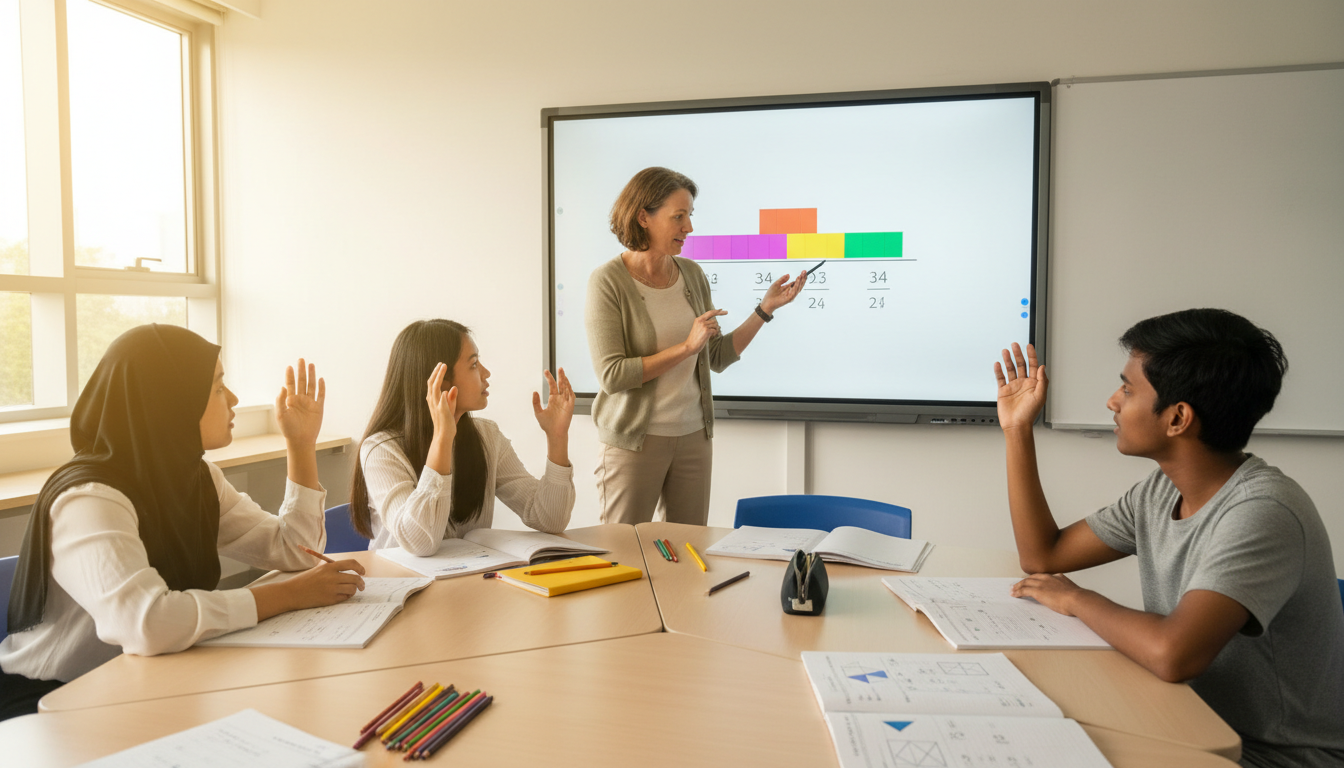
Pedagogy is the practice and study of teaching: how educators choose explanations, examples, activities, feedback and assessments to help people learn. A syllabus tells us what content a student is expected to know; pedagogy asks how a teacher will help that student understand and use it. Good pedagogy is responsive rather than fashionable. It begins with the learner’s starting position, the subject’s demands and an appropriate way to check genuine progress.
This guide explains pedagogy for parents, students, tutors and teachers. It compares explicit instruction, inquiry, discussion, differentiated teaching and feedback; shows how pedagogy works in Singapore English, Mathematics and Science; and offers a four-week guide for deciding whether an approach is actually helping. It also explains pedagogy versus curriculum, teaching philosophy and andragogy so readers can judge a school or tuition programme by meaningful evidence rather than slogans.
- What pedagogy means: decisions about teaching that connect learning goals with students’ needs.
- What good teaching needs: accurate content, clear examples, participation, suitable practice, feedback and fair access.
- What to look for: whether the learner can explain and solve a related task without copying the teacher.
- What to avoid: fixed learning-style labels, activity for its own sake and promises that one method works for everyone.
Find the answer you need
- What is pedagogy in plain English?
- What does UNESCO mean by pedagogy?
- Pedagogy versus curriculum: the useful difference
- Pedagogy versus teaching method versus learning activity
- What makes pedagogy appropriate rather than fashionable?
- The learner’s starting position is the first pedagogical decision
- Explicit instruction: when the teacher should explain first
- Worked examples: show the structure, not only the steps
- Scaffolding: help that is intended to disappear
- Guided practice and independent practice have different roles
- Inquiry-based teaching: questions need accurate knowledge
- Discussion: learning happens through reasons, not volume
- Differentiated instruction: same goal, suitable routes
- Formative assessment is part of pedagogy, not an extra test
- Feedback that changes the next attempt
- Pedagogy and metacognition: teach how to check thinking
- Why a preferred learning style should not dictate pedagogy
- What is constructivism?
- What is direct instruction?
- What is student-centred teaching?
- Pedagogy for Primary 1 and 2 learners
- Pedagogy for Primary 3 to 6
- Pedagogy during the Secondary 1 transition
- Pedagogy in English comprehension
- Pedagogy in Mathematics
- Pedagogy in Science
- Pedagogy in humanities and source evaluation
- Pedagogy for students needing additional support
- What parents should ask a tutor about pedagogy
- How to inspect a sample lesson fairly
- When teaching approaches fail, how should they change?
- What about educational technology and AI?
- Why pedagogy matters beyond school
- A four-week parent-teacher pedagogy check
- Three fictional learners, three different pedagogical responses
- Common pedagogy mistakes parents can recognise
- The final test: what did teaching make possible?
- Frequently asked questions about pedagogy
- Sources and connected education reading
What is pedagogy in plain English?
Imagine a Secondary 1 student who repeatedly makes a sign error in algebra. One tutor gives the student ten more questions. Another asks the pupil to explain the first incorrect line, discovers confusion about negative-number addition, models that specific relationship and then checks a changed equation. Both tutors are doing something called teaching, but their pedagogical decisions are different.
Pedagogy is concerned with the quality and reasons for those decisions. It covers how a teacher introduces a concept, notices misunderstanding, selects representations, provides practice and decides when the child is ready to move on. A good lesson is not merely one that feels pleasant. It should produce clearer understanding and increasing learner independence. That is why parents benefit from learning the word even if they never intend to become teachers.
What does UNESCO mean by pedagogy?
UNESCO’s explanation of pedagogy calls it the art and science of teaching and includes methods, strategies, instructional materials and assessment. This broad definition matters because pedagogy is not synonymous with just one activity such as group discussion, homework or a lecture. It is the entire relationship between learning aims and the teacher’s practical choices.
The art refers to judgement about learners, timing and communication; the science refers to learning from credible research and evaluating results. Neither should be exaggerated. Research averages cannot tell a parent precisely what will work for one child without diagnosing that child’s needs, while experience alone may reinforce a teacher’s untested habits. The most responsible approach connects careful observation with subject expertise and appropriate evidence.
Pedagogy versus curriculum: the useful difference
A curriculum defines intended learning, content, sequence and a broad plan for teaching and assessment. Pedagogy concerns how educators help learners reach those objectives in practice. A Mathematics syllabus might identify fractions and percentages; a teacher then selects models, demonstrations, questions and exercises suitable for the class.
The difference is especially useful when parents compare tuition providers claiming to cover the same MOE syllabus. Two programmes may list identical chapter titles while delivering very different learning experiences. One may rely on repetitive drills; another may diagnose concepts, explain the mathematical relationships and check transfer. For a fuller comparison, read eduKate’s Curriculum versus Syllabus guide. Content coverage is only part of the educational decision.
Pedagogy versus teaching method versus learning activity
A teaching method is a particular way of organising instruction, such as modelling, discussion or guided inquiry. A learning activity is what the student does, such as comparing two graphs or writing a paragraph. Pedagogy is the larger judgement connecting those choices to a goal and a learner’s needs. This distinction prevents the method from becoming an identity.
A teacher may use the same physical counters to teach a concept to two groups for different reasons. One group needs an initial representation of quantity; another needs to detect a misconception in a word problem. The activity alone does not explain its value. Ask what the activity reveals, what was taught before it and what the teacher will do with the learner’s response.
What makes pedagogy appropriate rather than fashionable?
Good pedagogy fits the learning goal, prerequisite knowledge, age, accessibility requirements and subject. A clear explanation is valuable when a concept is unfamiliar. A carefully structured discussion can help learners compare arguments once they understand the relevant terms. A practical investigation can test a scientific idea when safe measurement and theory have been introduced.
A fashionable label is weaker evidence than a complete teaching sequence. Ask the educator why that method was chosen, what common error it targets and how the learner’s next attempt will be evaluated. If the teacher cannot explain these decisions, the programme may be delivering activity rather than instruction. Good teaching is adaptable without being directionless.
The learner’s starting position is the first pedagogical decision
A student may achieve a modest Mathematics score because of weak fractions, careless arithmetic or unfamiliar language in word problems. The total mark alone cannot distinguish these causes. A tutor who assumes all students need more practice may inadvertently repeat the very conditions that caused the confusion.
Start with a short representative task and inspect the earliest substantive error. Then connect the finding to a suitable teaching action. The student missing a conceptual relationship needs explanation; the student with secure understanding but slow execution may need appropriately varied fluency practice. This is pedagogy grounded in diagnosis instead of broad labels such as weak student or fast learner.
Explicit instruction: when the teacher should explain first
Explicit instruction involves clearly stating the target, modelling important reasoning and providing guided opportunities to practise. A teacher explaining the equality principle can show how applying the same operation to both sides preserves an equation. Students then attempt related examples with feedback before working independently.
The Education Endowment Foundation’s Five-a-day guidance includes explicit instruction among evidence-informed approaches for supporting pupils with additional needs. It is not restricted to those pupils. Nor does it imply a teacher should talk continuously. A strong explicit lesson makes the reasoning visible and quickly moves toward a student demonstrating it.
Worked examples: show the structure, not only the steps
A worked example is helpful when learners cannot yet solve a task independently. It reduces guesswork and illustrates the correct reasoning. But copying many worked solutions can create familiarity without understanding. A student may recognise each algebra step while still being unable to choose the method for an unfamiliar equation.
A teacher can explain why each step is justified, then gradually remove prompts and present a changed task. Ask the student to state the relationship instead of copying a memorised phrase. When the learner can solve another problem and check the result, the example has served its purpose. It should not become a permanent substitute for independent thinking.
Scaffolding: help that is intended to disappear
Scaffolding provides temporary support so a learner can engage with a task beyond their current independent ability. The support might be a visual representation, a sentence frame, a partial example or a targeted question. A child who struggles to write an inference may begin with a prompt linking evidence to a claim.
Support should be adjusted as competence grows. If the teacher always supplies the first step, the student may appear successful but never learn to choose a method. A useful check removes one scaffold and observes what happens. A learner who cannot continue needs more instruction, not humiliation. Good scaffolding is a route toward agency, not permanent dependence.
Guided practice and independent practice have different roles
Guided practice allows the teacher to observe reasoning while help is available. Independent practice checks whether the learner can select and apply a method without continuous prompting. Both matter. A teacher who moves immediately from explanation to a difficult assessment may leave the child unprepared; a teacher who never removes prompts may conceal a gap.
Choose tasks that match the progression. Begin with a manageable case, increase variation and use clear feedback. Later revisit the concept after a delay. Students may need more than one cycle, but repetition should address the actual error. A polished guided worksheet is not necessarily proof of mastery when the child still needs the teacher to make every important decision.
Inquiry-based teaching: questions need accurate knowledge
Inquiry-based learning organises work around questions, evidence and explanations. A Science teacher can ask which safe material absorbs more water, guide students to control relevant variables and discuss what the observations support. A teacher may teach measurement principles before the investigation so that children can gather meaningful data.
Inquiry becomes shallow when students spend an hour on activities without connecting them to correct concepts. The teacher remains responsible for scope, safety, background knowledge and assessment. The Inquiry-Based Learning guide explores these boundaries. The pedagogical decision is not whether inquiry sounds inspiring; it is whether the students are prepared to investigate and can explain what they learned.
Discussion: learning happens through reasons, not volume
A good classroom discussion asks students to explain a claim, compare evidence or assess different methods. In English, pupils might discuss two interpretations of a character’s action and identify which textual details support each. The teacher can model accurate reasoning and prevent unsupported guesses from becoming accepted through confidence alone.
Group talk is not automatically active learning. Some pupils may dominate and others remain silent. Provide thinking time, short written responses and fair turns where useful. Then check individual work. A thoughtful student who speaks less can still demonstrate excellent understanding. Pedagogy values the quality of reasoning rather than the noise level of the room.
Differentiated instruction: same goal, suitable routes
Students can share a core learning goal while needing different immediate teaching. In a fractions lesson, one group may need a concrete equal-parts model, while another is ready for a word problem requiring deeper reasoning. The teacher can use formative evidence to decide which support or challenge is useful.
Differentiation is not permanently ranking children or preparing a completely separate syllabus for every pupil. Flexible grouping and scaffolding should be tied to current needs and reviewed. See Differentiated Instruction for a parent-friendly explanation. What matters is meaningful intellectual work for every student.
Formative assessment is part of pedagogy, not an extra test
Formative assessment gathers evidence during teaching so the teacher can decide what to do next. A one-question check may reveal that many pupils are confusing denominator size with quantity. The next explanation can address that misconception before moving ahead. A school that repeatedly gives quizzes but never adjusts teaching is missing much of the benefit.
Assessment must match the intended skill. If the objective is reasoning from a passage, a quiz testing only vocabulary recall may not reveal comprehension. The teacher should inspect errors, offer correction and test understanding with changed examples. A test is valuable as information for learning, not merely because it produces another number.
Feedback that changes the next attempt
Feedback should identify something the learner can use. ‘Wrong again’ provides little help; ‘you used the new price instead of the original price as the percentage base’ identifies a specific problem. The teacher can then demonstrate the relationship and invite a new calculation.
The EEF Teacher Feedback guidance emphasises high-quality initial instruction and formative assessment as foundations for effective feedback. Whether the comment is spoken or written matters less than whether the learner understands what to improve. A teacher should make room for the student to use feedback, not only provide pages of comments.
Pedagogy and metacognition: teach how to check thinking
Metacognition involves planning, monitoring and evaluating one’s learning. A teacher can model why an algebra method was chosen, how to detect a unit error or how to check whether an English paragraph answers the prompt. Students practise those decisions and gradually make them with less adult guidance.
The EEF’s November 2025 second-edition guidance notes the importance of teaching metacognitive strategies within subject lessons. General encouragement to study smarter is less useful than a concrete script tied to real work. The educational goal is a learner who can detect and repair mistakes without waiting for someone to announce every step.
Why a preferred learning style should not dictate pedagogy
Some programmes ask pupils to complete a questionnaire and then restrict lessons to visual, auditory or kinesthetic activities. Students can have preferences, but a fixed label does not show which concept they misunderstand. It also does not establish that matching teaching to the label reliably improves attainment.
Choose representations according to the subject and learner’s actual needs. A visual diagram is useful for spatial relationships, listening is important for pronunciation and writing is essential when the target is composition. Children need to become capable across these representations. The Learning Styles guide explains the limits of fixed categorisation.
What is constructivism?
Constructivist perspectives emphasise that learners build understanding by connecting new information with prior ideas and experiences. Teachers can use this principle to identify misconceptions and create meaningful explanations. A student interpreting a fraction picture brings existing assumptions about whole numbers, and those assumptions influence how the new concept is understood.
Constructivism is not an instruction to leave beginners to invent knowledge without guidance. Teachers still need subject expertise, accurate models and a plan for correcting mistaken ideas. The useful lesson is to attend to what learners already believe and show where an explanation needs revision. A student constructs understanding through interaction with reliable teaching and evidence.
What is direct instruction?
Direct instruction is a term used in several related ways, including clearly guided explanation and more specific structured instructional programmes. In everyday parent language it often means the teacher demonstrates a method and supports practice. A well-designed direct explanation can make unfamiliar knowledge accessible quickly.
Do not assume direct instruction is identical to endless lecturing. A teacher might explain for five minutes, ask every student to respond, then correct errors and provide independent work. The value depends on the clarity and completeness of the learning sequence. It can be complemented by inquiry or discussion when students are prepared to reason more independently.
What is student-centred teaching?
Student-centred teaching gives learners meaningful responsibility for aspects of questioning, decision-making or application. A student may choose a suitable representation for a problem, propose a testable research question or explain how feedback changed a draft. Agency is valuable when it is connected to academic knowledge and appropriate boundaries.
A student-centred classroom still needs a competent teacher. The adult must know when to provide direct instruction, when to offer a prompt and when to allow independent work. The Student-Centred versus Teacher-Led Learning guide compares the approaches. They are not necessarily rivals; teaching can shift between them as knowledge develops.
Pedagogy for Primary 1 and 2 learners
Young learners need clear, developmentally appropriate instruction, language-rich interaction and opportunities to move, explore and practise. A teacher can use concrete objects to represent quantities and stories to expand vocabulary. An effective lesson should have a manageable goal and avoid overwhelming pupils with unnecessary abstraction before foundations are secure.
Singapore’s reduced emphasis on weighted assessment in the first two primary years does not remove the need for teachers to check understanding. A child may be unable to count objects reliably even while reciting number words fluently. The educator needs to notice this difference and teach the relevant skill. Pedagogy protects early learning from becoming only worksheet completion.
Pedagogy for Primary 3 to 6
As reading, Science and Mathematics become more demanding, students need explicit vocabulary instruction, accurate conceptual models and practice in unfamiliar tasks. An educator should use the current subject syllabus to understand expectations while recognising that pupils in the same class have different starting points.
A Primary 5 learner who misunderstands percentages may need to revisit part-whole reasoning before attempting advanced problem sums. Another may understand the concept but repeatedly misread an instruction. The teacher should select different corrections. Good pedagogy prevents exam preparation from becoming an indiscriminate pile of questions.
Pedagogy during the Secondary 1 transition
Secondary school introduces more abstract Mathematics, complex writing and different expectations across subjects. Students may be accustomed to recognising familiar primary question types and become uncertain when they must express relationships symbolically. A teacher can bridge this by explicitly connecting earlier methods to new notation.
Pedagogy should also account for the transition in routine. Learners may need to organise several teachers’ assignments, ask for clarification and understand feedback. A tutor who assumes all difficulty is lack of intelligence may miss both curricular and organisational problems. Effective support begins with careful diagnosis and a realistic progression.
Pedagogy in English comprehension
A student can read quickly yet fail inference questions because they choose evidence that does not support the claim. The teacher models a short reasoning process: identify what the question asks, locate the relevant clue and explain the connection. The learner then tries the method on a changed passage.
Additional worksheets may be useful after the misconception is repaired, but not as a substitute for teaching. A child’s difficulty might instead involve vocabulary, decoding or interpreting tone, each requiring a different response. A pedagogically sound lesson distinguishes those causes and checks understanding rather than simply recording low marks.
Pedagogy in Mathematics
Mathematics pedagogy connects concrete meaning, diagrams, symbolic expressions and independent reasoning. In fractions, a bar representation can reveal why two equal parts are each larger than three equal parts of the same whole. In algebra, a balance model can clarify why operations must preserve equality.
These models should lead to more general understanding. Ask the child to apply the relationship to a changed problem without the original object or diagram. If they cannot, the teacher may need to return to the underlying concept. A correct formula recited from memory is helpful only when the learner knows when and why it applies.
Pedagogy in Science
Science requires accurate concepts and careful reasoning from evidence. Students can investigate safe questions, identify variables, observe results and discuss what their data support. The teacher must provide appropriate safety guidance and explain the scientific principles, especially when a model is too simple to represent every real-world condition.
A pupil who produces an impressive project may still misunderstand causation or measurement. Ask what was changed, what remained comparable and whether the conclusion is justified. A changed experiment or source of data provides a useful transfer check. Good teaching prevents the appearance of scientific activity from being mistaken for scientific understanding.
Pedagogy in humanities and source evaluation
History and Social Studies require subject knowledge alongside the ability to evaluate evidence. A teacher can demonstrate how the origin, purpose and context of a source affect what it may support. Students then compare accounts and explain why one conclusion is better justified than another.
Not every interpretation deserves equal confidence. The teacher should correct factual misunderstandings while allowing students to consider reasonable perspectives. A discussion can be lively and still fail educationally if it ignores evidence. Good pedagogy teaches students to distinguish observation, inference, claim and limitation in the context of the actual subject.
Pedagogy for students needing additional support
Some students require accessible materials, more explicit modelling, alternative communication or specialist support. A teacher should identify the functional barrier before selecting a strategy. Providing the same worksheet to everyone may be consistent treatment without being a meaningful opportunity for all to learn.
Support should preserve the academic goal where appropriate and include a plan for checking progress. A child who struggles with dense text may understand the Science concept once the instructions are accessible. Another may need specialist literacy instruction. Pedagogy is not a replacement for formal accommodation rules or qualified assessment when they are indicated.
What parents should ask a tutor about pedagogy
Ask the tutor to explain how they identify a student’s starting position, what a typical lesson contains and how they respond when a pupil does not understand. Request a concrete example of a misconception repaired through teaching. Can the tutor describe what the child could not do before and what they could do independently afterwards?
Also ask about curriculum alignment, class size, feedback and homework load. A smaller class may allow more individual observation, but it does not guarantee good pedagogy. The decisive evidence is whether the educator’s choices build understanding. A credible tutor should be able to explain the mechanism without promising that every child will receive an identical grade outcome.
How to inspect a sample lesson fairly
Do not judge solely by whether the room is quiet or the activities colourful. Look for a clear objective, accurate explanation and meaningful student responses. Are misconceptions identified? Does the teacher give thinking time? Can quieter students participate? Is the level of difficulty appropriate? Does practice move toward independent application?
After the lesson, ask the learner to explain one central idea and solve a related question. The result may not reveal everything from one observation, but it provides a better signal than the number of worksheets or slides used. Evaluate repeated teaching patterns over time and distinguish the student’s genuine needs from the atmosphere of a staged demonstration.
When teaching approaches fail, how should they change?
A teacher may find that a diagram causes more confusion than clarity, a group activity conceals individual gaps or a quiz reveals an unexpected misconception. Failure of one activity does not automatically prove that the learner cannot learn or the entire pedagogical philosophy is wrong.
The educator should identify what did not work, clarify the objective and select a new explanation or task. A brief direct model may be appropriate where open inquiry failed. A deeper application may be appropriate where routine practice has become too easy. Changing strategy in response to evidence is a sign of responsible teaching, not inconsistency.
What about educational technology and AI?
Digital platforms can provide explanations, access supports and opportunities for practice, but a completion badge is not proof of understanding. An AI assistant may give a polished answer while containing an error or doing the thinking the learner was meant to perform.
A teacher should decide which tool supports the actual lesson, what information is safe to use and how learning will be verified independently. The student’s ability to explain and apply a concept after closing the tool matters more than engagement statistics. Technology should be chosen as part of pedagogy rather than allowed to dictate it.
Why pedagogy matters beyond school
Adults in professional courses, workplaces and community programmes also need accurate instruction, practice and feedback. A workplace trainer may demonstrate a safe procedure and then assess the learner performing it under supervision. A language instructor may give specific feedback on communication rather than simply play another lecture.
Adult learners bring different responsibilities and experiences, but broad principles of clear goals and credible assessment remain relevant. A course is not automatically effective because its participants are motivated or its certificate looks formal. Whether learning is school-based or workplace-based, pedagogy should help the learner build capability and recognise its limits.
A four-week parent-teacher pedagogy check
Week 1 — Identify the real learning goal. Choose one subject concept, examine a recent independent attempt and describe the first meaningful error. Ask what a correct explanation would demonstrate. Avoid general labels such as weak foundation without identifying the specific missing relationship.
Week 2 — Review the teaching response. Ask how the concept is explained, which model or example is used and whether the pupil practises with appropriate support. Observe whether the teaching addresses the diagnosed misconception instead of adding unrelated material.
Week 3 — Check independence. Provide a changed question without the original prompt and inspect the reasoning. If misunderstanding persists, discuss another teaching strategy or a missing prerequisite. If the learner is secure, provide suitable extension rather than repetitive work.
Week 4 — Evaluate and choose the next step. Compare the student’s independent performance with week one and determine what still needs support. Keep the plan manageable. This is a parent communication and learning routine, not a formal teacher evaluation or a guarantee of exam results.
Three fictional learners, three different pedagogical responses
Alicia understands fraction pictures but cannot interpret a new word problem; her teacher models how the written quantities map to a diagram. Ben reads comprehension passages fluently but chooses irrelevant evidence; his teacher demonstrates inference and textual justification. Mira has mastered the introductory Science concept and needs more demanding comparisons rather than another basic worksheet.
All three are learning, but the useful teaching action differs. The teacher’s task is to diagnose, explain, practise and review. These fictional examples do not prove one method universally superior. They show why good pedagogy must be responsive to the subject and the individual learner.
Common pedagogy mistakes parents can recognise
Mistake: equating syllabus coverage with mastery. Repair: check independent understanding. Mistake: believing every engaging activity produces learning. Repair: ask what subject outcome it develops. Mistake: using learning-style labels as permanent teaching rules. Repair: choose representations based on the task and actual needs.
Mistake: assigning more practice without explaining the misconception. Repair: use accurate corrective teaching. Mistake: making all groupwork student-led without monitoring contributions. Repair: check individual understanding. Mistake: choosing a tutor because of marketing terminology alone. Repair: ask what the teacher will do when a child gets stuck.
The final test: what did teaching make possible?
At the end of a productive lesson, the student should be better able to explain, remember or apply an idea. The teacher’s method is valuable because it contributes to that change. Some lessons require direct instruction, some benefit from discussion and others use a safe practical experience. None succeeds by its label alone.
Parents can be ambitious about learning without becoming obsessed with every new teaching fashion. Start from the child’s real difficulty, ask how it is taught and check progress with another problem. Pedagogy works when the learner’s understanding grows beyond the teacher’s demonstration.
Frequently asked questions about pedagogy
What is pedagogy in simple terms?
The practice and study of teaching, including the choice of explanations, methods, examples, feedback and assessment.
Is pedagogy the same as curriculum?
No. Curriculum concerns intended learning and its wider organisation; pedagogy concerns how teachers help students learn it.
What is an example of pedagogy?
A teacher diagnoses a fraction misconception, explains it with equal-parts diagrams, guides practice and checks a changed question.
What are the main types of pedagogy?
Educators may use explicit instruction, guided inquiry, discussion, collaborative learning, differentiated teaching and other approaches depending on the objective.
Is student-centred teaching always better?
No. Strong teaching often combines clear direct explanation with increasing student independence.
What is a worked example?
A correct model of a task that explains relevant reasoning before learners practise and gradually work independently.
What is scaffolding?
Temporary support that helps a student complete a task and is removed when independent capability grows.
Does good pedagogy mean using technology?
No. Technology can help when it serves a learning objective, but a device or AI tool cannot establish understanding by itself.
How can parents recognise a good tutor?
Ask how the tutor diagnoses actual gaps, explains misconceptions and checks whether a student can solve a new problem without hints.
Can teachers use several pedagogies together?
Yes. Methods can be sequenced or combined as long as the subject goals, accuracy and learner needs remain clear.
Sources and connected education reading
Foundational reading: UNESCO: Pedagogy, EEF: Supporting High Quality Teaching for Pupils with SEND, EEF: Teacher Feedback to Improve Pupil Learning and EEF: Metacognition and Self-Regulated Learning (2025). These resources inform teaching choices but do not prove a specific method will help every child in every subject.
Continue reading eduKate Education Hub, The Gold Standard of Pedagogy, Curriculum versus Syllabus, Student-Centred versus Teacher-Led Learning and Mastery Learning. Choose the guide that answers the question your child or classroom actually faces.