
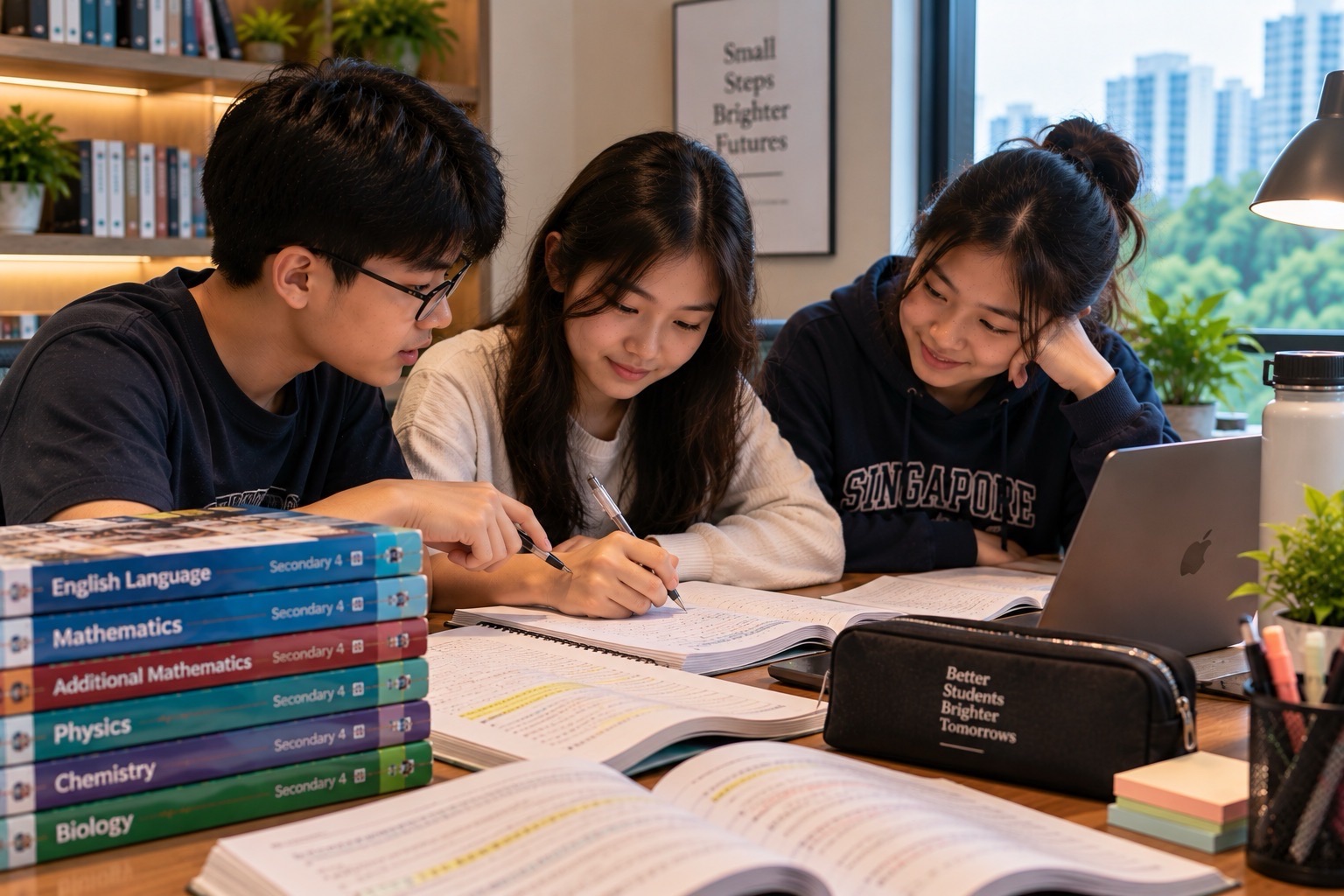
Should a PG2 student visit JC, polytechnic and ITE open houses before choosing a pathway? Yes, when accessible and relevant. A school open house can show what learners actually study, how teaching works, what daily travel feels like and whether the environment suits the student. It should supplement—not replace—official admission eligibility information.
Did you know? Posting Group 2 (PG2) is a Secondary 1 entry grouping under Singapore’s Full Subject-Based Banding arrangements. It does not by itself decide whether a child can visit or ultimately qualify for a junior college (JC), Millennia Institute (MI), polytechnic or ITE. The student’s actual SEC subject levels, grades and each programme’s rules matter for admission.
The first Singapore-Cambridge Secondary Education Certificate (SEC) examinations are in 2027, with results expected in January 2028 and a new Post-Secondary Admissions Exercise (PSE) beginning that year. Specific 2027–2028 open-house dates must come from the institutions’ official notices. Do not book transport or promise school admission based on a recycled event poster.
What an open house can reveal that a brochure cannot
A programme page lists modules and entry criteria. A campus visit lets a student look at workshops, lecture rooms, libraries, laboratories, presentation spaces and student support facilities. They can ask current learners how a regular school week actually unfolds.
A science enthusiast might enjoy a hands-on laboratory demonstration, but that does not tell them whether a diploma contains extensive mathematical modelling or report writing. The open house should prompt the student to read the actual module list, not replace it.
A student attracted to a JC’s school culture needs to ask about subject combinations, the academic pace, consultation arrangements, project work and CCAs. A two-year pre-university experience may feel very different from a three-year applied diploma or a technical course with extensive practical training.
The goal is to investigate fit between learner and learning. A polished booth, attractive free gift or friendly student guide is a pleasant part of an event but not a reliable admission criterion or guarantee of teaching quality.
JC and MI: questions about learning and subject choice
For JC visits, ask which subject combinations the institution offers, the exact prerequisites for each, the timetable structure, how new students receive academic guidance and whether the learner can discuss their interests with subject teachers.
Mathematics and Science preparation matters in many pre-university combinations, while humanities, languages and other disciplines require different strengths. Do not assume gaining a JC place guarantees the student’s preferred H2 subject package; school subject-combination rules still apply.
Millennia Institute offers a different three-year pre-university structure from the typical two-year JC route. Compare its curricular organisation and pace rather than treating it as merely a lower-ranked copy of another institution.
Ask about school reporting time, class support and realistic travel. A manageable commute can be especially important when lessons, project work and CCA commitments extend the day.
Polytechnic: go beyond the diploma title
Singapore has five polytechnics: Nanyang Polytechnic, Ngee Ann Polytechnic, Republic Polytechnic, Singapore Polytechnic and Temasek Polytechnic. Their programmes, pedagogy, facilities and actual course locations should be checked individually.
At a technology or engineering booth, ask students to show a real first-year project and describe what they learned from an error. At a business or design booth, ask about modules, assessment rubrics, teamwork and how industry experience is organised.
One diploma called ‘digital media’ may emphasise different skills from another programme with a similar name. Review the full module sequence, internship arrangements and any specialisation choices. A three-minute conversation about what students find hardest is often more revealing than a promotional slogan.
If considering the Polytechnic Foundation Programme (PFP), ask specifically whether a listed open-house activity describes direct Year 1 diploma admission or a separate foundation-year entry process. The qualifications and selection rules differ.
ITE: inspect the practical learning and progression options
ITE provides technical and vocational education including Higher Nitec programmes with distinct structures and, later, opportunities for eligible graduates to seek further qualifications. Programmes at ITE colleges can use specialist facilities, practical assessments and industry-linked learning.
A student interested in hospitality might inspect training spaces and ask what practical standards are assessed. An aspiring technician might seek information about safe equipment use, workplace routines, foundation theory and how practical competence is developed.
Ask what qualification the course awards, how long it runs, which attendance and assessment expectations apply, and which actual future qualifications may accept eligible graduates. Never translate a statement such as ‘students can progress’ into an unconditional promise of a polytechnic diploma or degree.
ITE is not simply a ‘backup building’ to visit after exam results. It may be the right place for a learner whose strengths and preferred learning style suit technical, applied education; the programme’s own entry requirements still control admission.
A practical comparison table for any campus visit
| Question | JC/MI | Polytechnic | ITE |
|---|---|---|---|
| What will I study? | Pre-university subjects | Field-specific diploma modules | Technical and applied skills |
| How will I be assessed? | School work, exams and relevant coursework | Modules, assignments and project or practical work | Practical skills, theory and course assessments |
| What must I check? | JC entry and subject-package prerequisites | Diploma entry and subject minima | Higher Nitec course entry and qualification |
| What is a useful campus question? | How do students prepare for demanding subjects? | What does a first-year project look like? | How are practical competencies taught safely? |
The five questions to ask a student ambassador
1. What does a normal week look like? Ask about lesson hours, laboratory or workshop time, assignments, practical projects and CCA commitments. The answer should help the prospective learner imagine routine rather than just event-day excitement.
2. Which first-year module surprised you? This surfaces content that may be missing from the programme’s short promotional description. Follow up by finding the official module outline.
3. How do lecturers or teachers help someone who falls behind? Ask about consultation, learning support and appropriate ways to seek help. One student’s experience is a useful perspective, not an institution-wide guarantee.
4. What equipment and materials do you actually need? Laptop specifications, workshop attire, art materials and transport expenses may vary. Confirm any reported compulsory purchases with the institution.
5. What would you tell your past self before applying? The answer often reveals useful preparation in English, Mathematics, science, practical skill, reading or time management.
Worked example: two campuses, one student, different questions
Imagine fictional student Meilin, who enjoys both biology and visual design. She is considering a healthcare-related diploma and a visual communication programme. Her family’s first question is not which campus looks more modern, but which actual curriculum she could see herself practising with persistence.
At the healthcare demonstration she asks about evidence, safe procedures, mathematics, science and professional conduct. At the design booth she asks about studio critiques, digital tools, iteration, teamwork and portfolio presentation. Those are different demands, even if both courses look exciting.
Afterwards, Meilin reviews her SEC subject levels and the actual minimum entry requirements of the specific programmes. An interesting visit does not turn an ineligible choice into an eligible one. She also checks the compulsory costs and travel time.
Her parents invite her to explain the two courses without using slogans. She can discuss which activities she liked, what would be difficult and which alternative programme she would genuinely attend. That is a productive open-house outcome, regardless of the eventual posting.
What to do when open-house dates are not available yet
For a student sitting SEC in 2027, watch the official school or institution event pages. Open houses and outreach sessions do not necessarily occur on the same day or month each year; some may offer online briefings and subject talks.
Use MOE SchoolFinder to research JC and MI profiles, and MOE CourseFinder plus the actual polytechnic or ITE website to learn about courses. These tools are discovery aids; official institution pages and the 2028 PSE instructions govern current dates and eligibility.
Make a shortlist first. When an event is announced, confirm its date, venue, registration requirements, accessibility arrangements and whether the talk actually covers the programme under consideration.
Do not assume a campus tour counts as a DSA-JC or EAE application. Those are separate admission routes with their own submission, aptitude assessment and offer conditions.
An open-house decision worksheet the student can fill in
Give each visit a separate page with six headings: course modules, entry requirements, assessment style, support, student life and travel/cost. Under each, write one observed fact, one question and a link to its official source.
A useful observation sounds like ‘First semester includes practical science labs’ or ‘Students presented a group coding project’. ‘Best campus ever!’ describes enthusiasm but cannot be checked or compared.
Ask the student to complete two sentences after each visit: ‘The part I would most enjoy is…’ and ‘The part I would need to prepare for is…’. This turns the day into a learning activity instead of a contest for the fanciest brochure.
For families unable to travel, compare online programme pages, recorded or live institution briefings, official virtual tours when available and direct questions to course representatives. A physical visit is useful, not a compulsory condition for a well-researched choice.
Check admission rules after the visit, not before the facts
MOE announced that the main Post-Secondary Admissions Exercise in January 2028 will enable eligible SEC candidates to consider JC, MI, polytechnic and ITE options together. It is therefore sensible to compare more than one pathway, particularly where a student has mixed G2 and G3 subject levels.
A learner’s qualification eligibility is not determined by whether they visited a campus, liked an open house or expressed enthusiasm to a student ambassador. It depends on the official conditions for the programme and pathway, including relevant grade and subject-level rules.
The new PSE also introduces choice order within its announced tie-break sequence. Only after the student has verified real eligibility and compared learning fit should the family choose an honest preference order. Older JAE cut-off ranges are reference information, not a promised 2028 outcome.
A late change of mind after an open house should trigger updated research: check whether the qualification is eligible, ask what the programme actually teaches and review the financial and travel implications before rearranging preferences.
A parent-and-student preparation checklist
Before visiting: Read each programme overview; verify the event notice; write down the student’s current subjects and interests; arrange accessible transport and realistic travel time.
During the event: Join one relevant course talk, inspect suitable learning spaces when allowed, ask three prepared questions, and record factual responses with the programme’s exact name.
After the event: Compare at most three or four serious options at a time. Check modules and prerequisites on official pages, calculate practical costs and plan an ECG conversation if choices remain unclear.
Before making a 2028 application: Use the actual SEC certificate and current PSE criteria, course codes, deadlines and instructions. A memory of an interesting demonstration is not an application form.
Frequently asked questions
Can a PG2 learner attend a JC open house?
Yes, an open house is generally an information event. Attendance does not confer admission or waive academic criteria; follow the event’s own visitor arrangements.
Does PG2 mean we should visit only ITE?
No. The student’s actual interests, SEC subject-level combination, grades and the programme’s requirements determine which routes merit research.
Will every college have an open house in January 2028?
Never assume the date. Check each institution’s official calendar and event announcements for the actual year.
Is a polytechnic open house the same as EAE?
No. An information event and the Polytechnic Early Admissions Exercise are different. EAE has its own eligibility, application and assessment process.
Can an open house guarantee a diploma place?
No. Meeting minimum academic and course requirements and succeeding under the admissions process is separate from attending a campus event.
Do I have to visit in person?
No. Official online programme information, virtual events if offered and direct questions to institutions can support a good decision.
What should we ask about university progression?
Ask which qualification is awarded, what the subsequent qualifying criteria are and what universities currently require. A diploma or Higher Nitec does not guarantee any specific degree admission.
What if the student likes a course but misses its subject prerequisite?
Explore other eligible courses or recognised progression paths and consult the institution or ECG counsellor. An open-house conversation cannot waive an official requirement.
How do we compare campus fees?
Use the institution’s published fee and financial-aid pages, including current bursary and loan eligibility. Include travel and required materials in the comparison.
Continue the PG2 pathway series
- PG2 Education and Career Guidance
- PG2 polytechnic diploma selection
- PG2 JC and MI subject combinations
- PG2 ITE Higher Nitec progression
- PG2 financial assistance
- PG2 2028 SEC results next steps
Official sources and course-finding tools
- MOE 2028 Post-Secondary Admissions Exercise announcement
- MOE post-secondary institution overview
- MOE SchoolFinder
- MOE CourseFinder
- MOE Full SBB and 2027 SEC background
- SEAB Singapore-Cambridge SEC
Editorial review: 25 October 2026. This guide does not announce any particular institution’s 2027 or 2028 event dates and does not promise admission. All student examples are fictional. Event details, course offerings, prerequisites and PSE rules must be checked against live official information for the relevant intake.