
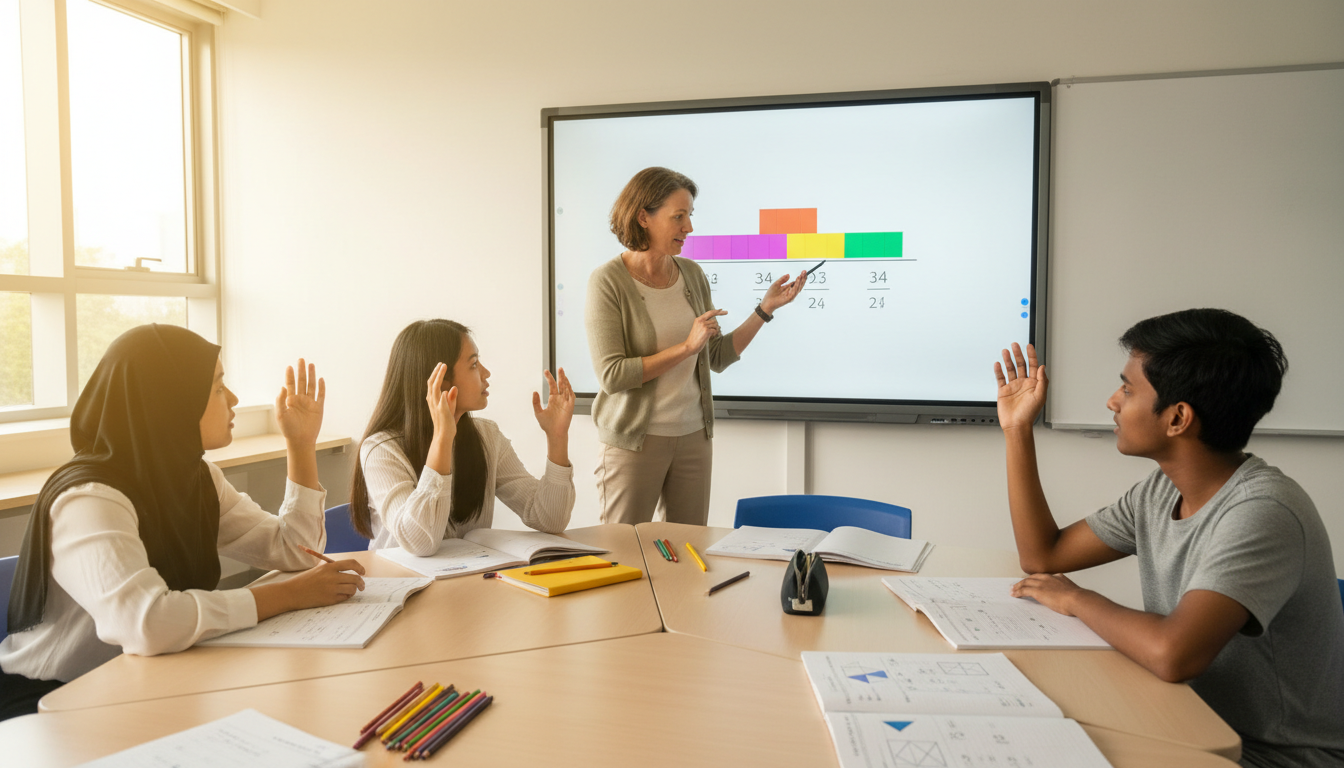
PG3 is the Secondary 1 Posting Group, while G3 is the level of Mathematics a child may take under Full Subject-Based Banding. If your child can solve an equation that is already written but cannot begin a G3 word problem, the gap may be mathematical modelling: deciding what the story means and representing it before calculating. The first move is to teach that translation, not to assign more difficult timed papers.
Use one current school question. Ask the child to identify the unknown, label each quantity, draw a bar or table when useful and write an equation that matches the given conditions. Let them solve and check it against the story. If a wrong equation keeps appearing, show the Mathematics teacher the first incorrect step and ask which foundation needs repairing.
- G3 word problems test reading, relationships and algebraic modelling—not just calculation speed.
- Practise a repeatable sequence: understand, define, represent, form, solve and check.
- Distinguish errors in reading the story from errors in manipulating an already-correct equation.
- Use familiar drawings or tables as a bridge to algebra, then fade support.
- Review progress on new school-aligned questions before introducing harder examination material.
Why the blank first line matters
Many Primary 6 pupils can use bar models and arithmetic to complete familiar problems. In Secondary 1, students increasingly represent relationships with algebraic expressions, equations, graphs and mathematical notation. A child may know how to solve 3x = 21 but not recognise that a situation requires 3(x + 2) = 21. The calculation is not the first barrier. Turning the story into the right structure is.
Parents sometimes call a blank page a sign of poor revision. A better diagnostic question is “Which relationship in the story has not become an equation?” If that relationship is misunderstood, drilling more equations will not solve the underlying problem.
What the MOE G3 Mathematics syllabus actually includes
The official G2/G3 Mathematics syllabuses describe Secondary 1 number and algebra, ratios, percentages, speed, algebraic expressions and real-world problem solving, among other areas. Algebraic notation is a language for expressing relationships rather than a set of arbitrary tricks.
The child’s teacher decides the current sequence and school assessment scope. The SEAB 2027 G3 examination directory describes examinations for the 2027 graduating cohort, not the syllabus of every first-year Secondary student. Parents should not use an upper-secondary book to judge whether a new Secondary 1 learner is on schedule.
A six-step way to start a word problem
- Read: identify precisely what is being asked and the relevant units.
- Define: say what the unknown symbol represents, including whether it is a price, quantity or length.
- Represent: draw a bar, label equal groups or construct a short relationship table.
- Form: translate the relationships into an expression or equation.
- Solve: use operations that preserve mathematical equality and show clear working.
- Interpret and check: test the result against every condition in the original question.
The method is a guide to choosing a valid approach, not a guarantee that all questions have one unknown or one equation. Later topics can require systems of equations, inequalities and other methods. Lower-secondary learning should build the first steps carefully.
Example 1: two prices and one total
A pen costs x dollars. A notebook costs $3 more than the pen. Their combined cost is $11. Write the notebook’s cost as x + 3, then form x + (x + 3) = 11. Simplify to 2x + 3 = 11, so 2x = 8 and x = 4. The pen costs $4 and the notebook $7.
Check both conditions: the difference is $3 and the total is $11. A student who writes x + 3 = 11 has ignored the cost of the pen in the total. Another who writes 2x – 3 = 11 has attached the increase to the wrong relationship. Both are modelling errors, not simply arithmetic mistakes.
Example 2: why brackets describe groups
Three identical packs each contain x cards and two bonus cards, giving 27 cards altogether. Each pack therefore has x + 2 cards, and three packs have 3(x + 2) cards. The equation is 3(x + 2) = 27; divide by 3 to get x + 2 = 9, so x = 7.
The common wrong expression 3x + 2 counts the two bonus cards only once. Draw three boxes labelled x + 2 and ask the child to explain why each box must be counted. Then replace three packs with four and change the total. Can the student recognise that the outside multiplier must apply to the whole pack? That is transfer.
Example 3: reverse percentage is about the base
After a 10% increase, a jacket costs $88. Let x be the original price. The final price is 110% of the original, so 1.10x = 88. Hence x = 80. A student who subtracts 10% of $88 has chosen the final price as the percentage base, even though the increase was measured against the original price.
Ask, “Which quantity was 100%?” Then test the answer: 10% of $80 is $8, producing $88. Another question may involve a discount rather than an increase. The useful skill is identifying the base quantity, not memorising a different trick for every sentence.
Example 4: speed and units reveal the relation
A cyclist covers 36 km in 1.5 hours at a constant speed. Speed equals distance divided by time, so 36 ÷ 1.5 = 24 km/h. A child who knows the numbers but does not know whether to multiply or divide needs to express the relationship before calculating. Kilometres divided by hours gives kilometres per hour.
Now ask how far the same cyclist travels in two hours. Distance equals speed multiplied by time, producing 48 km. The difference between the questions is the required unknown. Encourage the student to choose the relationship by meaning rather than by remembering what operation appeared in the previous exercise.
Example 5: when a table is more useful
Twenty tickets were sold for $180. Adult tickets cost $12 each and student tickets cost $6 each. Let a be the number of adult tickets and s the number of student tickets. The total-number condition is a + s = 20. The revenue condition is 12a + 6s = 180. Solving the two equations gives a = 10 and s = 10.
The answer checks against both conditions. This example may require more advanced methods than an early Secondary 1 class has covered. Use it to demonstrate how two real-world constraints become two equations, not as an assumption that every new Secondary 1 pupil must already solve simultaneous equations independently.
How to find the first wrong step
Place a finger on the first line where the child’s mathematical statement no longer matches the question. Did they define the unknown as the wrong object? Did they misread “more than” or “remaining”? Did they mistake a per-item price for a total? Only after checking the model should you inspect the algebra.
A wrong first equation can make every later calculation irrelevant to the original problem, even if the later algebra is mechanically correct. A short correction of the initial model can therefore be more useful than marking an entire page with repeated crosses.
Why bar models can still help in Secondary 1
A familiar picture can bridge the move from primary arithmetic to symbolic algebra. Draw two bars, one longer than the other by three units. Label the shorter x and the longer x + 3. When the combined length is 11, the equation becomes visible. The goal is to use the drawing to understand the relationship and gradually express it without the picture.
This is not a reason to keep the child on primary methods indefinitely. When the school requires algebra, the final working should demonstrate the expected notation. Visual models help the learner understand why an equation is valid and then move toward independent symbolic representation.
When the difficulty is actually reading
Long word problems contain instructions, unfamiliar vocabulary and information that may be relevant or irrelevant. If a child solves short equations correctly but freezes on a paragraph, examine the reading load. Ask them to underline what is required, circle the important quantities and explain the relationship in plain language. A table can reduce the burden of holding several facts in memory.
If similar comprehension problems occur in English, Science and Humanities, ask teachers whether the student needs broader support in interpreting question words or extended texts. However, subject-specific mathematical reasoning remains necessary; understanding a paragraph does not automatically produce a valid equation.
A two-week modelling repair plan
Week 1: practise forming equations before solving
Choose three problems from the child’s current school topic. Ask the student to identify quantities and write equations without being rushed to finish the calculations. Use drawings or tables when needed. On a later day, change the numbers while preserving the structure. The student should explain what stayed the same and why.
If they consistently need a parent to name the unknown, use a simpler task with one relationship. Once they can produce a valid first line, move back to the school question. Avoid jumping immediately to unfamiliar Secondary 4 examination papers.
Week 2: build independent selection and checking
Mix three different problem types and do not label the method beforehand. Ask the child to choose the representation, write the equation, solve and check in context. Give one new question after a delay of several days. Record whether the first equation is correct, not just the final mark.
When a specific pattern repeats, such as multiplying a group bonus only once or using the wrong percentage base, practise that one relationship. This produces a clear target for teacher consultation or focused tutoring.
When timing and speed become relevant
Timed work has a place after the child can model and solve a representative question independently. Until then, speed pressure can reinforce guessing. A child who is accurate but slow may benefit from brief fluency practice. A child who starts with an incorrect equation needs conceptual correction before being asked to work faster.
Assessments should be reviewed using the actual school marking criteria. One poor word-problem paper does not predict a future SEC Mathematics grade. Look for repeated patterns across classwork, homework and independent corrections.
How to evaluate tuition or extra practice
Ask what the tutor is teaching that the child could not previously do. Does the student learn to define unknowns and form equations, or do they merely copy a demonstrated solution? Can they solve a changed question alone a week later? Do the practice materials match the current school topic and G3 subject level?
Our Secondary 1 Mathematics bridging guide explains the shift from arithmetic to structure. Extra support is most useful when it diagnoses the actual gap rather than assuming all students need more questions.
Common parental concerns
Does this mean my child should move out of G3?
Not necessarily. Difficulty modelling word problems is a specific skill issue. If difficulties are broad and persistent, speak with the school about foundations, support and the child’s overall needs. Subject-level changes under Full SBB involve eligibility and school review; a single weak test is not an automatic trigger.
Should we abandon primary bar models?
No. Use them to reveal relationships, then connect them to algebraic notation and gradually reduce dependence on the drawing.
Should I buy the hardest G3 workbook?
Choose practice matching the student’s learning stage. A very difficult book full of unfamiliar concepts can create discouragement without repairing the first modelling step.
Why can the child solve the problem after one hint?
The hint may have supplied the equation or named the operation. That shows partial knowledge but not independent modelling. Note the hint, teach the relationship and retest on a changed task without guidance.
Does Additional Mathematics solve this weakness?
Not automatically. Additional Mathematics is a distinct subject option with its own school criteria. Its demands generally require secure algebraic foundations, so repair basic interpretation and modelling first.
The best next action for parents
Choose one school word problem. Have the child identify the unknown, draw or list the relationships, and write the first correct mathematical line. Do not start by insisting on a perfect final answer. Teach the earliest weak step, let the child solve independently and revisit the idea after several days. Better models lead to better answers and a calmer G3 Mathematics experience.
Example 6: the same perimeter, two different unknowns
Suppose a rectangle has a length that is 4 cm greater than its width, and its perimeter is 28 cm. Let x be the width in centimetres, making the length x + 4. Perimeter means the sum of all four sides, so 2x + 2(x + 4) = 28. Expanding gives 4x + 8 = 28 and x = 5. The width is 5 cm and the length is 9 cm. Check: 5 + 9 + 5 + 9 = 28.
A child might instead write x + (x + 4) = 28 because they have counted only two sides, or x + 4 = 28 because they have treated the perimeter as the length. Ask them to draw the rectangle, label every side and explain what perimeter means. This reveals whether the error is geometric understanding or algebra.
Example 7: separating a quantity from its change
“A school club had x members. Eight joined and three left. It now has 29 members.” The correct equation is x + 8 – 3 = 29, so x = 24. Check: 24 + 8 – 3 = 29. A child might write x + 8 + 3 = 29 because they noticed two numbers but failed to connect each action to a direction of change.
Have the student construct a simple number line or running total. Ask, “Which event increased the number of members, and which decreased it?” Then change the story: five members leave before seven join. The result should reflect the same logic even though the order of events differs. This is a bridge from arithmetic meaning to algebraic representation.
Example 8: two quantities in a ratio
If the number of red and blue tokens is in a 2:3 ratio and there are 25 tokens altogether, represent the amounts as 2k and 3k. Then 2k + 3k = 25, giving k = 5, so there are 10 red and 15 blue tokens. A common error is to treat 2 and 3 as the actual numbers rather than as parts of a relationship.
Ask the learner what a single “part” represents. A drawing of five equal parts can make the connection clear. Then change the total to 40 tokens and see whether the child can adapt without being told to repeat the same formula. This checks whether ratios are understood as relationships rather than fixed quantities.
How to teach word problems without doing all the thinking
Show one worked example that illustrates the target structure. In the next question, stop before writing the equation and ask the child to define the unknown. In the third, provide no prompts and let the child choose a representation. Compare the different approaches and discuss why a particular equation matches the wording. The amount of adult guidance should decrease as understanding strengthens.
If the child repeatedly asks “Is this right?” after every line, resist giving an immediate yes or no. Ask them to test the line against the story. Does x represent the same quantity throughout? Does the equation include every group? Are the units consistent? Learning to check validity helps the student become less dependent on a teacher or tutor’s approval.
Word-problem errors that look like careless mistakes
A copied number may be wrong because the child misread the unit, not because their arithmetic is weak. A negative sign may be missing because the student misunderstood “less than”, not because they forgot a rule. A percentage may be calculated from the wrong base because the story contains two prices. Record the actual cause before prescribing repetition.
An effective correction says “I treated the final price as one hundred per cent” or “I counted the bonus cards for only one pack”. A vague note such as “careless” is hard to improve. Specific error records help students select a better method when the next problem looks different.
When to contact the Mathematics teacher
If the student continues to form invalid equations after targeted instruction, gather two or three attempts and ask where the missing knowledge lies. The gap may be algebraic notation, fractions, percentages, reading comprehension or interpreting a particular topic. Request one school-aligned example the child can try independently and ask how the teacher will assess progress.
When extra support is arranged, confirm that it follows the child’s current school learning sequence. A lesson is useful if the student can choose an appropriate model and justify it without the tutor naming the method. A very advanced worksheet cannot replace this foundational work.
Other PG3 guides that help with Mathematics progress
- What is PG3: Helping a child ask questions during difficult lessons.
- What is PG3: Applying familiar knowledge to unfamiliar questions.
- What is PG3: Reading school Mathematics feedback.
Official references and connected guides
- MOE G2 and G3 Mathematics syllabus.
- MOE Full Subject-Based Banding.
- SEAB: 2027 G3 SEC school-candidate syllabuses.
- SEAB SEC assessment overview.
- eduKateSG: Secondary 1 Mathematics tutor Clementi.
- eduKateSG: G3 unfamiliar-question application skills.
Fact-checked on 24 November 2026. Worked problems are educational examples and do not replace school instructions or current syllabus documents.