
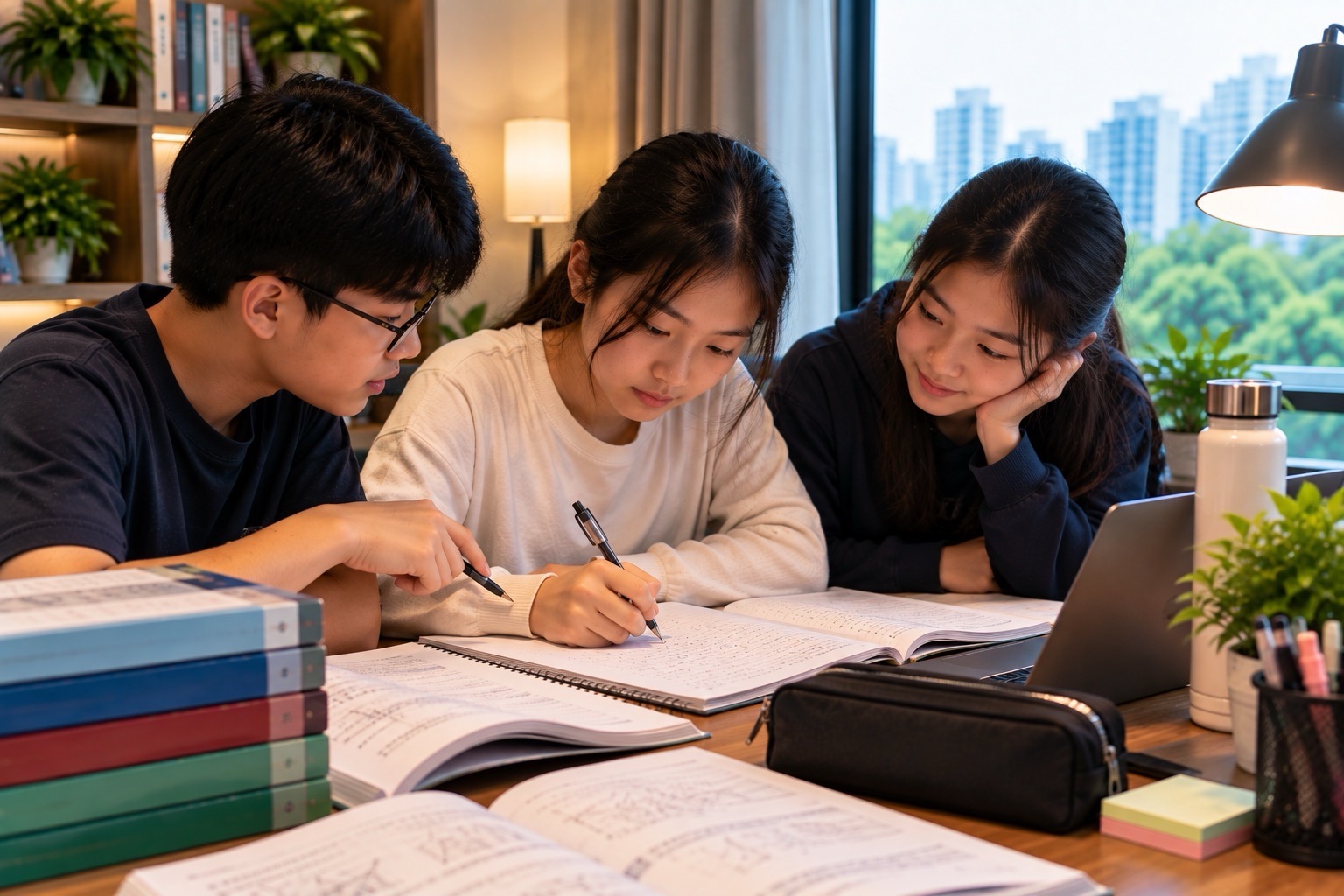
- SEAB G3 2027 Higher Chinese K355 and Chinese K320
- MOE changes to JC/MI and polytechnic admissions from 2028
- MOE revised JC L1R4 requirements
- MOE first SEC cohort and 2028 PSE
- Higher Chinese K355 full syllabus guide
- Common Higher Chinese difficulties and how to fix them
- Ordinary PG3 Chinese K320 pathway
- Mother Tongue examination sitting and oral arrangements
- Strong foundations through clear teaching and precise feedback
Explore the PG3 Higher Mother Tongue pathways
PG3 Tamil Language · PG3 Higher Malay Language · PG3 Higher Tamil Language · PG3 ordinary Chinese Language · PG3 ordinary Malay Language
The best result of Higher Chinese is not a bigger vocabulary list. It is a student who can read difficult ideas fairly, express a considered view, summarise without distorting and respond thoughtfully when someone asks a new question.
- Is the child registered for G3 Higher Chinese K355, or ordinary Chinese K320?
- What school eligibility and support arrangements apply to Higher Mother Tongue?
- Does the learner understand the writing, reading, summary and video-oral demands?
- How might an eligible K355 result be used in the actual JC L1R4 calculation, without double-counting ordinary Mother Tongue?
- Which future diploma or degree requirements should the family research before interpreting an extra language qualification as an automatic advantage?
18. Did you know? Parent questions answered
Is PG3 Higher Chinese an official posting stream?
No. PG3 is an admission grouping; G3 Higher Chinese K355 is the formal 2027 SEC subject.
How long is Higher Chinese Paper 1?
Two hours; writing contributes 40% of the total assessment.
Does K355 have a separate listening paper?
No separately weighted listening paper is specified in the 2027 K355 40/40/20 assessment.
How many characters are needed for practical writing?
The prescribed 2027 practical response requires at least 220 Chinese characters.
What is the composition minimum?
At least 500 Chinese characters for the longer K355 writing task.
Does Paper 2 include summary writing?
Yes. The 2027 reading paper has a concise summary task of approximately 80 characters, following the actual question.
Is Higher Chinese oral the same as ordinary Chinese oral?
No. K355 uses a video-based report of at most two minutes followed by discussion.
Can Higher Chinese be used as JC L1?
Eligible Higher Mother Tongue can be used under MOE’s revised JC language criteria. Full aggregate and other eligibility rules still apply.
Does a strong K355 result guarantee a JC place?
No. L1R4 subject groups, minimum grades and competitive posting also determine admission.
Does K355 guarantee admission to a Chinese-studies university degree?
No. Degree applicants need the relevant accepted post-secondary qualification and programme-specific selection requirements.
19. Official sources and related language learning
- SEAB G3 2027 Higher Chinese K355 and Chinese K320
- MOE changes to JC/MI and polytechnic admissions from 2028
- MOE revised JC L1R4 requirements
- MOE first SEC cohort and 2028 PSE
- Higher Chinese K355 full syllabus guide
- Common Higher Chinese difficulties and how to fix them
- Ordinary PG3 Chinese K320 pathway
- Mother Tongue examination sitting and oral arrangements
- Strong foundations through clear teaching and precise feedback
Explore the PG3 Higher Mother Tongue pathways
PG3 Tamil Language · PG3 Higher Malay Language · PG3 Higher Tamil Language · PG3 ordinary Chinese Language · PG3 ordinary Malay Language
The best result of Higher Chinese is not a bigger vocabulary list. It is a student who can read difficult ideas fairly, express a considered view, summarise without distorting and respond thoughtfully when someone asks a new question.
- Treating fluent conversation as proof of advanced formal writing competence.
- Memorising idioms without understanding context and appropriate register.
- Writing 500 characters without answering the actual essay question.
- Correcting sentences by instinct without diagnosing grammatical or logical errors.
- Summarising by removing random words instead of selecting the passage’s central meaning.
- Preparing an oral speech without learning to respond to new video stimuli or follow-up questions.
- Assuming the ordinary K320 oral and listening scheme is identical to K355.
- Neglecting the equal 40% contribution of reading/language use while focusing on composition.
A useful correction names the exact underlying gap: irrelevant content, inaccurate word choice, unsupported inference or poor summary selection. The learner then tackles a fresh passage or prompt. Progress is real when a method works outside the example in which it was taught.
16. Four weeks of sustainable K355 readiness
| Week | Practice task | What improvement looks like |
|---|---|---|
| 1 — Read | Study one unfamiliar Chinese opinion article; separate claim, evidence and qualification. | The student explains what is supported and what is assumed. |
| 2 — Write | Draft an original practical message and short argumentative outline. | Audience and purpose remain clear. |
| 3 — Summarise | Select central information from a changed passage; practise the prescribed character limit. | Meaning remains accurate while unnecessary detail disappears. |
| 4 — Speak | Present a brief response to a video and discuss a follow-up question. | Ideas respond to the actual evidence and examiner question. |
Keep revision proportional to the learner’s real difficulties. A student whose oral is secure but summary is weak needs different practice from one who reads accurately but cannot organise a written request. The aim is independent communication, not maximum study hours.
17. Five school questions before committing to Higher Chinese
- Is the child registered for G3 Higher Chinese K355, or ordinary Chinese K320?
- What school eligibility and support arrangements apply to Higher Mother Tongue?
- Does the learner understand the writing, reading, summary and video-oral demands?
- How might an eligible K355 result be used in the actual JC L1R4 calculation, without double-counting ordinary Mother Tongue?
- Which future diploma or degree requirements should the family research before interpreting an extra language qualification as an automatic advantage?
18. Did you know? Parent questions answered
Is PG3 Higher Chinese an official posting stream?
No. PG3 is an admission grouping; G3 Higher Chinese K355 is the formal 2027 SEC subject.
How long is Higher Chinese Paper 1?
Two hours; writing contributes 40% of the total assessment.
Does K355 have a separate listening paper?
No separately weighted listening paper is specified in the 2027 K355 40/40/20 assessment.
How many characters are needed for practical writing?
The prescribed 2027 practical response requires at least 220 Chinese characters.
What is the composition minimum?
At least 500 Chinese characters for the longer K355 writing task.
Does Paper 2 include summary writing?
Yes. The 2027 reading paper has a concise summary task of approximately 80 characters, following the actual question.
Is Higher Chinese oral the same as ordinary Chinese oral?
No. K355 uses a video-based report of at most two minutes followed by discussion.
Can Higher Chinese be used as JC L1?
Eligible Higher Mother Tongue can be used under MOE’s revised JC language criteria. Full aggregate and other eligibility rules still apply.
Does a strong K355 result guarantee a JC place?
No. L1R4 subject groups, minimum grades and competitive posting also determine admission.
Does K355 guarantee admission to a Chinese-studies university degree?
No. Degree applicants need the relevant accepted post-secondary qualification and programme-specific selection requirements.
19. Official sources and related language learning
- SEAB G3 2027 Higher Chinese K355 and Chinese K320
- MOE changes to JC/MI and polytechnic admissions from 2028
- MOE revised JC L1R4 requirements
- MOE first SEC cohort and 2028 PSE
- Higher Chinese K355 full syllabus guide
- Common Higher Chinese difficulties and how to fix them
- Ordinary PG3 Chinese K320 pathway
- Mother Tongue examination sitting and oral arrangements
- Strong foundations through clear teaching and precise feedback
Explore the PG3 Higher Mother Tongue pathways
PG3 Tamil Language · PG3 Higher Malay Language · PG3 Higher Tamil Language · PG3 ordinary Chinese Language · PG3 ordinary Malay Language
The best result of Higher Chinese is not a bigger vocabulary list. It is a student who can read difficult ideas fairly, express a considered view, summarise without distorting and respond thoughtfully when someone asks a new question.
What is PG3 Higher Chinese Language? PG3 is Posting Group 3, an entry grouping used for secondary schools in Singapore. G3 Higher Chinese Language (高级华文) is an actual examinable subject, K355, under the 2027 Singapore–Cambridge Secondary Education Certificate (SEC). It is a separate syllabus from ordinary G3 Chinese Language K320. A student’s original Posting Group does not automatically place them into Higher Chinese or determine every subsequent education opportunity.
Did you know? A pupil may hold long Mandarin conversations but find it difficult to summarise an unfamiliar argumentative text accurately. Another may know elegant 成语 yet use them in situations where they obscure rather than clarify meaning. Higher Chinese demands precise reading, purposeful extended writing, language control and genuine oral reasoning—not a competition to memorise the most impressive expressions.
Why does this matter for junior college (JC), polytechnic and later university? Eligible Higher Mother Tongue results have a distinct role in the 2028 JC L1R4 language component. But the result is only part of the applicant’s full aggregate and subject eligibility; it does not guarantee a JC place, an H2 combination, a diploma or a degree. This guide explains the 2027 examination before turning to the realistic pathways.
Independent eduKateSG parent and student guide, reviewed 24 October 2026 against SEAB’s 2027 G3 Higher Chinese K355 syllabus information and MOE’s revised JC admissions criteria. Confirm the actual registered examination code, school arrangements and the applicable intake-year rules.
PG3 Higher Chinese: quick answers for busy families
| Question | Answer |
|---|---|
| Is PG3 Higher Chinese a separate posting stream? | No. PG3 is the admission group; G3 Higher Chinese is the registered subject. |
| 2027 Higher Chinese subject code? | K355, earlier reference 1116. |
| How is K355 assessed? | Paper 1 Writing 40%, Paper 2 Language and Reading 40%, Paper 3 Oral 20%. |
| Is listening a separate 10% paper? | No. Unlike ordinary Chinese K320, Higher Chinese K355 does not have a separately weighted listening paper. |
| How long is writing? | A functional response of at least 220 Chinese characters and a composition of at least 500 characters, under the 2027 task choices. |
| Can it be used for the 2028 JC language component? | Eligible Higher Mother Tongue may be used as L1, subject to the full MOE aggregate and minimum-grade rules. |
Go to: PG3 versus G3 · the three papers · writing · reading and summary · oral presentation · worked example · JC/MI · FAQ.
1. PG3 and Higher Chinese are different labels
Imagine a teenager who enters Secondary 1 through PG3. Their parent assumes this must automatically mean Higher Chinese. Under Full Subject-Based Banding, a Posting Group helps determine entry and starting subject levels. Individual subjects and Higher Mother Tongue arrangements are governed by MOE and school eligibility, provision and registration rules.
The 2027 SEC formally distinguishes G3 Chinese K320 from G3 Higher Chinese K355. Their papers and weights are not the same. A general tuition worksheet can be useful for language skills, but using a K320 examination mock as if it were the complete K355 format may leave important writing or summary demands uncovered.
Check the registered title and exam year before preparing. See What is PG3 | MOE and SEAB Syllabus and the ordinary PG3 Chinese Language guide.
2. The exact 2027 K355 exam structure
| Paper | Published requirement | Weight |
|---|---|---|
| Paper 1 — 写作 | 2 hours, 80 marks; situational/practical writing and extended composition | 40% |
| Paper 2 — 语文应用与阅读理解 | 1 hour 45 minutes, 80 marks; language use, reading, sentence correction and summary | 40% |
| Paper 3 — 口试 | About 20 minutes, 40 marks; video-based oral report and conversation | 20% |
| Separately weighted listening | Not listed as a separate K355 examination component | No additional 10% paper |
The 40/40/20 split makes a useful point: extended writing and sophisticated reading carry equal weight. A learner who writes impressive essays but repeatedly misreads the comprehension questions is not yet prepared across the syllabus. Similarly, natural spoken fluency cannot substitute for written accuracy and a genuine ability to select essential ideas from a passage.
The 2027 K355 Paper 1 requires practical writing of at least 220 Chinese characters and a composition of at least 500 characters. Paper 2 includes a concise reading-based summary of approximately 80 characters, according to its instructions. The oral report is no more than two minutes before an examiner-led discussion. Use the actual SEAB instructions for task choices and marking.
Source: SEAB’s official 2027 G3 school-candidate syllabus directory; open Higher Chinese K355 from that register.
3. Why practical writing at 220 characters is not padding
A practical email or forum contribution has a reader and a purpose. It should respond to the particular situation, supply relevant details and choose a register that suits the relationship. A lengthy opening full of polite phrases is not helpful if the essential request or recommendation remains vague.
Suppose a school council is considering changes to library opening hours. The writer should identify whom they represent, what problem has been observed, what change is being suggested and why it may help. The reader should not have to guess the proposed action from a collection of general comments about the importance of reading.
Word or character minima are boundaries for the examination response. They do not turn repetition into good writing. A student should outline content before drafting and revise for clarity, coherence and accuracy, not simply add phrases until the page appears sufficiently full.
4. Extended composition: different prompts require different decisions
Narrative writing needs development
A narrative gains meaning when events, decisions and consequences connect. A story containing five sudden surprises may still feel flat if none changes the character’s situation. Ask the learner what matters in the opening, how a difficulty changes the action and what the ending reveals.
Explanatory writing needs organisation
An explanatory response should define the issue, organise related points and make each example serve a specific reason. Listing advantages without explaining when they matter is not enough. Writing with clear transitions often improves meaning more than including unfamiliar vocabulary.
Argumentative writing needs evidence and judgement
An argument identifies a claim, considers plausible reasons, uses examples proportionately and addresses limitations. Students should avoid treating an opinion as a universal fact. A balanced answer can have a firm conclusion while still recognising trade-offs.
5. Original Chinese-language teaching example: improve the request
Original illustration, not an SEC writing response: “老师,我觉得阅读很重要,请您帮忙。” This statement is polite but vague. What help is wanted? Is it an event, a room, books or a timetable?
A more purposeful opening could be: “老师您好。我们建议把图书馆的课后开放时间延长半小时,让需要安静学习的同学有更多选择。我们愿意协助收集同学的意见,并遵守图书馆的使用规定。”
The revision identifies an actionable proposal, the intended users, a reason and an offer to support it. A complete K355 answer still must meet the exact scenario, required content and 220-character minimum. This short example is a lesson about message structure, not a model submission to copy.
Did you know? The most persuasive change was not an idiom. It was moving from “please help” to a proposal the recipient can evaluate. That is the kind of communicative independence that Higher Chinese should develop.
6. Paper 2: sentence correction is a reasoning task
Higher Chinese uses more demanding language-application work, including sentence-correction tasks. A student needs to locate why a sentence is faulty: meaning, structure, collocation, repetition or logical relation. Making a sentence sound different is not proof that the original error has been repaired.
Original micro-example: “因为下雨,所以活动取消了。” expresses a cause followed by an effect: because it rained, the activity was cancelled. If the question changes the relation to a contrast—students still attended despite rain—the candidate needs a different structure, such as “虽然下雨,但是同学们仍然参加了活动。” The two expressions serve different logical purposes.
Learning the meaning of connectors is more useful than memorising lists of interchangeable words. Students should explain what each clause contributes and check whether the final sentence communicates a coherent idea.
7. Reading comprehension: understanding an argument is not quoting the passage
Longer texts can present claims, objections, qualifications and examples. A strong reader identifies which sentences provide central information and which merely illustrate it. If a passage says several surveyed students prefer one option, it does not establish that every student in Singapore shares that preference.
A useful three-part check is: What does the text state? What can reasonably be inferred? What is not supported? That distinction makes a comprehension answer reliable and helps the learner resist unsupported certainty when encountering news, advertisements or online claims.
Where a question compares viewpoints, the student should identify the common issue and then explain the actual difference using precise evidence. Copying several paragraphs cannot replace clear interpretation.
8. Summary writing: compress the meaning, not the truth
The K355 reading paper requires a concise summary of approximately 80 Chinese characters under the question instructions. The learner needs to select central points, combine related ideas where appropriate and remove repeated examples while preserving the source’s actual relationships.
Imagine a fictional passage explaining that a new school timetable reduces clashes, clearer notices prevent confusion and student feedback helps organisers revise activities. A summary should preserve those three mechanisms. It should not spend half the permitted length describing the colour of one notice unless the question specifically asks about that detail.
A useful revision process identifies the requested focus, underlines the relevant ideas, drafts independently and checks both accuracy and the required length. A summary that is short but changes the author’s meaning is not successful.
9. Oral: video presentation is different from reciting a speech
Higher Chinese K355 oral uses a video stimulus. Candidates prepare and deliver a report of no more than two minutes, followed by a conversation with the examiner. Good preparation begins with observation: which situation is actually shown, which stakeholders are involved, and what judgement is relevant?
A prepared script can become fragile when a video or follow-up question changes. Instead, practise a short structure: state the issue, explain one or two relevant observations, provide a reasoned opinion and be ready to refine the answer in response to the examiner.
Speaking fast is not the same as communicating effectively. A learner who pauses, clarifies a point and gives a relevant example may be more persuasive than one who delivers a long memorised monologue without answering the question.
10. K355 versus K320: do not merge the exam schemes
| 2027 category | Ordinary G3 Chinese K320 | Higher Chinese K355 |
|---|---|---|
| Writing | 30%, with shorter functional and composition minima | 40%; practical writing at least 220 characters and composition at least 500 |
| Language and reading | 35% | 40%, including sentence correction and summary |
| Oral | 25%, including reading aloud and video-based conversation | 20%, using a short video-based report and discussion |
| Listening | Separate 10% component | No separately weighted component |
The comparison is not a ranking of students as people. It shows the actual type of learning and assessment being requested. A child may be ready for Higher Chinese but need extra support with advanced written language, or may be more successful in ordinary Chinese while maintaining an active interest in reading and conversation.
11. From Secondary 1 to Secondary 4 Higher Chinese learning
| Stage | Learning focus | Checkpoint |
|---|---|---|
| Secondary 1 | Reading varied texts beyond everyday conversation and choosing accurate word forms. | Can the child explain a short article’s main claim in Chinese? |
| Secondary 2 | Clearer formal writing, argument and language analysis. | Can the learner correct a sentence and explain why? |
| Secondary 3 | Extended reading, essays, contextual language use and oral development. | Does the student summarise a changed passage independently? |
| Secondary 4 | K355 timed writing, comprehension and video-based oral readiness. | Can the candidate adapt a genuine method to an unfamiliar prompt? |
Students benefit when regular language reading remains a source of understanding, not only examination pressure. Short discussions about a news story, book or public notice can build vocabulary, inference and clarity together.
12. What Higher Chinese can mean for JC admission
MOE’s 2028 revised JC L1R4 framework recognises English or eligible Higher Mother Tongue as the L1 language component. A candidate’s Higher Chinese result may therefore matter differently from an ordinary Chinese result, but its actual eligibility, grade use and remaining subject requirements must be checked under the official admissions rules.
The JC gross qualifying threshold is 16 from the 2028 intake, and the full aggregate still requires specified Humanities and Mathematics/Science contributions, minimum grades and competitive posting. If Higher Chinese is used as L1, the same ordinary Mother Tongue cannot simply be counted again as R4 in the prohibited double-counting arrangement. Verify the exact current MOE rules for the candidate.
The 2027 SEC cohort is expected to receive results in January 2028 and enter the new Post-Secondary Admissions Exercise (PSE). Choosing Higher Chinese is therefore an academic decision with potential aggregate implications, but it is not a guaranteed route to a particular JC or H2 subject combination.
13. Polytechnic: fluency complements course-specific skills
Polytechnic students may find Chinese useful in multilingual client communication, business-related projects, design research, media, tourism or regional work. These are possible applications, not proof that every diploma requires Higher Chinese. The diploma’s published entry requirements and actual curriculum determine the route.
MOE’s 2028 ELR2B2 polytechnic reforms permit one eligible G2 subject in the final best-subject position and adjust the aggregate cut-off to 22. Those changes do not remove minimum English, Mathematics or relevant-subject requirements. A strong K355 result does not automatically substitute for a named diploma prerequisite.
A qualifying diploma can later provide a university application route where accepted. Language skill can remain useful during study and employment, but the student must still meet the academic requirements of the intended programme.
14. University and Chinese-language fields
Potential later interests include Chinese studies, linguistics, translation-related work, education, Chinese-language media, intercultural communication, business or programmes in which Chinese is used for research. However, universities normally assess accepted later qualifications such as A-Levels or recognised diplomas, plus their specific prerequisites and selection methods.
K355 is not itself a direct university admission credential. A learner interested in a degree taught in Chinese or in specialist language work may face additional programme-level language tests or standards. Read the actual institution’s current requirements and work backwards rather than assuming Higher Chinese guarantees professional-level competence.
15. Why Higher Chinese learning can stall
- Treating fluent conversation as proof of advanced formal writing competence.
- Memorising idioms without understanding context and appropriate register.
- Writing 500 characters without answering the actual essay question.
- Correcting sentences by instinct without diagnosing grammatical or logical errors.
- Summarising by removing random words instead of selecting the passage’s central meaning.
- Preparing an oral speech without learning to respond to new video stimuli or follow-up questions.
- Assuming the ordinary K320 oral and listening scheme is identical to K355.
- Neglecting the equal 40% contribution of reading/language use while focusing on composition.
A useful correction names the exact underlying gap: irrelevant content, inaccurate word choice, unsupported inference or poor summary selection. The learner then tackles a fresh passage or prompt. Progress is real when a method works outside the example in which it was taught.
16. Four weeks of sustainable K355 readiness
| Week | Practice task | What improvement looks like |
|---|---|---|
| 1 — Read | Study one unfamiliar Chinese opinion article; separate claim, evidence and qualification. | The student explains what is supported and what is assumed. |
| 2 — Write | Draft an original practical message and short argumentative outline. | Audience and purpose remain clear. |
| 3 — Summarise | Select central information from a changed passage; practise the prescribed character limit. | Meaning remains accurate while unnecessary detail disappears. |
| 4 — Speak | Present a brief response to a video and discuss a follow-up question. | Ideas respond to the actual evidence and examiner question. |
Keep revision proportional to the learner’s real difficulties. A student whose oral is secure but summary is weak needs different practice from one who reads accurately but cannot organise a written request. The aim is independent communication, not maximum study hours.
17. Five school questions before committing to Higher Chinese
- Is the child registered for G3 Higher Chinese K355, or ordinary Chinese K320?
- What school eligibility and support arrangements apply to Higher Mother Tongue?
- Does the learner understand the writing, reading, summary and video-oral demands?
- How might an eligible K355 result be used in the actual JC L1R4 calculation, without double-counting ordinary Mother Tongue?
- Which future diploma or degree requirements should the family research before interpreting an extra language qualification as an automatic advantage?
18. Did you know? Parent questions answered
Is PG3 Higher Chinese an official posting stream?
No. PG3 is an admission grouping; G3 Higher Chinese K355 is the formal 2027 SEC subject.
How long is Higher Chinese Paper 1?
Two hours; writing contributes 40% of the total assessment.
Does K355 have a separate listening paper?
No separately weighted listening paper is specified in the 2027 K355 40/40/20 assessment.
How many characters are needed for practical writing?
The prescribed 2027 practical response requires at least 220 Chinese characters.
What is the composition minimum?
At least 500 Chinese characters for the longer K355 writing task.
Does Paper 2 include summary writing?
Yes. The 2027 reading paper has a concise summary task of approximately 80 characters, following the actual question.
Is Higher Chinese oral the same as ordinary Chinese oral?
No. K355 uses a video-based report of at most two minutes followed by discussion.
Can Higher Chinese be used as JC L1?
Eligible Higher Mother Tongue can be used under MOE’s revised JC language criteria. Full aggregate and other eligibility rules still apply.
Does a strong K355 result guarantee a JC place?
No. L1R4 subject groups, minimum grades and competitive posting also determine admission.
Does K355 guarantee admission to a Chinese-studies university degree?
No. Degree applicants need the relevant accepted post-secondary qualification and programme-specific selection requirements.
19. Official sources and related language learning
- SEAB G3 2027 Higher Chinese K355 and Chinese K320
- MOE changes to JC/MI and polytechnic admissions from 2028
- MOE revised JC L1R4 requirements
- MOE first SEC cohort and 2028 PSE
- Higher Chinese K355 full syllabus guide
- Common Higher Chinese difficulties and how to fix them
- Ordinary PG3 Chinese K320 pathway
- Mother Tongue examination sitting and oral arrangements
- Strong foundations through clear teaching and precise feedback
Explore the PG3 Higher Mother Tongue pathways
PG3 Tamil Language · PG3 Higher Malay Language · PG3 Higher Tamil Language · PG3 ordinary Chinese Language · PG3 ordinary Malay Language
The best result of Higher Chinese is not a bigger vocabulary list. It is a student who can read difficult ideas fairly, express a considered view, summarise without distorting and respond thoughtfully when someone asks a new question.