
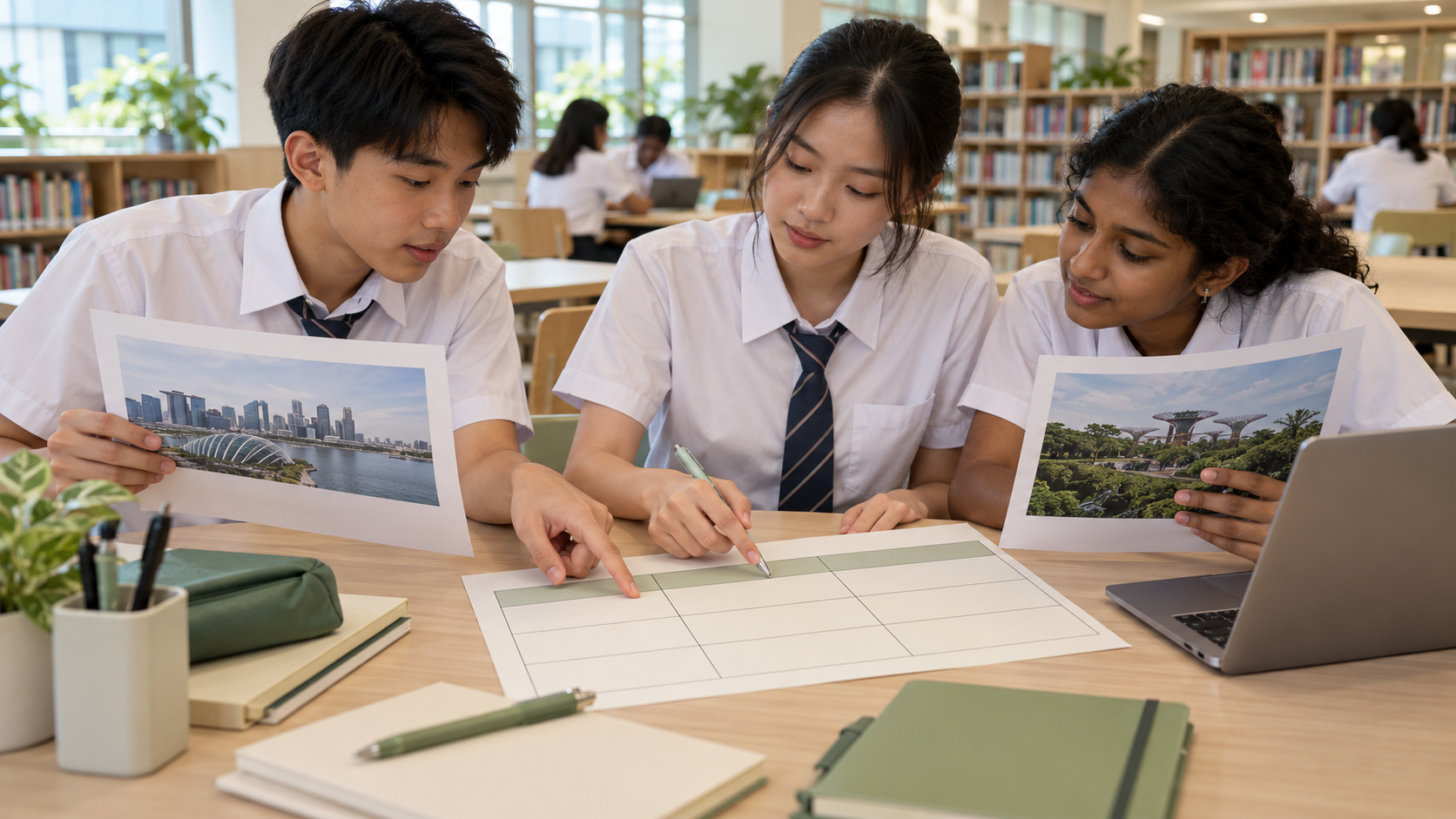
What is PG3 Humanities (Social Studies, Literature in Chinese)? PG3 stands for Posting Group 3, used in Singapore secondary-school admission. The formal 2027 Singapore–Cambridge Secondary Education Certificate (SEC) subject is G3 Humanities (Social Studies, Literature in Chinese), K338. It combines two compulsory papers: English-medium Social Studies worth 50% and Chinese-medium Literature worth 50%. These together form one Humanities result. K338 is not standalone G3 Literature in Chinese K332, and it does not require the standalone K332 novel examination.
Did you know? Reading a government notice about a community decision and reading a poem about leaving home involve different kinds of understanding, yet both begin with a vital question: What do the words actually establish? Social Studies asks students to interpret claims, evidence and competing interests in society. Chinese Literature asks how writers use imagery, narrative and poetic voice to convey meaning. Together they encourage precise reasoning across English and Chinese.
For students and families planning junior college (JC), polytechnic or later university, this subject can develop critical reading, empathy and bilingual communication. But a K338 grade, however strong, is not a guaranteed education pathway. Admission depends on the complete SEC profile, the official use of Humanities within score calculations and later programme-specific qualifications.
Independent eduKateSG parent-and-learner guide, reviewed 24 October 2026 against the official SEAB 2027 G3 subject list and K338 paper scheme. Fictional Social Studies evidence and Chinese Literature passages below are original instructional exercises, not national exam questions.
PG3 Social Studies–Chinese Literature in one minute
| Question | Short 2027 answer |
|---|---|
| Is PG3 a combined Humanities examination code? | No. PG3 is a posting group; the national subject is G3 Humanities K338. |
| What was the earlier subject reference? | 2263; the 2027 SEC code is K338. |
| What language is each paper in? | Social Studies in English; Literature in Chinese in Chinese. |
| Paper 1? | Social Studies, 1h45, 50 marks, 50%. |
| Paper 2? | Literature in Chinese, 1h40, 50 marks, 50%. |
| Which Chinese literary tasks? | One choice from prescribed poetry/short fiction, one choice from unseen literary analysis. |
| Are Social Studies and Literature separate grades? | No. They contribute to one combined Humanities result. |
Find your question: PG3 vs G3 · 2027 papers · Social Studies · Chinese Literature · worked examples · JC/Poly/Uni · FAQs.
1. The first distinction: PG3 entry is not the K338 exam
Imagine a Secondary 2 student entered the school through PG3, studies Chinese and enjoys poetry. Does that automatically mean the child will take Social Studies–Chinese Literature? No. Full Subject-Based Banding distinguishes secondary entry Posting Groups from the actual General level and combination of each examined subject. Schools offer particular combinations and apply their own permitted selection criteria.
For 2027, K338 is the formal G3 combined Humanities examination pairing Social Studies with Literature in Chinese. K332 is the separate Literature in Chinese subject, containing two Literature papers and a prescribed novel. K320 is Chinese Language, with writing, comprehension, oral and listening assessments. These are not different names for one paper.
Before deciding on learning materials, ask the school for the registered title and code. For the general framework, read What is PG3 | MOE and SEAB Syllabus and the Mother Tongue Literature and combined Humanities comparison.
2. Exactly how the two 2027 K338 papers work
| Paper or section | Duration and marks | Contribution |
|---|---|---|
| Paper 1 — Social Studies | 1 hour 45 minutes, 50 marks | 50% of combined Humanities |
| Social Studies Source-Based Case Study | Compulsory evidence questions, 35 marks | Within Paper 1 |
| Social Studies Structured-Response Questions | Compulsory explanations, 15 marks | Within Paper 1 |
| Paper 2 — Literature in Chinese | 1 hour 40 minutes, 50 marks | 50% of combined Humanities |
| Literature Section A | One chosen 25-mark question from prescribed poetry or short fiction | 25% of combined result |
| Literature Section B | One chosen 25-mark question on unseen modern literary material | 25% of combined result |
The student must prepare for both papers. A teenager who writes excellent Chinese literary analysis but finds Social Studies source-based questions difficult still needs a meaningful learning plan for half the grade. Similarly, students cannot rely on memorised Social Studies source phrases and neglect unfamiliar Chinese poetry.
One key distinction from standalone K332: K338 Paper 2 does not include the standalone K332 novel Paper 1. The Literature paper here focuses on the prescribed poems and short fiction plus unseen literary analysis. Check the examination-year texts and the school’s confirmed registration to avoid revising the wrong novel.
SEAB’s official 2027 G3 Humanities K338 syllabus specifies the scheme, prescribed material and task choices.
3. Social Studies: claims about society need proportionate evidence
Social Studies examines how people live together, how public choices are made and how communities respond to change. The SEC syllabus includes content on citizenship and governance, living in a diverse society, and responding to globalisation. Students need accurate contextual understanding and the ability to interpret sources fairly.
A source can show a viewpoint without proving it is universal
A community organisation’s poster might encourage volunteering. It can show what the organisation wants people to do, but cannot by itself prove that every resident agrees with its position. Recognising the difference between a persuasive purpose and independent evidence is a core civic-reading skill.
The same change can affect people differently
A proposed extension of library opening hours may help students with crowded homes, while creating staffing and operating costs. A useful answer considers affected groups and what further information would help a decision-maker weigh competing needs.
Facts, opinions and judgements need to be distinguished
A statistic may describe how many people participated in a survey. A participant may then offer an opinion about what the findings mean. A student should not silently turn that opinion into an established fact. Strong Social Studies writing explains the status of each claim.
Globalisation creates more than one kind of effect
Trade, movement and digital connectivity can produce opportunities and vulnerabilities. An informed argument names which group, sector or community is affected, what mechanism causes the effect and why one policy response might be appropriate under particular conditions.
4. How to answer a source-based case study effectively
An effective source-based answer reads the question first, identifies the exact claim made by the document, selects relevant evidence and explains what that evidence can support. When asked to compare sources, the student must identify the common issue before explaining agreement or difference.
A source’s origin and purpose may help assess its reliability or usefulness, but a partisan source is not automatically worthless. It might be useful evidence of how a group presented an issue even if its factual claims need corroboration.
A poor answer says “Source A is unreliable because it is biased”. A more useful answer specifies which assertion is being assessed, what wording reveals the perspective and which other evidence would help verify the claim. This is concrete reasoning rather than an examination phrase memorised without meaning.
5. Original Social Studies exercise: a small survey and a large claim
Fictional classroom example: A student council surveys 40 volunteers at an activity about whether the school should provide more shaded seats. 30 of 40 favour the proposal. The response rate among those questioned is therefore 75% in favour.
Can the writer conclude that 75% of every student in the school favours the change? No. The sample is limited to volunteers at one activity, so its representativeness is unknown. Another student group or time of day might produce a different result.
A stronger judgement would say: “Most of the surveyed volunteers supported more shaded seating, suggesting interest among that group. Wider consultation and information about space, cost and accessibility would help assess the proposal for the whole school.”
Did you know? Social Studies can reward a carefully limited conclusion over an impressive but unsupported claim. Evidence becomes useful when the reader knows precisely whom it describes.
6. Chinese Literature: a different kind of close reading
Literature asks how imaginative writing produces meaning. In K338’s Chinese Literature component, students interpret the prescribed poetry and modern/contemporary short fiction and show they can handle unfamiliar literary material. The 2027 syllabus includes classical poetry, modern poetic voices and short stories from Chinese-language traditions, including regional and Singapore writing.
A literary answer should go beyond recognising a poem’s topic or retelling a short story. It may examine imagery, tone, contrast, narrator perspective, dialogue, a character’s silence or the arrangement of events. A technique matters because of what it does for meaning, not because it has an elegant technical name.
Classical poetry can compress several meanings into few characters
The syllabus includes prescribed classical poetry by writers such as 李白 and 杜甫, among other poets. Context can deepen understanding, but the actual words and question remain primary. A student should not substitute an invented biographical narrative for analysis of imagery or tone.
Modern poetry can make everyday images unfamiliar
A street light, a river or a closed door may evoke waiting, change or separation. Which interpretation is persuasive depends on surrounding language and structure. An image is not automatically a symbol for one fixed emotion in every poem.
Short fiction can reveal character indirectly
A character who repeatedly avoids opening a letter may suggest reluctance. The narrator’s selective information may create suspense. These effects become stronger when an answer connects the detail to context rather than claiming to know every unspoken motive.
7. A bilingual challenge: different evidence, shared intellectual care
| Social Studies Paper 1 — English | Chinese Literature Paper 2 — Chinese |
|---|---|
| Asks about a societal claim, policy issue or perspectives. | Asks how a literary work creates meaning and emotional or thematic effects. |
| Uses source origin, content, corroboration and contextual knowledge. | Uses imagery, narrative, character, structure and literary context. |
| A poster’s message may reveal a group’s advocacy but not population-wide support. | A narrator’s viewpoint can suggest a character’s experience but not automatically the author’s belief. |
| The judgement evaluates relevant social evidence and trade-offs. | The interpretation is grounded in the literary text and the question. |
The two parts reward disciplined reading, but they need different vocabulary and answer structures. Preparing for Social Studies entirely through Chinese model essays or for Literature entirely through English civic source phrases would miss the distinct competencies being examined.
8. Original Chinese Literature example: a lamp by the window
Original fictional poetic lines, not prescribed texts: “灯还亮着,窗外的路却静了。她合上书,仍不肯拉上窗帘。” The lamp remains lit, the road outside is quiet, and a character closes her book yet does not draw the curtains.
What can a careful reader observe? Light contrasts with the quiet road, while the character chooses to keep the window open to view. A plausible inference is that she is waiting or remains attentive to something outside. But we cannot establish whom she expects or why without additional text.
A supported analytical sentence might read: “屋内持续亮着的灯与屋外沉寂的道路形成对比,人物迟迟不拉窗帘的动作暗示一种难以放下的等待。” The answer links contrast and repeated attention to a possible emotional effect.
The strongest response would then relate the interpretation to the actual question and avoid inventing an absent backstory. Chinese Literature rewards imagination guided by evidence, not unrestrained speculation.
9. Another literary question: who is speaking in a poem?
A poem written in the first person is not necessarily autobiography. The poet may create a voice representing another person, an imagined situation or a larger social experience. A student should distinguish the speaker’s expression from the verified author’s personal history.
Ask whether the tone changes, which objects are repeated and how the poem moves from one image or question to another. A careful answer may note that different readings are possible, but it still needs to justify the chosen interpretation with precise words.
This habit can be practised with short, age-appropriate Chinese poems outside the official prescribed set, while the actual national examination preparation must also cover all 2027 set works.
10. K338 is one grade, not a shortcut to two Humanities results
Because K338 combines Social Studies and Chinese Literature, the final result is one formal Humanities subject. The presence of two named components does not make it two separate results for the JC aggregate or for polytechnic course calculations. Parents should also not assume a student can omit one half because the other half is stronger.
A separate K332 Literature in Chinese subject has its own two literary papers, including a prescribed novel. The decision between standalone and combined offerings should depend on what the school offers, the learner’s interests, overall workload and any relevant next-stage requirements.
For a detailed distinction, read What is PG3 Literature in Chinese K332? and Chinese, Malay and Tamil Literature versus combined Humanities.
11. A Secondary 1 to Secondary 4 preparation path
| Stage | Social Studies preparation | Chinese Literature preparation |
|---|---|---|
| Secondary 1 | Read short informational texts, identify claims and perspectives. | Read accessible Chinese stories and discuss small details. |
| Secondary 2 | Compare sources and practise reasoned explanations. | Explain how dialogue or imagery shapes meaning. |
| Secondary 3 | Study K338 issues and source-based response methods. | Read prescribed poems and fiction with careful textual notes. |
| Secondary 4 | Timed case studies and structured responses in English. | Timed prescribed and unseen literary answers in Chinese. |
The strongest plan keeps both languages and assessment styles active each week. A learner may feel confident discussing an issue orally but need more precise English writing; another may recite a poem in Chinese but struggle to explain how its imagery works. These require different corrections, not the vague instruction to “study more Humanities”.
12. How a teacher diagnoses an evidence problem
Consider two sample difficulties. In Social Studies, the child writes that “everyone agrees” based on a one-off source. In Chinese Literature, the child says a character is “definitely unhappy” when the excerpt shows only unusual silence. Both involve overclaiming, but the next teaching steps differ.
For Social Studies, the student should identify the source’s scope and whether another source corroborates it. For Literature, the student should revisit the actual language and explain why silence suggests a plausible feeling. The shared habit is proportional judgement; the technique is tailored to the discipline.
When giving feedback, ask “Which part of the text justifies your conclusion?” Then invite the learner to reformulate a claim so it fits the evidence. That small change often does more than assigning another long practice essay.
13. JC and MI: combined Humanities within the revised 2028 route
For the first 2027 SEC cohort, MOE expects results in January 2028 and will introduce the Post-Secondary Admissions Exercise (PSE). JC eligibility from 2028 uses the revised five-subject L1R4 framework with a gross qualifying threshold of 16, plus language, Humanities, Mathematics/Science and minimum-grade rules.
K338 can be relevant within the candidate’s eligible Humanities profile according to official admission classifications. Yet it contributes one combined Humanities grade, not two. The complete subject mix, other grades and competitive JC posting still matter. A student hoping to study particular H1/H2 subjects must separately meet the intended JC’s subject-combination requirements.
If the learner enjoys bilingual literary study, there may be later Humanities or language interests to explore. But never assume every JC offers the same advanced literature courses or that K338 itself grants an H2 subject.
14. Polytechnic: communication and evidence beyond the classroom
Applied diploma interests may include communications, media, design, education-related activities, business, tourism, digital content and other programmes. These are examples of possible directions, not guarantees that a particular institution offers every title or accepts every subject combination.
MOE’s announced polytechnic Year 1 admission changes from 2028 allow one eligible G2 subject in the final best-subject position under ELR2B2 and adjust the aggregate cut-off to 22. Every diploma retains its published minimum entry requirements, including relevant English, Mathematics, Science or other conditions.
A student who becomes skilled at explaining a complex issue in English and interpreting a Chinese literary passage may be well placed to keep learning through applied projects. But those skills complement rather than replace the diploma’s own technical curriculum.
15. University and future choices
Possible future degree interests include Chinese studies, Humanities, literature, education, communications, social sciences, cultural history, linguistics or public policy. K338 can supply valuable habits of bilingual reading and reasoning, but it is not a direct university entrance qualification. Accepted A-Level, recognised diploma or other eligible post-secondary credentials and programme-specific prerequisites determine admissions.
An effective family plan works backwards from actual university programmes. Read the degree’s entry page, identify an appropriate JC subject combination or qualifying diploma and check whether the current SEC choices keep that pathway realistic. Revisit the plan as the learner discovers new interests.
16. Common mistakes in K338 preparation
- Mistaking PG3 for an actual examined subject level or a separate qualification.
- Confusing combined K338 with standalone Literature in Chinese K332.
- Revising the K332 full-novel paper instead of preparing the compulsory Social Studies component.
- Ignoring Social Studies because literary reading is the student’s favourite half.
- Using generic “biased, therefore useless” statements without examining what a source shows.
- Presenting a small survey as an entire population’s opinion.
- Naming an image in a poem without explaining what it contributes to meaning.
- Inventing a character’s motive or a poet’s life without textual support.
- Memorising an old anthology list instead of checking 2027 prescribed texts.
- Counting one K338 Humanities grade as two separate admissions subjects.
The correction should begin with the precise error. Did the learner overstate a source, misidentify an image’s effect, confuse a narrator and an author or prepare the wrong paper? Rebuild that reasoning step, then practise with an unfamiliar piece of English or Chinese evidence to verify transfer.
17. Four weeks to balance the two components
| Week | Social Studies work | Chinese Literature work |
|---|---|---|
| 1 — Establish evidence | Identify claim, source scope and perspective from a short fictional example. | Read a prescribed poem and explain one image. |
| 2 — Develop reasoning | Compare two sources about a common issue. | Analyse characterisation through speech or action. |
| 3 — Practise unfamiliar material | Write a short structured response on competing stakeholder needs. | Interpret a new poem or short narrative without a model essay. |
| 4 — Integrate | Attempt a timed source-based question and review errors. | Attempt a K338-style literary analysis with precise textual support. |
Short, consistent feedback makes improvement visible. Parents can ask questions without writing students’ responses: What does the document actually say? Which Chinese words led you to that interpretation? What evidence could change your view?
18. The subject-choice briefing checklist
- Is the student registered for G3 Humanities (Social Studies, Literature in Chinese) K338?
- Does the school offer this pairing under the child’s chosen upper-secondary subject combination?
- Which prescribed Chinese poems and short stories are on the actual examination-year list?
- Can the learner write a clear Social Studies argument in English and a literary analysis in Chinese?
- What JC, polytechnic or later degree prerequisites will need checking for the child’s interests?
19. Did you know? Questions parents ask about K338
Is PG3 Social Studies–Chinese Literature a formal national subject?
The formal 2027 examination is G3 Humanities (Social Studies, Literature in Chinese), K338. PG3 is the school admission grouping.
Which language is used for Social Studies?
The Social Studies component is examined in English; the Literature in Chinese component uses Chinese.
How much does each paper contribute?
Each paper contributes 50% to one combined Humanities result.
Does K338 include the K332 full-novel paper?
No. K338 has Social Studies Paper 1 and the prescribed/unseen Chinese Literature paper.
What is examined in Chinese Literature Paper 2?
Prescribed poetry or short fiction and unseen literary analysis, with a choice question in each section.
Can one component compensate for completely ignoring the other?
Both are compulsory, so neglecting either is a serious preparation gap.
Does K338 provide two separate L1R4 subjects?
No. K338 is one combined Humanities result, not two individual national subject grades.
What if my child is better in English than in Chinese?
Diagnose the specific Chinese literary-language skills and consider school-offered combinations and the student’s interests. Do not assume the original PG3 label decides this.
Does K338 automatically secure JC admission?
No. All aggregate, subject-group, minimum-grade and posting conditions apply.
Can it lead to university Chinese or social-science study?
It may be good preparation, but an accepted later qualification and programme-specific prerequisites are necessary.
20. Official sources and continuing eduKate reading
- SEAB official 2027 G3 Humanities (Social Studies, Literature in Chinese) K338 syllabus
- SEAB subject directory for K338 and standalone K332
- MOE 2028 JC L1R4 subject eligibility
- MOE post-secondary admissions from 2028
- K338 prescribed poems, stories and unseen work
- Two-paper study method for Social Studies and Chinese Literature
- All three G3 Mother Tongue Literature choices
- The separate PG3 Literature in Chinese K332 pathway
- Standalone versus combined Mother Tongue Literature
- Clear foundations and meaningful learning feedback
Continue the PG3 bilingual Humanities pathways
PG3 Social Studies–Literature in Malay · PG3 Social Studies–Literature in Tamil · PG3 Literature in Chinese · PG3 Social Studies–Literature in English
The deepest learning from K338 is not simply bilingual vocabulary. It is the ability to evaluate a public claim responsibly in one language and explain a literary interpretation convincingly in another—always guided by what the evidence really shows.