
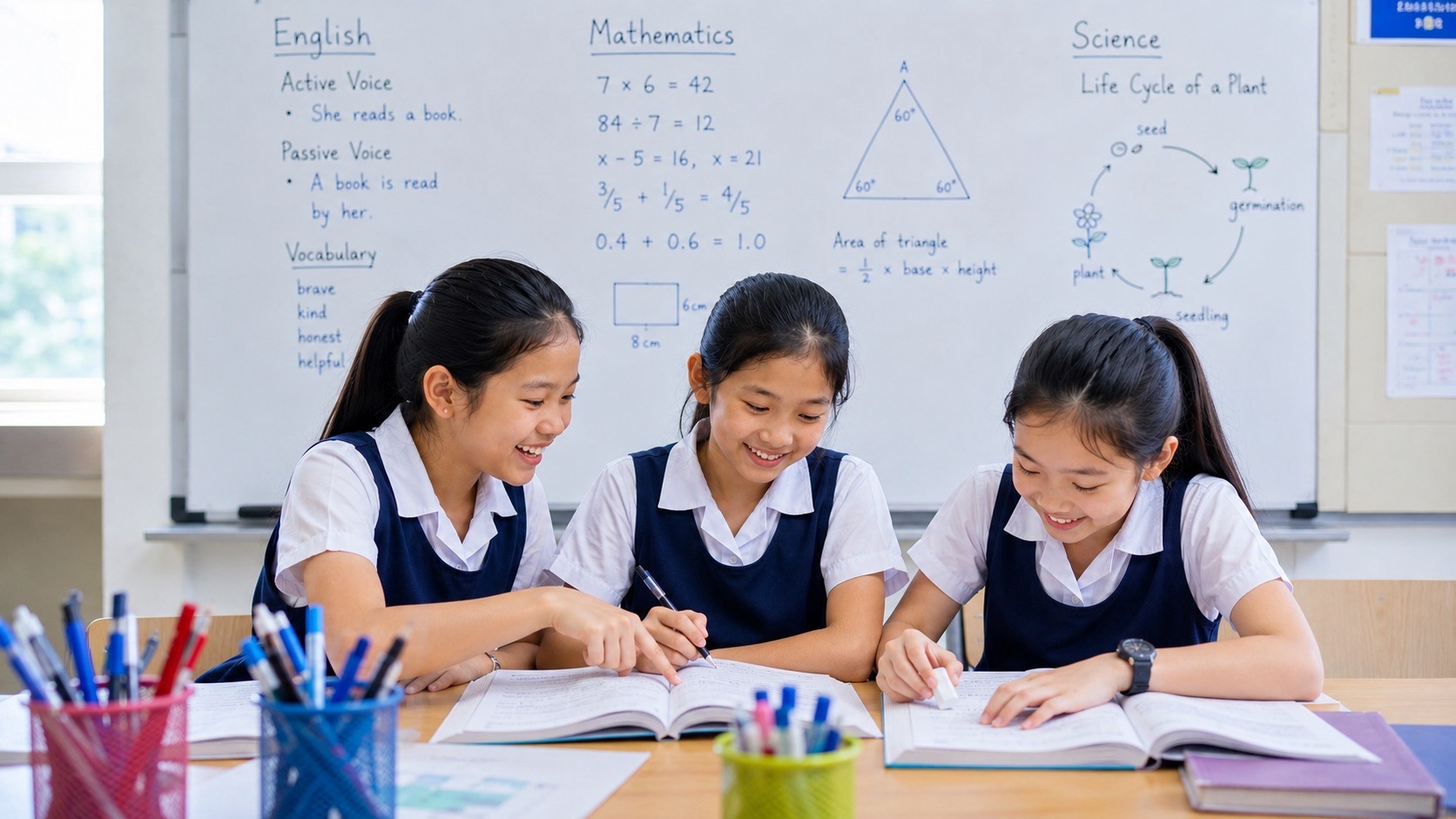
Did you know that Geylang Methodist School (Primary) began in 1924 with just 27 girls in a classroom carved out of Geylang Chinese Methodist Church — and that today its Applied Learning Programme develops pupils as competent, confident and empathetic communicators?
That century-long journey makes GMS(P) especially interesting in 2026.
The school’s vision is Inspired by Values — Grow · Lead · Serve · with Joy. Its mission is to inspire minds, nurture character and touch community. Its current programmes connect communication, sustainability, Science inquiry, National Education, digital learning and servant leadership. Source: GMS(P) official school information.
So what is so awesome about Geylang Methodist School (Primary)? It is the way a school founded to serve a community still treats communication and contribution as central educational outcomes.
Independent eduKateSG profile checked on 4 October 2026. This is not a ranking or school-endorsed publication. Programme details may change.
The Quick Answer: What Makes GMS(P) Stand Out?
- A heritage dating to 1924. The school began as Geylang Methodist Girls’ School.
- The ALP puts communication at the heart of real-world learning.
- The programme follows Experience · Reflect · Pen · Speak.
- The LLP focuses on Sustainability Education. Pupils progress from awareness to action to advocacy.
- Science explicitly combines Inspire, Inquire and Innovate.
- National Education and Social Studies develop rooted global citizenship.
- The school’s Methodist identity keeps service visible.
Did You Know? GMS(P) Started in a Church Classroom
Geylang Methodist Girls’ School began in 1924 in a small classroom within Geylang Chinese Methodist Church. The school was established to provide education for girls in what was then a poor part of Geylang. Source: GMS(P) heritage.
In 1984, the school split into primary and secondary schools and became co-educational. The two Geylang Methodist schools remain side by side at Geylang East Central.
That continuity matters. The school’s present language about touching community is not disconnected from its founding story.
The ALP: Communication for the Real World
GMS(P)’s Applied Learning Programme develops pupils as informed, confident and empathetic communicators. The programme progresses from speech, drama and poetry in lower primary to visual storytelling, presentation, research, perspective evaluation and advocacy in the upper-primary years. Source: GMS(P) ALP.
The learning cycle is memorable: Experience · Reflect · Pen · Speak.
That sequence is powerful because it begins before writing. The child first encounters something, reflects, organises the thinking in writing, then speaks.
Language becomes a way to process experience rather than merely reproduce model answers.
Empathetic Communication: The Audience Is Part of the Task
GMS(P)’s ALP explicitly includes empathy. A persuasive message for classmates may not work for younger children. An environmental campaign may fail if it ignores practical constraints. Empathy improves the learner’s model of the audience.
Sustainability LLP: Awareness, Action, Advocacy
The school’s Learning for Life Programme focuses on Sustainability Education and the 4Rs — Refuse, Reduce, Reuse and Recycle. It uses a progression from awareness to action to advocacy. Source: Sustainability LLP.
This is excellent educational design because awareness alone does not change a system. Action tests whether the child can change behaviour. Advocacy tests whether the child can explain the issue to someone else.
Science: Inspire, Inquire, Innovate
GMS(P)’s Science programme follows three verbs: Inspire, Inquire and Innovate. The school aims to give pupils a strong foundation in Science for life and society while developing ethical reasoning. Source: GMS(P) Science.
Inspiration creates curiosity. Inquiry disciplines that curiosity. Innovation asks what can be done with the understanding.
An eduKateSG Example: From Environmental Concern to Evidence
The following is our illustration, not a documented GMS(P) assignment.
Imagine pupils notice many disposable cups after an event. The weak response is simply: “We should recycle more.”
The stronger response asks how many cups were used, whether alternatives exist, who makes the purchasing decision and what change is realistic.
Mathematics measures. Science considers materials. English communicates the proposal. Empathy considers the users.
That is interdisciplinary learning through a real problem.
National Education: Rooted in Singapore, Aware of the World
The school’s National Education and Social Studies curriculum develops active community life, national and cultural identity, global awareness and socio-cultural sensitivity. Source: NESS.
Upper-primary pupils engage with current affairs and contemporary issues. Citizenship therefore becomes more than memorising national symbols; it becomes learning to understand Singapore’s story, recognise different perspectives and contribute responsibly.
What Families Can Borrow From GMS(P)’s Learning Design
- Begin communication with experience and reflection.
- Teach audience awareness and empathy.
- Move sustainability from awareness to action.
- Use evidence before advocacy.
- Connect Science to ethical reasoning.
- Discuss current affairs as part of citizenship education.
The eduKateSG Learning Connection
GMS(P) makes the eduKateSG words-to-action sequence very clear. Experience gives the child something real. Reflection gives it meaning. Writing organises the thinking. Speaking tests whether the idea can travel. Service asks whether the idea can help.
How GMS(P) Connects to the eduKateSG Singapore Graph
Geylang Methodist School (Primary) is at 4 Geylang East Central, Singapore 389706. Source: official contact page.
- History of Singapore | Geylang
- Why Singaporeans Love Geylang
- Fun facts about Singapore | Geylang
- Tutors and Tuition in Geylang
Frequently Asked Questions
When was GMS(P) founded?
The school traces its heritage to Geylang Methodist Girls’ School, founded in 1924. Official heritage page.
What is the ALP?
It develops competent, confident and empathetic communicators through real-world English-language experiences. Official ALP.
What is the LLP?
The LLP focuses on Sustainability Education through awareness, action, advocacy and Values in Action. Official LLP.
Where is GMS(P)?
4 Geylang East Central, Singapore 389706. Official contact page.
Official References Checked for the 2026–2027 Edition
- GMS(P) — Our Rich Heritage
- GMS(P) — Applied Learning Programme
- GMS(P) — Learning for Life Programme
- GMS(P) — Science
- GMS(P) — National Education & Social Studies
- GMS(P) — Contact Us
So, What Is So Awesome About Geylang Methodist School (Primary)?
It is the way communication becomes contribution.
Pupils experience, reflect, write and speak. Then sustainability and service ask what they will do with that voice.
Did you know that this is one of the strongest forms of primary education? Not merely helping children know more — but helping them communicate what matters and act on it responsibly.