
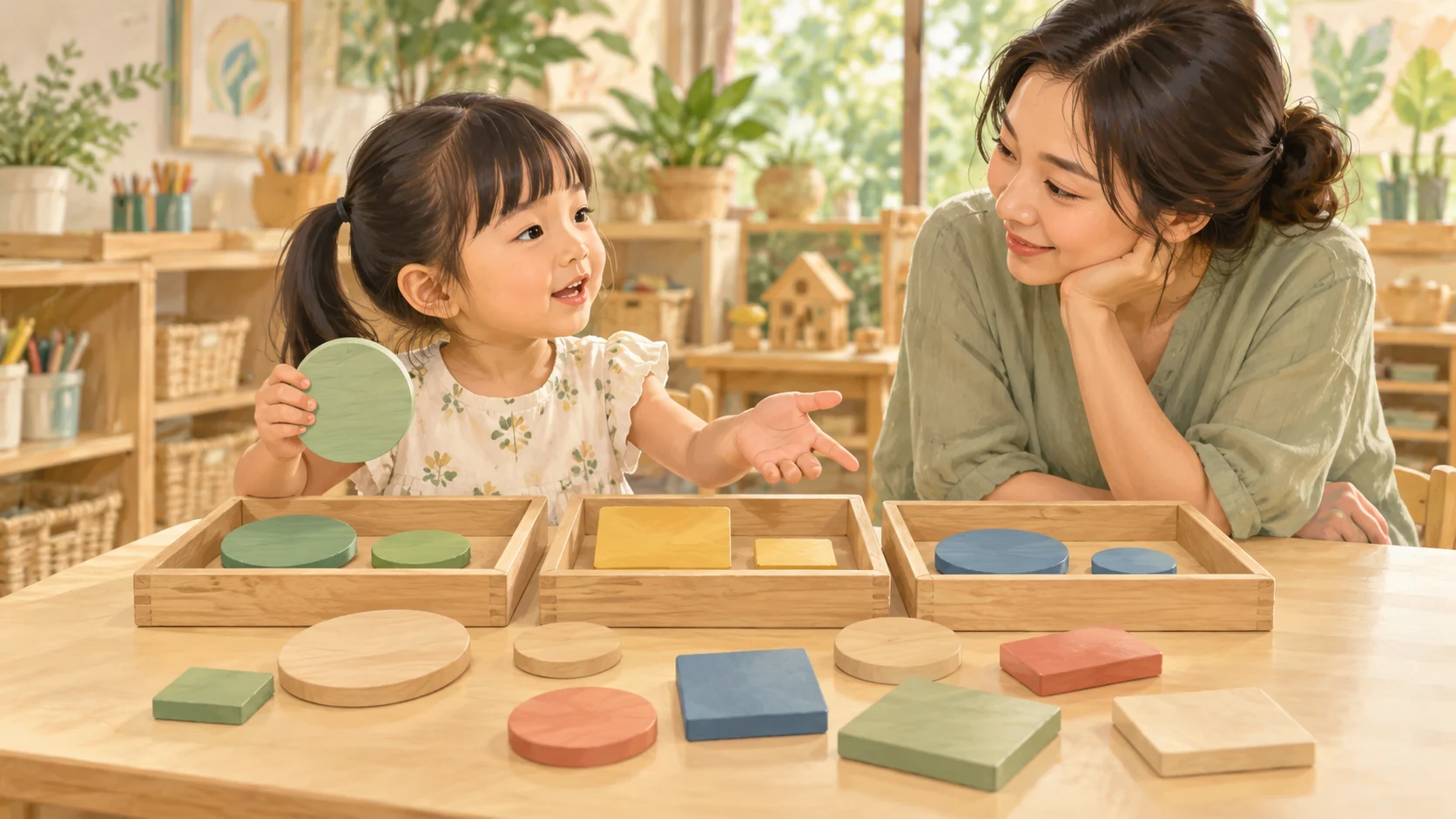
For a three-year-old, vocabulary means the words a child understands and uses to describe things, explain simple events, ask questions and take part in conversations. The child is no longer only naming a truck or asking for another biscuit. Words are becoming tools for making connections: “The truck is stuck”, “Why is the floor wet?” or “I was sad when the toy broke”.
At age three, the value of vocabulary is not measured only by how many words a child can recite. It is also visible in whether the child can use familiar words in different situations, explain an action, understand a location, take conversational turns and connect ideas. One child may speak confidently while still learning precise meanings; another may know what to do but need more time to organise a spoken answer.
Quick guide for families of children aged approximately 36–47 months
- Vocabulary includes naming words, action words, describing words, location words, feelings and question words.
- By three, many children can take at least two back-and-forth conversational turns and ask simple who, what, where or why questions.
- Words such as under, bigger, wet, empty, before, because and help connect ideas rather than simply label objects.
- Use pretend play, daily events, short stories and real comparisons to build meaning.
- Model a clearer sentence without making every reply a correction.
- Milestone guides help with observation; concerns or loss of skills deserve professional attention.
What changed between two and three?
A two-year-old might say “Dog run”. A three-year-old may say “The dog is running fast” and ask where it is going. The most important shift is not a sudden requirement for flawless grammar. It is that the child can combine words to make a more detailed message, answer someone else’s question and stay on the same topic for another turn.
Consider two ways of describing a puddle. “Water” labels the substance. “The floor is wet because the cup fell” connects a place, a condition, an event and a reason. Some three-year-olds will produce much simpler versions, but adults can model these connections whenever a real situation provides meaning.
The five layers of vocabulary at age three
1. Words for people, objects and categories
A child may recognise spoon and fork separately and then learn that both are utensils. The category term helps the child organise several items without treating them as unrelated. Begin with familiar categories such as food, clothes, animals and vehicles. Do not insist on abstract category names before the concrete examples make sense.
2. Words for actions and changes
Verbs such as push, pull, carry, spill, hide, build, melt, pour do more work than naming nouns alone. When a child understands “spill”, they can describe a problem even if the object changes from water to rice or sand. Use verbs inside safe, ordinary actions where the result is visible.
3. Words for qualities and comparisons
Descriptions such as heavy, light, sticky, smooth, noisy, quiet, long make noticing more precise. “The small spoon” is not just a longer phrase than “spoon”: it tells the listener how to choose between two possible objects.
4. Words for position and sequence
Location terms such as in, on, under, next to, behind help children follow directions and explain where something is. Sequence words such as first, next, then support accounts of daily experiences. Introduce these in actions: “First wash hands, then eat.”
5. Words for thoughts, feelings and reasons
Words such as happy, worried, frustrated, surprised, because, maybe give children ways to describe experiences that are not visible like a cup or a ball. A child might say, “I’m sad. The tower fell.” The adult can reply, “You feel disappointed because the tower fell.” The child does not have to say “disappointed” immediately for the adult’s explanation to be useful.
A worked example: one missing shoe becomes a small conversation
Situation: a child is ready to go outside, but one shoe is missing. An adult asks, “Where is your other shoe?” The child says, “Gone!” The adult responds, “It is missing. Let’s look under the chair.” The child finds it under a bag and says, “It was there.”
This tiny exchange connects several types of vocabulary: other expresses a relationship; missing describes a problem; under gives a location; find names an action; and was helps talk about something that happened. No worksheet was required.
Now change the case. Next week a toy car goes missing. If the child can say “The car is missing” or understands “Look under the sofa”, that is evidence the word has begun to transfer beyond the original shoe. Transfer is stronger evidence of meaning than repeating a memorised sentence with the same object.
What can a three-year-old commonly do with language?
The CDC’s milestones by three include having conversations with at least two back-and-forth exchanges, asking who/what/where/why questions, stating what someone is doing in a picture, and giving a first name when asked. ASHA’s 3–4 year guidance highlights comparisons, location words and telling a story from a book or video.
These are age-anchored indicators rather than a checklist on which every child must earn full marks on the birthday. Listen across home, play and other familiar environments. A child might use rich language while playing with a sibling yet become quiet with an unfamiliar adult. The contexts matter when interpreting what you hear.
Fifteen practical vocabulary examples, with meaning rather than drills
- Empty: “The bottle is empty. No water left.” Contrast it with full.
- Heavy: “This bag is heavy; we need two hands.” Contrast it with light.
- Stretch: “Pull the stretchy band gently.” Use only safe materials with supervision.
- Pour: “Pour the water into the cup.” Watch the action.
- Hide: “Hide the teddy behind the cushion.” Then let the child find it.
- Under: “The ball rolled under the table.” Move an object to show the relation.
- Between: “The cup is between two plates.” Use real objects.
- Same: “These socks are the same colour.” Contrast with different.
- Different: “This spoon is different because it is smaller.”
- Before: “Before the story, we washed our hands.” Tie it to a familiar event.
- After: “After the rain, the ground is wet.” Let the child observe.
- Because: “We moved inside because it started raining.”
- Worried: “You look worried about the loud sound.” Ask rather than assume.
- Surprised: “We were surprised when the box opened!”
- Share: “Let’s share the blocks. You use these; I use those.”
Do not teach all fifteen in one session. Two or three words that naturally fit a particular experience are more usable than a rapid-fire performance of the entire list.
Three useful conversation games—and why they work
The silly picture test
Draw or arrange a safe pretend scene, such as a fish in a tree or a shoe on a plate. Ask, “What is strange?” A child may answer, “Fish can’t climb.” Accept the observation, then introduce a richer distinction: “Yes, fish usually swim. A bird can sit in a tree.” This builds categories, expectations and explanations without requiring a right-or-wrong examination.
The sorting and reasons game
Place three large safe objects on a table: a spoon, a fork and a sock. Ask, “Which two go together?” The child can group by use, shape, colour or another property. Follow with “Why did you put them together?” Some children will point or offer a very short reason. Model an answer: “Both help us eat.”
The goal is not a single official category. A sock and a spoon might be grouped because they are both blue; that can be a valid explanation if the child can communicate the rule. This teaches flexible thinking as well as words.
The missing step story
Say, “We planted a seed. Then we watered it. What might happen next?” The child can use pictures, gestures or words to complete the sequence. Talk about what happens if we change a condition: “What if we forget the water?” You are supporting simple connections, not demanding scientific detail.
An easy weekly plan that uses normal family routines
- Day 1 — notice: name one action during dressing or cooking, such as fold or pour.
- Day 2 — compare: describe two objects as longer/shorter or heavy/light.
- Day 3 — locate: hide a large toy and use in, under, behind or beside.
- Day 4 — imagine: run a five-minute pretend shop or doctor’s visit.
- Day 5 — remember: ask what happened at the park; model first and then.
- Day 6 — explain: discuss a real reason, such as why wet clothes need drying.
- Day 7 — revisit: reuse two familiar words in a different context.
Choose moments when your child wants to participate. If a question leads to silence, supply a possible answer and continue play. Learning is not proved by forcing a response. Revisit the same word across days and places so its meaning can become stable.
How to observe progress without turning home into a classroom
Watch for three useful changes. First, spontaneity: the child uses a word without being prompted. Second, precision: the child starts choosing a more accurate word, such as under rather than only there. Third, transfer: a word from one game appears in a new situation. These are practical observation clues, not diagnostic tests.
Keep an example in ordinary language: “She said ‘behind the cushion’ while searching for her toy, then used ‘behind’ again during the walk.” That note reveals what the child understands better than a tally of correct flashcards. Children may not show every ability on demand.
Four mistakes that hide the real job of vocabulary
- Teaching only animal and colour names: add verbs, relationships, locations, feelings and reasons.
- Confusing longer sentences with deeper meaning: a short, accurate explanation can show more understanding than a long memorised phrase.
- Correcting every grammar error immediately: answer the message first, then model a natural sentence.
- Measuring only English in a multilingual home: listen across the languages the child actually uses and understands.
Speech clarity, multilingual families and professional support
A three-year-old’s spoken sounds are still developing. Clearer speech is common with age, but pronunciation and vocabulary are different dimensions. If you have difficulty understanding much of your child’s speech, or are concerned about word understanding or social communication, discuss it with a doctor or speech-language professional. Hearing can also affect language learning.
Children learning multiple languages may distribute words across those languages. ASHA states that multilingualism itself does not cause language disorder. Support the languages you speak comfortably, and tell any assessing professional about the child’s languages and settings. Concerns in more than one language are especially important to discuss rather than attributing them automatically to bilingual exposure.
Questions parents often ask
How many words should a three-year-old know?
Word totals are difficult to compare across children, languages and methods of counting. Milestone guidance offers a broader view: conversation, questions, understanding, explaining actions and putting ideas together. If you are worried about progress, seek individual advice instead of using an online number to diagnose your child.
Why does my child repeat words but not use them later?
Repeating a sound shows something different from using its meaning independently. Move the word into an activity, repeat it across real situations, and let the child see a contrast—such as full versus empty—without demanding recitation.
What if my child says “why” constantly?
Respond with a short truthful explanation. “Because the floor is slippery when wet” gives a real connection. If you don’t know, say “I’m not sure. Let’s look together.” Questions are an opportunity for a genuine conversation.
Should I introduce reading and spelling lists?
Stories, picture books and playful awareness of print can enrich language. Formal spelling drills are not a substitute for understanding and discussing words. Follow the child’s interest and readiness.
Reliable sources for this age
- CDC: Milestones by age three — conversation, questions and action words.
- ASHA: Communication milestones 2–3 years — explanations, word combinations and speech.
- ASHA: Communication milestones 3–4 years — comparisons, locations and stories.
- ASHA: Learning more than one language — multilingual development.
- American Academy of Pediatrics: Playful reading tips — talking about stories and images.
Where to go next with eduKate
Use Learning Vocabulary for Children Age 3 for additional play and language ideas. If understanding or expression is worrying you, read Solving Vocabulary Problems for Children Age 3 alongside professional advice. Compare the prior stage in What is Vocabulary to Children | For Age 2, or return to eduKate’s Vocabulary Hub.
Editorial note: Age-based descriptions are developmental guides rather than a personal diagnosis or a fixed word-count requirement. If skills regress or concerns persist, obtain professional advice.